
Professional boat detailing in Pitman, NJ, typically costs between $10 and $40 per foot for standard service, with oxidation restoration running $55 to $125 per foot and ceramic coating packages reaching $200 per foot on larger vessels. For a 25-foot boat common on the Delaware River and South Jersey waterways, expect to pay $250 to $1,000 for basic detailing and $1,500 to $3,000+ for full restoration. Mobile service adds approximately $75 to the total.
How Much Does Boat Detailing Cost Per Foot in South Jersey?
The per-foot pricing model is the industry standard for a simple reason: it scales fairly across vessel sizes without penalizing owners of smaller boats or undercharging on larger ones. In the South Jersey and Gloucester County market, local detailers generally land within a tight band of the national range, with some regional nuance driven by labor costs, seasonal demand, and the specific water conditions boats encounter along the Delaware River corridor.
For Pitman-area boat owners, CDC Detailing LLC offers transparent, per-foot pricing with no hidden fees, including a clearly disclosed mobile service surcharge rather than burying travel costs inside inflated base rates.
| Service Tier | Cost Per Foot | 25-ft Boat Estimate | 35-ft Boat Estimate |
|---|---|---|---|
| Basic Wash and Rinse | $10–$15/ft | $250–$375 | $350–$525 |
| Wash, Polish, and Wax | $15–$25/ft | $375–$625 | $525–$875 |
| Full Detail (Exterior + Interior) | $25–$40/ft | $625–$1,000 | $875–$1,400 |
| Oxidation Removal and Restoration | $55–$125/ft | $1,375–$3,125 | $1,925–$4,375 |
| Ceramic Coating and Paint Correction | $75–$200/ft | $1,875–$5,000+ | $2,625–$7,000+ |
| Mobile Service Surcharge | Flat fee | +$75 | +$75 |
Regional data from South Jersey marine detailers confirm a wash-down rate of $12 to $25 per foot and a full-detail rate of $20 to $40 per foot, which align closely with national averages while reflecting the area’s moderate cost of labor. Smaller boats under 20 feet often incur a minimum charge, typically $200 to $400, because setup, travel, and product costs are fixed regardless of vessel size.
What Factors Drive the Price of Boat Detailing?
Vessel Size and Boat Type
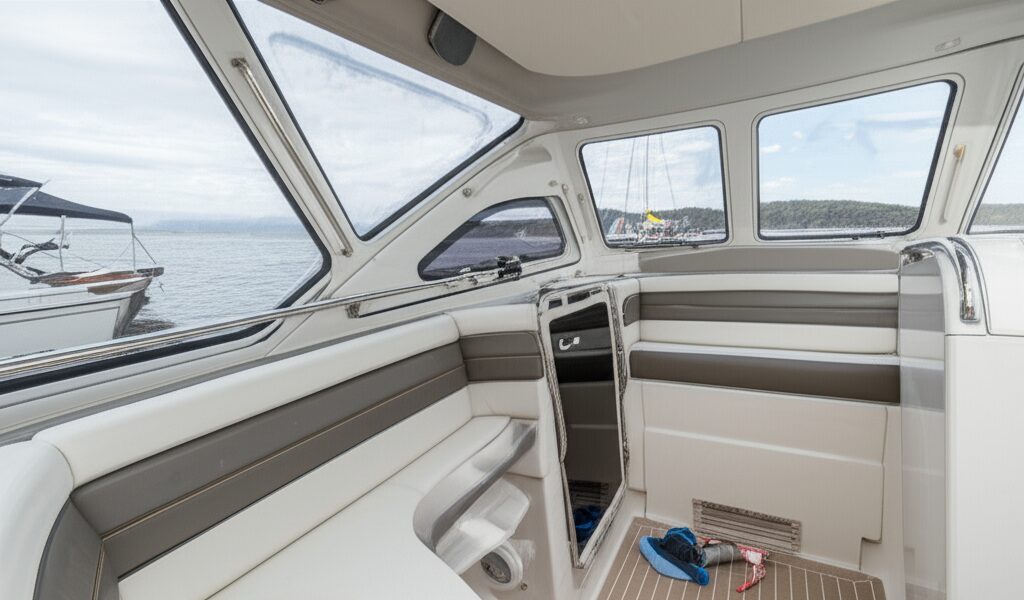
Length is the most obvious pricing factor, but boat type matters nearly as much. A 22-foot center console with open deck space is far faster to detail than a 22-foot cabin cruiser with enclosed compartments, upholstered seating, a head, and galley surfaces. Pontoon boats present their own challenge: the tubes require dedicated aluminum polishing that adds time and product cost. Bowriders, deck boats, and ski boats tend to be the most straightforward to service.
Surface Condition and Oxidation Severity
Surface condition is the single strongest cost driver in marine detailing. Gelcoat that has been allowed to oxidize, chalk, or stain requires multi-stage machine polishing before any protective coating can be applied. One multi-step correction process runs approximately $25 to $30 per stage per foot. A 22-foot boat needing two exterior correction stages and three interior stages can land between $1,500 and $1,800 before coating. Boats maintained on a regular annual schedule rarely reach this level of degradation, which is why consistent detailing is genuinely cost-preventive, not just cosmetic.
Interior Scope and Upholstery Condition
A full boat detail is not just an exterior polish. Interior work covers vinyl upholstery cleaning and conditioning, carpet extraction, bilge deodorizing, console wipe-downs, glass polishing, and metal brightwork. Neglected vinyl that has developed mildew staining or UV cracking may require additional treatment time. Interiors in good condition add relatively little to the total; interiors that have been left damp or uncovered through the off-season can substantially extend labor hours.
Protective Coating Selection
Wax is the entry-level protectant, offering three to six months of UV and water resistance at the lowest cost. Sealants extend that protection window. Ceramic coatings, the premium option, bond at a molecular level and can protect gelcoat for two to five years with proper maintenance washes. For South Jersey boat owners who launch in April and pull out in October, a ceramic coating applied every few seasons is often more economical over time than annual wax applications, particularly given the UV intensity of summer boating on the Delaware River. For long-term surface protection on your hull, paint protection film is another option worth discussing with your detailer for high-impact areas like the bow and waterline.
Is Boat Detailing Worth It? The Case for Pitman and Gloucester County Boat Owners
Pitman sits approximately five miles from the Delaware River, and Mantua Creek runs directly through Gloucester County. While these are freshwater and mildly brackish waterways rather than open ocean, the assumption that freshwater boating means minimal maintenance is a costly myth. UV exposure at the water’s surface is intense regardless of salinity. Algae, tannins from organic matter, and dock staining from biological growth affect gelcoat in freshwater just as aggressively as salt affects boats on the Jersey Shore. The protection mechanisms are simply different.
Regular detailing preserves resale value in a market with over 157,000 registered boats in New Jersey, where buyers can afford to be selective. A well-maintained gelcoat that has been polished and protected annually will show dramatically better than a neglected hull, and the price difference at resale typically far exceeds the cumulative cost of detailing. Gloucester County’s median household income of $105,630 and 80.1% homeownership rate indicate a local market where recreational investment and its long-term protection are taken seriously.
How Often Should You Detail a Boat?
The standard recommendation for freshwater boats is a full professional detail at least once per year, typically timed to spring launch or fall winterization. Boats that see heavy seasonal use, are stored outdoors, or operate in harsher UV environments benefit from a mid-season wash and wax to prevent oxidation from accumulating between full details.
For Pitman-area boats operating on the Delaware River, the primary maintenance concerns are UV degradation from long summer days on open water, algae bloom staining near tidal inlets, and biological residue from docking. A practical maintenance schedule looks like this: a full detail in April before launch, a mid-season exterior wash and wax in July, and a winterization detail in October that includes thorough interior cleaning, vinyl conditioning against winter dryness, and a protective coat applied before the boat goes into storage. This three-service annual model keeps gelcoat in restoration-free condition and eliminates the steep cost of corrective polishing down the road.
What Is Included in a Full Boat Detail?
A comprehensive boat detail from a professional South Jersey detailer covers every surface of the vessel. Exterior work includes hull washing, waterline scrubbing, gelcoat compounding and polishing, chrome and stainless brightwork polishing, glass cleaning, and a final protective wax or sealant coat. Interior work covers full vacuuming, vinyl upholstery cleaning and UV protectant application, carpet shampooing or extraction, bilge deodorizing, console and instrumentation wipe-down, and odor treatment. Engine compartment cleaning is often available as an add-on. The distinction from a basic wash is not merely product quality but the multi-stage, surface-by-surface restoration process that returns the boat to near-showroom condition.
What Is the Difference Between Boat Washing and Boat Detailing?
A boat wash removes surface dirt, debris, and biological growth using soap and water, followed by a rinse. It is maintenance, not restoration. Boat detailing is a comprehensive reconditioning process that covers gelcoat, vinyl, metal, glass, and upholstery, using professional-grade compounds, polishes, and protectants. Detailing addresses oxidation, micro-scratches, UV haze, and staining that a wash cannot touch. Think of washing as brushing your teeth and detailing as a professional cleaning and whitening. Both matter. Only one can reverse damage.
Why NJ-DEP Compliance Matters When Choosing a Boat Detailer Near Pitman
This is a detail most boat owners never consider, but it carries real consequences. The New Jersey Department of Environmental Protection enforces strict rules governing the discharge of boat wash wastewater. The Federal Water Pollution Control Act prohibits the discharge of oil or oily waste into navigable waters, with penalties reaching $5,000 per violation. New Jersey’s municipal stormwater regulations separately prohibit any non-stormwater discharge into the MS4 system, meaning process wastewater from boat washing that enters storm drains or waterways is a punishable offense.
Professional detailers operating in compliance contain, collect, or use biodegradable products that meet state environmental standards. Mantua Creek, which flows through Gloucester County and ultimately reaches the Delaware River system, is a waterway shared by the entire community. Choosing a detailer that cuts corners on chemical runoff is not just an environmental risk but a regulatory liability for the marina or property owner where the work is performed. CDC Detailing LLC uses exclusively biodegradable, NJ-DEP-compliant chemicals, which is not a marketing claim but a legal and operational necessity for responsible operation in this watershed.
DIY vs. Professional Boat Detailing: A Realistic Cost Comparison
DIY detailing has genuine appeal for boats already in good condition. The product cost for a wash, wax, and interior wipe-down runs $100 to $250 in supplies. For a boat that has been properly maintained and stored, this is a reasonable annual refresh. The calculation shifts entirely when oxidation, correction, or coating is involved. A dual-action polisher capable of proper gelcoat work costs $150 to $300. Cutting compounds, polishes, and finishing pads add another $100 to $200. A professional-grade ceramic coating kit adds $200 to $500 on top of that. Factor in the time required, typically a full weekend for a thorough DIY detail on a 25-footer, and the economics of professional detailing become considerably more competitive. More critically, improper machine polishing technique can permanently damage gelcoat, turning a cost-saving exercise into an expensive corrective repair.
How Long Does It Take to Detail a Boat?
A basic wash and wax on a well-maintained 20 to 25-foot boat takes three to five hours. A full detail covering exterior polishing, interior cleaning, and protectant application typically runs six to ten hours on the same-sized vessel. Boats requiring oxidation removal and multi-stage correction can take a full day or more, depending on condition. Ceramic coating application adds curing time that extends the overall process. For planning purposes, full-service detailing on a South Jersey recreational boat should be scheduled as a full-day appointment.
Frequently Asked Questions About Boat Detailing Costs in Pitman, NJ
How much does it cost to detail a boat in Pitman, NJ?
Boat detailing in Pitman, NJ runs $10 to $40 per foot for standard service, meaning a 25-foot boat typically costs $250 to $1,000 depending on the package selected. Full oxidation restoration on the same vessel can range from $1,375 to $3,125. Mobile detailing adds a flat surcharge of approximately $75 to the base price for travel and equipment setup at your location.
How much does boat detailing cost per foot in South Jersey?
South Jersey detailers generally charge $12 to $25 per foot for wash and light polish service and $20 to $40 per foot for full exterior and interior detailing. Ceramic coating packages run $75 to $200 per foot, depending on vessel condition and prep work required. These rates align with regional labor costs and are consistent with statewide NJ marine detailing market pricing in 2026.
Can boat detailing remove oxidation from a fiberglass hull?
Yes. Professional oxidation removal involves machine compounding with progressively finer abrasive polishes to cut through the chalky, UV-damaged layer of gelcoat and expose the fresh surface beneath. Severe oxidation may require two or three correction stages before a protective coating can be applied. This process is not achievable with hand application and consumer-grade products alone.
How often should a boat used on the Delaware River be detailed?
Boats used on the Delaware River and South Jersey freshwater waterways should receive a full professional detail at least once annually, ideally at spring launch. Boats used heavily throughout the season or stored outdoors benefit from a mid-season exterior service in addition to the annual full detail. UV exposure and biological growth in freshwater environments demand the same protective maintenance as in saltwater use.
Why does mobile boat detailing cost more than in-shop service?
Mobile detailing requires the technician to transport a full equipment setup, including water supply, power generation, compressors, and product inventory, to your location. The travel time, fuel, and logistical overhead of running a fully equipped mobile operation are built into the service rate. The convenience premium is typically $75 or more, depending on distance and job scope.
What is the difference between a boat wax and a ceramic coating?
Marine wax is a sacrificial protective layer applied over gelcoat that lasts three to six months before UV and washing degrade it. Ceramic coating is a semi-permanent, chemically bonded layer that resists UV, biological growth, and abrasion for two to five years. Ceramic coating costs more upfront but significantly reduces long-term maintenance frequency and preserves gelcoat condition over multiple seasons.
Ready to protect your investment before the season peaks? Whether you need a spring launch detail, oxidation restoration, or a full ceramic coating package, CDC Detailing LLC brings professional-grade marine detailing to Pitman and throughout Gloucester County with full NJ-DEP-compliant products and transparent, per-foot pricing. Reach out through the contact us page to schedule your appointment or get a custom quote based on your vessel’s size and current condition. You can also find us and read local reviews on CDC Detailing LLC on Google Maps. Don’t wait until oxidation sets in. A single season of neglect can turn a $500 maintenance detail into a $2,500 restoration job, and your gelcoat deserves better than that.