
You should avoid brush-style and soft-touch automatic washes on a car with paint protection film. Hand washing is the safest method, and a touchless automatic wash is an acceptable backup when properly configured. Wait 48 to 72 hours after installation before any wash, per guidance from 3M and XPEL, and similar timing is recommended for installations.
TL;DR:
- Automatic brush and soft-touch washes can damage PPF by scratching the surface and dislodging edges, making hand washing the safest option.
- If using an automatic wash, only opt for a confirmed touchless system with no brush cycle and low-pressure settings to prevent film damage.
- Wait at least 48 to 72 hours after PPF installation before washing to allow the adhesive to fully cure and reduce the risk of lifting.
- Regular inspections and immediate removal of contaminants like bird droppings or bugs help maintain film integrity and prevent costly repairs.
- Maintain proper washing routines with two buckets, pH-neutral soap, and careful drying to protect PPF edges and adhesive bonds.
Table of Contents
- Quick rules to check before you wash
- Why brushes and contact washes damage PPF
- Touchless versus soft-touch automatic washes
- A safe washing routine you can follow at home
- Pressure washer limits that protect the film’s edges
- How to inspect PPF after every wash
- When to skip the automatic wash entirely
- Installer tips that keep PPF looking new
- A technician’s take on convenience versus protection
- Let experienced professionals handle the protection side
- Where these care standards come from
- Sources
- FAQ
Quick rules to check before you wash
Before you pull into any wash bay, run through this list. It takes less time than the wash itself and saves you from a repair bill later.
- Wait 48 to 72 hours after installation before the first wash, since curing times vary by film and conditions.
- Choose hand washing first. If you must use an automatic wash, pick touchless and confirm the brush cycle is off.
- Use a pH-neutral, PPF-safe soap with the two-bucket method and straight-line washing motions, never circular scrubbing.
- Check every panel edge after each wash for lifting, curling, or dulling before you park the car.
- Skip abrasive polishes, dyed waxes, and compounds. They attack the film’s topcoat instead of protecting it.
Keep this list somewhere you will actually see it, like a note on your phone, until the routine becomes automatic.
Why brushes and contact washes damage PPF
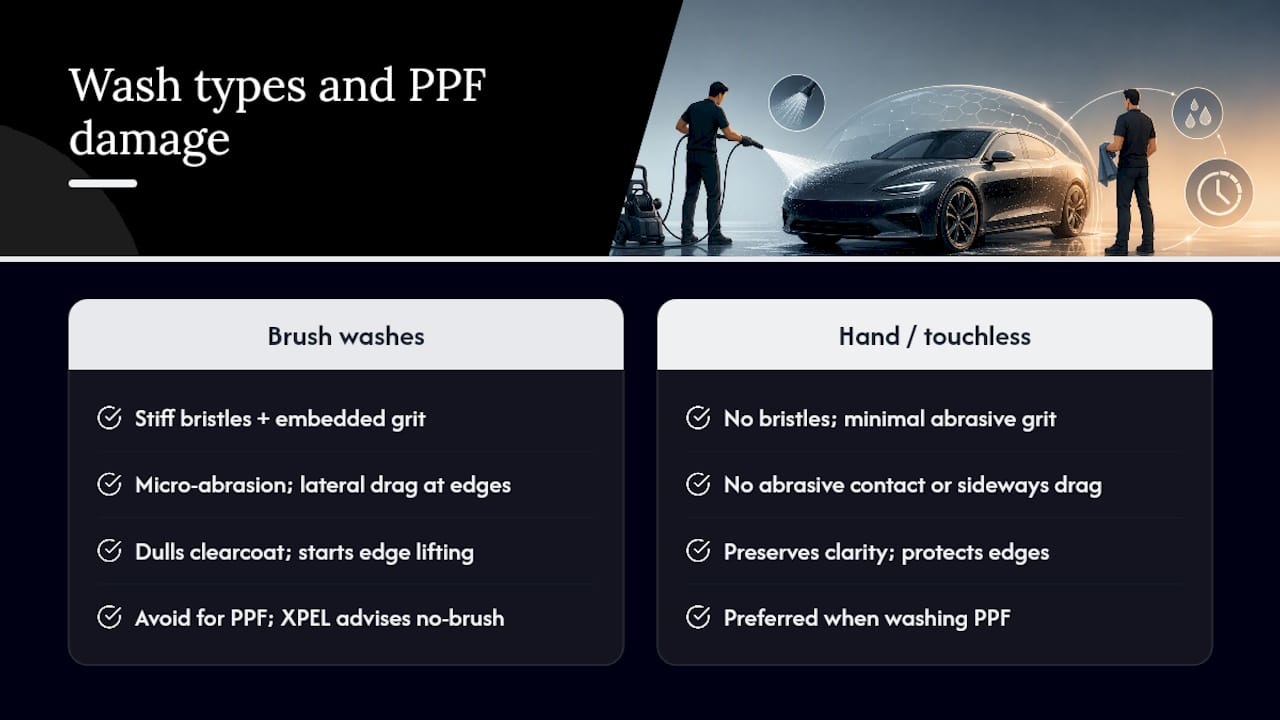
Automatic brush systems drag stiff bristles across the film’s clear topcoat, and that repeated contact can micro-abrade the surface until it dulls. Brushes shared by hundreds of vehicles a day also collect grit, sand, and road debris between uses, and that embedded material turns the next pass into light sanding rather than cleaning.
Lateral force is the other problem. A spinning brush does not just clean forward and back, it drags sideways across panel seams and film edges. That sideways pressure is exactly what starts edge lifting, since PPF edges rely on an adhesive bond that resists vertical peel far better than it resists being pushed sideways. XPEL advises against automatic tunnel washes that use brushes for this reason, favoring hand washing or touchless systems when a hand wash is not possible.
Touchless versus soft-touch automatic washes
Not every automatic wash carries the same risk, and the type matters more than the word “automatic” itself.
- Touchless washes: conditionally acceptable. They rely on detergent and water pressure instead of physical contact, but you still need to confirm the detergent is not high-pH and that the pressure setting is not aggressive.
- Soft-touch or brush washes: avoid these for PPF. “Soft-touch” cloth strips still drag across the surface and pick up grit the same way bristle brushes do.
- Self-service bays: safer when you control the tools yourself, since you can skip the shared brush and use only the wand rinse and foam. Watch out for community mitts and brushes left in these bays, since you have no idea what they last touched.
Manufacturer care pages from 3M treat hand washing as the safest default and touchless as the fallback, never the other way around.
A safe washing routine you can follow at home
A hand wash done right takes about 20 to 30 minutes and protects both the film and the paint underneath it.
- Rinse the entire car first with a hose or low-pressure wand to knock loose grit off the surface before any soap or cloth touches it.
- Fill two buckets: one with pH-neutral, PPF-safe soap and water, one with plain rinse water, each fitted with a grit guard at the bottom.
- Wash in straight lines, top to bottom, rinsing your mitt in the plain bucket between every section to keep grit out of the soap.
- Wash wheels and tires last, using a separate mitt and bucket, since brake dust is abrasive and should never touch the same cloth as your panels.
- Dry with an electric blower or a plush microfiber towel, working gently and avoiding hard rubbing at panel edges.
If you are stuck using an automatic wash, tell the attendant you want touchless mode only, with wax and polish cycles skipped entirely. A pre-wash rinse at home first also reduces how much grit the wash itself has to deal with.
Keep these supplies on hand:
- Two wash buckets with grit guards
- pH-neutral, PPF-safe car soap
- Microfiber wash mitts, one for paint and one for wheels
- A plush drying towel or electric air blower
Pressure washer limits that protect the film’s edges
A pressure washer can be safe on PPF, but only within specific limits. 3M’s installation guideline sets a maximum pressure around 1,200 psi (about 80 bar), a minimum spray angle of 40 degrees, and a nozzle held perpendicular to the panel rather than angled at seams.
A minimum 40 degree spray pattern and roughly 1,200 psi (80 bar) ceiling are the two figures worth memorizing, since narrower angles or higher pressure can force water directly under the film edge and start a lift.
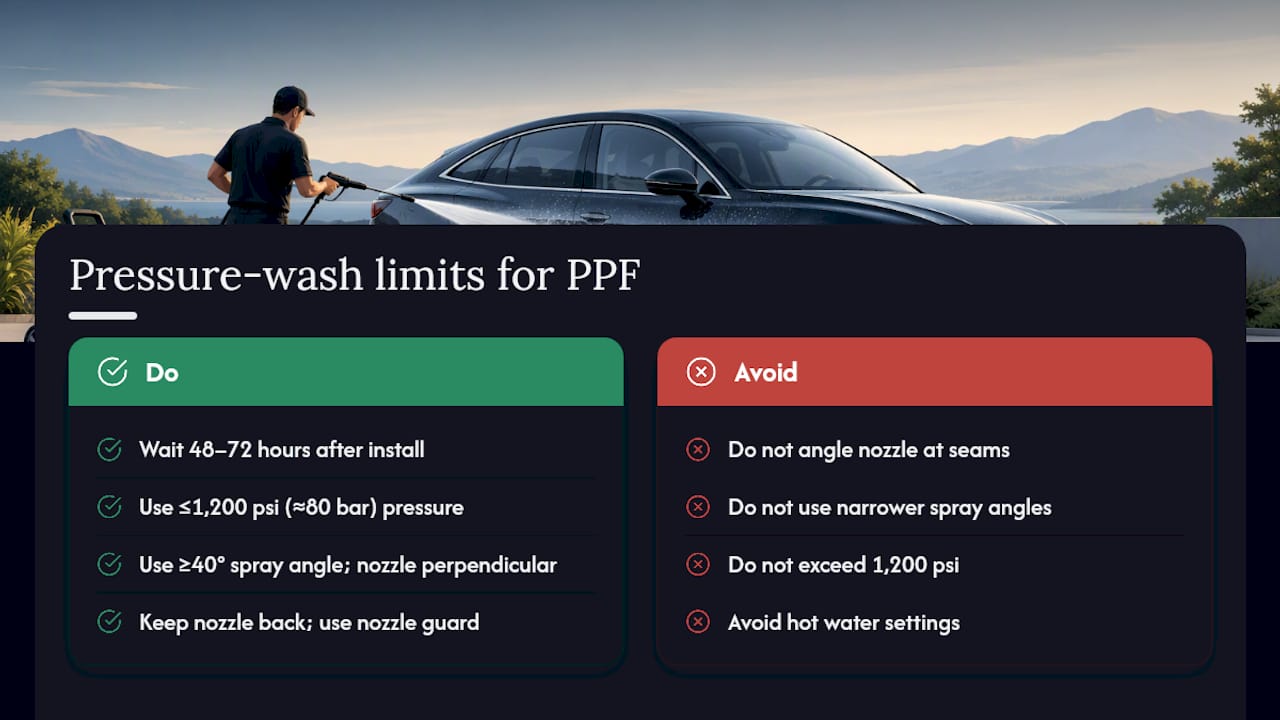
Stay a safe distance back rather than working the nozzle close to the surface, use a nozzle guard where possible, and avoid hot water settings that soften the adhesive.
How to inspect PPF after every wash
Walk the car panel by panel while it is still wet, since lifting and dulling show up more clearly when the surface is reflective. Look at every edge, seam, and corner for curling or bubbling, and check the film’s finish for spots that look flatter or hazier than the rest of the panel.
- Remove bird droppings, bug splatter, and tar as soon as you notice them rather than waiting for the next scheduled wash.
- Use a ceramic booster spray rated safe for film rather than a dyed or abrasive wax, which can stain or scuff the topcoat.
- Stick to a weekly or biweekly wash interval for daily drivers, and book a professional inspection if you spot any edge issue.
Pro Tip: Keep a soft microfiber towel in the car specifically for quick bug and bird dropping removal, since letting contaminants sit is what turns a wipe into a scrub.
When to skip the automatic wash entirely
Skip automatic washes altogether if the film was installed in the last 72 hours, if you can already see lifting anywhere on the car, or if the only option nearby uses brushes. Any of those conditions raises your odds of turning a minor issue into a costly repair.
Watch for these red flags after any wash: edges curling or lifting, small tears near seams, a sudden loss of gloss, or visible scrape marks on a panel. If you see any of them, stop washing the car, keep it dry, and contact your installer for an inspection before the damage spreads.
Installer tips that keep PPF looking new
Honoring the 48 to 72 hour cure window matters because the adhesive is still setting during that stretch, and early contact from water or wiping can shift the bond before it fully grabs.
Beyond that window, dry edges with a blower rather than a towel, use a nozzle guard on any pressure tool, and never aim water directly at a seam. Stick to ceramic-based boosters marked safe for film, and skip anything with dye or abrasive polish compounds mixed in.
A technician’s take on convenience versus protection
Automatic washes exist because hand washing takes time most owners do not want to spend every week, and that tradeoff is real. But film replacement costs far more than the time saved, so the convenience only makes sense when the wash type is verified touchless and grit-free.
My honest recommendation: default to hand washing, treat touchless as an occasional substitute, and get a professional check any time you are unsure what a wash did to your edges.
— Charles
Let experienced professionals handle the protection side
Washing carefully protects film you already have. Getting it installed and maintained by people who do this daily is what keeps it from needing early repair. CDC Auto Detailing installs Paint Protection Film with documented processes built for long-term durability, and offers scheduled upkeep through its detail packages so edges and finish get checked before small issues turn into replacement jobs.
- Professional PPF installation with a defined cure window before your first wash
- Detail packages that include exterior maintenance suited to filmed panels
- Ceramic coating packages compatible with PPF for added gloss and protection
If your film needs a look before your next wash, book an inspection through CDC Auto Detailing’s PPF page today.
Where these care standards come from
These recommendations trace back to the people who make and install the film, not general car care advice.
- 3M’s vehicle maintenance FAQ covers wash timing, method preference, and pressure washer limits.
- XPEL’s product care page covers automatic wash types to avoid and booster product guidance.
- 3M’s installation guideline covers precise pressure, angle, and distance specs.
- A step-by-step wash guide covers the two-bucket method in more hands-on detail.
- Diamondbrite’s swirl prevention guide covers pre-wash timing and technique for avoiding surface scratches.
Sources
- 3M protection wrap film vehicle maintenance FAQ
- XPEL product care
- How to wash vehicle with paint protection film, ceramic coating, window tint
- 3M paint protection film installation guideline
FAQ
Can you go through an automatic car wash with PPF?
Yes, but only a touchless automatic wash with the brush cycle disabled. Brush and soft-touch systems should be avoided since they can dull the film’s topcoat and stress its edges, according to XPEL’s care guidance.
Is a touchless car wash safe for PPF?
Touchless washes are the safer automatic option because they clean with water pressure and detergent rather than physical contact. Confirm the detergent is not high-pH and that pressure settings stay within the limits described in 3M’s installation guideline.
Is it easier to wash a car with PPF than without it?
PPF resists many contaminants better than bare paint, but it is still vulnerable to physical abrasion and adhesive damage from harsh washing. Gentle hand washing or a vetted touchless wash keeps both the film and the paint beneath it in good shape.
How long do I have to wait to wash my car after PPF installation?
Wait 72 hours after installation according to 3M’s guidance, or 48 to 72 hours per XPEL depending on curing conditions. Washing too early risks disturbing the adhesive before it fully sets.