
TL;DR:
- Car detailing prices vary significantly based on vehicle size, location, and service scope, making comparison challenging. Understanding how different factors influence costs helps consumers evaluate quotes fairly and avoid red flags, especially regarding premium treatments and surcharges. Requesting written estimates that detail all services ensures transparency, enabling informed decisions and better value in professional car detailing.
Car detailing pricing looks simple until you actually start comparing quotes. One shop charges $150 for a “full detail,” another charges $400 for what sounds like the same service, and a mobile detailer wants $250 with a list of add-ons you didn’t ask for. Understanding how to price car detailing as a buyer means knowing what drives those numbers, so you can compare offers fairly, spot red flags, and decide where your money actually goes the furthest.
Table of Contents
- Key takeaways
- How to price car detailing: the core factors
- Pricing models: how detailers structure their rates
- 2026 market pricing benchmarks
- Applying pricing knowledge: how to compare and evaluate quotes
- Add-ons and premium treatments worth knowing
- My honest take on how buyers should think about pricing
- See what professional detailing actually looks like
- FAQ
Key takeaways
| Point | Details |
|---|---|
| Vehicle size changes everything | Sedans and SUVs can differ by $50 to $75 in price for the same service package. |
| Location affects rates dramatically | Coastal city prices run 50 to 100% higher than rural or Midwest markets for identical services. |
| Flat-rate packages protect you | Package pricing removes uncertainty and shows you exactly what you’re getting before you book. |
| Premium treatments cost more for a reason | Paint correction and ceramic coatings require specialized equipment and often take one to two full days to complete. |
| Get everything in writing | Ask for written estimates that include all add-ons and surcharges before committing to any appointment. |
How to price car detailing: the core factors
Most pricing confusion comes from one simple problem. People compare prices without comparing scope. A $150 quote and a $300 quote are not the same service wearing different price tags. They reflect genuinely different variables.
Service scope and vehicle size
The single biggest driver of price is how much work is actually involved. Detailing ranges from a basic exterior wash to a multi-day paint correction with ceramic coating application. These are not remotely the same job, and treating them as comparable is where most buyers go wrong.
Vehicle size matters just as much. Vehicle size surcharges typically run $25 to $75 per service class. A full interior detail on a compact sedan takes roughly two to three hours. The same job on a full-size SUV or pickup truck can take five hours or more. The labor is different, the material usage is different, and the price reflects that.
| Vehicle class | Basic wash | Interior detail | Full detail |
|---|---|---|---|
| Compact/sedan | $30–$60 | $90–$140 | $130–$200 |
| Mid-size/crossover | $50–$80 | $110–$160 | $160–$260 |
| Full-size SUV/truck | $70–$100 | $140–$200 | $220–$350+ |
Location and market rates
Where you live shapes what you pay, sometimes dramatically. Detailing prices in major coastal cities like New York or Los Angeles can run 50 to 100% higher than comparable services in smaller Midwest or rural markets. This reflects higher overhead costs for local businesses, including labor, insurance, and facility costs.
A full detail priced at $180 in a mid-size Midwestern city might cost $320 or more in Manhattan for the same scope of work. Neither price is wrong. They reflect local operating realities. When you use national average pricing as your reference point, always account for your specific market.
Vehicle condition
Walk a neglected vehicle into a detailer and expect surcharges. Heavy pet hair, years of built-up grime, smoke damage, and severely oxidized paint all require extra time and materials. Most reputable detailers will inspect the vehicle before quoting and adjust the price accordingly rather than absorbing the extra cost.
Pricing models: how detailers structure their rates
Understanding pricing models helps you evaluate whether a quote is fair or unclear. Most professional detailers use one of three approaches.
-
Flat-rate package pricing. This is the most transparent model and the one most buyers prefer. You select a tier (Quick Clean, Full Detail, Premium Package) and the price is fixed regardless of exact time spent. Flat-rate packages save clients 10 to 15% compared to equivalent à la carte bookings and remove uncertainty from the transaction.
-
À la carte add-ons. Many detailers build their base packages and then offer optional services on top. Engine bay cleaning, pet hair removal, headlight restoration, and leather conditioning are classic examples. Each carries its own price, which you will see in the pricing section below.
-
Hourly pricing. Specialty work runs $70 to $110 per hour for professional detailers. Hourly rates are typically reserved for complex paint correction or custom jobs where scope cannot be determined upfront. For standard interior and exterior detailing, hourly pricing creates confusion and is generally a sign to ask more questions.
-
Vehicle-size surcharges. Some detailers post a base sedan price and add a flat surcharge for larger vehicles. This is perfectly normal and reflects genuine differences in labor time and materials.
Pro Tip: When you see a price listed without specifying vehicle size, always ask. A “full detail starting at $150” that doesn’t mention vehicle class will almost certainly be higher for your SUV.
2026 market pricing benchmarks
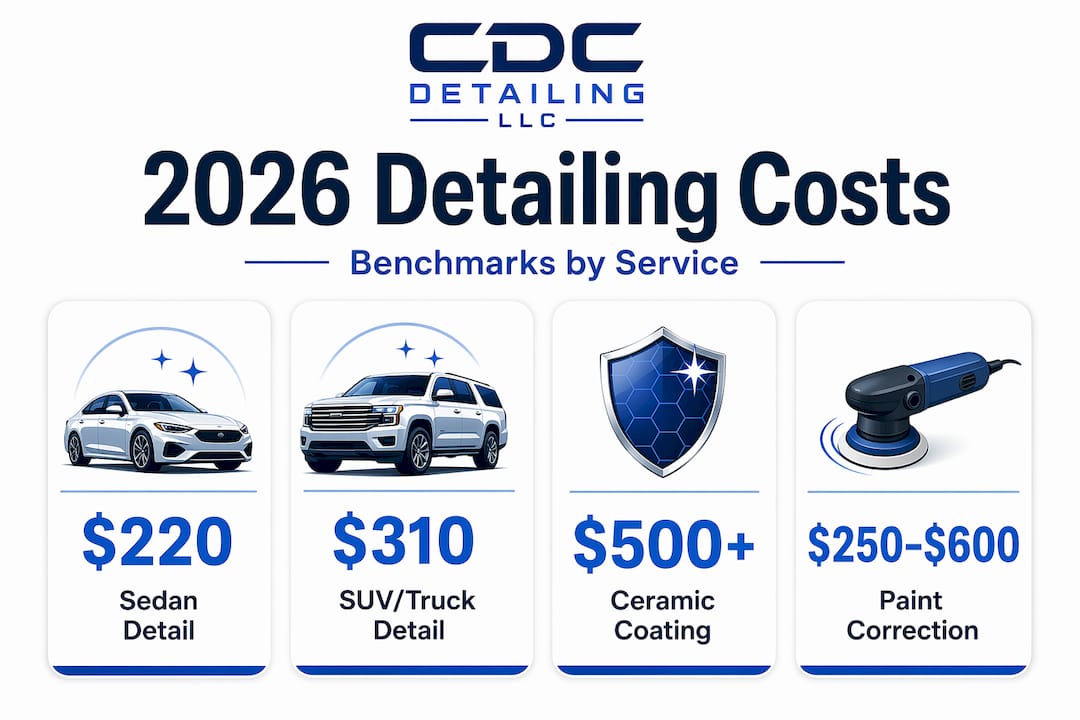
The national average full detail in 2026 is approximately $220 for sedans and $310 for SUVs and trucks. Interior-only details start around $90, while premium packages exceed $400. These figures reflect mid-tier markets and should be adjusted for your location.
Here is how typical pricing breaks down across market tiers in 2026:
| Service type | Entry-level market | Mid-tier market | Premium market |
|---|---|---|---|
| Basic exterior wash | $25–$45 | $40–$65 | $60–$100 |
| Interior-only detail | $80–$120 | $110–$160 | $150–$250 |
| Full detail (sedan) | $130–$200 | $180–$280 | $250–$450+ |
| Paint correction | $200–$350 | $300–$500 | $450–$800+ |
| Ceramic coating | $500–$900 | $900–$1,500 | $1,500–$2,500+ |
Paint correction typically ranges from $250 to $600, with professional-grade ceramic coatings ranging from $500 to over $2,000 depending on vehicle size and product tier. These are not impulse purchases. They represent real technical work.
Prices across the board have risen over the past two years. Premiumization is driving demand for advanced protective treatments as consumers shift their thinking from cosmetic cleaning to long-term vehicle preservation. Supply costs for professional-grade compounds, coatings, and detailing products have also increased, and those costs move through to consumer pricing.
If a quote you receive sits well below the entry-level ranges above, that is worth investigating. Either the scope is narrower than advertised, or the detailer is cutting corners on materials or coverage.
Applying pricing knowledge: how to compare and evaluate quotes
You now have the framework. Here is how to put it to work when you are actually shopping for a detailer.
-
Request written estimates. Any professional detailer should provide a written breakdown of exactly what is included. This means service scope, materials used, vehicle size assumptions, and any add-ons that would change the price.
-
Compare inclusions, not totals. A $200 quote that includes interior vacuuming, leather conditioning, exterior wash, clay bar treatment, and a paint sealant is genuinely different from a $200 quote that means a vacuum and a wipe-down. Read the line items.
-
Understand deposit policies. Most professional detailers require deposits of 25 to 30% of the total, with 48-hour cancellation windows. This is standard. If a detailer asks for no deposit at all, that is sometimes a sign of a less organized operation.
-
Use market benchmarks as a floor, not a ceiling. The tables above tell you what reasonable pricing looks like. If someone comes in far below the floor, ask why. If someone comes in above the ceiling, ask what justifies the premium.
-
Factor in reputation and reviews. A detailer charging $280 with 150 five-star reviews is almost always a better spend than one charging $180 with three reviews and no photos of their work.
Pro Tip: Use the phrase “what exactly is included in this package” before you book anything. A detailer who gives you a vague answer or gets defensive is telling you something important.
Add-ons and premium treatments worth knowing
Add-on services can meaningfully change your total cost. Knowing what they cover helps you decide which are worth it and which you can skip.
Pet hair removal runs $25 to $60, odor elimination $30 to $75, and headlight restoration $50 to $100. These are not padding. Pet hair removal is genuinely labor-intensive. Headlight restoration requires compounds and polishing equipment. Odor elimination for smoke or mildew often involves ozone treatment or enzyme-based products.
Paint correction is in a category of its own. If your paint has visible swirl marks, scratches, or oxidation, paint correction is the only service that actually fixes them rather than masking them temporarily. Expect to pay $250 to $600 for a full single-stage correction and more for multi-stage work on heavily damaged paint.
Ceramic coatings represent the highest-value long-term investment in this category. Ceramic coatings bond chemically to the paint surface and protect against UV damage, chemical contamination, and light scratches for two to five years, depending on product tier. The cost is real, ranging from $500 to over $2,000, but compared to repainting or repeatedly waxing every few months, the math often favors the coating over a three to four year window.
Other useful add-ons include engine bay cleaning ($50 to $100), leather conditioning ($30 to $60), and fabric protection treatments ($50 to $80). These are worth considering on higher-mileage vehicles or when you are preparing a car for resale. Premium detailing benefits extend well beyond appearance and into actual vehicle preservation and resale value.
My honest take on how buyers should think about pricing
I have reviewed a lot of detailing quotes over the years, and the pattern I see repeatedly is buyers optimizing for the lowest number rather than the best outcome. That is a reasonable instinct with most purchases. With detailing, it creates problems.
The detailers most likely to underquote are often the same ones who lack the overhead structure of a serious operation. Sustainable detailing businesses price to cover insurance, quality products, proper equipment, and training. When a quote looks too good, one of those things is usually missing. You end up with a scratched paint surface from improper technique or a “ceramic coating” that is actually a spray wax that washes off in six weeks.
What I have found actually works is treating price as a data point rather than a decision maker. Get two or three quotes in writing, compare their inclusions side by side, and look at documented results from their previous work. A detailer who shows you before-and-after photos and explains exactly what products they use on your specific paint type is worth paying more for. The one who just gives you a number without explanation is not.
The shift toward protective treatments in this industry is real and worth taking seriously. A $1,200 ceramic coating applied correctly to a vehicle you plan to own for five more years is not an extravagance. It is practical math. Your budget is a constraint, not a target. Spend up to your limit on the best verifiable quality you can find.
— Charles
See what professional detailing actually looks like
If this guide has helped you understand what goes into fair car detailing pricing, the next step is seeing real service examples from a professional provider. Cdcautodetailing serves South Jersey with transparent package pricing, mobile convenience, and premium treatment options including ceramic coatings and paint correction. You can browse detailed service examples to compare what each tier includes before you book. There are no vague descriptions or mystery pricing. Just clear packages, honest rates, and professional results delivered to your driveway. Book directly at Cdcautodetailing whenever you are ready.
FAQ
How much does an interior car detail cost in 2026?
Interior-only details start around $90 for compact sedans and reach $200 or more for larger vehicles in premium markets. Pricing depends on vehicle size, condition, and which specific services are included in the package.
What factors affect car detailing prices the most?
Vehicle size, service scope, geographic location, and vehicle condition are the four primary factors. Coastal cities can charge 50 to 100% more than smaller markets for the same service.
Is flat-rate or hourly pricing better for detailing customers?
Flat-rate package pricing is better for customers because it provides a fixed total with clear inclusions. Hourly pricing creates unpredictability and is generally reserved for complex specialty work.
When is paint correction worth the extra cost?
Paint correction is worth it when your paint has visible swirl marks, scratches, or oxidation that basic detailing cannot address. It costs $250 to $600 on average and restores paint rather than simply cleaning it.
How do I avoid hidden fees on a detailing quote?
Ask for a written estimate that lists every included service, all add-ons, and any vehicle-size surcharges before you confirm the appointment. Detailers with transparent pricing will provide this without hesitation.