
If you spend your week on the Parkway, the Turnpike, Route 55 or the AC Expressway, paint protection film (PPF) belongs on the front end of your car. PPF is a clear urethane film applied over your paint. At highway speed, the bumper, hood, fenders and mirrors take the stone strikes, so full-front coverage is where highway drivers get the most protection for the money. We install paint protection film as a mobile service across South Jersey, and the plan below is how we would think through coverage for a commuter car.
TL;DR
- Highway miles send rocks and road debris at the leading edges of your car: bumper, hood, fenders, mirror caps and lower rockers. Cover those first.
- PPF acts as a sacrificial layer, so the film takes the hit before your paint does.
- Partial front is the entry point, full front is the usual commuter choice, and full body is a bigger investment that suits some cars and owners.
- Paint condition matters: film goes over sound paint, and repainted panels need extra care.
- Pairing a front-end film with ceramic coating on the rest of the car covers both chips and everyday grime.
Table of Contents
- Why highway driving is hard on paint
- What PPF does on the highway
- Which areas to cover first
- Partial front, full front or full body
- What PPF costs
- PPF and ceramic coating: layer them
- Paint condition and repainted panels
- What good installation looks like
- Looking after film on a highway car
- Who this matters most for
- Why we come to you
- Get a quote for your car
- FAQ
- Sources
Why highway driving is hard on paint
City driving wears a car down slowly: door dings, parking lot scuffs, a few swirl marks from washing. Highway driving does something different. You follow trucks and other cars at 60 to 70 mph, and anything they kick up arrives at your front end with real force. Gravel, road salt, sand, bits of tire and construction debris all hit the same few surfaces again and again.
The result is the pitted, speckled look on the leading edge of a hood and bumper that many commuter cars get within a couple of years. Each chip breaks through the clear coat. Bare metal underneath is where surface corrosion can start, and a chip repair never looks quite like factory paint.
That is the job PPF was built for. Edmunds compares it to a phone screen protector: a sacrificial physical barrier between rocks, debris and road hazards and your car’s finish. Motor1 describes the same mechanism: when a stone strikes a protected panel, the film absorbs the impact first, lowering the chance that the paint underneath is chipped.
What PPF does on the highway
Three things matter to a highway driver.
It absorbs impact. The film is a thick, flexible layer that takes the stone strike. Your clear coat and base coat sit untouched below it.
It resists light scratches and swirls. Many modern films are self-healing. According to Motor1, heat from sunlight or warm water can make minor scratches and swirls in these films disappear. That helps a car that gets washed regularly and sits outside at work.
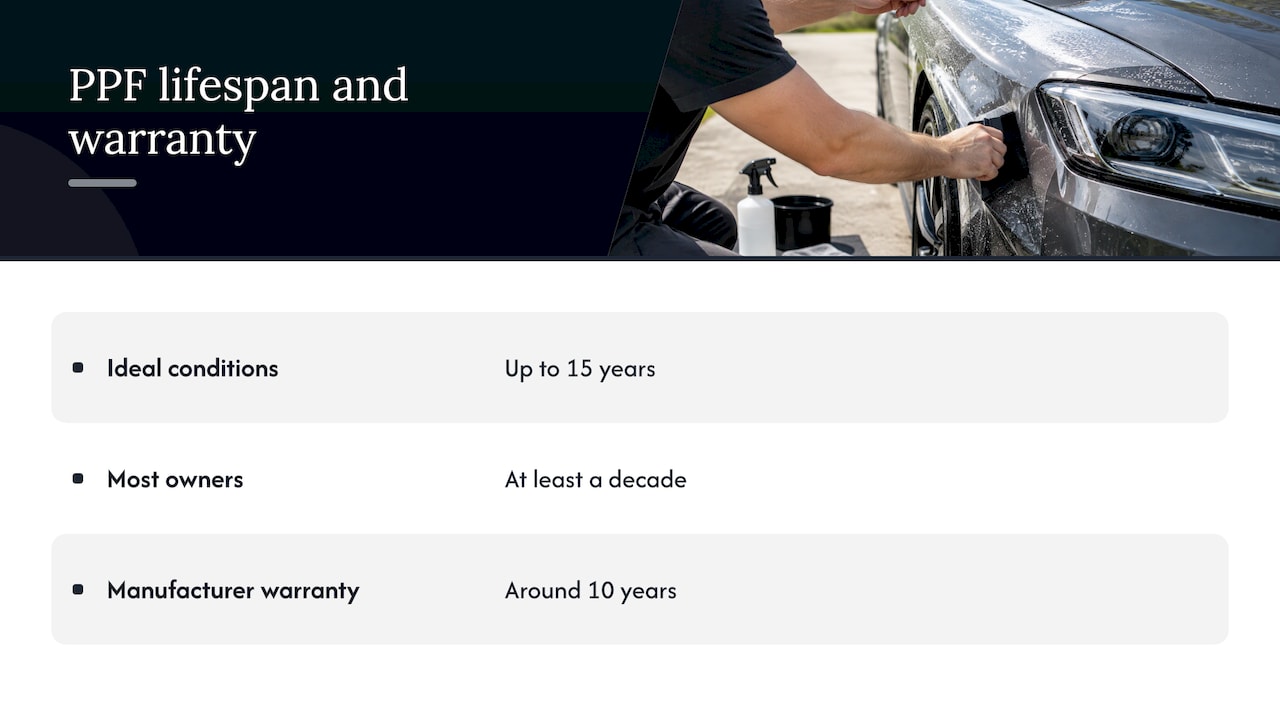
It lasts. Edmunds reports that modern PPF can last up to 15 years under ideal conditions, such as a garaged car with a ceramic coat, and at least a decade for most owners. Hagerty notes that most manufacturer warranties run around 10 years, and that a car parked outside every day ages its film faster than a garaged weekend car. Plan around the conditions your car lives in.
PPF is a protective layer, not an invisible force field. A very deep cut or a piece of debris that tears through the film may mean replacing that section of film. That is a film panel to replace, not a repaint of your car.
Which areas to cover first
The highest-priority areas are the ones facing forward and low. Hagerty says installers typically apply PPF to the front bumper and fenders, the hood, the mirror caps and the lower rocker panels. That matches what highway driving does to a car.
| Area | Why it takes damage on the highway |
|---|---|
| Front bumper | Lowest forward surface, hit by gravel and debris kicked up from the road |
| Hood (leading edge and full panel) | Faces oncoming debris at speed, and chips show clearly on a large flat panel |
| Front fenders | Sit beside the hood and take the same stream of debris |
| Mirror caps | Stick out into the airflow and catch strikes |
| Lower rocker panels | Sandblasted by debris from your own tires and from passing traffic |
| Door edges and cups | Prone to scuffs from fingernails, keys and bags |
If you drive an SUV or truck with a tall, flat front end, the hood and windshield-facing surfaces take even more of the stream, which is a good reason to choose a full hood rather than a strip along its leading edge.
Partial front, full front or full body
Motor1 lists three common coverage options:
- Partial front: bumper, mirrors and the leading edge of the hood.
- Full front: the entire hood, front fenders, bumper and mirrors.
- Full body: every painted panel.
Here is how we would pick between them for highway use.
Partial front works when your budget is tight or when you want to protect the worst-hit zones now and add more later. It leaves the back half of the hood unprotected, and a hood edge strip creates a visible line some owners prefer to avoid.
Full front is where most commuters should land. The whole hood and both fenders are covered, so there is no edge line across the middle of the panel, and the panels that take the most strikes are all protected. The film runs wall to wall across the part of the car that faces the road.
Full body covers the doors, quarter panels, roof and trunk too. Motor1 says it is hard to justify financially for most drivers, because the front end takes most of the damage. It suits owners of a high-value car who want every panel covered and are happy to pay for it.
Many owners add the lower doors and rear arches to a full front, because tires throw debris sideways and backward as well.
What PPF costs
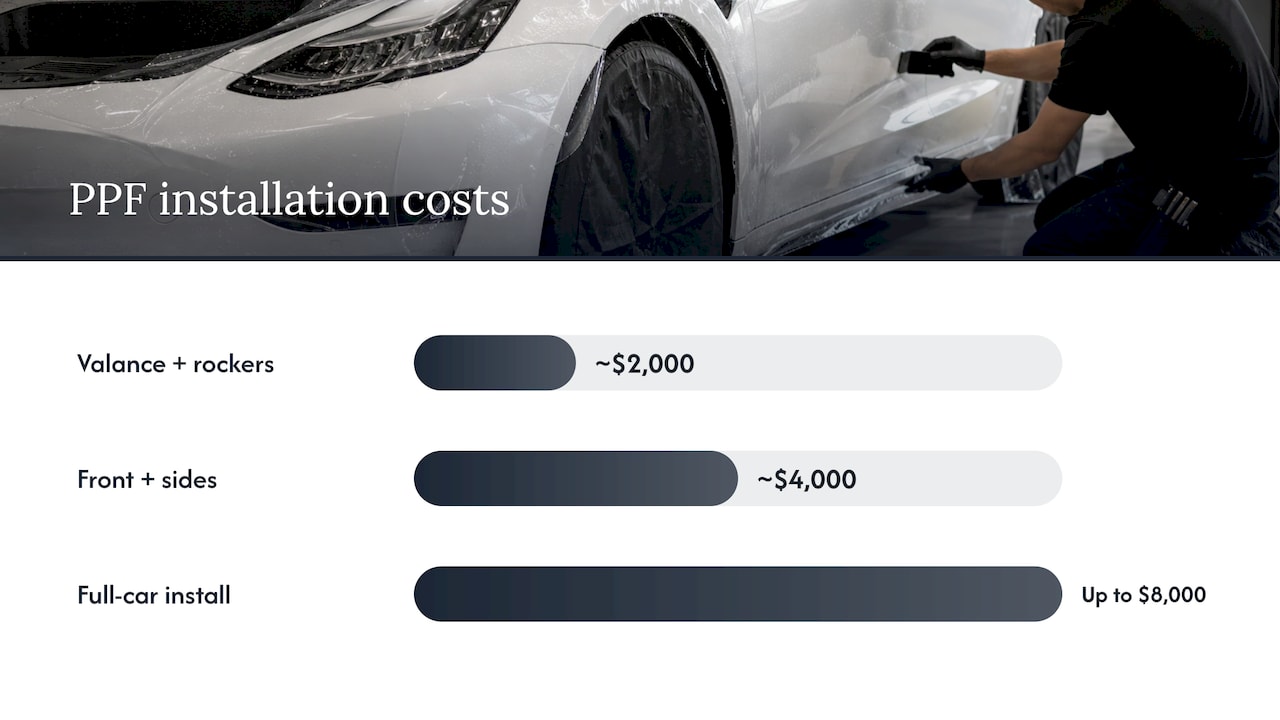
PPF pricing varies with the car, the film and how much of the car you cover. National figures give you a frame. Hagerty reports that a shop may charge around $2,000 for a front valance plus lower rockers and around $4,000 for the entire front end and sides. Edmunds notes that a full-car installation can reach as much as $8,000, because installers remove door panels, taillights and exterior trim so the film tucks neatly between seams and does not lift later.
That trim removal is why price tracks labor as much as film. A tucked, wrapped edge is harder to see and less likely to lift than a film cut short at a seam.
Edmunds also frames the value math: against today’s high average new-car prices, protecting the high-impact areas is a relatively small sum. For a commuter car with a loan or lease, the question is simple. What does it cost to keep the front end looking new for the years you plan to own it, compared with what chips will do to resale value?
We do not publish a PPF price, because it depends on the vehicle and the coverage you choose. To get a quote for your car, use the booking form on our paint protection film page.
PPF and ceramic coating: layer them
PPF and ceramic coating do different jobs. PPF is the thick physical layer that takes stone strikes. Ceramic coating is a thin chemical-resistant layer that makes paint slick, easier to wash and glossier. A highway car benefits from both: film on the impact zone, ceramic on the rest of the paint.
That is also how we would plan it with you. Our ceramic coating packages are listed at these prices:
| Package | Price |
|---|---|
| 3 Year Package | $1,000-$1,200 |
| 5 Year Package | $1,500-$1,700 |
| 8 Year Package | $2,200-$2,400 |
Ceramic coating carries a 10% booking charge. Details are on our ceramic coating page, and our guide to PPF vs ceramic coating explains which one fits which driver.
Paint condition and repainted panels
Film should go over sound paint. Hagerty warns that on original paint or older repaints, poorly bonded paint can come off with the film at removal, and that installers should decline to install over paint that is already flaking. So before you book, look at the front of your car in daylight. Panels with a smooth, intact clear coat are good candidates. If a bumper or fender has been repainted after a collision, see our guide on PPF on repainted panels for what to check and how long to wait.
If you drive a new car, the best time for film is before chips happen. Fresh paint can be covered before the first thousand highway miles add up.
What good installation looks like
Motor1’s Dan Mihalascu stresses that installation quality matters enormously. Poorly fitted film can show visible edges, bubbles, lifting or trapped contamination. Film can also age by yellowing, staining, cracking or peeling, so he advises having the shop inspect the finish and explain removal and replacement terms before installation.
Take that advice into any conversation about your car. Ask what the installer does at the edges and seams, how the paint is prepared, and what the warranty covers. Motor1 notes that XPEL’s 10-year limited warranty covers specified film defects, not paint damage or every kind of scratch. Know that before you buy.
We lay out our process in PPF installation explained and in the paint protection film workflow.
Looking after film on a highway car
Film is low maintenance, but habits matter. A few rules keep a front end looking right:
- Wash regularly. Bugs and road film bake on during summer highway runs. Washing them off promptly keeps the film clear.
- Pay attention to edges. Edges are the first place wear shows on any protective film or coating. Avoid aiming a pressure washer nozzle straight at an edge.
- Plan a check-up. After long highway seasons, have the film looked over so that small lifts are caught early.
- Know the timeline. Hagerty’s installer source advises reapplying every seven years, and warns that film left on beyond a decade can be difficult to remove. Our PPF maintenance timeline covers what to do and when, for busy owners and fleets.
We also offer an Exterior Maintenance Plan at $100 per week per vehicle or $200 per month per vehicle, which keeps the exterior washed on a schedule. For a work truck or a commuter that sees salt and grime every day, a schedule is easier than remembering.
Who this matters most for
Commuters and sales reps. If you log hundreds of highway miles a week, a full-front film pays back in clean paint at trade-in or lease return.
Fleet managers. Vehicles that run the same routes every day take the same damage every day. Film on the front end of a van or service truck keeps it presentable between repaints. Our fleet washing service handles regular cleaning for commercial vehicles.
Enthusiasts. If you have a car you care about, a front-end film plus ceramic coating is the standard way to keep paint looking factory fresh while you actually drive it.
Why we come to you
Our view on PPF for highway cars
We are a mobile detailing company in Pitman, and most of the cars we care for are daily drivers. When a customer tells us they commute on the highway, we start with one question: what is the front of your car going to look like in three years?
Our answer is almost always full front film for the panels that face the road, with ceramic coating on the rest of the paint. It is a clear plan: film takes the stone strikes, and ceramic makes the whole car easier to keep clean. We also care about the surface under the film, which is why paint condition and repaired panels come up before any booking.
Because we are mobile, you do not have to rearrange your week around a shop drop-off. We care for your vehicle with the same personal attention whether it is a commuter sedan, a pickup or a fleet van.
Charles
Get a quote for your car
If your car sees highway miles every week, the quickest way to find out what front-end coverage looks like for it is to ask us. We come to you anywhere in our South Jersey service area, and the booking form on our paint protection film page is where you tell us the vehicle and the coverage you are considering.

If you want a ceramic coating or a full detail ahead of the film, our detail packages start at $375 for Bronze. Mobile detailing carries an additional fee from $100, and the booking charge is $100.
FAQ
Is PPF worth it if I mostly drive on the highway?
Yes, highway driving is the use case it was designed for. The film sits on the surfaces that face debris and absorbs the strikes that would otherwise chip your paint. For most commuters, covering the full front end gives the best balance of coverage and cost.
How much of the car should I cover?
Start with the front: bumper, hood, fenders and mirror caps. Add rocker panels and door edges if you want more coverage. Full-body film is a bigger investment, and Motor1 says most drivers will find it hard to justify financially.
How long does PPF last on a highway car?
Manufacturer warranties are commonly around 10 years, and Edmunds says modern films can last at least a decade for most owners. Cars parked outside every day see wear sooner than garaged ones, so your real timeline depends on how and where you drive and park.
Should I get PPF or ceramic coating?
For a highway car, film is the one that answers rock chips, and ceramic coating makes the paint easier to clean. We recommend film on the front end and ceramic coating across the rest of the car. Our ceramic coating packages cover 3, 5 and 8 years.
Can I put PPF on repainted panels?
Often you can, but the paint has to be well bonded and fully cured. Our guide to PPF on repainted panels explains what to check before you book.
Sources
- Paint Protection Film (PPF): Cost, Benefits, And Is It Worth It, Motor1
- Car Paint Protection Film (PPF): Is It Worth It?, Edmunds
- What You Need to Know About Paint Protection Film, Hagerty Media