
Paint protection film (PPF) is a clear urethane layer applied over your paint, and a new car is the best time to put it on. The paint is untouched, so the film locks in factory finish before rock chips, scratches and road grime start. The best results come from installing within the first week or two of delivery, covering the panels that take the most hits (front bumper, hood, fenders, mirror caps, rocker panels), and having a trained installer do the work. We install PPF at CDC Detailing, and this guide covers what we would want every new-car owner to know before booking.
TL;DR
- PPF acts as a sacrificial layer over factory paint. It is aimed mostly at rock chips, scratches and road debris, and some films self-heal light scuffs with heat.
- Install early: XPEL recommends within one week of delivery and before highway driving.
- Partial coverage (front end, rockers, mirrors) is the usual starting point. Full-car wrapping is available for owners who want everything covered.
- Installation takes 1 to 4 days depending on coverage, and you should plan on about a week of limited driving while the film cures.
- Pricing varies by car and coverage. One US shop example reported by Hagerty ran about $2,000 for a front valance and lower rockers.
Table of Contents
- What PPF does for a new car’s paint
- Why a new car is the best candidate
- What to cover: partial versus full coverage
- How long installation takes and what to expect
- What PPF costs on a new car in the US
- Is PPF worth it on a new car?
- PPF and ceramic coating together
- Caring for new-car PPF
- Perspective
- Book PPF for your new car in South Jersey
- FAQ
- Sources
What PPF does for a new car’s paint
PPF creates a physical barrier between your finish and rocks, debris and other road hazards. Edmunds describes it as a sacrificial layer, meaning the film takes the abuse so the paint underneath does not. Avery Dennison explains the mechanism as the film absorbing and dispersing impact energy so less of it reaches the paint.
That is why PPF matters most on the parts of the car that face forward. A pebble kicked up on the Atlantic City Expressway or a gravel shoulder on a South Jersey farm road hits the hood and bumper first. Those chips are small, but on a new car they are the first blemishes you will see and the hardest to ignore.
Beyond chips, the benefits owners usually look for are:
- Scratch resistance. Door-edge dings, key-ring marks near handles and light abrasion from brushing past things.
- UV and contaminant protection. RAC Drive lists protection from scratches, chips, UV rays and environmental contaminants among the main benefits.
- Self-healing. Per the same source, minor scratches can disappear when the film is warmed, for example by the sun or warm water.
- Resale story. When the film is removed correctly, the paint beneath has been shielded from the daily wear the car saw.
Why a new car is the best candidate
Film bonds to whatever is under it. On a brand-new car, that is flawless factory paint. On an older car, a shop first has to correct swirls and defects, because anything under the film stays under the film.
XPEL’s new-car guidance says the ideal timing is within a week of delivery, the sooner the better, and before highway driving. Waiting lets minor damage build up, and that can mean paint correction before the film goes on. Paint correction adds time and cost, and a new car is the one case where you can often skip it.
If you have already driven the car for a few weeks, you are still in good shape. Just book an inspection so the installer can judge the paint and tell you whether any prep is needed.
Why not wait and see?
The question we hear most is whether to wait until the first chip appears. The trouble is that a chip cannot be undone with film. Film goes over paint that is already damaged; it does not hide or repair the damage. Protecting before the damage is the whole point of putting PPF on a new car.
What to cover: partial versus full coverage
You do not have to wrap the whole car. Hagerty notes that installers generally apply PPF to the front bumper and fenders, hood, mirror caps and lower rocker panels. Full-car wrapping is possible too, though hard-to-contour areas can produce visible seams.
Here is how we think about the main options:
| Coverage level | Typical panels | Best for |
|---|---|---|
| Partial front | Front bumper, part of hood and fenders, mirror caps | Commuters and highway drivers on a budget |
| Full front | Entire hood, both fenders, bumper, mirrors, headlights | Most new-car owners who want the high-impact zones fully covered |
| Front plus rockers and doors | Full front plus rocker panels, door edges and cups | Cars parked in tight lots, or driven on gravel or salted roads |
| Full car | Every painted panel | Owners of high-value or dark-colored cars who want maximum coverage |
Dark and black paints show every swirl and chip, so they tend to push owners toward fuller coverage. Light colors hide small marks better, and many of those owners choose a front-end package.
PPF is also commonly supplied in sectioned designs, as Edmunds explains. If one section is badly damaged later, the affected panel can be replaced rather than the whole car being redone.
How long installation takes and what to expect
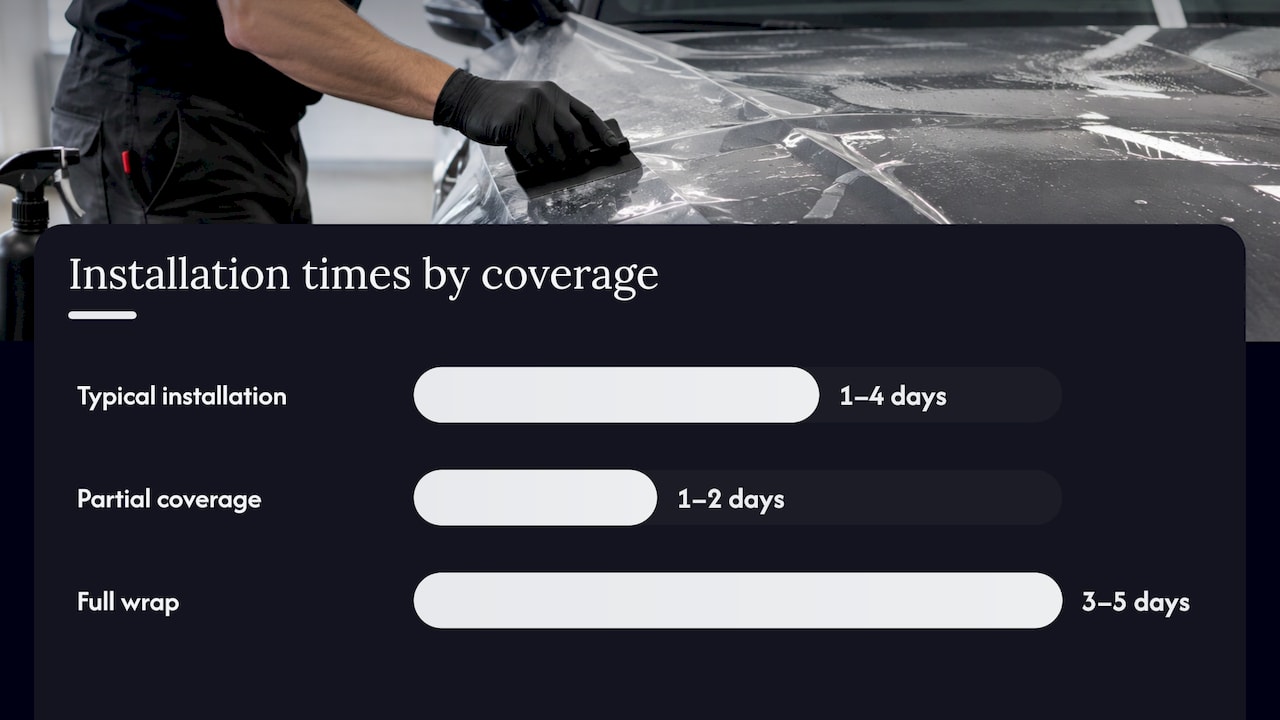
XPEL says installation typically takes 1 to 4 days, depending on how much of the car is covered. The firm gives roughly 1 to 2 days for partial coverage and 3 to 5 days for a full wrap, and you should allow about a week of limited driving while the film cures.
The process has a rhythm worth knowing:
- Wash and decontamination. The paint has to be clean, since any grit trapped under film stays there. Forbes describes the process as including cleaning and, where needed, paint correction before film is applied.
- Application. Installers use a tack solution and a slip solution, then press out the liquid with a hard plastic squeegee so the film adheres.
- Edge finishing. Film has to be tucked and trimmed so edges are as close to panel edges and curves as possible.
- Cure. The adhesive sets over days, not hours.
Temperature matters as much as technique. 3M’s film FAQ recommends 70°F to 79°F as the ideal range for both environment and vehicle, with application possible from 60°F to 85°F. Legend PPF’s guide advises against installing in direct sunlight or in open-air areas where contamination can get between film and paint. In New Jersey, that is a good reason to look for a controlled space in the cold months and to avoid a driveway install on a hot, dusty day.
Why a trained installer matters
Forbes notes that proper installation takes training, specialized tools and practice. Poorly applied film can bubble, peel or look unattractive, as RAC Drive points out. Ask a shop how it prepares paint, how it handles edges and what its policy is on film that has to be redone. We cover our own process in more detail in our PPF workflow guide and in PPF installation explained.
What PPF costs on a new car in the US
Price depends on the vehicle, the film, how much of the car is covered and the shop. Hagerty reported one shop charging around $2,000 to apply PPF to a front valance and lower rockers, and around $4,000 for the entire front end and sides. Treat those as a single example of the range rather than a quote for your car.
What moves the price up or down:
- Coverage. A front-end kit takes much less film and labor than a full wrap.
- Vehicle shape. Cars with complex curves, sensors and sharp creases take longer to wrap cleanly.
- Paint condition. A car with factory paint that needs no correction costs less to prep.
- Film grade. Premium films often include self-healing top coats and longer warranties from the manufacturer.
- Installer skill and facility. Experienced installers and controlled spaces cost more, and they tend to deliver cleaner edges.
At CDC Detailing, PPF pricing is quoted per vehicle and coverage. See our paint protection film page for details, and expect a booking charge as listed on our packages page. Because we are mobile, a mobile detailing fee from $100 may apply for on-site service.
Is PPF worth it on a new car?
The answer depends on how you drive, where you park and how long you plan to keep the car. A few questions can settle it quickly:
- Do you drive highways often? More miles at speed means more stone strikes on the front end.
- Do you park outside? Sun, tree sap, bird droppings and weather all hit unprotected paint.
- Will you keep or lease the car for years? Film can last a long time. Under ideal conditions it can reach up to 15 years, and Edmunds says most owners can expect at least a decade.
- Is the finish important to you? If a chip on a black hood would bother you every day, front-end film is cheap peace of mind compared to repainting a panel.
- Is it a premium or hard-to-match color? Repainting a panel is costly and blending a new finish into factory paint is tricky.
If you answered yes to two or three, film on the high-impact zones is a sound decision. For more on the film-or-coating choice, our PPF vs ceramic coating comparison walks through each.
Using film well
A few practical points help you get the most from it:
- Hagerty cautions that film on compromised paint, such as poor adhesion on older repaints, is where problems start. On a new car with intact factory paint, you avoid that. A good installer still checks the paint first.
- RAC Drive notes that deeper damage can still break through the film. Film is protection against everyday hazards, not an armor plate, so drive as you normally would.
- Plan for edges. A pro installer says film may not wrap perfectly into every crevice, so ask how the edges will be handled around the panels you choose.
PPF and ceramic coating together
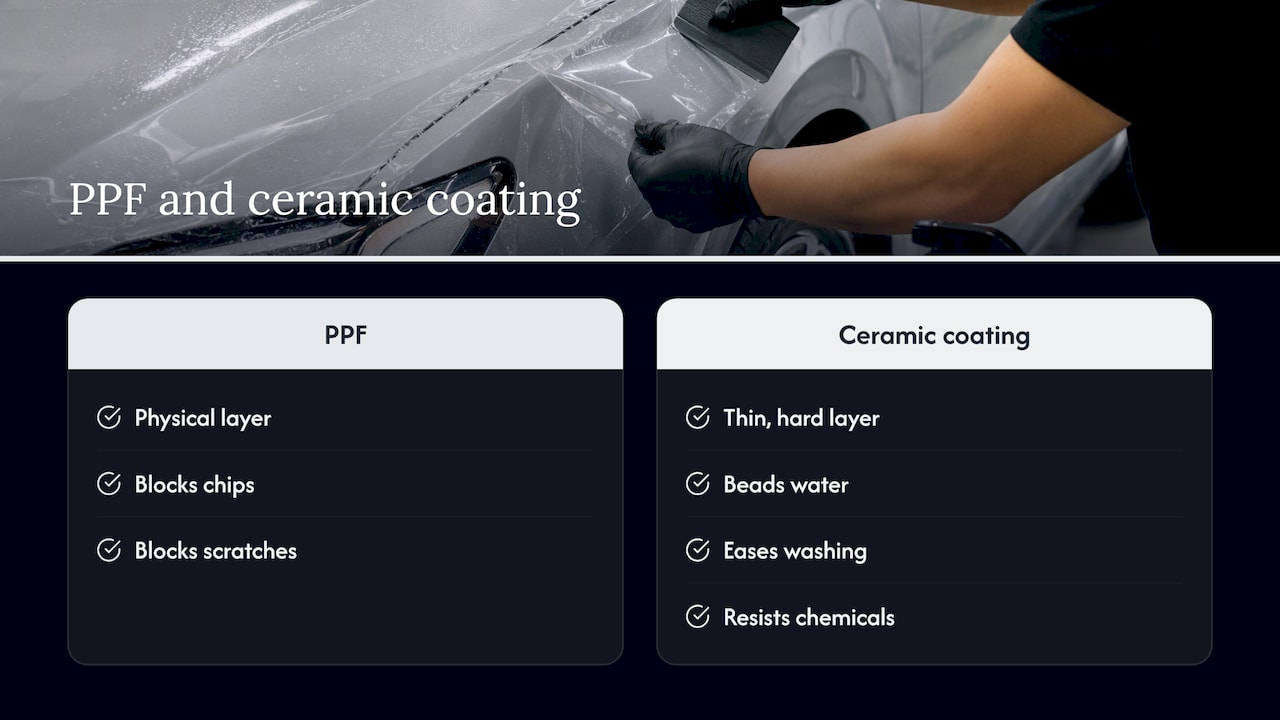
Many new-car owners ask whether they need both. They do different jobs. Film is a physical layer against chips and scratches. Ceramic coating is a thin, hard, slick layer that helps with water beading, easier washing and chemical resistance. Owners who want the full package often put film on the front end and ceramic coating on the rest of the car.
We offer ceramic coating in 3, 5 and 8 year packages, covered on our ceramic coating page. If you are weighing the two, see our guide to the benefits of ceramic coating.
Caring for new-car PPF
Aftercare is simple, and following the manufacturer’s rules protects your film.
- First wash. 3M says to avoid washing for the first 72 hours after installation. Legend PPF says at least 3 days, and longer in winter months. XPEL advises not touching the car for at least 48 hours and not washing for 7 days, and notes that some moisture at film edges during curing is normal. Follow your installer’s instruction, since it depends on the film.
- Car washes. 3M advises choosing touchless if you must use an automatic wash, because brushes can dull or scratch film and lift edges.
- Wax. 3M recommends waiting one week after installation, and avoiding waxes with dyes, abrasive polishes and rubbing compounds.
- Inspections. Edmunds recommends a yearly inspection by your installer.
For a longer maintenance schedule, see our PPF maintenance timeline. If film ever needs to come off, our PPF removal guide explains how a pro does it safely.
Perspective
We see new cars every week that are a few days old and already carry a chip or two from the ride home. That is the moment PPF makes the most sense, and it is the main reason we encourage owners to book before the first long highway trip.
Our approach is built around personalized care for each vehicle. We look at how you drive, where you park and what finish you have, then recommend coverage to match. A commuter on Route 55 gets a different plan than a weekend car that lives in a garage.
Because we come to you in South Jersey, there is no need to leave your new car at a shop for days. We use professional-grade materials and document the process, which also helps when you sell the car later.
If you are on the fence, start with the front end and add coverage over time. Film, ceramic coating and regular maintenance work well together as a long-term plan for the asset.
Charles
Book PPF for your new car in South Jersey
CDC Detailing is a mobile detailing service based in Pitman, NJ, serving vehicle owners across South Jersey. We install paint protection film, ceramic coatings and window tint, and we bring the work to you. Tell us the make, model, color and how you use the car, and we will recommend a coverage level.
Start on our paint protection film page or reach us through cdcautodetailing.com to schedule an appointment.
If you want tint at the same visit, our window tinting options include GeoShield Carbon Tint at $350 and GeoShield Ceramic Tint at $500.
FAQ
How soon should I get PPF on a new car?
As soon as you can, ideally within the first week after delivery and before highway driving, per XPEL’s guidance. Waiting lets small damage build up, and that may require paint correction before the film goes on.
How many days does PPF installation take?
XPEL says installation typically takes 1 to 4 days, with about 1 to 2 days for partial coverage and 3 to 5 days for a full wrap. Plan on a week of limited driving while the film cures.
How long does PPF last on a new car?
Under ideal conditions, PPF can last up to 15 years, and Edmunds says most people can expect at least a decade. Yearly installer inspections and correct washing help it reach that range.
Do I need PPF on the whole car?
No. Most owners start with the front bumper, hood, fenders and mirror caps, and some add rocker panels. Full-car coverage is available if you want every panel protected.
Can I wash my car right after PPF is installed?
Not right away. 3M says to wait 72 hours, and other manufacturers give longer waits, so follow your installer’s instructions. After that, a touchless wash is the safer choice for film.
Sources
- Car Paint Protection Film (PPF): Is It Worth It? (Edmunds)
- The Science Behind Paint Protection Films (Avery Dennison)
- The pros and cons of Paint Protection Film (RAC Drive)
- What You Need to Know About Paint Protection Film (Hagerty)
- PPF for New Cars: When and How to Protect Your New Vehicle (XPEL)
- PPF installation guide (XPEL)
- Behind The Scenes: How Is Automotive PPF Installed? (Forbes)
- 3M Paint Protection Film FAQ
- Paint Protection Film Installation Guide (Legend PPF)