
The PPF removal process comes down to four moves: warm the film evenly, lift a corner with a plastic tool, peel slowly at a low angle while you keep rewarming, then clean off the leftover adhesive. Done on healthy factory paint with film in decent shape, it is a patient afternoon job. Done on brittle, sun-baked film or repainted panels, it can lift clear coat along with the film. This guide covers the method, the tools, the adhesive cleanup and the situations where you should stop and call a professional.
TL;DR
- Heat is the whole game. Manufacturers recommend warming the film (3M cites 160°F to 200°F) so the adhesive softens, then peeling slowly at a shallow angle.
- Use plastic tools, never metal blades, and stop if paint begins to lift with the film.
- Old, brittle film tears into small pieces and takes much longer. Repainted panels and chipped paint are the highest-risk spots.
- Expect adhesive residue. Remove it with a purpose-made adhesive remover and a microfiber towel, then wash and protect the paint.
- Leave it to a professional if the film is under warranty, the paint is not original, the film is crumbling, or you have no shaded, ventilated space.
Table of Contents
- Is PPF hard to remove?
- Before you start: inspect the car
- Tools and products you need
- The PPF removal process, step by step
- Removing old PPF and adhesive residue
- Removing film from windows, trim and headlights
- DIY or professional?
- When should PPF come off?
- Our perspective: removal starts at installation
- Thinking about new film after removal?
- FAQ
- Sources
Is PPF hard to remove?
It depends far more on the condition of the film and the paint under it than on the film brand. Fresh or moderately aged film on original paint usually comes off in large, satisfying sheets. Film that has spent many summers in the sun may crack and come away in small pieces, which multiplies the time and the adhesive you have to clean.
Three factors decide how hard your job will be:
- Film age and exposure. 3M’s removal bulletin says removability depends on more than the adhesive itself: film construction, the surface underneath and the exposure history all play a part. It also warns that films with a “Not Removable” adhesive are not designed to come off and may leave heavy residue.
- Paint condition. One removal guide singles out repainted panels and chipped or flaking paint as the higher-risk conditions, because film makers’ removal guidance is written around factory paint. Aftermarket paint often has weaker adhesion to the layer beneath it.
- Temperature and technique. Cold film is stiff and the adhesive grips. Rushed peeling at a steep angle stretches and tears the film.
So is it hard? Not on the right car with the right patience. It is unforgiving if you rush it or if the paint was never factory original.
Before you start: inspect the car
Walk around the vehicle in good light and check for the things that change your plan.
- Repaint history. Look for slight color mismatches, orange peel that differs between panels, overspray on rubber trim, or a panel that has a different feel. If you bought the car used, ask for body shop records. Treat any suspected repainted panel as high risk.
- Chips, cracks and flaking clear coat. Film can hide paint damage. Edges that have lifted may already have pulled paint at the corners.
- Film condition. Yellowing, cracking, heavy hazing or lifting edges signal older film that may tear. (If your film is only yellowed and not failing, our pH 6 to 8 decontamination test for yellowed PPF is worth trying before you commit to removal.)
- Warranty. If a warranty still covers the film, removing it yourself can jeopardize a claim. Contact the installer first.
The temperature of the film and panel matters too. Avery Dennison’s bulletin advises that for best results the film and surface should be above 55°F when the film is removed, pulled at an angle between 0° and 45°. In a New Jersey winter that means a heated garage, not the driveway.
Tools and products you need
A well-equipped job is a safe one. A wrap removal guide from a chemical supplier lists the standard kit: a heat gun or steamer, plastic scrapers or picks, microfiber towels and nitrile gloves, plus isopropyl alcohol and adhesive remover.
| Tool or product | What it does |
|---|---|
| Steamer or heat gun | Softens the adhesive so the film releases |
| Plastic razor blades or picks | Lift a corner without gouging the paint |
| Adhesive remover | Dissolves residue left on the paint |
| Isopropyl alcohol (IPA) | Final wipe to clear oily remover film |
| Microfiber towels | Hold the remover, wipe residue, protect panels |
| Nitrile gloves | Keep solvents off your skin |
| Painter’s tape | Masks trim, emblems and edges you do not want touched |
Steamer or heat gun? Manufacturers lean toward steam. XPEL says to use a steamer to keep the film pliable if you remove it by hand, and 3M’s installation guideline recommends a steamer for removal. Steam delivers gentle, moist heat that is harder to overdo. A heat gun works, but it can scorch paint, soften clear coat and warp plastic trim if you hold it still or too close. If you use one, keep it moving and check the panel temperature with your hand: you should be able to touch it.
A safety note on solvents. Many adhesive removers are flammable. One removal guide notes that 3M’s safety data sheet classifies its 03618 adhesive remover as extremely flammable, and it points out that the New Jersey Department of Health describes isopropyl alcohol as a flammable liquid. Never use a heat gun and a flammable solvent at the same moment on the same spot. Work in a shaded, ventilated space, away from sparks and open flames, and read the label of whatever you buy.
The PPF removal process, step by step
1. Wash and dry the panel
Grit trapped under a towel or scraper scratches paint. Wash the car, dry it, and work on one panel at a time. Mask nearby trim, badges and rubber seals with painter’s tape.
2. Warm the film evenly
Heat a section roughly the size of your forearm. The goal is warm and pliable, not hot. 3M states that heating softens the adhesive and makes almost any film easier to remove, and it recommends uniform heating to 160°F to 200°F (72°C to 93°C) as long as the surface is not heat-sensitive. That figure is for a controlled, measured process. At home, work gradually and stop well short of anything uncomfortable to touch on the paint.
One caution from the same bulletin: UV inks and UV clear coats can turn brittle when heated, which affects how quickly removal goes. Cars with aftermarket graphics or unusual finishes need extra care.
3. Lift a corner with a plastic tool
Start at an edge or a corner, ideally on a flat panel such as the hood or a door, not a tight curve. Slide a plastic pick or your fingernail under the film. Never use a metal blade: it only takes one slip to cut through clear coat.
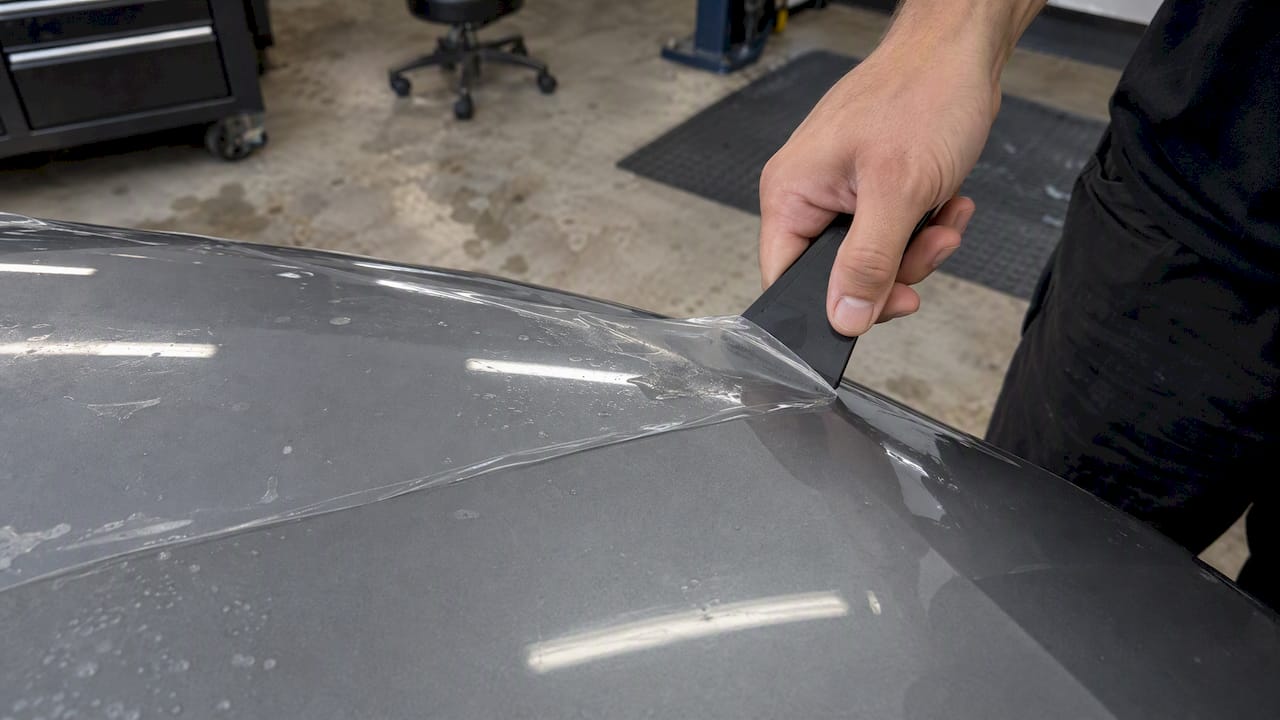
4. Peel slowly at a low angle
Pull the film back on itself at a shallow angle and keep it close to the surface. The published guidance differs slightly: SunTek recommends lifting at a 45-degree angle and pulling toward you, and warns against folding the film over itself because that can leave adhesive behind. XPEL calls for less than 45 degrees, and 3M’s guideline gives 30 to 60 degrees. All of them point the same way: low, slow and steady.
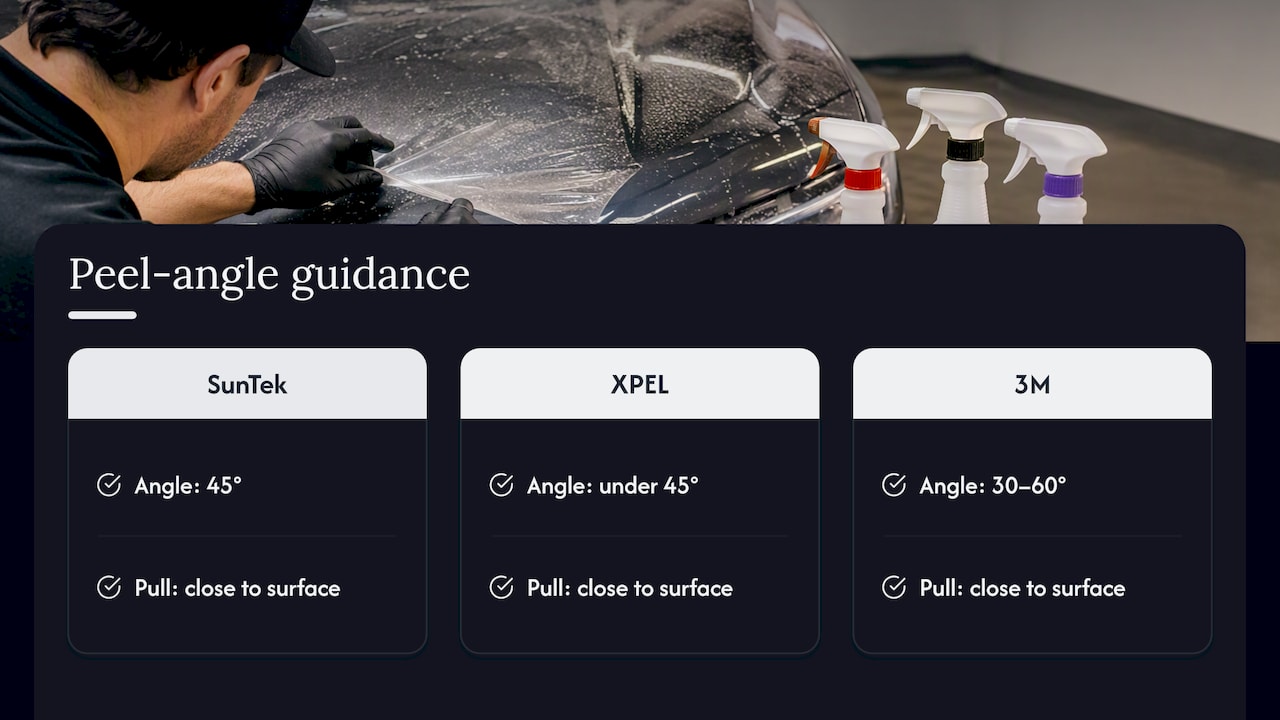
Work in short pulls of a few inches. When the film resists or starts to stretch, stop and rewarm that area. Pulling harder is what tears film and lifts paint.
5. Stop if paint lifts
If you see clear coat or paint coming up with the film, stop. Do not keep going to finish the panel. That is a sign of weak paint adhesion, a repaint or a previous chip, and it is the point where a professional can save you from a much bigger repair bill.
6. Remove the adhesive residue
Here the job often turns sticky. The next section covers it in detail.
7. Wash, inspect and protect
Wash the panel again, wipe with isopropyl alcohol diluted per the product label to clear any oily film, and inspect under light. Look for paint-edge lines where the film ended, faint tracks and any fading. The paint under film has been shielded from sun, so it may look different from adjacent unprotected paint. A light polish can blend it. Then protect the paint again: wax, sealant or a ceramic coating, so it is not left bare.
Removing old PPF and adhesive residue
Old film leaves the hardest cleanup. Instead of peeling off in one sheet, it can come away in flakes, with a patchy glue layer that has baked onto the clear coat. A few principles help:
- Soak, do not scrub. Wet a microfiber towel with adhesive remover and lay it over the residue so the solvent has time to work. Scrubbing dry glue grinds it into the paint.
- Use a plastic scraper wrapped in a towel. A towel wrapped tightly around a plastic scraper, soaked in remover, lets you push softened glue without touching bare paint with an edge.
- Work in small areas. Treat a panel section, wipe it off, then move on, so solvent never dries on paint.
- Rewarm stubborn patches. A bit of gentle steam helps the glue release again.
- Test first. Try the remover on a hidden spot to make sure it is safe on your paint and trim.
- Avoid harsh solvents. Strong chemicals can dull or soften paint and damage plastic and rubber. Choose a product made for automotive paint and follow its label.
For a deeper look at technique, our guide to four-step glue removal for car paint without stripping the clear coat walks through the residue stage in detail. The same logic applies if you are also thinking about taking off a ceramic coating: see how to remove ceramic coating without damaging paint.
Removing film from windows, trim and headlights
PPF on a headlight, a piece of gloss black trim or a door cup follows the same logic, with extra care. Plastics and textured trim are more sensitive to heat than painted metal, so use lower heat and shorter passes. Gloss black pieces scratch easily. For window film (which is a different product), the method differs, so do not assume the PPF steps apply to tint.
DIY or professional?
Removing PPF yourself makes sense when the film is moderately aged, the paint is original, you have a shaded, ventilated space and a few hours. Call a professional when any of these is true. The removal guide we reviewed lists the same situations:
- The film is still under warranty.
- The paint has been repainted or is damaged.
- The film is brittle or tearing.
- You have no shaded, ventilated place to work.
XPEL itself recommends professional removal. A professional brings a calibrated steamer, experience reading how a given film and paint behave, and insurance if something goes wrong. If removal reveals small dings or dents, a technique such as paintless dent repair can fix them without refinishing the panel, which is another job best left to specialists.
What does PPF removal cost?
There is no reliable national price, because cost depends on how much of the car is covered, the age and type of film, and the condition of the adhesive. Full-front coverage takes less time than a full-body wrap, and older film takes longer. Ask local installers for a written quote based on your actual vehicle and coverage, and ask what they will do if they find a repaint or paint damage under the film.
When should PPF come off?
Modern film can last a long time. Edmunds reports that under ideal conditions PPF can last up to 15 years, and recommends having an installer inspect it yearly. If a section is extensively damaged, replacing the affected panel is often better than removing everything.
Good reasons to remove film:
- Yellowing or discoloration that cleaning does not fix
- Cracking, peeling or lifting edges
- Deep gouges or damage in the film
- You are selling the car and want it presented fresh, or you want new film
If the film is healthy and you only want it to look better, maintenance and decontamination are cheaper than removal. Our PPF maintenance timeline explains what a sensible upkeep schedule looks like.
Our perspective: removal starts at installation
We install and look after protective films on vehicles across South Jersey, so we see the whole life of PPF, not just the first day. Here is what we have learned: the easiest removal is the one the installer planned for.
Clean prep, quality film and proper edge work make a difference years later. Film applied over poor paint, or over a panel that was repainted without the owner’s knowledge, is where removal goes wrong. That is why inspection and honest conversation about paint history come first on any film job. Our paint protection film workflow shows how we approach it.
If you are removing film because it has yellowed, check whether maintenance can rescue it first. If you are removing it to sell, document the paint condition with photos before and after. And if you hit resistance, stop. Rewarming a section for ten more minutes costs nothing. A lifted patch of clear coat costs a repaint.
When you replace film, think about the next removal too. Choose a film and installer that can tell you what to expect when the time comes.
— Charles
Thinking about new film after removal?
If you are taking old film off, it is a natural moment to protect the paint again. We apply paint protection film for drivers in Pitman and across South Jersey, and we come to you. See our paint protection film service and get in touch to talk through coverage for your vehicle. Pricing for PPF is quoted per vehicle, so it is not listed on the page.

On bare, freshly cleaned paint, a ceramic coating is another option; our ceramic coating packages start with a 3 year package at $1,000 to $1,200, a 5 year package at $1,500 to $1,700 and an 8 year package at $2,200 to $2,400.
FAQ
Is PPF hard to remove?
Not usually, if the film is in decent shape and the paint is original. Warmed properly and peeled slowly, it comes off in large pieces. Brittle old film, repainted panels and chipped paint make it much harder and riskier.
How do I remove clear bra without damaging paint?
Warm the film evenly with a steamer, lift a corner with a plastic tool and peel slowly at a low angle, usually 45 degrees or less. Rewarm as you go and stop immediately if paint starts to lift. Clean the adhesive afterward with a remover made for automotive paint.
Can I use a heat gun instead of a steamer?
Yes, but it takes more care. Keep it moving and never overheat the panel, because heat can damage paint and plastic. Manufacturers such as XPEL and 3M point to steamers for removal because the heat is gentler and easier to control.
How long before PPF should be removed?
There is no fixed date. Under ideal conditions modern film can last up to 15 years, according to Edmunds. Remove or replace it when it yellows, cracks, peels or is damaged beyond repair, and have an installer inspect it yearly.
How much does PPF removal cost?
Prices vary with coverage, film age and paint condition, so no single figure applies. Ask local installers for a quote for your vehicle and tell them if you suspect any repainted panels.
Sources
- 3M Instruction Bulletin: Removal
- 3M Paint Protection Film Installation Guideline
- SunTek Paint Protection Film FAQ
- XPEL Product Care Instructions
- Avery Dennison IB4.30 Paint Protection Film Application
- Wrap Removal 101, Brothers Chemical
- How to Remove PPF From Your Car, The Daily Automotive
- Car Paint Protection Film: Is It Worth It?, Edmunds