
Premium self-healing PPF genuinely removes light surface scratches, but only when heat reactivates the film’s topcoat, and only on damage that hasn’t cut through it. Try the fingernail test: if a mark barely catches your nail, hot water or a hair dryer will likely erase it in under two minutes. Deep gouges, punctures, and edge lifting won’t budge no matter how much heat you throw at them, and pushing past high temperatures risks damaging the paint underneath.
TL;DR:
- Self-healing PPF can only repair surface scratches up to about 5 microns deep, which typically includes light swirl marks and minor scuffs.
- Applying heat above the film’s glass transition temperature enables the topcoat to flow back into place, but deep cuts or punctures remove material that cannot be healed.
- Cleaning scratches with hot water at 120-130°F or a hair dryer held six to eight inches away usually restores shallow marks within a few minutes, but deeper damage requires patching.
- Over time, UV exposure and harsh chemicals degrade the topcoat’s flexibility, significantly reducing the film’s self-healing ability after three to six years.
- Proper installation, panel prep, edge sealing, and verifying film performance via live demo are crucial to ensure long-lasting self-healing effects.
Table of Contents
- How PPF Self-Healing Scratches Actually Works
- What Scratches Self-Healing PPF Can and Can’t Fix
- How to Trigger Healing Safely at Home
- Maintenance That Keeps Self-Healing Working
- How Long Does Self-Healing Last?
- What Installers Look for Before Recommending PPF
- The Honest Verdict on Self-Healing PPF
- Get Professional PPF Installation and Ongoing Care
- Sources
- FAQ
How PPF Self-Healing Scratches Actually Works
Self-healing has nothing to do with the paint underneath repairing itself. It’s a property of the film’s topcoat, a thin elastomeric layer bonded over the thermoplastic polyurethane (TPU) body that makes up most premium paint protection film. Below that sits the adhesive layer that grips your car’s clear coat. Three layers, one job each: the topcoat flexes and heals, the TPU body absorbs impact, and the adhesive holds everything in place.
The science behind the healing effect comes down to something called glass transition temperature, or Tg. Below its Tg, a polymer behaves like a rigid solid, brittle in the sense that a scratch stays put because the molecular chains are locked in position. Push the temperature above Tg and those chains gain enough mobility to flow back toward their original shape, gradually smoothing out a scratch the way a dented soda can won’t recover but a stretched rubber band will. Paint protection film’s multilayer construction is built specifically to exploit this heat-driven chain movement in the topcoat, restoring visible scratches without touching the layers below.
That distinction between deformation and material loss matters more than most owners realize:
- Deformation happens when the topcoat is pushed, pressed, or dragged out of shape without actually removing any material. Heat lets it flow back.
- Material removal happens when something cuts, gouges, or punctures through the topcoat entirely. There’s nothing left to flow back into place.
Pro Tip: Run your fingernail lightly across a mark before you assume it needs a heat treatment. If the nail catches or drags, you’re likely dealing with material loss, not a surface deformation, and heat alone won’t fix it.
Not all self-healing topcoats are formulated the same way. Aliphatic TPU resists UV yellowing far better than aromatic variants, which matters over years of sun exposure, while softer topcoat formulations tend to heal faster but scratch more easily in the first place. That tradeoff between resilience and repair speed is why film brands differ so much in real-world performance, even when the marketing language sounds identical. Lab work on photothermal conversion combined with dynamic bonds shows researchers pushing these polymer chemistries toward faster, light-triggered healing, a preview of where automotive films may eventually head, though commercial PPF today still relies on applied heat rather than ambient light.
What Scratches Self-Healing PPF Can and Can’t Fix
The rule of thumb installers use is depth, not visibility. A mark that’s barely there but deep will outlast a scratch that looks dramatic but sits shallow in the topcoat. Field and bench testing puts the practical ceiling for recovery around 5 microns, roughly a tenth the width of a human hair. Anything shallower than that is a good candidate for heat activation. Anything deeper is permanent.
Marks that typically heal:
- Fine wash swirls from improper drying or automated car washes
- Light key grazes where the key didn’t dig in
- Branch and shrub scuffs from tight parking spots
- Shopping cart brushes and light fingernail drags
Damage that won’t heal, no matter how much heat you apply:
- Deep rock chips that punch through to the adhesive layer
- Cuts or slices from box cutters, keys pressed too hard, or sharp trim edges
- Punctures from road debris
- Edge lifting where the film has started peeling from the panel
- Chemical staining or etching from bird droppings or tree sap left too long
Age changes this equation too. A film that healed a swirl mark in 60 seconds during year one might need three or four minutes for the same-sized mark by year four, because prolonged UV exposure gradually stiffens the topcoat’s polymer chains and raises the effective energy needed to trigger movement. If you notice healing slowing down dramatically or marks staying put after heat you know used to work, that’s usually your first visible sign of aging film, not a defect.
How to Trigger Healing Safely at Home
Heat is the only trigger that matters for commercial TPU film, and it needs to be applied deliberately, not guessed at. Here’s the protocol installers actually use:
- Photograph the mark first. You need a baseline to judge results honestly, since fresh scratches can look worse under certain lighting than they actually are.
- Start with hot water. Pour water at roughly 120 to 130°F directly over the scratch. This is the most even heat source available to most owners, and testing shows it produces faster, more uniform recovery than uneven sunlight because it heats the whole surface at once rather than in patches, a finding backed by field comparisons of hot water against sun exposure.
- Or use a hair dryer on medium heat, held six to eight inches from the surface, moving in slow circles rather than parking it on one spot.
- Check recovery at 60 seconds, then 2 minutes, then 5 minutes. Light swirls often vanish within the first minute at 120 to 130°F. Deeper (but still shallow-enough) marks may need the full five.
- Stop if the panel feels hot to the touch beyond warm. Anything approaching 180°F risks damaging the clear coat underneath, and you’ve overshot the film’s needs by a wide margin.
Sun parking works too, but unevenly, since shadows and panel angles create hot and cool zones on the same surface. Steam guns and low-heat guns give shops more control, which is why in-shop touch-ups often finish faster than a DIY hair dryer session.
Pro Tip: Every 10°F increase above the film’s activation point roughly cuts healing time, so the jump from 110°F to 130°F matters far more than it sounds. Don’t waste time at lukewarm temperatures hoping patience will substitute for heat.
If a mark doesn’t respond after five minutes at 130°F, it’s not a heat problem. It’s depth, and no amount of additional warmth will change that outcome.
Maintenance That Keeps Self-Healing Working
Self-healing capability degrades gradually with exposure and misuse, and how you wash the car has more influence on that timeline than most owners assume. High-pH cleaners, solvents, and aggressive polishing compounds all attack the topcoat’s flexibility over time, which slows down or eventually kills its ability to recover from marks. Stick to pH-neutral car shampoo and avoid anything marketed as a heavy-duty degreaser near film-wrapped panels.
A simple annual inspection catches problems early:
- Check panel edges for lifting or bubbling, especially around mirrors and door handles where stress concentrates.
- Look for yellowing, which signals UV degradation of the topcoat’s polymer chains.
- Run a hot-water test on a small area you know had a minor scratch. If it takes noticeably longer to heal than it used to, that’s your degradation marker.
- Inspect for staining from bug splatter or sap that sat too long, since these can etch into the topcoat rather than sitting on the surface.
Installers sometimes offer a sample-card demo where you can scratch a piece of film and watch it heal under a hair dryer on the spot, a useful way to verify a brand’s claims before committing to a full wrap. If self-healing genuinely fails on a section, and hot water and careful heat application don’t restore it, patching that panel is usually more cost-effective than a full reinstall, provided the damage is localized and the surrounding film is still healthy. Avoid abrasive polishing compounds entirely on film. If a section develops swirl marks that heat won’t fix, gentler correction methods exist for painted surfaces, but they’re not appropriate for PPF topcoats and can permanently dull the finish. For a fuller rundown of what to check and when, an installer-backed maintenance timeline breaks down year-by-year expectations in more detail.
How Long Does Self-Healing Last?
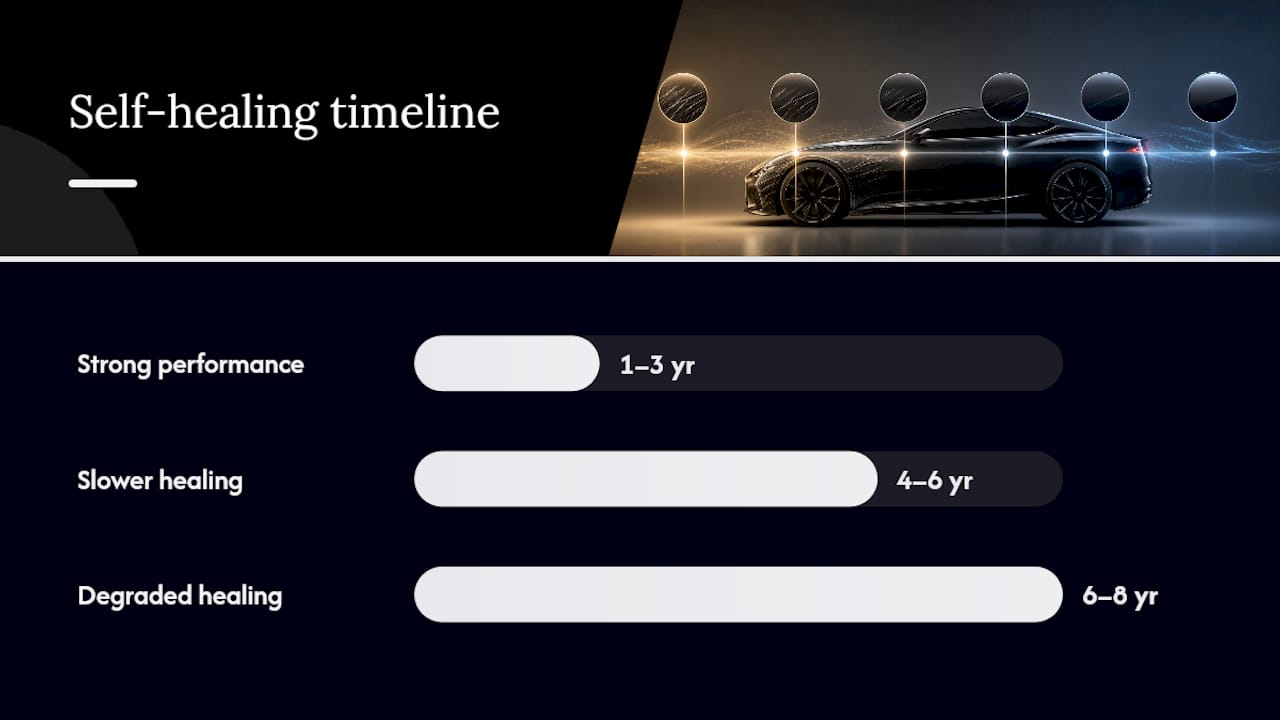
Self-healing performance isn’t permanent, and knowing the rough timeline helps you set realistic expectations before you ever book an install. Most premium TPU films perform strongly for the first one to three years, when the topcoat is still fresh and flexible. Years four through six typically bring functional but slower healing, where marks still recover but take longer than they did on day one. Past six to eight years, performance usually degrades enough that many marks stop healing altogether, though the exact timeline shifts heavily with climate, since UV-heavy environments and repeated chemical exposure accelerate the decline compared to milder, shadier conditions.
Three factors drive that decline faster than anything else:
- UV exposure, which stiffens the topcoat’s polymer chains over years of sun contact.
- Harsh chemical exposure, particularly high-pH washes and degreasers used repeatedly on the same panels.
- Repeated deep abrasion, since even non-healing scratches accumulate and eventually compromise the topcoat’s structural integrity.
When you’re comparing spec sheets or warranty terms, look for language specifying the topcoat formulation (aliphatic TPU tends to hold up better against yellowing) and warranty duration tied specifically to self-healing performance, not just general film defects. A film that spot-repairs well in year two but has a five-year warranty that only covers delamination, not healing failure, is telling you something about how long the manufacturer actually expects the self-healing property to last.
What Installers Look for Before Recommending PPF
A demo tells you more than any spec sheet. Ask your installer to scratch a sample card and heal it in front of you with a hair dryer or hot water, since watching the reaction firsthand is the fastest way to separate genuine self-healing topcoats from marketing language.
Installation quality affects healing performance just as much as the film itself. Proper panel prep, meaning a fully decontaminated and clay-barred surface, prevents trapped debris from creating pressure points that resist heat recovery. Edge sealing matters too: a poorly sealed edge is where lifting starts, and lifted edges don’t heal regardless of topcoat quality. If you’re layering ceramic coating over PPF, confirm compatibility first, since not every coating chemistry bonds well with every topcoat formulation. Reviewing professional installation practices before booking gives you a clearer sense of what separates a lasting install from one that fails early.
In the field, strong healing typically holds through year three, with a gradual slowdown afterward that tracks closely with sun exposure and wash habits. Owners in coastal or high-UV regions tend to see that decline sooner than those in milder climates.
The Honest Verdict on Self-Healing PPF
Most of the marketing around self-healing film oversells what it actually does, and that gap between promise and reality is where owner disappointment usually starts. Self-healing isn’t magic, and it isn’t a substitute for careful driving or garage parking. It’s thermal physics applied to a specific polymer layer, with real limits measured in microns, not intentions.
The conventional advice, “self-healing film fixes scratches,” skips the part that matters most: which scratches. A five-second glance at a mark tells you almost nothing. The fingernail test and a controlled heat check tell you everything. That’s the habit worth building, testing before assuming, because it separates owners who get years of genuine value from film from owners who feel misled the first time a rock chip doesn’t disappear.
If there’s one thing worth prioritizing, it’s asking for a live demo before you buy. A shop willing to scratch a sample card and heal it in front of you, with hot water or a hair dryer, has nothing to hide about their film’s real performance. A shop that hesitates on that request is telling you something too.
— Charles
Get Professional PPF Installation and Ongoing Care
Professional installers give you what a DIY hair dryer session can’t: a trained installer who preps the panel correctly, seals every edge, and shows you a live sample-card demo before the film ever touches your car.

Booking a consultation gets you a hands-on look at how the film heals, what topcoat formulation is being used, and how it holds up against seasonal heat and humidity swings. Ask about warranty coverage specifically tied to self-healing performance, not just general defects, since that detail tells you how long the manufacturer actually expects the topcoat to keep working. During your appointment, the installer walks through panel prep, edge sealing, and ceramic coating compatibility if you’re layering both. If you’re weighing a DIY kit against professional PPF installation, a proper install avoids the trapped debris and edge failures that cause early healing loss. Schedule a visit and request the sample-card test in person before you commit.
Sources
- Paint protection film — Wikipedia
- High-performance self-healing epoxy resin film based on the synergistic effect of photothermal conversion and dynamic bonds — RSC Publishing
- Self-Healing PPF Test: Heat Recovery Results & Data – HighCool
- Self-healing polymer film studies — MDPI Polymers
FAQ
Does PPF Actually Self-Heal?
Yes, but only the topcoat layer heals, and only for shallow marks. Heat above the film’s glass transition temperature lets the polymer chains flow back into place, typically recovering scratches up to about 5 microns deep.
Does PPF Heal Deep Scratches or Cuts?
No. Cuts, punctures, and deep rock chips remove material rather than deform it, so there’s nothing left for heat to move back into position. These require patching or panel replacement.
How Do You Get Rid of a Scratch on PPF?
Pour hot water at roughly 120 to 130°F over the mark, or use a hair dryer on medium heat held six to eight inches away, and check recovery at one, two, and five minutes. If it hasn’t healed by then, the damage is likely too deep to recover.
Is It Normal for PPF to Peel?
Minor edge lifting after years of exposure isn’t unusual, but widespread peeling usually points to poor edge sealing during installation or adhesive failure. Either issue needs a professional look, since lifted edges won’t self-heal and tend to worsen over time.
How Long Does Self-Healing PPF Last?
Expect strong performance for the first one to three years, a gradual slowdown through years four to six, and noticeably reduced healing after six to eight years, depending heavily on UV exposure and climate.