
Self-healing paint protection film (PPF) smooths out light scratches and swirl marks when its clear top coat is warmed. For most owners, sunlight or a pour of warm water is all the activation needed. A heat gun is a tool for trained hands, because too much heat can damage the film you are trying to protect. Below is what is happening in the film, what temperatures the film makers publish, how to warm a mark safely, and which damage will not heal at all.
TL;DR
- Heat softens the film’s top coat so shallow marks flow back to a smooth surface. 3M describes this as heat applied to the film surface removing minor scratches or marks.
- One film maker says light scratches heal in 20 to 30 minutes at room temperature, and that pouring 120°F water over the area speeds it up in cold weather.
- Cuts, punctures and gouges that go through the film do not heal, and neither does damage that reaches the paint underneath.
- Skip the heat gun at home. Overheating film can leave pattern show-through and burn the top coat.
- If a mark stays after warming, have the film inspected before it collects dirt and wear.
Table of Contents
- What heat activation actually does
- What temperature do you need?
- Three ways to warm a mark, safest first
- What will heal and what won’t
- How long does healing take?
- Keeping the film healthy so it keeps healing
- Why film warmth matters for fleets and daily drivers
- Get self-healing film installed on your vehicle
- FAQ
- Sources
What heat activation actually does
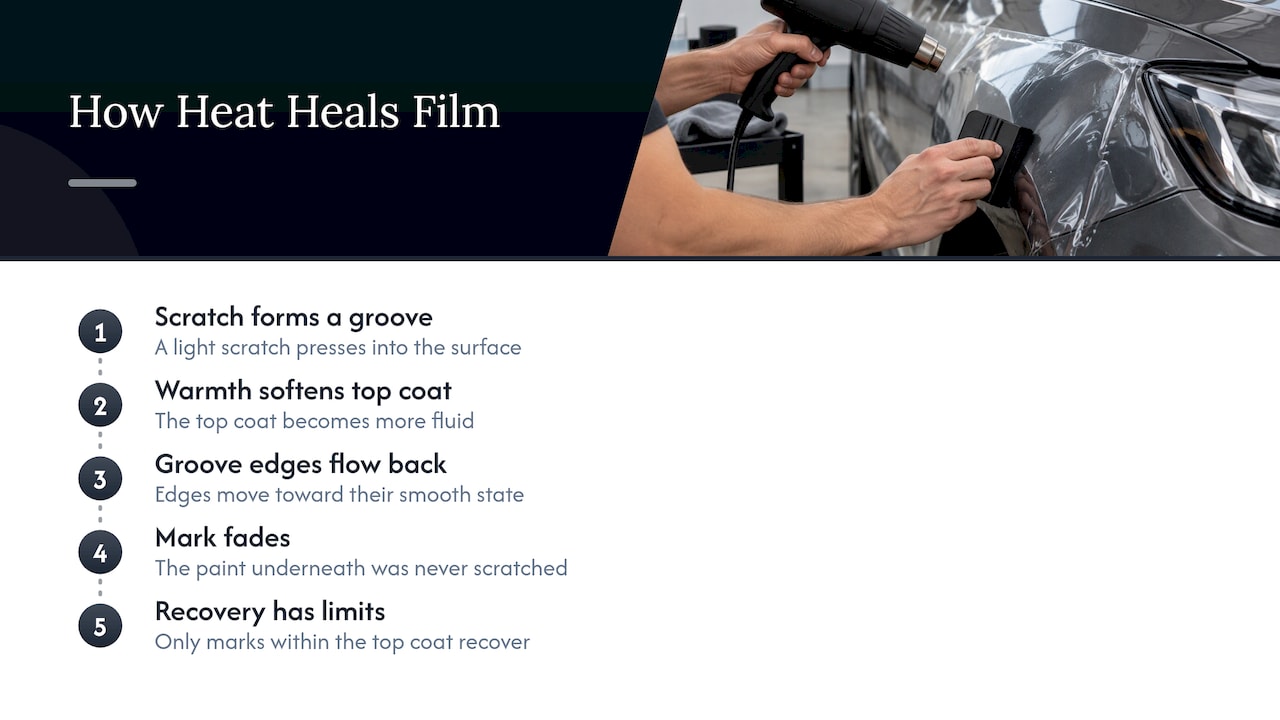
Self-healing PPF is a clear, flexible urethane film with a specialized top coat. That top coat is built so its surface can move a little when warm. A light scratch is mostly a tiny groove pressed into the surface. Warm the film and the top coat becomes more fluid, so the edges of the groove flow back toward their original smooth state and the mark fades.
3M’s product page for its Series 100 film states the idea plainly: the self-healing technology removes minor scratches or marks when heat is applied to the film surface. Note the wording: the film heals, not the paint. The paint under it was never scratched in the first place, which is the whole point of wearing film.
It helps to think of it as physical recovery rather than a repair. Nothing is being added or chemically bonded. The surface is relaxing back into shape. That is why the effect has limits: the top coat can only recover marks that stayed within the top coat.
Why swirl marks respond so well
Swirl marks from washing and wiping are hairline scratches, shallow and wide. They are exactly the type of mark the top coat can recover. On a bare clear coat those same swirls stay until someone polishes them out. On film, a warm day often does the work. XPEL’s own FAQ says its film can self-heal minor scratches and swirls.
What temperature do you need?
There is no single number for every film. Formulations differ, and makers describe activation in different ways. Two published figures are worth knowing:
- One film maker’s care instructions say light scratches in several of its films self-heal at room temperature in 20 to 30 minutes, and colder conditions slow the process.
- The same instructions recommend warm water at 120°F to accelerate healing when it is cold.
Another major maker, SunTek, describes self-healing film as using heat from the vehicle’s engine or the sun so that the top coat repairs surface scratches with minimal effort. In other words, the film is designed to be activated by ordinary conditions: a car parked in sun, or a hood warm from driving.
We test our own work against a 120 to 130°F range, and we explain the results in our scratch-healing test write-up. If you want the cost side of the technology, our guide to how self-healing film works and what it costs covers it.
What this means in South Jersey
Warm months do much of the work for free. A dark car left in July sun gets hot enough that light marks tend to fade on their own, often without you noticing them at all. The slow season is winter. On a cold morning in January a fresh scratch will linger, and it is in that season that a deliberate warm-water pour is useful. The time to act is when the film itself is cold and the mark is still visible.
Three ways to warm a mark, safest first
1. Let the sun do it
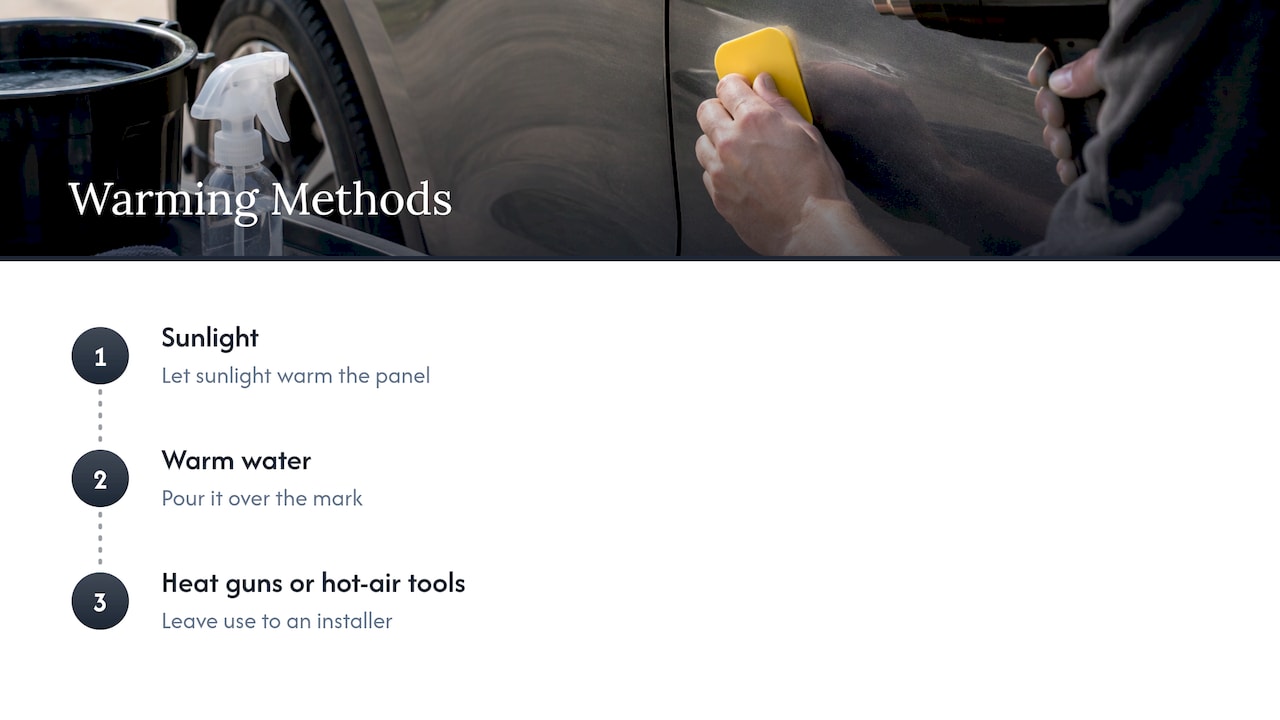
If the car is going to sit outdoors on a mild or warm day, the simplest approach is to leave it be. Park it where the panel gets direct sunlight and check again after the time the film maker gives, around half an hour for light marks at room temperature. Most owners never need to do more.
2. Pour warm water
For a cold day or an impatient owner, warm water is the method the manufacturer actually documents. The care instructions call for pouring 120°F water over the affected area, and they warn against high-pressure water near film edges.
A practical routine:
- Wash and dry the panel first so you are not dragging grit across a warm, soft surface.
- Use a thermometer or a tap you know runs around 120°F. Hotter is not better.
- Pour gently over the mark. Do not spray with a pressure washer, especially near edges, where water can lift film.
- Wait and look again. Light marks should fade over minutes, not seconds.
- Repeat once if needed, then stop. If a mark is still there, it is probably deeper than the top coat.
3. Leave heat tools to the installer
Heat guns and hot-air tools show up in a lot of viral videos. We do not recommend them for owners. Installers use heat constantly, but they do it with practice and with the film maker’s guidance. For example, Avery Dennison’s dry-apply bulletin advises keeping a heat gun about 15 cm (roughly 6 inches) away and moving constantly to avoid localized overheating. The same bulletin notes that overheating film in the wrong areas can cause pattern show-through and burn the top coat.
Those warnings are about installation, but the physics carry over: a spot held too hot for too long can distort the film. A mark you could have healed with a bucket of warm water is not worth a permanent blemish.
What will heal and what won’t
Self-healing is a feature of the top coat, so everything depends on how deep the damage goes.
| Damage | Will heat activation help? |
|---|---|
| Swirl marks from washing | Yes, these are shallow |
| Light scratches from a wipe, a key ring or a brush | Usually yes |
| Fine marks from automatic car washes | Usually yes |
| Deeper scratches that go through the top coat | Not fully; may need professional attention |
| Cuts, punctures, tears | No |
| Chips that reach the paint | No |
The film maker’s FAQ puts it this way: deeper scratches that penetrate the film may not fully heal and could require professional repair or replacement. A quick field test many people use: if your fingernail catches in the scratch, it is probably too deep for the top coat to close.
When the paint underneath is damaged
Occasionally a hard strike goes through the film and reaches the paint, such as a stone chip or a deep key mark. Film cannot recover that, and the paint needs its own repair. For readers curious about how paint-level scratches are touched up in general, this walkthrough on fixing scratches in car paint explains how severity changes the approach. If the damage is in film you had installed, though, start with the installer, since the first question is whether the film itself needs a panel replaced.
How long does healing take?
Expect minutes for light marks in warm conditions. The film maker’s instructions quote 20 to 30 minutes at room temperature for light scratches. In cold weather healing slows, which is when warm water earns its place.
What shapes the timing:
- Depth of the mark. Hairline swirls fade fastest. Heavier marks take longer, and the deepest never fully close.
- Temperature of the panel. A black hood in afternoon sun heals faster than a shaded door in February.
- Film type and condition. Different films have different formulations, and film that has aged a lot may not respond like new.
If you want a timing yardstick, give a light mark an hour in mild weather before deciding it will not heal. Then try warm water once. After that, stop and ask a professional rather than trying hotter or harder methods.
Keeping the film healthy so it keeps healing
Self-healing is not a reason to be careless. A film that is cared for heals better and lasts longer. A few habits matter:
- Wash with a clean mitt and plenty of lubrication so you are not adding marks faster than the film can erase them.
- Keep pressure washers at a distance from edges and seams.
- Be careful about what you put on the surface. Our guide on whether you can wax PPF explains what is safe and what to skip.
- Follow a regular upkeep schedule. We lay one out in our PPF maintenance timeline for owners and fleets.
One caution on expectations: the self-healing property is generally described as lasting through the film’s service life, but healing can become less efficient where the same spot is damaged repeatedly. A high-traffic spot like the front of a hood on a commuter vehicle is the likeliest place to see it.
Why film warmth matters for fleets and daily drivers
A work truck or a commuter sedan collects marks from hands, tool bags, brush contact and car washes. For fleet managers, the useful part of heat activation is that routine light marking does not need a trip to the shop. Vehicles that spend hours outdoors in summer sun are getting the activation passively. Vehicles garaged all winter are the ones where you may need to pour warm water on a visible mark.
It also changes how you judge the film. A film that looks scratched on a cold morning may look new by afternoon. Judge it after it has been warm, not in the first minutes after damage.
Our view on heat and self-healing film
We get asked about heat guns more than anything else on this topic, and our answer is always the same: you almost never need one. The film is built to recover with sun and warmth, and the care guidance from the film makers points owners to sunlight and warm water, not hot tools.
What we care about is that the film does its job for years. That means a clean installation, an owner who knows what normal healing looks like, and a plan for what to do when a mark does not fade. Clients who understand this stop worrying about every swirl and start enjoying how the car looks.
If you are choosing between film, a ceramic coating or a self-healing coating, think about what you want to prevent. Film is for impacts and scratches. A coating is for gloss and easier cleaning. We install and care for both, and we are glad to talk through which suits your vehicle and how you use it.
Charles
Get self-healing film installed on your vehicle
If you would rather have film that heals light marks and an installer who can answer these questions in person, our team does paint protection film as a mobile service for vehicles across South Jersey, based in Pitman. PPF has no published price, so tell us the vehicle and the panels you want covered when you get in touch. We also offer the Revivify self-healing coating, which you can see on our homepage.

If your goal is protection for a work vehicle or a fleet, mention that when you book, and we will talk through what makes sense for how the vehicles are used.
FAQ
Does self-healing PPF need a heat gun to work?
No. The film is designed to recover with ordinary warmth, such as sunlight or heat from the engine, as SunTek’s product page describes. In cold conditions, pouring warm water is the documented way to speed things up. Heat guns carry a real risk of damaging the film when used without training.
How hot should the water be?
The film maker’s care instructions say 120°F. Pour it gently over the mark rather than spraying it, and keep water pressure away from edges. The care instructions also say to keep high-pressure water away from film edges.
Can self-healing PPF fix a deep scratch?
Not completely. The healing works in the top coat, so marks that go through it may not fully close, and cuts or punctures will not heal at all. A fingernail catching in the scratch is a sign it is probably too deep. In that case, have the film looked at before the area collects dirt.
Will heating a scratch damage the film?
Warm water at the documented temperature is fine. Excess heat from a tool is the risk: Avery Dennison’s guidance warns that overheating can burn the top coat and cause pattern show-through.
How long should I wait before deciding a scratch is permanent?
In mild weather, light marks typically fade within about 20 to 30 minutes per the film maker’s instructions. Give it an hour, try warm water once if it is cold out, and then get it checked if the mark remains.
Sources
- 3M Paint Protection Film Series 100 Gloss product page
- Product care instructions, film manufacturer help center
- Frequently asked questions, film manufacturer support
- SunTek Paint Protection Film Ultra Defense
- Avery Dennison IB4.40 Dry Apply PPF Guidelines
- Fixing scratches in car paint