
TL;DR:
- Poor quality control in auto detailing damages vehicle surfaces, wastes money, and reduces longevity.
- Using structured checklists, skilled technicians, and environmental considerations ensures consistent, high-quality results.
You paid for a professional detailing service, the technician packed up and left, and then you noticed streaks on every window, wax residue packed into your door trim, and a musty smell still lingering inside. That frustration is real, and it costs you money. Poor quality control in auto detailing is not just an annoyance; it shortens the life of your vehicle’s surfaces, wastes your investment, and forces you to rebook a job that should have been done right the first time. The good news is that you have more influence over the outcome than you might think, and knowing what to look for before, during, and after your service makes all the difference.
Table of Contents
- What impacts detailing quality control?
- Checklist essentials: Foundation of consistent quality
- Step-by-step: How to verify detailing work quality
- Avoiding common detailing pitfalls
- Our take: Why demanding quality control pays off — even for mobile detailing
- Ready for meticulous results? Choose certified detailing experts
- Frequently asked questions
Key Takeaways
| Point | Details |
|---|---|
| Standardize with checklists | Using detailed, stage-based checklists is crucial for consistent, high-quality results. |
| Inspect before approving | Always perform a thorough walkaround and check for missed spots before accepting your car. |
| Avoid common errors | Know the typical pitfalls so you can spot and address them quickly. |
| Mobile detailing can be premium | Mobile services can match shop-level quality when proper quality control is enforced. |
| Ask for transparency | Don’t hesitate to request checklists or proof of quality control from your detailing provider. |
What impacts detailing quality control?
Quality detailing is not simply a matter of showing up with the right products. Several interconnected factors determine whether your vehicle comes back looking flawless or whether you are left counting missed spots in the parking lot.
Professional tools and skilled staff sit at the top of the list. A dual-action polisher used correctly by a trained hand removes swirl marks cleanly. The same machine used aggressively by an undertrained technician burns through clear coat. There is no middle ground. Skilled detailers follow detailing best practices that balance machine speed, pad type, compound aggressiveness, and dwell time to protect every surface they touch.
Environmental conditions hit mobile detailing differently than a fixed shop. Wind carries dust onto freshly waxed panels. Direct sunlight heats paint surfaces and causes products to cure too fast, leaving streaks or uneven bonding. A professional mobile detailer accounts for shade, temperature, and humidity before selecting products and application methods. If your detailer arrives at noon in July and immediately starts laying ceramic coating on a sun-baked hood, that is a warning sign.
Structured checklists are the backbone of consistent outcomes. According to the Vehicle Detailing Quality Inspection Checklist, using stage-based checklists standardizes results across different detailers and shifts, ensuring consistent outcomes before the vehicle is returned to the owner. Without a checklist, technicians rely on memory, and memory fails under time pressure.
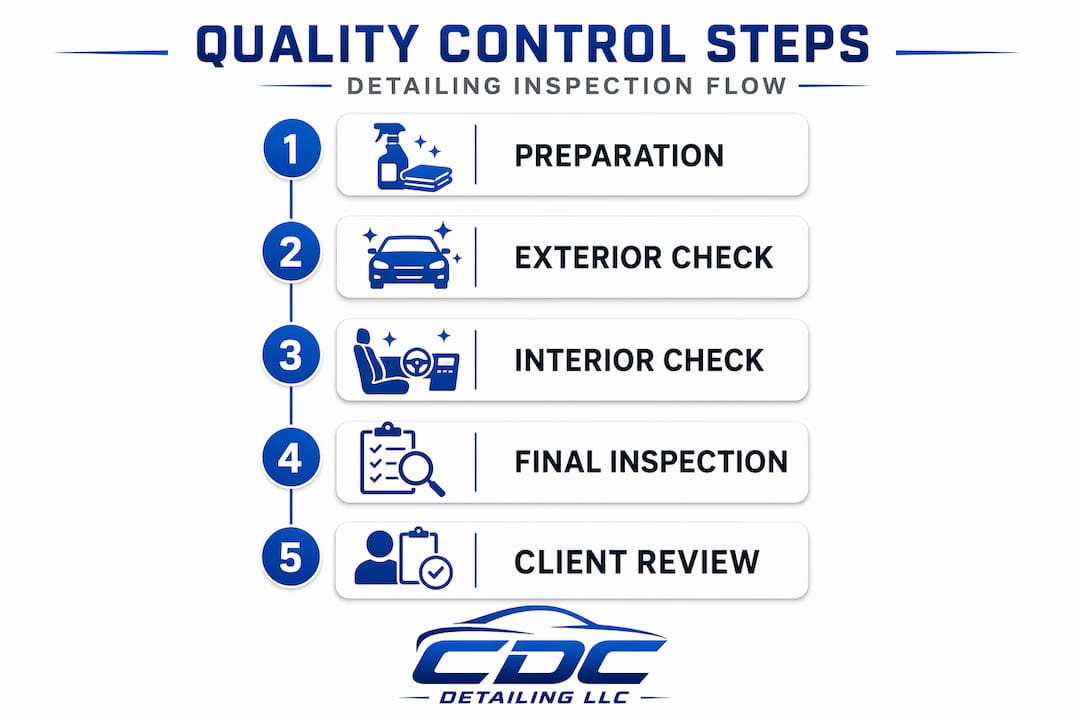
Customer communication rounds out the quality equation. A detailer who asks about your priorities — protecting a new paint job, eliminating pet odor, removing water spots on glass — can allocate time and products where they matter most to you. Understanding why quality matters from the start sets realistic expectations and creates a shared standard for success.
| Quality factor | Impact on results | Mobile detailing consideration |
|---|---|---|
| Technician skill level | High | Training must cover mobile-specific challenges |
| Equipment quality | High | Portable tools must match shop-grade performance |
| Environmental control | Medium to high | Shade, temperature, and timing must be managed |
| Checklist adherence | Very high | Prevents missed stages and inconsistent results |
| Customer communication | Medium | Aligns priorities before work begins |
Key factors that most vehicle owners overlook when evaluating mobile services:
- Product selection matched to specific paint type or coating
- Proper decontamination before polishing or coating application
- Safe chemical dilution ratios for interior surfaces
- Adequate cure time for wax, sealant, or ceramic products
- Final inspection under multiple lighting conditions
Checklist essentials: Foundation of consistent quality
Think of a stage-based detailing checklist the same way a pilot thinks of a pre-flight checklist. It is not a sign of inexperience. It is a guarantee that nothing gets skipped because the technician was tired, rushed, or distracted. As noted in the Vehicle Detailing Quality Inspection Checklist, a structured approach ensures consistent results before the vehicle is returned to the owner, regardless of which technician performed the work.
A professional detailing checklist breaks the job into distinct stages, each with specific pass or fail criteria. Here is what a thorough checklist covers across four core stages:
- Exterior wash stage — Rinse, foam, two-bucket hand wash, wheel and tire cleaning, wheel well rinse, clay bar decontamination, and final rinse
- Paint correction and protection stage — Inspection for swirls and scratches, polish or compound application, paint sealant or wax application, and cure time verification
- Glass and trim stage — Interior and exterior glass cleaning, rubber trim conditioning, and chrome or plastic trim protection
- Interior cleaning stage — Vacuum all surfaces and crevices, shampoo carpets and mats, clean and condition leather or fabric seats, wipe all hard surfaces, deodorize, and inspect for residue
| Stage | Common skipped steps | Quality benchmark |
|---|---|---|
| Exterior wash | Wheel wells, door jambs | Zero visible road grime in all cavities |
| Paint correction | Missed swirl clusters on hood | Swirl-free finish visible in direct light |
| Glass and trim | Interior windshield corners | Streak-free glass at all viewing angles |
| Interior cleaning | Under seats, seatbelt buckles | No debris, no chemical residue |
Reviewing an interior detailing checklist before your appointment lets you communicate priorities clearly and verify results systematically once the job is done.
Pro Tip: Before your appointment, write a short list of your specific concerns and share it with your detailer. Note anything unusual about your vehicle, such as a ceramic coating from a previous service, a fabric that stains easily, or a wheel finish that requires special cleaners. This small step keeps your checklist personal and prevents assumptions that lead to damage.
Step-by-step: How to verify detailing work quality
A professional detailer should hand your vehicle back to you with confidence. That confidence is your invitation to inspect the results carefully. You paid for premium quality, and a systematic walkthrough takes less than ten minutes but catches issues that would otherwise go home with you and worsen over time.
Follow this inspection sequence after every detailing appointment:
- Start outside in natural light. Move the vehicle away from the service area if needed. Position yourself so sunlight hits the paint at a low angle. This exposes swirl marks, buffer trails, missed spots, and uneven wax distribution that artificial lighting hides.
- Run your hand across painted surfaces. After a proper clay bar treatment, paint should feel as smooth as glass. Any roughness signals that decontamination was skipped or incomplete.
- Check glass from multiple angles. Look through the windshield from the driver’s seat, then step outside and check the exterior glass in direct light. Streaks from improper glass cleaner application show up clearly when you change your viewing angle.
- Inspect wheels and tires closely. Brake dust should be completely gone from spoke faces and barrel edges. Tires should show an even, non-greasy shine. Excess tire dressing that flings onto fenders is a sign of poor product control.
- Open every door and check jambs. Door jambs collect old wax, dirt, and product residue. A quality detail cleans them fully. Inspect hinges, seals, and the sill plate.
- Move inside and test every surface. Run a clean white cloth across the dashboard, center console, and door panels. No residue should transfer. Check the carpet and mats for damp spots that indicate incomplete drying.
- Test glass visibility from the driver’s seat. Look through the side windows and rearview mirror. Haze on the inside of windows is one of the most common complaints and one of the easiest to miss until you are driving into the sun.
“The final walkaround, conducted with the checklist in hand, is the moment that separates a mediocre detailing job from a truly professional one.” A checklist-based approach, according to the Vehicle Detailing Quality Inspection Checklist, is specifically designed to ensure consistent results before the vehicle is returned to the owner.
If you notice something that looks off, ask your detailer directly and calmly. Questions like “I’m seeing some haze on the interior glass, can we take a look at this together?” are professional and productive. A quality-focused detailer will fix the issue on the spot without hesitation. Knowing how to assess detailing results gives you the language and confidence to have that conversation effectively.
Pro Tip: Inspect your vehicle in natural daylight, ideally within 30 minutes of service completion. Waiting until you get home or until the next morning means issues have already been driven into and become harder to address promptly.

Avoiding common detailing pitfalls
Even experienced detailers fall into patterns that produce predictable, repeatable mistakes. Knowing what these are means you can spot them early, communicate corrections before they become expensive problems, and choose detailers who have processes in place to prevent them.
The most common detailing errors vehicle owners encounter include:
- Wax or sealant residue in trim crevices — White powdery buildup around door handles, grilles, or rubber seals signals rushed buffing and no final detail inspection
- Streaked windows — Usually caused by using too much product, the wrong product type, or cleaning in direct sunlight where the cleaner dries before it can be wiped off
- Uneven paint correction — Heavy polishing in easy-to-reach areas like hood centers, with light passes around edges and pillars, leaves a mismatched appearance
- Chemical residue on leather or fabric — Cleaners left on seats without proper extraction or wiping cause discoloration and, in some cases, accelerated material degradation
- Seatbelt buckles and anchor points overlooked — These collect debris and skin oils over time and are almost always skipped when a checklist is not used
- Tire dressing applied to brakes or calipers — A safety concern that happens when product control is poor and technicians work quickly without a final check
Safety issues in detailing are not always obvious. Chemical residue on steering wheels, gear shifters, and pedals creates genuine grip and control hazards. A quality control process that follows detailing safety tips addresses these concerns systematically rather than leaving them to chance. Reviewing detailing mistakes to avoid before booking a service is a smart way to set expectations.
A stage-based checklist approach eliminates most of these pitfalls simply by requiring confirmation at each stage before moving forward. You cannot rush through a checklist step without knowingly skipping it.
Pro Tip: Ask your detailer for a brief review meeting every few appointments. Not to complain, but to share what you noticed and what you loved. This builds a relationship where your detailer knows your vehicle’s specific needs and your quality standards. The best detailing relationships are partnerships, not transactions.
Our take: Why demanding quality control pays off — even for mobile detailing
Here is something the detailing industry does not talk about enough: mobile services are often held to a lower standard simply because the shop walls are missing. Customers assume that convenience comes at the cost of precision. We think that is completely backward.
Mobile detailing, done right, requires more discipline than shop work, not less. You are managing your environment, your equipment logistics, your chemical temperatures, and your client’s expectations, all without the controlled setting of a fixed bay. That demands better processes, not more forgiveness.
We have learned through real-world experience that the detailers who consistently wow their clients are not the ones with the fanciest products. They are the ones with the most reliable systems. A $30 wax applied with a precise process and verified on a checklist delivers better results than a $300 ceramic coating rushed by someone working from memory.
Customers sometimes push back on our checklist process, saying they just want a “quick detail.” But even a quick service deserves structured execution. Skipping steps to save 20 minutes is where mistakes live. That is why understanding mobile detailing for premium results means understanding that quality is non-negotiable regardless of location.
The other thing we have noticed is that quality control builds trust faster than any marketing. When a client watches you work through a checklist and hands them back a car that is genuinely spotless, they do not need to be convinced to rebook. That result speaks for itself.
Ready for meticulous results? Choose certified detailing experts
You now know what separates an average detail from a premium one. The next step is choosing a service built around exactly these standards.
At CDC Auto Detailing, we bring structured quality control to every mobile appointment across South Jersey. Our team works through documented, stage-based processes on every vehicle, from standard packages to detailing service examples that include ceramic coatings, paint protection film, and fleet services. Whether you are new to professional detailing or you want to understand exactly how detailing works before your first appointment, we make the process transparent and the results verifiable. Ready to experience the difference that process-driven detailing makes? Book mobile detailing directly through our site and see what real quality control looks like at your driveway.
Frequently asked questions
What should I look for after a professional detailing job?
Check all glass for streaks, run your hand over painted surfaces to feel for roughness, and inspect trim and crevices for wax residue. A quality service verified against a stage-based inspection checklist should show spotless, even results across every area.
How can I tell if a detailer follows quality control protocols?
Ask directly whether they use multi-stage checklists and request a walkthrough of their inspection process before service begins. Detailers committed to consistent outcomes will be transparent about their process, as outlined in professional vehicle detailing standards.
How often should a vehicle get professional detailing with quality control?
Most vehicles benefit from a full quality-controlled detail every three to six months, with lighter maintenance washes in between depending on how much you drive, park outdoors, or live near salt air.
Why do some detailing services miss spots or leave residue?
Missed spots and residue are almost always the result of skipping final inspections and not using a systematic checklist. A checklist-based approach requires sign-off at each stage, which eliminates the habit of rushing through the final steps.
What should I do if I’m not satisfied with the detailing results?
Raise your concerns immediately and calmly while your detailer is still present. Reference the specific area or issue you noticed and ask for it to be corrected on the spot. A professional service provider will welcome the feedback and fix the problem before leaving.