
Professional paint correction in the United States typically runs $300 to $2,500, with a two-stage correction on an average sedan landing between $500 and $1,200. That two-stage package is the most commonly booked option, since it balances real gloss and swirl removal against a job that usually takes a full day rather than several.
- Single-stage (enhancement polish): $300–$700
- Two-stage correction: $500–$1,200
- Multi-stage/show-quality correction: $1,200–$2,500+
Those numbers assume a healthy clear coat and average-size vehicle. Paint condition varies so much car to car that a detailed price guide still recommends getting an in-person inspection before treating any number as final. A quote given sight-unseen, without someone actually looking at your paint under proper lighting, is a guess, not a price.
Key Takeaways
Paint correction cost in the United States depends primarily on defect density and correction stage, not vehicle size alone, with two-stage work at $500–$1,200 covering most sedans and SUVs.
| Point | Details |
|---|---|
| Know the price bands | Budget $300–$700 for single-stage, $500–$1,200 for two-stage, and $1,200–$2,500+ for multi-stage correction. |
| Get an in-person quote | Sight-unseen pricing is unreliable since defect density, not just vehicle size, drives labor hours. |
| Watch for red flags | Avoid shops promising 100% defect removal on heavily damaged paint or offering prices far below market. |
| Protect the result | Pair correction with a professional ceramic coating or PPF to preserve gloss and lower lifetime cost. |
| Ask about method | Confirm paint-depth checks, pads/compounds used, and warranty coverage before booking. |
| Consider Cdcautodetailing | Cdcautodetailing inspects your paint in person and quotes correction and ceramic coating packages sized to your vehicle’s actual condition. |
Table of Contents
- How Much Does Paint Correction Cost by Vehicle Size?
- What Factors Affect Paint Correction Pricing?
- What Do Single-Step, Two-Step, and Multi-Stage Correction Include?
- What Add-Ons and Follow-Up Protection Cost?
- How Do Detailers Price and What Should You Ask Before Booking?
- A Detailer’s Take on Pricing Paint Correction Fairly
- Book Your Paint Correction Assessment
- Frequently Asked Questions About Paint Correction Cost
- Sources
How Much Does Paint Correction Cost by Vehicle Size?
Price scales with two things at once: how many defects need removing and how much surface area a detailer has to cover. A two-door coupe with light swirl marks costs less to correct than a three-row SUV with years of neglected oxidation, even at the same correction stage.
| Service Level | Vehicle Size | Expected Result | Typical US Price Range |
|---|---|---|---|
| 1-step (enhancement) | Small car/coupe | 50–70% defect removal | $300–$500 |
| 1-step (enhancement) | Mid-size sedan | 50–70% defect removal | $350–$600 |
| 2-step correction | Mid-size sedan | 80–95% defect removal | $500–$1,200 |
| 2-step correction | Full-size SUV/truck | 80–95% defect removal | $700–$1,200 |
| Multi-stage (show-level) | Luxury/exotic | about 80 to 95% defect removal | $1,500–$2,500+ |
A few real-world examples make the table easier to use:
-
Light swirl marks on a compact sedan: a single-stage polish, usually around $350–$500, restores most of the gloss.
-
Moderate swirls and light oxidation on a mid-size SUV: two-stage correction, typically $700–$1,000.
-
Heavy oxidation, deep scratches, or a car prepped for a show or resale: multi-stage correction, often $1,500 or more depending on paint hardness.
Geography moves these numbers too. Shops in high-cost metro markets, the Bay Area being a well-documented example, often charge 20 to 40% above the national averages quoted above. Rural shops with lower overhead tend to sit at the bottom of each range. If you’re pricing a job in a major metro, add roughly a quarter to a third onto these figures before you start comparing quotes.
Mobile detailing doesn’t automatically mean cheaper. Since you’re paying for labor and skill rather than a storefront, mobile paint correction pricing tracks shop pricing closely in most markets, generally within that same $200 to $2,000+ band.
What Factors Affect Paint Correction Pricing?
Detailers don’t price by the hour alone or by vehicle model alone. They price by how much correction the paint actually needs, and that’s shaped by several variables stacked together.
- Paint condition and defect density. Light swirl marks from an automatic car wash cost far less to remove than years of oxidation, water spots, and scratches layered on top of each other.
- Correction level requested. Enhancement, two-stage, and show-quality work require different compounds, pad combinations, and pass counts.
- Vehicle complexity. Tight trim, multiple curves, and hard-to-reach panels add labor time that surface area alone doesn’t predict.
- Paint hardness and color. Soft European clear coats correct differently than harder Japanese factory paint, and dark colors show holograms and micro-marring that light colors hide.
- Prior damage or bad correction work. Undoing a botched DIY polish job or a previous shop’s over-aggressive cut often takes longer than working on untouched paint.
- Shop overhead and location. Rent, insurance, and local labor rates shape the baseline price before your car even factors in.
Two quick examples show how this plays out. A daily-driven Honda Civic with light wash-induced swirls might need three hours of correction time. A 10-year-old truck with heavy oxidation across every panel and prior clear-coat damage from a bargain polish job could take eight or nine hours, pushing the same “two-stage” label from $600 up past $1,000.
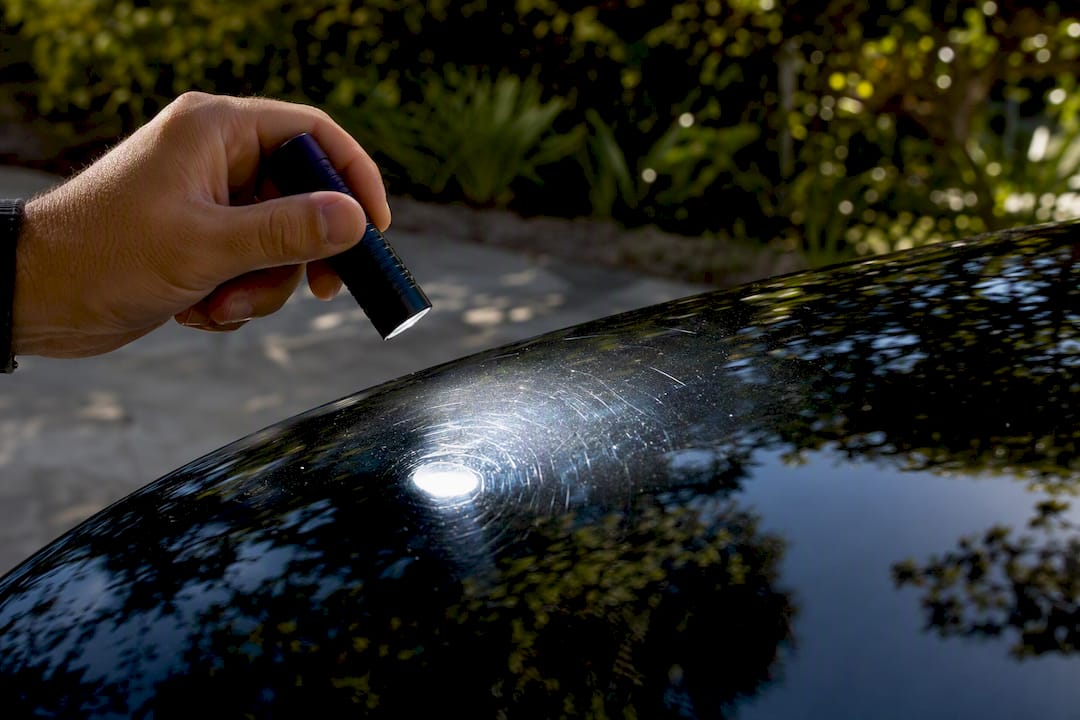
Pro Tip: Ask your detailer to show you the paint under a swirl-finder light before you agree to a price. Seeing the actual defect density yourself makes it obvious why one car costs more than another, even at the same stage.
What Do Single-Step, Two-Step, and Multi-Stage Correction Include?
Single-stage (enhancement) correction uses one cutting or finishing polish pass to remove light swirl marks, minor oxidation, and fresh wash-induced marring. It typically achieves 50–70% defect removal and is the right call for a daily driver that just needs its shine refreshed.
Two-stage correction adds a compounding step before the finishing polish, tackling moderate scratches, deeper swirls, and water spot etching. This is the most commonly booked package, and detailers generally expect 80 to 95% defect removal when the paint is in reasonably good shape to start.
Multi-stage or show-quality correction involves several compounding and polishing passes, sometimes with wet sanding for isolated deep scratches, aiming for the closest thing to a flawless finish the paint allows.
Clear coat is a finite layer, not a renewable one. Every aggressive pass removes a measurable amount of it, which is why reputable detailers check paint thickness with a gauge before committing to multiple correction rounds, and why “100% defect removal” on heavily damaged paint is rarely a realistic promise.
Our automotive paint correction service walks through exactly which stage fits which paint condition before any polish touches the panel.
What Add-Ons and Follow-Up Protection Cost?
Correction restores the paint. Protection is what keeps it looking restored, and skipping it means paying for the same work again sooner than you’d like.
- Consumer-grade sealants: $50–$150, lasting a few months.
- Consumer ceramic coatings: $150–$400, typically lasting six months to a year.
- Professional ceramic coatings (3–5 year): $600–$1,500, applied after correction for lasting gloss and easier maintenance.
- Paint protection film, partial front: $800–$1,800; full-vehicle PPF often runs $4,000–$7,000+.
- Spot correction or wet sanding for isolated deep scratches: $100–$400 per repair.
Booking correction and coating together usually saves money compared to scheduling them separately, since the detailer isn’t re-prepping the paint twice. For most daily drivers, a professional ceramic coating after correction offers the best value. Owners planning to keep a vehicle long-term or protect a high-mileage front end often add paint protection film on top.
How Do Detailers Price and What Should You Ask Before Booking?
Shops price paint correction one of four ways: hourly labor (common for unpredictable or heavily damaged paint), flat-rate by stage (most common for standard sedans and SUVs), per-panel or spot pricing (used for isolated repairs), and package pricing (correction bundled with coating or PPF). Since labor hours drive the cost far more than materials do, two shops quoting the same car can land on very different numbers depending on how thoroughly they inspect the paint first.
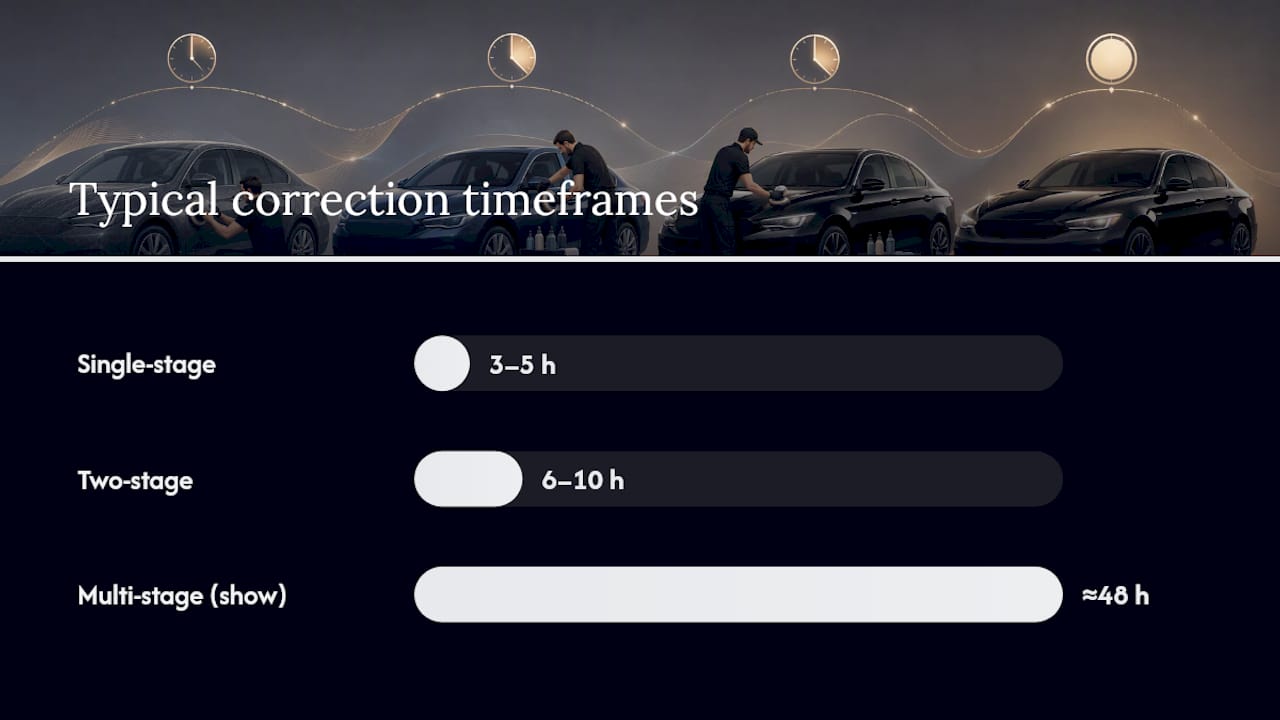
Timeframes scale with stage: single-stage work often finishes in 3–5 hours, two-stage correction in 6–10 hours, and multi-stage show work can stretch across two full days.
Before booking, ask your detailer:
- Will you measure paint thickness before correcting?
- Exactly which stage are you quoting, and what percentage of defects do you expect to remove?
- What pads and compounds will you use on this paint?
- Is there a written warranty or guarantee on the finish?
Pro Tip: If a quote comes in dramatically below every other estimate you’ve collected, ask specifically what corners are being cut. Fewer passes, harsher compounds, or skipping paint-depth checks are the usual answers.
A firm price given without ever seeing your car, and a promise of “100% removal” on paint that’s clearly oxidized or scratched, are the two clearest signs a shop is either inexperienced or cutting corners that will cost you later.
A Detailer’s Take on Pricing Paint Correction Fairly
Every quote we give starts with an inspection, not a guess. Paint condition varies too much between two identical models parked next to each other to price blind. Locally, we see the same pattern national data shows: two-stage work covers most requests, and pairing it with a ceramic coating package protects the investment instead of letting it fade in a season.
Book Your Paint Correction Assessment
Cdcautodetailing gives South Jersey vehicle owners something a phone quote never can: an actual look at your paint before any number gets attached to it. Rather than guessing your correction stage from a photo, our mobile team inspects your vehicle at your home or office and quotes the real work required, not a generic package.

That matters most for owners comparing multiple estimates and trying to figure out why prices differ so much. We walk you through exactly what your paint needs, whether that’s a single-stage refresh or full multi-stage correction, and pair it with professional ceramic coating so the results last instead of fading by summer. If you’re ready to see what your car actually needs, book a paint correction inspection and get a scope built around your paint, not a national average.
Frequently Asked Questions About Paint Correction Cost
How much does paint correction cost on average in the U.S.?
Most vehicle owners pay between $300 and $2,500, with two-stage correction on an average sedan typically falling between $500 and $1,200.
Is paint correction worth the cost?
For most owners planning to keep their vehicle, yes, especially when correction is followed by a ceramic coating or PPF that protects the work and slows future defect buildup.
Why do paint correction price quotes vary so much between shops?
Pricing is driven mostly by labor hours, which depend on defect density, vehicle complexity, and paint hardness, not a flat per-car rate. Two shops inspecting the same car can reasonably land on different numbers.
Can paint correction remove deep scratches?
Deep scratches that penetrate the clear coat often can’t be fully removed without wet sanding or spot repair, and multiple aggressive passes risk thinning the clear coat permanently.
Does mobile paint correction cost more than shop-based service?
Not typically. Mobile pricing usually tracks standard shop rates since you’re paying primarily for labor and skill rather than facility overhead.
Sources
- Paint Correction Cost in 2026: Complete Pricing Guide
- Paint correction: what it is, when you need it
- How Much Should Paint Correction Cost? – Ask a Pro Blog