
Yes, paint protection film can often go over a repainted panel, but only if the new paint is fully cured, smooth and well bonded. Film makers design and warranty their products for original factory paint, so a repaint changes the conditions. The usual waiting period for fresh paint is about 30 days, and the panel should be inspected before any film touches it.
This guide covers what the manufacturers say, how to tell whether a repaint is ready, what goes wrong when it isn’t, and how to plan a body repair and film job so they work together.
TL;DR
- Film can be installed over repaired paint, but the major manufacturers warrant it for fully cured original paint, so repainted areas usually fall outside the warranty.
- LLumar gives 30 days as the common wait for new paint to outgas before film goes on.
- The panel must be hard, dry, smooth and free of overspray, sanding marks and solvent residue.
- Uncured or poorly prepped paint can cause bubbling, poor adhesion, and paint lifting when the film is later removed.
- Best plan: have the repaint inspected first, then schedule film after the cure window.
Table of Contents
- Why a repaint changes the PPF equation
- What film manufacturers say about repainted paint
- How long to wait after a repaint
- What goes wrong when film goes on too early
- What an installer should inspect on a repainted panel
- Perspective: how we approach repainted paint
- Planning body work and film together
- Warranty and expectations
- Why not do it yourself?
- Get your repaired car inspected
- FAQ
- Sources
Why a repaint changes the PPF equation
Paint protection film is a clear urethane layer that sits directly on your clear coat. Whatever is under it shows through, and whatever is wrong under it can come up with it. On factory paint, that surface is baked at the factory, consistent from panel to panel, and well understood by film makers.
A repainted panel is different. It may be sprayed in a body shop with air-dried or low-bake products, blended into an adjacent panel, and finished by hand. Each of those steps can leave something behind: trapped solvent, a thin or soft clear coat, dust nibs, orange peel, or a slightly rough patch where overspray was missed.
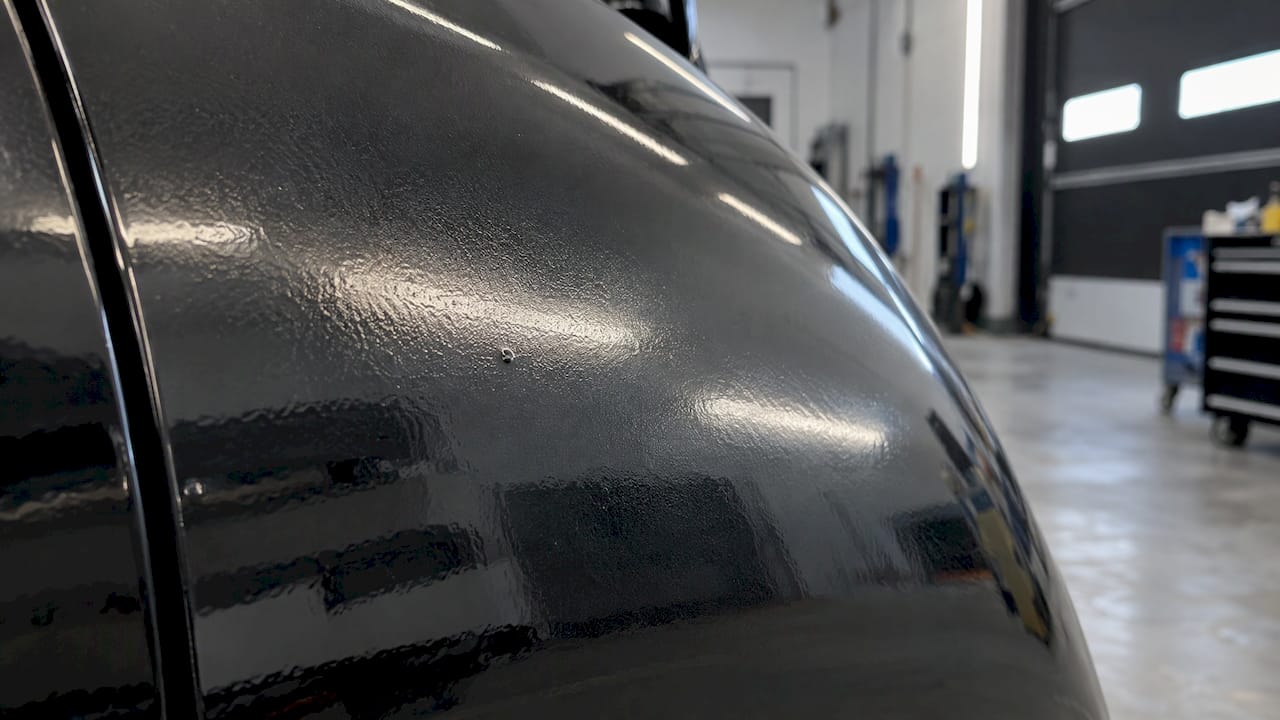
That is why the manufacturers draw a line. Avery Dennison states in its application bulletin IB4.30 that its film is intended and warranted for fully cured OEM painted surfaces. It adds that on non-OEM paint, removing the film without paint damage is not warranted.
That is a statement about warranty and risk, not a ban. Many repainted cars carry film successfully. The difference is that the installer has to verify the paint, not assume it.
What film manufacturers say about repainted paint
The wording differs by brand, but the message is consistent.
| Manufacturer | What it says about repainted or aftermarket paint |
|---|---|
| Avery Dennison | Warranted for fully cured OEM paint. Removal from non-OEM paint without damage is not warranted. |
| LLumar | Designed for original painted surfaces. Issues with aftermarket and repaired paint are not covered. Thirty days is the common wait for fresh paint to outgas. |
| XPEL | Its Ultimate Plus and Stealth warranty excludes areas that have not been re-wrapped after a paint or body repair. |
The XPEL language is worth reading closely. Its warranty disclaimer covers defects like yellowing, cracking, blistering and delaminating for 10 years from installation. It excludes areas that were not re-wrapped after a paint or body repair. In practice, if a panel is repainted after film is installed, the new work needs fresh film to stay in coverage.
Two takeaways follow. First, a repaint before film is a different situation from a repaint after film, and you should ask which one you are in. Second, always read the specific warranty for the film being installed, because terms change by product and year.
How long to wait after a repaint
The most cited figure from a manufacturer is 30 days. LLumar’s FAQ says 30 days is the common waiting period for new paint to outgas if a customer still chooses to install film on a freshly painted vehicle.
Outgassing is the slow release of solvents from fresh paint as it cures. Paint can feel dry within hours while still releasing solvent for weeks. Film is not very breathable, so solvent trapped under it has nowhere to go.
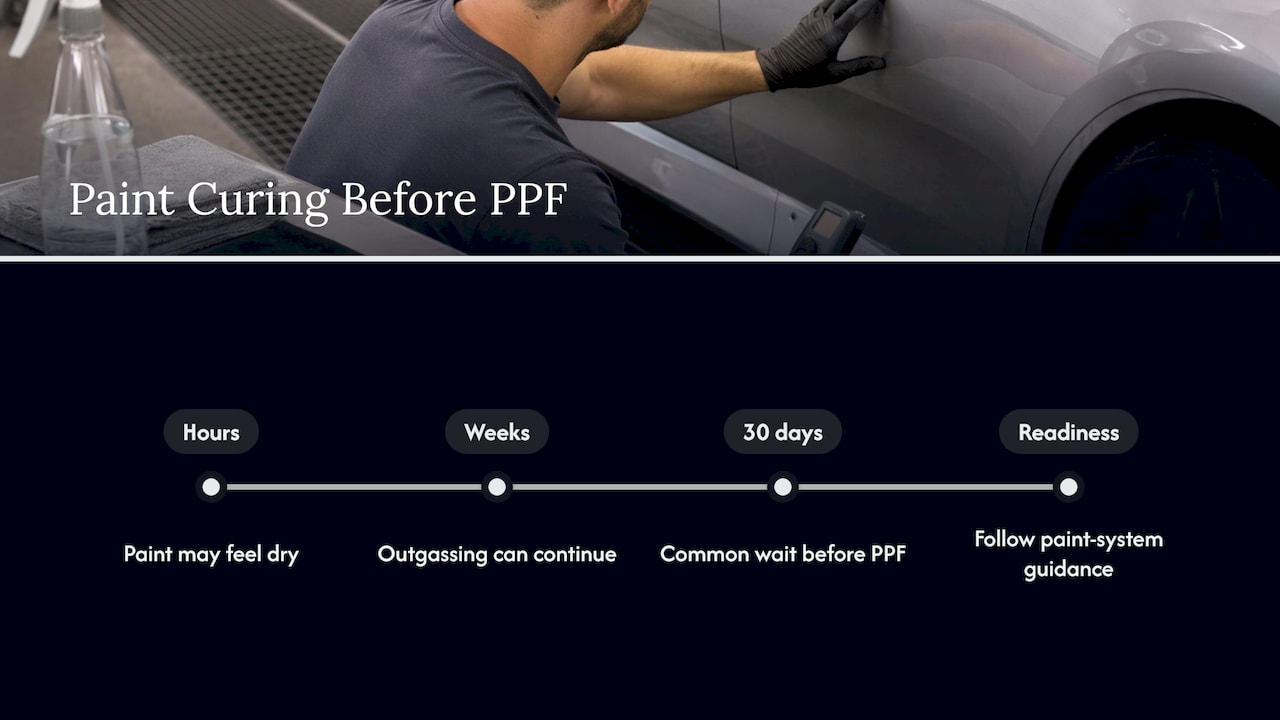
Several forum and shop pages quote shorter windows, with some installers saying 48 to 72 hours or 7 to 14 days for small spot repairs. Treat those as opinions, not specifications. The manufacturer bulletin is clear on the real rule: for non-OEM paint, surfaces must be completely dry, hardened and free of scratches. On most baked paints, film can go on once the paint has cooled. For air-dried and car repair paints, the installer should consult the paint manufacturer’s guidelines on when the paint counts as fully cured.
A practical way to plan the wait
- Full respray or large panels: plan on at least the 30-day figure, and longer if the body shop’s paint system calls for it.
- Spot repair or single panel: the cure still depends on the paint products used. Ask the body shop for the product data sheet or cure guidance.
- Cold or damp storage: cure time is set by the paint chemistry, so ask the shop rather than counting calendar days alone.
The right answer is the paint maker’s cure guidance, confirmed by an inspection, not a number someone quoted in a forum thread.
What goes wrong when film goes on too early
Avery Dennison’s substrate preparation bulletin lists the risks of uncured or poorly prepared aftermarket paint:
- Outgassing and bubbling under the film
- Softening of the adhesive
- Reduced adhesion
- Film shrinkage
- Loss of long-term removability
- Adhesive transfer
- Debonding of the aftermarket paint from the vehicle
It also says any application to aftermarket automotive coatings is at the installer’s risk.
The IB4.30 bulletin adds that solvent residue in painted surfaces may hurt film adhesion and can cause excessive shrinkage or blistering. It also warns that paint system layers that are not compatible, or do not adhere well to each other, may cause paint to be lifted when film is removed later.
That last point matters most. Film failure is a nuisance you can fix. Pulling a layer of paint off with the film is a body shop bill. This is why a careful installer treats a repainted panel as a surface to qualify, not a surface to cover.
What an installer should inspect on a repainted panel
A good pre-install inspection answers one question: will this paint stay put under film, now and when the film eventually comes off?
Cure and bond
The installer should confirm the cure time with the paint product’s guidance and the body shop’s records. A panel that smells of solvent, feels soft under a fingernail test the installer is trained to do carefully, or was painted days ago is not ready.
Surface quality
Film does not hide defects. Avery Dennison notes that non-OEM surfaces must be free of scratches. In practice, an inspector looks for:
- Sanding marks or deep scratches left from the repair
- Overspray on trim, edges and adjacent panels
- Dirt nibs and rough patches
- Heavy orange peel that could trap air or telegraph through the film
- Thin clear coat or edges where paint blends into old paint
- Lifting, chipping or early cracking at panel edges
Cleaning and decontamination
The prep steps come from the film makers too. Avery Dennison says wax and polish residue must be completely removed, recommends clay bar decontamination, and calls for a final cleaning with isopropyl alcohol. 3M’s installation guidelines (Revision C, March 2024) require that no ceramic coating be applied to the paint before installation. They also call for removing residue with an adhesive cleaner, using a non-ammonia foaming glass cleaner to clear solvent residue, claying surface contaminants, and doing a final inspection before the film goes on.
Body shops often finish a repair with a polish or a sealant. That finishing layer has to be removed before film, which is another reason to tell your detailer exactly what the shop used.
Records
The more documentation you bring, the faster the decision. Useful items include the body shop invoice, the date of the repaint, the paint system used, and photos from before and after the repair. A shop that keeps its own documented process can add inspection notes to that file, which also helps at resale.
Perspective: how we approach repainted paint
We see repainted panels often, and we do not treat them as a no. We treat them as a panel that has to earn the film.
Our approach starts with the paint, not the film. We want to know when the work was done, what was sprayed, and what the body shop put on top. Then we look at the surface under good light, check for texture and defects, and decontaminate before anything else happens. If the paint is not ready, the right move is to wait, not to hurry the install.
We build our work around personalized care for each vehicle and documented processes, because a record of what was inspected and prepared is useful to you at resale and when you maintain the film later. For owners who want long-term protection of a repaired car, a patient, well-prepped film install is the way to get a clean result that holds up.
If you have just had a repair, call us before you pick a date. A short conversation about timing usually saves a second trip.
Charles
Planning body work and film together
If you know a repair is coming, sequence matters.
- Decide on film before the repair. Tell the body shop you plan to install film afterward, and ask which paint system they will use and what cure guidance applies.
- Ask for no wax or sealant on the new paint. A bare, cured surface is simpler to prep.
- Collect the paperwork. Keep the invoice and any paint product data.
- Wait out the cure. Use the paint maker’s guidance and the 30-day common figure as a floor for fresh paint, not a target to beat.
- Book an inspection. Have the installer look at each panel before the date is locked in.
- Film the repaired area with the rest of the front end. Matching coverage looks better than isolated patches.
If film is already on the car and a panel needs paint, expect that panel’s film to be removed and replaced. Our guide to the PPF removal process explains how that works, and the PPF workflow shows each step from prep to final inspection.
Warranty and expectations
Assume that film on a repainted panel will not carry the manufacturer’s defect warranty. Avery Dennison, LLumar and XPEL all limit or exclude coverage for repaired or aftermarket paint, as quoted above. That does not mean the installation is poor. It means the maker cannot control what is underneath.
What you can control is the quality of the install. Ask your installer what their own workmanship terms cover and get those in writing. Then keep the film in good shape with the habits in our PPF maintenance timeline, and check how long film typically lasts so you know when to inspect or replace it.
Matte and special finishes
If a repair involved a matte or satin finish, the preparation is different again. Our article on PPF over matte paint covers what to know before you choose a film.
Why not do it yourself?
For a repainted panel, the stakes of a bad install are higher than on factory paint, because a failure can lift new paint. Judging cure and surface quality takes training. If you still want to understand the process, our DIY installation guide walks through the steps, and for a repaired panel we recommend bringing in a professional who can inspect it.
Get your repaired car inspected
We are a mobile detailing company based in Pitman, NJ, serving South Jersey. We install paint protection film and come to you. If your car has had body work, tell us when it was done and who did it, and we will review the panels before we recommend a date. A published price for PPF is not listed on our site, so the quote follows the inspection.

If you also want the paint corrected and sealed ahead of film, or protection for panels that are not a fit for film, see our ceramic coating packages: the 3 Year package is 1000-1200 USD, the 5 Year package is 1500-1700 USD and the 8 Year package is 2200-2400 USD. A ceramic coating is not applied beneath PPF, as 3M’s guidelines above require bare paint, so plan one or the other for each panel. You can reach us through the CDC Detailing site to ask about timing and book an appointment.
FAQ
Can you put PPF on a repainted car?
Often yes, once the paint is fully cured and the surface passes inspection. Manufacturers warrant film for original paint, so the repainted area usually sits outside the warranty. The installer has to verify cure and condition first.
How long after a repaint can PPF be installed?
LLumar cites 30 days as the common waiting period for new paint to outgas. The exact answer depends on the paint system, so ask the body shop for the cure guidance. An installer should also inspect the panel before booking.
What happens if PPF is installed on paint that hasn’t cured?
Avery Dennison warns of bubbling from outgassing, softened adhesive, poor adhesion, film shrinkage and, in the worst case, aftermarket paint debonding from the vehicle. That is why waiting and inspecting come first.
Do I need to remove wax or polish the body shop applied?
Yes. Film makers require wax and polish residue to be fully removed, with decontamination and a final alcohol wipe before application. Tell your installer what products the shop used so the prep matches.
Will film hide sanding marks or orange peel on new paint?
No. Film follows the surface, so defects underneath can still show. Surface flaws are best fixed by the body shop or a paint correction before film goes on.
Sources
- XPEL Ultimate Plus and Stealth warranty disclaimer
- Avery Dennison IB4.30 Paint Protection Film Application
- Avery Dennison IB 1.01 Substrate Cleaning and Preparation
- LLumar Paint Protection Film FAQ
- 3M Paint Protection Film installation guidelines, Revision C