
The best road salt rust prevention is a routine, not a single product: protect the paint before the first salting, rinse the salt off (undercarriage included) every couple of weeks, keep water out of the places that can’t dry, and fix chips early. Do those four things and you slow corrosion a long way. Below is how each step works, what it costs, and where a mobile detailer fits in.
TL;DR
- Salt itself isn’t the whole problem. Salt water in contact with bare or thin metal speeds up rusting, so the goal is removing it and sealing the surfaces it reaches.
- AAA advises washing every two weeks in winter, with undercarriage cleaning, and more often after heavy snow.
- Apply wax, sealant or a coating in autumn, on a clean, dry car, before the first salting.
- Chips on rocker panels and wheel arches are where rust usually starts. Seal them before winter and check again in spring.
- We offer mobile detailing, ceramic coatings and paint protection film across South Jersey, so protection comes to your driveway.
Table of Contents
- How road salt turns into rust
- Where road salt does the most damage
- Before winter: build a barrier on the paint
- During winter: wash, rinse, repeat
- Undercoating: what it is and how to use it well
- What if rust has already started?
- Our perspective: protect first, then maintain
- Protection and maintenance with CDC Detailing
- A simple winter schedule
- FAQ
- Sources
How road salt turns into rust
Rust is a chemical reaction: iron gives up electrons to oxygen. PBS explains that adding salt, which is an electrolyte, to water speeds that reaction up. The Transportation Research Board says chloride ions disrupt the natural protective films on metal and make water conduct better, which starts and accelerates electrochemical corrosion.
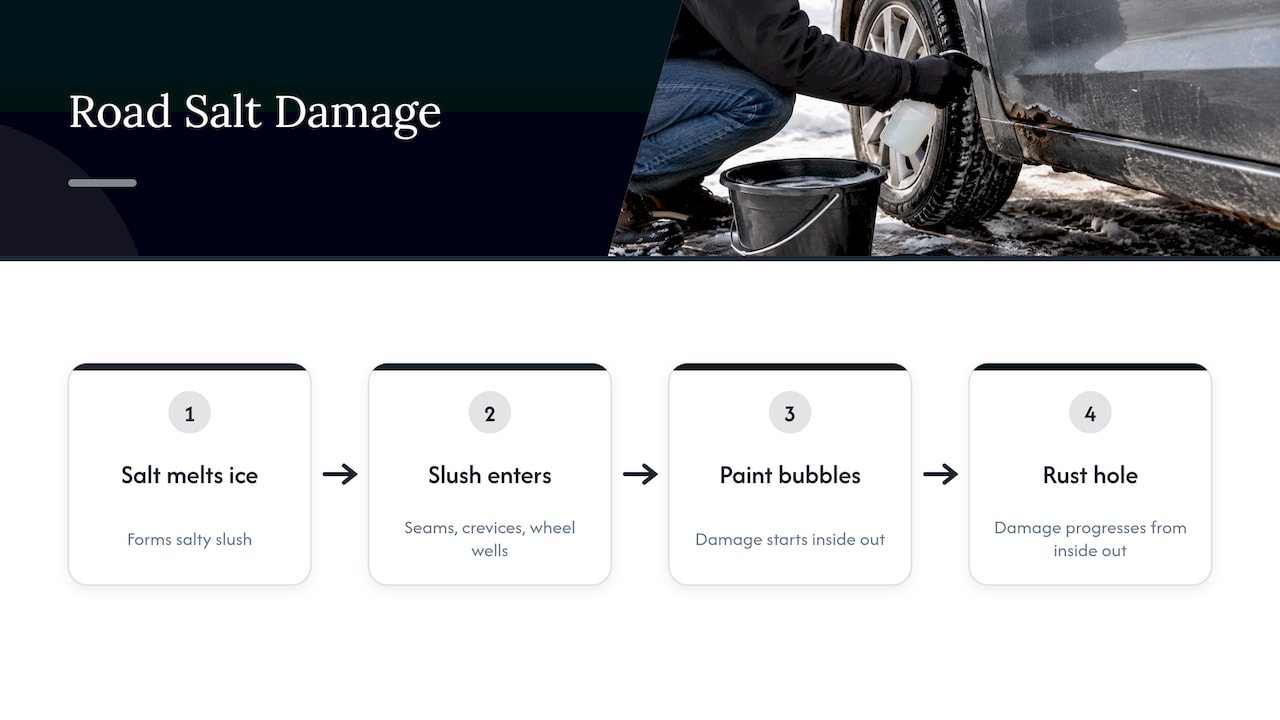
The practical effect is easy to picture. Dry salt sitting on a road does little to your car. Salt that melts snow and ice becomes salty slush that is thrown into every seam, crevice and wheel well. AutoZone describes how the damage then works from the inside out: a bubble in the paint first, then a rust hole.
There is good news. The same TRB study notes that today’s cars are less vulnerable than those of the 1970s thanks to precoated steels, plastics and better primers and coatings. Factory protection is a head start, though, not a guarantee. A stone chip or a scratch opens a door through it.
Why South Jersey is not a gentle place for a car
New Jersey treats its roads before storms, not only during them. NJDOT says it pre-treats selected lane miles with salt brine or a brine blend before winter precipitation starts, and that the application can stay on the road surface for up to several days. That means your car can pick up salt before a single flake falls, and again on the dry, cold days after a storm when spray lingers.
If you commute on Route 55, Route 42 or the Turnpike, you are driving through that treated spray regularly. Salt is not only a snow-day issue here.
Where road salt does the most damage
Most people check the body panels and forget what is underneath. AAA’s Marcea Cazel points out that the engine is usually well protected under the hood, but salt accumulates on the undercarriage, where it can corrode parts such as the oil pan and transmission housing. Salt can also attack electrical connections, which is why gaskets, seals and wiring need to stay intact.
A short inspection list for any vehicle:
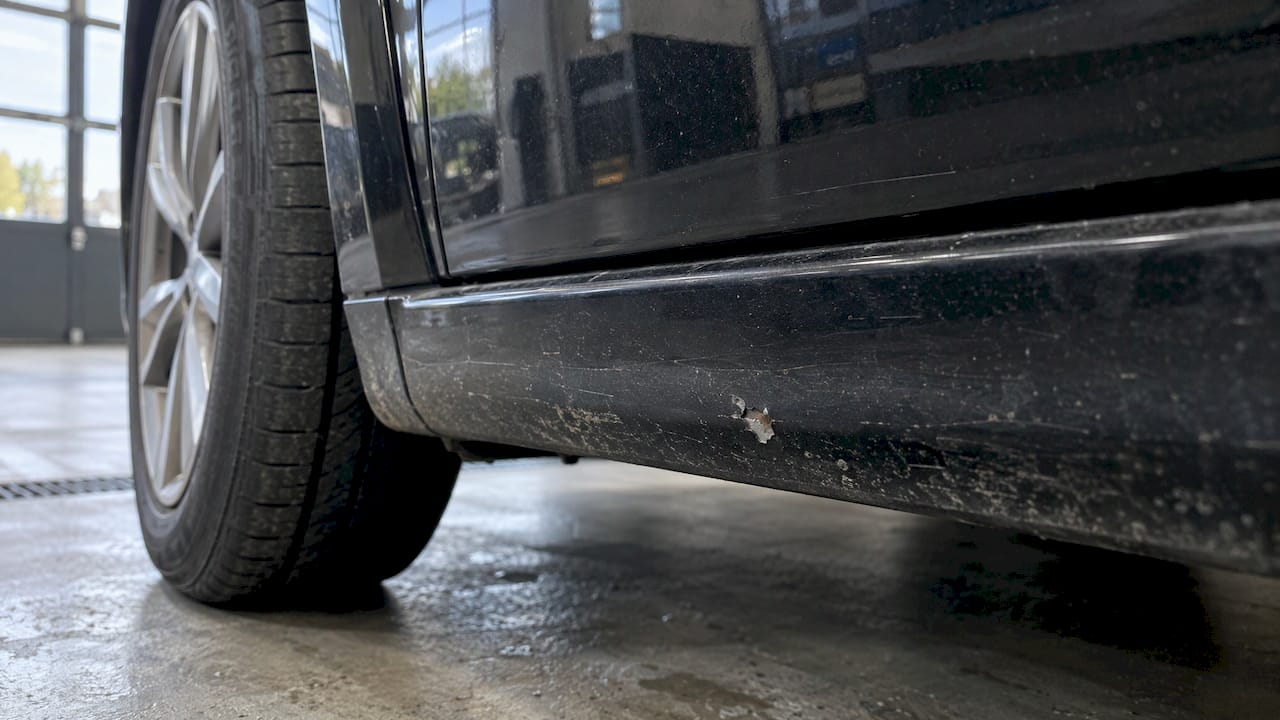
- Rocker panels and wheel arches. AAA says a small chip here can become a rust spot quickly once salt reaches bare metal. Look for bubbling paint.
- Undercarriage, frame rails and cross-members. These are hard to see and slow to dry.
- Brake and fuel lines. Quartz lists checking these midwinter as part of a full routine.
- Wheel wells and drain holes. Packed mud holds salt water against metal. Drain holes in doors and rockers need to stay open.
- Floors inside. Slush and salt from your shoes can start floor rust, so the Costco-linked tip of keeping floors clean and dry applies. Rubber floor mats help, and our guide to removing salt stains from car carpet covers the cleanup.
- Electrical components. Corrosion in connectors and modules can show up as warning lights. If you want to know what that looks like on a safety system, this write-up on a corroded airbag module shows the symptoms and why diagnosis should come before a reset.
Electric vehicles have their own checklist. AAA recommends rinsing the undercarriage regularly, using corrosion-inhibiting coatings, keeping charging ports dry and free of salt, and inspecting sensors and wiring.
Before winter: build a barrier on the paint
Autumn is the time to act, and in November you are right on schedule. Quartz notes that a coat of wax or paint sealant creates a thin barrier between paint and salty slush, and that it works best when applied in autumn to a clean, dry car before the first salting.
There are three tiers of paint protection, from simplest to most durable.
| Option | What it does | Typical effort |
|---|---|---|
| Wax or paint sealant | A thin sacrificial layer between paint and slush | Reapply as the season goes on |
| Ceramic coating | A harder, longer-lasting protective layer bonded to the paint | Professional application, multi-year |
| Paint protection film (PPF) | A clear film that physically shields high-impact areas from stone chips | Professional installation |
We install the last two. Our ceramic coating packages are priced at $1,000 to $1,200 for the 3 Year Package, $1,500 to $1,700 for the 5 Year Package and $2,200 to $2,400 for the 8 Year Package, with a 10% booking charge. You can see what each includes on our ceramic coating page. Paint protection film suits the front end, where stone chips happen. See paint protection film for details, and our guide to mobile road salt protection with front clip PPF and ceramic explains how we combine them for winter driving.
Neither film nor coating makes a car immune. They reduce what salty slush and gravel can do to the paint, and they make salt easier to rinse off. They work best alongside regular washing.
Decontaminate before you protect
Wax or coating sealed over contamination traps it. A clean surface bonds better, and that is why our process starts with a wash and a decontamination wash before anything is applied. Our pre-winter paint protection guide for Pitman walks through the timing.
Seal chips before the first brine
Walk around the car in daylight and look at the lower doors, rocker panels, hood edge and wheel arches. Quartz’s pre-winter list includes sealing chips alongside waxing and applying an undercoating or rust-inhibiting spray. Touch-up paint on a clean chip is far cheaper than repairing a rust bubble later.
During winter: wash, rinse, repeat
Washing in winter feels pointless when the car is dirty again by Tuesday. It still pays off. Quartz’s Colleen Cabili explains that washing in the middle of winter slows rust because salt keeps attacking metal for as long as it stays on the car.
How often to wash
Two respected sources give slightly different numbers, so here is a practical reading:
- AAA: at least every two weeks, more often after heavily salted roads, with underbody sprays.
- Consumer Reports: monthly during snow season, or more often if the car is coated in salt.
For South Jersey, where roads are pre-treated and storms are followed by cold, salty spray, every two weeks is a sensible target, and after any storm where the car turns white with residue, wash sooner.
Get the undercarriage, not just the doors
Consumer Reports recommends a touchless wash that cleans the whole car, including underneath. The underbody spray is often an extra charge, but they call it a worthwhile upgrade for removing salt. At a self-service bay, spray the wheel wells and undercarriage with the hose.
Two habits help:
- Rinse loose salt off before you touch the paint, so you aren’t dragging crystals across the finish. AAA lists rinsing before washing as a paint-protection step.
- Pick milder days when you can. Quartz suggests washing on milder days, and cleaning wheel wells and drain holes too.
Automatic washes are convenient but can leave marks if the brushes are dirty. Our steps to avoid scratches from automatic car washes cover what to look for. If you would rather wash at home, we have a step-by-step guide to washing a car at home, and a deeper walkthrough on undercarriage salt removal in South Jersey.
Keep the car dry
Parking in a garage helps, because AAA lists it among the steps to keep the car dry. A splash shield or skid plate, and sealing vulnerable areas around gaskets, seals and wiring, are also on AAA’s list. Heavy rubber floor mats keep slush off the carpet and floor pan.
Undercoating: what it is and how to use it well
Undercarriage protection is the second half of the question. Jalopnik’s overview describes the main types:
- Asphalt-based: suited to heavy-duty trucks and effective against road salt.
- Rubberized: a strong barrier against liquids and better sound isolation.
- Wax: can last around a year or two.
- Oil-based: handles deep-seated rust but needs annual reapplication.
- Polyurethane: up to four years of shielding.
Jalopnik reports that professionals typically charge around $300 to $800 for oil-based undercoating and $150 to $200 for yearly reapplications. Treat those as a national ballpark from early 2026, since local quotes vary.
The key to using any undercoating well is preparation. Rubberized and asphalt products need extensive prep, and a coating applied over dirt or moisture can crack and hold water against the metal. Apply it to a clean, dry underbody, ideally in the early fall.
The GM Anti-Corrosion Repair Guide adds two safe-use points. Material must not be sprayed into door locks, window mechanisms, seat belt retractors, or moving suspension parts, especially the parking brake cable, and all body drain holes must be open afterward. The same guide says closed-cavity coatings give the best protection inside rocker panels, pillars, frame rails and doors. Those are jobs for a shop that follows the manufacturer’s procedures.
Our own work focuses on the paint, glass and interior side of protection. Pair a well-done underbody treatment with a protected, regularly washed body and you cover both fronts.
What if rust has already started?
The rule is the same everywhere: the earlier you act, the cheaper it is. Quartz recommends a spring inspection to catch early rust while it can still be treated. A few practical cues:
- A paint bubble or orange speck means moisture is already under or in the paint. Don’t wait for the next storm.
- A rust spot at a chip should be cleaned, treated and sealed promptly by a body shop or a careful DIYer.
- Flaking on frame rails, brake lines or fuel lines is a safety matter. Have a mechanic look at it, not a detailer.
- Warning lights after a wet winter can come from corroded connectors. Have them diagnosed before anything is reset.
Once the metal is repaired and repainted, protect the repair as you would any other paint. A fresh coating or film over the area helps keep it from becoming the next weak spot.
Our perspective: protect first, then maintain
We see the same pattern every spring in South Jersey: the cars that come through winter looking best are not the ones that got one heroic wash in February. They are the ones that were protected in October and kept clean in between.
That is why we pair protection with maintenance. A ceramic coating or paint protection film on the front end gives the paint a durable layer to take the salt and gravel, and a regular wash schedule keeps that layer doing its job. Our process is designed around documented, personalized care for each vehicle, which also helps long-term value if you resell.
We come to you. Mobile service means no waiting room and no skipped appointment because the car is filthy and you are busy. For people who want it handled all winter, our Exterior Maintenance Plan costs $100 per week or $200 per month per vehicle.
Salt is going to be on the road from the first storm to the last. Treat the car the way you would treat any investment that spends five months outdoors.
Charles
Protection and maintenance with CDC Detailing
If you would like the work done at your home or workplace, we offer mobile exterior and interior detailing, ceramic coating and paint protection film across South Jersey. Our Exterior Detail starts from $175, our Interior Detail from $275, and our Bronze Package from $375. The Exterior Maintenance Plan is $100 per week or $200 per month per vehicle. A $100 booking charge applies, and mobile service carries an additional fee from $100. Current packages are listed on our detail packages page.

Fleet managers can ask about fleet washing, which keeps salt off trucks and vans that spend the winter on treated roads. To book, use the form on our site and tell us the year, make and model, and whether you want protection before winter or a salt cleanup now.
A simple winter schedule
| When | What to do |
|---|---|
| Early to mid autumn | Wash, decontaminate, seal chips, apply wax, sealant, coating or film |
| Before first storm | Check floor mats, drain holes, wheel wells |
| Every two weeks (and after heavy salting) | Rinse and wash with undercarriage spray |
| Midwinter | Check brake and fuel lines, clean wheel wells |
| Early spring | Full wash, inspect rockers, arches, underbody, treat any early rust |
FAQ
How do I protect my car from road salt?
Protect the paint in autumn with wax, sealant, ceramic coating or paint protection film. Then wash every two weeks with undercarriage spray, fix chips early and keep the interior floors dry. No single step makes a car immune, but used together they slow corrosion.
Is a wash worth it when it’s freezing?
Yes, if you can do it safely. Salt keeps attacking metal while it stays on the car, so removing it slows rust. Choose a milder day when possible and spray the wheel wells and underbody.
Does undercoating stop rust completely?
No. It adds a barrier, and its life depends on the type: wax around a year or two, oil needing annual reapplication, polyurethane up to four years, per Jalopnik. It works best on a clean, dry underbody applied with care around moving parts and drain holes.
Can I schedule winter protection at home in South Jersey?
Yes. We offer mobile detailing, ceramic coating and paint protection film across South Jersey. A $100 booking charge applies, and mobile service carries an additional fee from $100. Use the form on our site to request a time.
Sources
- Transportation Research Board, Summary of Cost and Benefits of De-Icing (SR 235)
- PBS, Why Does Metal Rust?
- AutoZone, Best Ways to Prevent Rust in Winter
- NJDOT Winter Readiness FAQ
- AAA, Protecting Your Car from Road Salt Damage
- AAA Newsroom, Winter Road Salt Can Cause Hidden Vehicle Damage
- AAA Newsroom, EV winter damage
- Quartz, How to protect your car from road salt and rust
- Consumer Reports, How Often Should You Wash Road Salt Off Your Car?
- Jalopnik, Pros, Cons and Risks of Underbody Coating
- GM Anti-Corrosion Repair Guide