
TL;DR:
- Bonded contaminants like iron fallout and tar require specialized decontamination to prevent paint damage.
- A proper decontamination process includes pre-wash, chemical removal, clay treatment, and protection steps.
- Regular decontamination every 3-12 months helps maintain vehicle paint and prevents costly repairs.
Your car might look clean after a regular wash, but the paint is hiding a layer of invisible damage. Bonded contaminants like iron fallout, brake dust, tar, and industrial pollution cling to the surface in ways that soap and water simply cannot reach. Regular car washes cannot remove all of these bonded particles, leaving your clear coat vulnerable to etching, oxidation, and long-term paint failure. For South Jersey vehicle owners dealing with coastal salt air, highway grime, and rail dust, a proper decontamination wash is not optional. It is the foundation of every smart paint care routine. This guide walks you through exactly what decontamination is, how it works, and how to get it done right.
Table of Contents
- What is a decontamination wash?
- Decontamination wash process: Step-by-step breakdown
- Types of decontamination products and tools
- When, how often, and who should perform decontamination washes?
- Expert perspective: What most people get wrong about decontamination
- Convenient South Jersey decontamination wash solutions
- Frequently asked questions
Key Takeaways
| Point | Details |
|---|---|
| Removes hidden contaminants | Decontamination washes strip pollutants regular washes leave behind, protecting paint and value. |
| Long-term paint protection | Routine decontamination helps prevent oxidation, etching, and clear coat damage caused by salt and road grime. |
| Professional guidance matters | Expert services are recommended for heavy buildup, especially after NJ winters or frequent highway driving. |
| DIY for light maintenance | Maintenance washes and safe tools allow owners to tackle minor contamination themselves every 6 months. |
| Finish with protection | Always seal the paint after decontamination to prolong shine and guard against new contaminants. |
What is a decontamination wash?
A decontamination wash is a specialized cleaning process designed to remove contaminants that have physically bonded to your vehicle’s paint, glass, or trim. Unlike a standard car wash that lifts loose dirt from the surface, decontamination targets particles that are embedded in or fused to the clear coat itself. These are the things you cannot see but can feel when you run a clean finger across your hood and notice rough, gritty patches.
Decontamination washes remove bonded contaminants like iron fallout, tar, tree sap, brake dust, and industrial pollution that standard washing leaves behind. In South Jersey specifically, vehicles face a unique combination of threats: salt from coastal roads and winter treatments, rail dust from freight corridors, and heavy traffic pollution from routes like the Atlantic City Expressway and I-295.
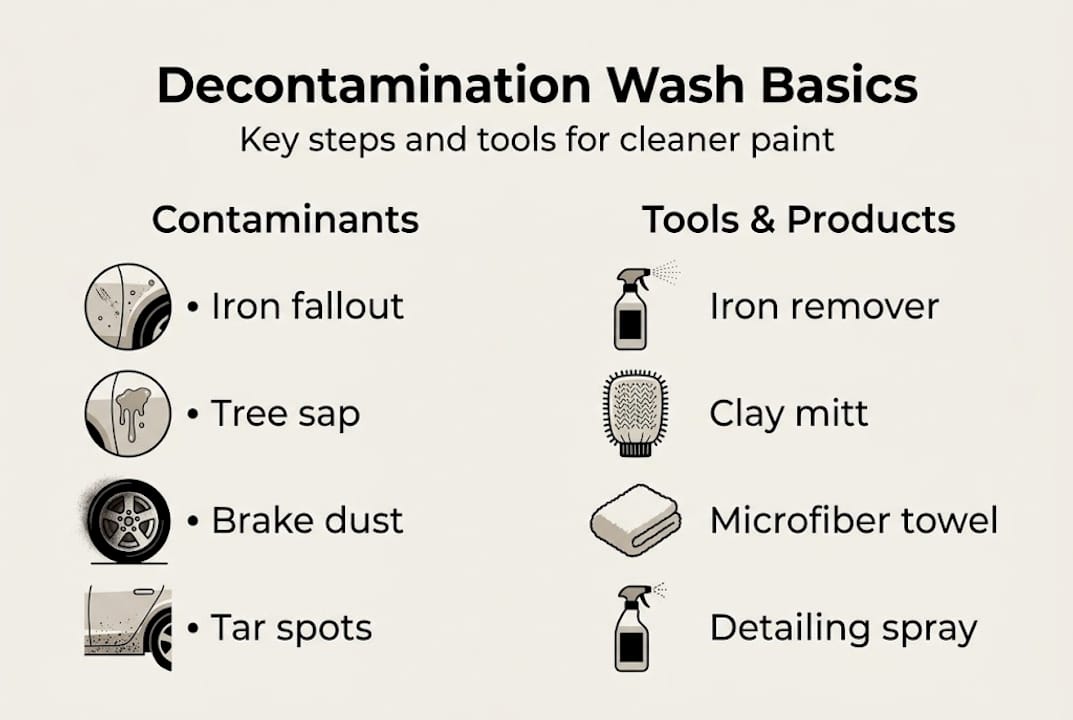
Here is a quick comparison to show why a standard wash simply is not enough:
| Feature | Standard Car Wash | Decontamination Wash |
|---|---|---|
| Removes loose dirt | Yes | Yes |
| Removes bonded iron fallout | No | Yes |
| Removes tar and sap | No | Yes |
| Prepares paint for protection | No | Yes |
| Requires chemical agents | No | Yes |
| Recommended frequency | Weekly/bi-weekly | Every 3-12 months |
Common contaminants South Jersey drivers deal with include:
- Iron fallout from rail lines and brake dust that turns paint orange over time
- Road tar from fresh asphalt on summer highway projects
- Tree sap from suburban streets and parking lots
- Salt residue from winter road treatments along shore communities
- Industrial fallout from manufacturing zones near Camden and Gloucester County
Here is a number that should get your attention: improper washing causes 80% of clear coat damage on most vehicles. That means skipping decontamination and relying solely on a standard wash is actively wearing down your paint every single time. Understanding the difference between detailing vs car wash processes is the first step toward making smarter choices for your vehicle.
Decontamination wash process: Step-by-step breakdown
Knowing what decontamination does is one thing. Knowing how it actually gets done is what separates a proper treatment from a wasted afternoon. The process follows a clear sequence, and skipping steps leads to poor results or worse, paint damage.
The process starts with a pre-wash, followed by chemical decontamination and then physical decontamination using clay or a clay mitt. Here is the full breakdown:
- Pre-wash rinse – Blast the vehicle with a pressure washer or foam cannon to remove loose dirt, mud, and debris before any chemical contact.
- Iron remover application – Spray an iron remover across all painted panels. Watch for the purple or red bleeding reaction, which shows the chemical is dissolving bonded iron particles. Rinse thoroughly.
- Tar and sap remover – Apply a dedicated tar remover to lower panels and wheel arches where road tar accumulates. Allow dwell time, then wipe and rinse.
- Decontamination soap wash – Use a dedicated decon shampoo during the hand wash stage to lift any remaining surface-level contamination.
- Clay bar or clay mitt decontamination – Lubricate the panel with a clay lubricant spray, then work the clay bar or mitt in straight, overlapping passes. This physically shears off any remaining bonded particles.
- Final rinse and dry – Rinse completely, then dry with a clean microfiber towel to prevent water spots.
- Apply protection – Always protect afterward with wax, sealant, or ceramic coating to seal the now-clean surface.
Pro Tip: After claying a panel, do the “bag test.” Slip your hand inside a clean plastic sandwich bag and glide it over the paint. If it still feels rough or gritty, the panel needs another clay pass. If it feels smooth as glass, you are done.
Many vehicle owners wonder about car wash after paint correction and the answer always circles back to decontamination first. Skipping this step before correction or coating work is one of the most common and costly mistakes in detailing. For a deeper look at professional standards, detailing best practices cover exactly how pros sequence these steps for lasting results.
Types of decontamination products and tools
Walking into an auto parts store and staring at rows of detailing products can feel overwhelming. Understanding what each product does and when to use it makes the decision much simpler.
Here are the main product categories used in decontamination:
- Iron removers – Chemical sprays that react with and dissolve ferrous (iron-based) particles. Color-changing formulas show you where contamination is heaviest.
- Tar removers – Solvent-based products that break down petroleum-based deposits like road tar and adhesive residue.
- Decontamination soaps – Specialty shampoos with mild chelating agents that help lift light contamination during routine washes.
- Clay bars – Traditional physical decontamination tools that require lubrication and careful technique.
- Clay mitts and towels – Larger-surface alternatives to clay bars, faster for full-vehicle decontamination.
Decontamination soaps are for maintenance washes every 6 months, while heavy buildup requires iron and tar removers first. Do not expect a decon soap alone to handle a vehicle that has not been properly treated in years.
| Product | Ease of Use | Risk Level | Best For |
|---|---|---|---|
| Iron remover | Easy | Low | All users |
| Tar remover | Easy | Low-Medium | All users |
| Decon soap | Very easy | Very low | Maintenance washes |
| Clay bar | Moderate | Medium | Experienced DIYers |
| Clay mitt/towel | Easy | Low | Large panels, beginners |
Clay bars are precise but risky for beginners; clay mitts and towels are safer for large vehicles and less experienced hands. If a clay bar is dropped on the ground, throw it away immediately. Ground-in grit will mar your paint badly.
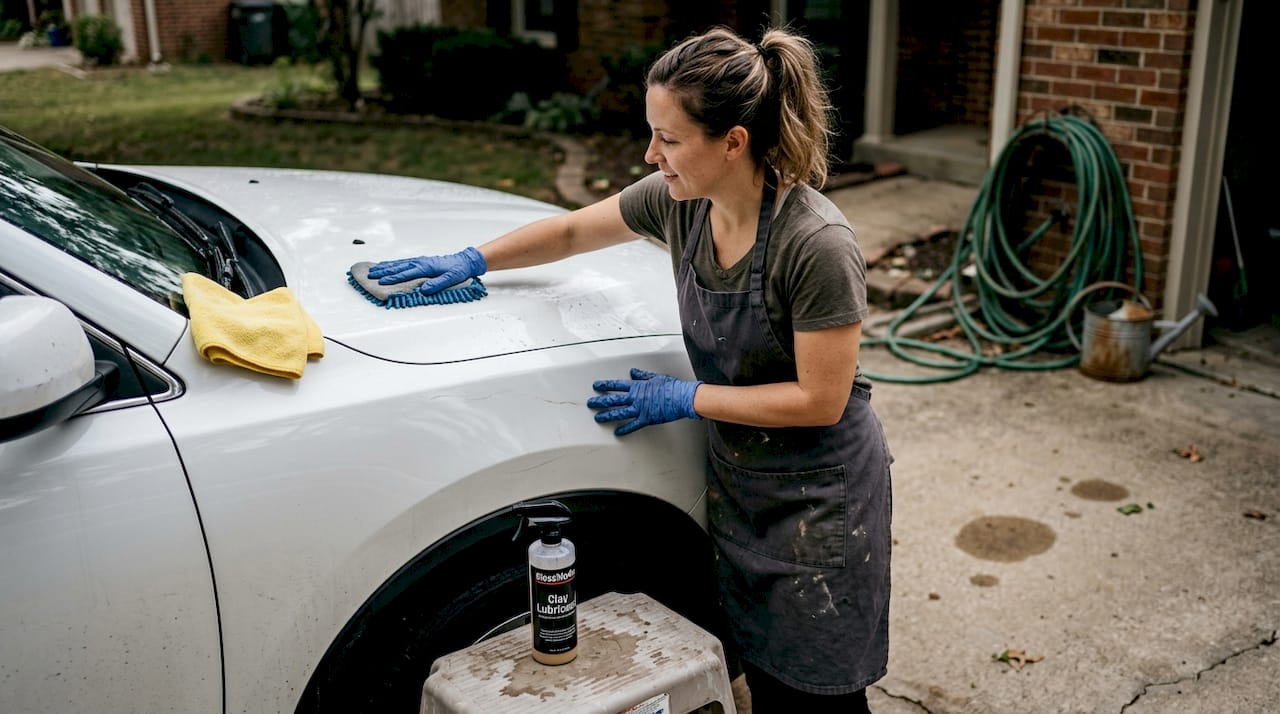
Pro Tip: Avoid any product containing hydrofluoric acid unless you are a trained professional with proper safety gear. It is highly effective on mineral deposits but extremely dangerous and can cause permanent paint and skin damage. Always do a small patch test on an inconspicuous area before applying any new chemical to your full vehicle.
For those curious about how professionals handle this safely at scale, the mobile detailing process and detailing safety protocols explain the systems pros use to protect both the vehicle and themselves.
When, how often, and who should perform decontamination washes?
Frequency matters as much as technique. Doing a decontamination wash too rarely lets contamination build up and etch into the clear coat. Doing it too aggressively with physical clay can create micro-marring if the paint is not ready.
Iron decontamination every 3-6 months and full clay decontamination every 6-12 months is the general recommendation, with higher frequency needed in polluted or highway environments. South Jersey drivers should lean toward the shorter end of those intervals for several reasons:
- Winter road salt is applied heavily across South Jersey from November through March, and it bonds to paint fast
- Shore area humidity accelerates iron oxidation and speeds up surface contamination
- Heavy commuter traffic on Routes 42, 55, and the Garden State Parkway generates significant brake dust and road film
- Rail corridors near Glassboro, Woodbury, and Camden deposit fine metallic particles on nearby vehicles regularly
Pro Tip: Always apply a fresh layer of wax, paint sealant, or ceramic coating immediately after decontamination. A clean, bare surface is highly vulnerable. Sealing it right away protects the paint and dramatically improves how long the results last, which directly supports your vehicle’s resale value.
“Decontamination is not just cleaning. It is resetting your paint to a factory-fresh state so that every protective layer you apply afterward actually adheres and performs the way it should.”
For DIY enthusiasts, light iron decontamination with a spray product is manageable at home. But for full clay decontamination, pre-coating prep, or post-winter recovery after South Jersey salt season, professional service is strongly recommended. CDC Detailing offers convenient pro decon with strong local demand across South Jersey, bringing the service directly to your driveway. Reviewing detailing frequency recommendations and a solid mobile car washing guide can help you build a routine that fits your schedule and budget.
Expert perspective: What most people get wrong about decontamination
Here is the honest truth that most detailing content skips over: people treat decontamination like a bonus step rather than the most important step. They spend money on ceramic coatings and paint sealants, then skip the decontamination that makes those products actually work. It is like applying sunscreen over dirty skin and expecting full protection.
Think of decontamination as exfoliation for your car’s paint. Just like skin care, you have to remove the dead buildup before any treatment can bond properly. A ceramic coating applied over contaminated paint will not cure correctly, will not last as long, and will not look as good.
Another common mistake is assuming clay bars are always better than mitts or towels. They are not. Clay bars offer precision on small problem areas, but for a full vehicle decontamination, a clay mitt is faster, safer, and just as effective on most paint types.
The post-winter decontamination window in South Jersey is critical and widely ignored. Decon prevents etching but does not fix existing scratches, and improper washes cause 80% of clear coat damage. Waiting until summer to address salt and iron buildup from winter means months of active damage sitting on your paint. Catching it in early spring, before it etches, is the difference between a decontamination wash and an expensive paint correction job. Understanding the real deep cleaning vs. basic wash distinction is what separates vehicle owners who maintain value from those who watch it drop.
Convenient South Jersey decontamination wash solutions
If you are ready to give your vehicle the reset it needs, CDC Auto Detailing makes it easy for South Jersey vehicle owners to access professional-grade decontamination without leaving home.

We bring full decontamination services directly to your driveway across Pitman, Glassboro, Woodbury, and surrounding South Jersey communities. From iron and tar removal to full clay decontamination and post-treatment ceramic coating application, our auto detailing process is built around protecting your investment at every step. Explore auto detailing service examples to see what a complete treatment looks like, or check out our ceramic coating services to pair your decontamination with long-term paint protection. Book your appointment today and start with a truly clean surface.
Frequently asked questions
What contaminants does a decontamination wash remove?
A decontamination wash removes bonded contaminants including iron fallout, tar, tree sap, brake dust, industrial pollution, and bird droppings that regular car washes cannot lift from the paint surface.
How often should I get a decontamination wash in South Jersey?
Iron decon every 3-6 months and full clay decontamination every 6-12 months is the standard recommendation, though South Jersey drivers dealing with winter salt and highway exposure should aim for the shorter end of both ranges.
Can I perform a decontamination wash myself?
DIY iron decontamination with a spray product is manageable for most owners, but pros are recommended for heavy buildup, full clay treatments, or vehicles exposed to South Jersey winter salt and road grime.
Is decontamination safe for all types of car paint?
Yes, when performed correctly with proper lubrication and safe chemical choices. Avoid hydrofluoric acid and always lubricate clay thoroughly to prevent marring on any paint type.
What should I do after a decontamination wash?
Always protect afterward with a wax, paint sealant, or ceramic coating to seal the freshly cleaned surface and prevent new contamination from bonding quickly.