
Yes, bird droppings can damage your car’s paint, and the clock starts the moment they land. Droppings contain digestive enzymes and uric acid salts that can begin breaking down clear coat. In cooler weather they may take up to a day to stain paint, while on a hot summer day etching can show up within a few hours. The fix is simple: soften the dropping, lift it off without rubbing, and put a protective layer under the paint so the next one does less harm.
TL;DR
- Heat is the accelerator. Sun bakes the dropping onto the paint, and the clear coat softens and then contracts around the dried deposit, which is how etching starts.
- Remove droppings as soon as you can. Soften them with a bird and bug remover, then lift them with a clean microfiber towel. Never scrub a dry one.
- If a faint outline stays after cleaning, the clear coat is probably etched. Buffing alone will not remove it. The surface has to be leveled by polishing or sanding.
- A wax, sealant, ceramic coating or paint protection film gives droppings something to hit other than your clear coat.
- If you are in South Jersey, we can correct and protect the paint at your home or workplace.
Table of Contents
- Why bird droppings hurt paint
- Fresh or dried: how to remove bird poop safely
- How to tell if the paint is etched
- Why birds seem to pick your car
- How to protect your car from bird droppings
- Our perspective
- Have us handle it in South Jersey
- A simple routine that prevents most damage
- FAQ
- Sources
Why bird droppings hurt paint
A bird dropping is not just a stain. It is a mix of waste that includes uric acid, and uric acid is nearly 100% water-insoluble. That matters in two ways. A splash of plain water will not dissolve it, and the longer it sits, the more time the acid has to work on the finish.
There is a physical side too. As the sun heats the panel, the clear coat softens a little and the dropping dries and shrinks. The paint then sets around that hardened, uneven shape. Even after you remove the dropping, you can see a dull ghost of it. That ghost is etching: a change in the surface of the clear coat itself, not dirt sitting on top.
What decides how bad it gets:
- Temperature. Hot panels in direct summer sun are the worst case. Cool, shaded paint buys you time.
- How long it sits. Fresh droppings are far easier to remove than ones that have baked for a day or more.
- Paint condition. Faded, thin or already-scratched clear coat has less margin than a healthy, protected finish.
- What the bird ate. The chemistry varies, so there is no single safe window to count on.
On timing, treat “as soon as you reasonably can” as the rule. Some guides cite a figure of about 30 minutes as the ideal window, but nobody can promise that an hour or a day is safe in July. If you can reach it, remove it.
Fresh or dried: how to remove bird poop safely
The goal is to let the product do the work and keep the pressure off the paint. Birds excrete sand, grit and small bits of gravel, so scrubbing a dried dropping drags that grit across the clear coat and causes scratches.
What to use
- A bird and bug remover made to deal with acidic messes. One example from a maker of such products says its formula is safe on paint, clear coat, glass, plastic and chrome, and safe for ceramic coatings and PPF. Check the label of whatever you buy for the same compatibility.
- A clean, plush microfiber towel or a bug sponge for softened residue.
- A second clean towel for the final wipe.
- Water in a spray bottle, but only as a helper and never as the main cleaner.
One tip surprises people: quick detailer spray is not the right tool here, because the polymers or wax in it can seal the acid in rather than lift it. Save it for dust.
Step by step
- Work on a cool panel. If the car has been in the sun, move it into shade or wait until the metal is cool to the touch. The product’s directions say to apply it to a cool surface.
- Saturate the dropping. Spray the remover generously over the whole deposit, not just the middle. Let it sit for a minute or two so it softens.
- For dried-on deposits, add a damp cloth. Laying a damp microfiber over the spot for a few minutes rehydrates stubborn material so it lifts instead of gripping.
- Lift, don’t scrub. Use a clean towel and wipe lightly in one direction with minimal pressure. If residue remains, apply more product and repeat rather than pressing harder.
- Rinse and check. Rinse the area, dry it with a fresh towel, and look at it from a few angles in good light.
If you are out and about and have only a napkin, resist the urge to wipe a dry dropping. Dab a wet cloth over it to soften, lift gently, and do a proper clean when you are home.
Things that make it worse
- Paper towels and dry shop rags on a dried deposit.
- Scrubbing with a dirty wash mitt, which spreads grit.
- Household cleaners or anything harsh that is not made for automotive paint.
- Cleaning on a hot, sunlit panel, where the product flashes off before it softens anything.
The same patience applies to other bonded contaminants. Our guides on removing sap from car paint and pollen removal without scratching use the same soften-first approach.
How to tell if the paint is etched
After you have cleaned the spot, look for these signs:
- A dull or hazy patch with the outline of the dropping.
- A rough or slightly dished spot when you gently run a clean fingertip across it.
- A mark that is still visible after a thorough wash, and that shows most clearly under direct sunlight or a bright light.
If the area is smooth and glossy once clean, you caught it in time and there is nothing more to do. If it is etched, expect to need correction. When the paint has been physically altered, the only way to make the mark disappear is to level the surface, best done by sanding, and simply buffing will not do it.
Light etching versus deep etching
| Condition | What you see | Typical approach |
|---|---|---|
| Surface stain | Mark disappears after proper cleaning | Remover and microfiber, no correction needed |
| Light etching | Faint ghost that is hard to see or feel | Water spot remover or fine polish, as one detailing shop suggests for marks that are hard to see or feel |
| Moderate etching | Visible dull patch you can feel | Machine polishing with a compound and polish, leveling the clear coat |
| Deep etching | Crater, discoloration or dull spot that persists | Wet sanding and polishing by a professional |
| Clear coat failure | Cloudy, peeling or cracking paint | Panel refinishing at a body shop |
The jump from light to moderate is where most owners should stop experimenting. A machine polisher and sanding paper can remove a stain, but they also remove clear coat, and clear coat is thin. Once it is breached, no DIY product restores it, and a refinish becomes the only real answer. A professional measures the remaining film and corrects only as much as is needed.
What does it cost to fix?
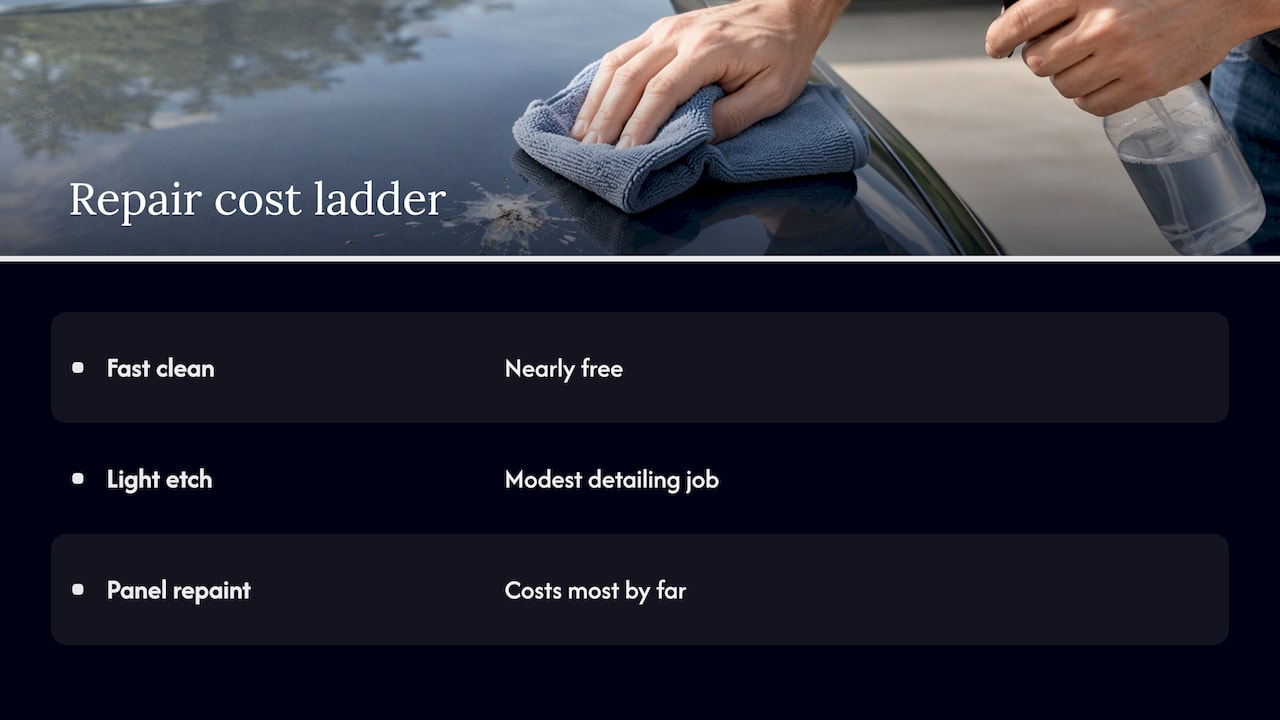
The cost ladder is steep, which is the whole argument for acting early. A fast clean is nearly free. Polishing out a light etch is a modest detailing job. Repainting a panel costs the most by a wide margin, and a body shop will usually respray a whole panel rather than spot repair one. Prices vary by region and by vehicle, so get a quote for your car.
Insurance is rarely the answer for one panel. Environmental damage like this would generally fall under comprehensive coverage, not collision, but a single-panel repair is often smaller than a typical deductible. Check your own policy and deductible before deciding to file.
Why birds seem to pick your car
It feels personal, but it usually is not. Cars parked under trees, power lines, rooftop ledges or near dumpsters and food courts are in the fall zone. Light-colored and glossy cars stand out, and dark paint shows the etched ghost more clearly. Hot, bright days are when the damage moves fastest, but fruiting and berry seasons can make droppings more frequent in many places, including South Jersey neighborhoods with plenty of mature trees.
The practical fix is parking choices: avoid parking beneath perches when you can, and use a garage or a car cover where it is practical. For everything else, protection on the paint is the better plan.
How to protect your car from bird droppings
Nothing makes paint immune. The aim is to buy time and make removal easy. Here is the ladder from least to most durable.
Wax and sealants
Waxes and sealants are not acid-proof and only protect for a short time, but they act as a sacrificial layer between uric acid and the paint. That makes them a good baseline, provided you keep them renewed. If you want a closer comparison with something longer lasting, see our breakdown of ceramic coating versus wax.
Ceramic coating
A ceramic coating bonds to the clear coat and forms a hard, slick layer. Droppings sit on that layer instead of on your paint, and it is designed to make them easier to wipe away. It does not let you ignore a dropping for a week, but it gives you more margin and makes clean-up easier. Our ceramic coating packages come in three durability levels, and you can read more about the benefits of ceramic coating before choosing. If you plan to protect the car through the winter as well, our winter maintenance tips for ceramic-coated vehicles cover the upkeep.
Paint protection film
Paint protection film (PPF) is a clear urethane layer applied to the paint. It is the choice for panels that take the most abuse. Many owners put it on the hood, fenders and mirrors, and those are also the surfaces facing upward where birds hit. We install PPF and can tell you which panels make sense for your car. Our PPF installation overview explains the process.
Regular washing
Protection only works when the surface is kept clean. Wash gently with a clean mitt and avoid harsh automatic washes that can leave marring, which our guide on avoiding scratches from automatic car washes explains. A scheduled maintenance wash means droppings that you missed get caught before they bake in.
Our perspective
Most of the bird dropping damage we see is not from the dropping itself, it is from what happened afterward: a dry wipe, a paper towel, a day in the July sun. The paint was bare, and the owner was in a hurry.
We approach it in two parts. First, correct what is already there, carefully and only as much as the paint requires, because clear coat is a finite resource. Second, put a layer between the car and the next incident. For most of our customers that means a ceramic coating, and for the highest-impact panels it means paint protection film. We document the process on each vehicle so you know what was done and what to maintain.
Because we are mobile, you do not have to take a day off to do this. We come to your driveway or your lot, and that includes fleets and farm vehicles that spend their days under trees and around barns, where droppings are a constant.
If you are unsure whether a mark is a stain or etching, send us a photo. We would rather look at it early than quote a larger job later.
Charles
Have us handle it in South Jersey
If you have etched paint or want to prevent it, we come to you in South Jersey from our base in Pitman. Our published pricing starts with an Exterior Detail from $175, and our detail packages start at $375 for Bronze and run up to $1,500 for Gold. Mobile detailing carries an additional fee from $100, and a $100 booking charge applies. Prices are listed as starting points, so the final quote depends on your vehicle and its condition.

For longer-term protection, our ceramic coating packages are priced at $1,000 to $1,200 for 3 years, $1,500 to $1,700 for 5 years and $2,200 to $2,400 for 8 years, with a 10% booking charge. We also install paint protection film and can quote it for your car. For a vehicle that sits outside daily, our Exterior Maintenance Plan is $200 per month per vehicle, or $100 per week, so droppings never get a chance to sit.
Book your appointment on our site and tell us what you are seeing.
A simple routine that prevents most damage
- Keep a small bottle of bird and bug remover and two clean microfiber towels in the car, in a bag, so they stay clean.
- Check the roof, hood and trunk when you park. They are the surfaces birds hit most.
- Treat droppings the same day, and on hot days within the hour if you can.
- Wash every one to two weeks, and refresh your sealant on schedule.
- Once a year, have the paint inspected under good light so any light etching is corrected before it deepens.
FAQ
Will bird poop ruin car paint?
Not if you deal with it quickly. Left on a hot panel, it can etch the clear coat within hours, and the mark can become permanent without polishing or sanding. Fresh droppings that are softened and lifted gently usually leave nothing behind.
How long can bird poop stay on a car?
There is no universal safe time. In cool weather, staining may take up to a day, but on a hot summer day, etching can appear in a few hours. The safest habit is to remove it the same day, and sooner in summer sun.
What is the best cleaner for bird poop?
Use an automotive bird and bug remover made for acidic messes, with a clean microfiber towel or bug sponge. Avoid plain water as your only cleaner, and avoid quick detailer spray, because it can seal the acid in rather than remove it.
Can etched paint from bird droppings be fixed?
Light etching can often be polished out. Deeper etching needs the surface leveled by wet sanding and polishing, which is best left to a professional. If the clear coat has broken down, the panel has to be refinished.
Does a ceramic coating stop bird droppings from damaging paint?
A ceramic coating gives droppings a hard, slick layer to sit on instead of your clear coat, and it makes clean-up easier. It does not mean you can leave them for days, so keep removing them promptly. For the most exposed panels, paint protection film adds another layer.
Sources
- Can Bird Droppings Damage Your Car Paint? Here’s What Auto Experts Say (Yahoo Autos)
- Cleaning Bird Poop: The Scientific Breakdown (Dr. Beasley’s)
- How to Remove Bird Dropping Etching from Car Paint (Dr. Beasley’s)
- Splatt Bug & Bird Dropping Remover (Rislone)
- Removing spots or etchings caused by bird droppings (Detailed Image)