
Marks on leather seats usually come from one of three things: sustained pressure (a child seat base or a heavy object), dye transfer from clothing, or heat and sun drying the surface. Pressure dents can often be reduced, dye transfer is easiest to deal with early, and sun damage is best prevented. Harsh cleaners and DIY heat make most of these problems worse, so the safest first move is gentle, patient care.
Below, we explain how to tell the marks apart, what automaker guidance says about treating them, and when it is time to hand the seat to a professional.
TL;DR
- Dents and creases come from long, concentrated pressure, and heat inside a parked car speeds them up.
- Dark denim, cotton and suede can transfer dye to light leather. Wipe it early with water and mild detergent on a microfiber towel.
- Avoid solvent-based cleaners and improvised heat. Automaker bulletins warn both can damage the finish.
- Put a manufacturer-approved protector or folded towel under a child seat, and shade the interior to limit sun and heat.
- Persistent marks, cracking or color loss are a job for a trained detailer or leather repair specialist.
Table of Contents
- What Those Marks on Your Leather Seat Actually Are
- Child Car Seats and Leather: Will It Leave Marks?
- How to Reduce Dents and Remove Marks Without Damaging the Leather
- Preventing Marks: A Practical Routine
- Cracked Leather: Preventing It Before It Starts
- Perspective
- When to Call a Professional
- Book a Mobile Interior Detail in South Jersey
- A Quick Checklist You Can Use Today
- FAQ
- Sources
What Those Marks on Your Leather Seat Actually Are
Before you treat anything, work out what you are looking at. The fix for a dent is not the fix for a stain.
| What you see | Likely cause | How it usually behaves |
|---|---|---|
| Flat, shiny or recessed patch in the shape of a base or object | Pressure and compression | Can soften with time and gentle care, may be permanent if heat was involved |
| Blue, gray or dark tint, often on light leather | Dye transfer from clothing | Easiest to clean when fresh |
| Fine wrinkles and a dry, faded look | Sun and heat exposure | Prevent early, harder to reverse |
| Pale scuffs or worn color on bolsters | Friction and abrasion | Needs color restoration, not cleaner |
| Rings, spots, streaks | Spills, cosmetics, cleaner residue | Remove fast with gentle cleaning |
The wording matters because people often describe all of these as “stains.” A dent will not wipe away, and wiping a dye mark aggressively can spread it.
Pressure marks and indentations
Leather over foam behaves like a cushion. Leave something heavy and firm on it and the surface compresses. A Mercedes-Benz technical service bulletin on crease removal notes that objects left on genuine leather seats for extended periods can cause pressure marks.
This is why a folded-down seat with a bag on it, a toolbox, or a child seat base leaves a mark that outlasts the object. A 2026 CarXplorer guide describes the mechanism: constant, concentrated pressure from a car seat base causes a compression set, a physical deformation of the material fibers that may be permanent when leather and foam are exposed to heat.
That heat point is the practical one for New Jersey drivers. A car parked in a July lot gets far hotter than the air outside, and the same guide says indentations form significantly faster in warm conditions than cool ones. A base that left no trace in April can leave a clear imprint by August.
Dye transfer from clothing
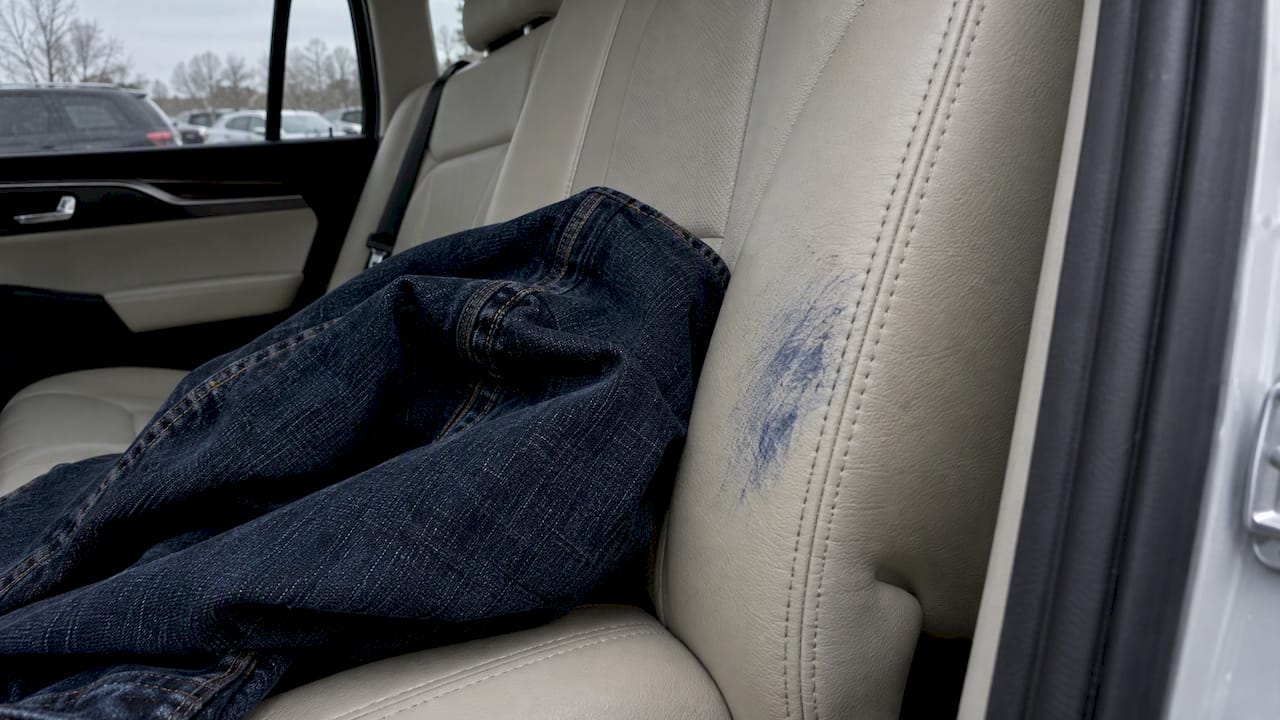
A lot of “mystery marks” on light seats are dye. General Motors guidance states that dye transfer occurs when natural fibers like cotton, silk, wool or suede contact leather, and that lighter colors show it more quickly.
Think new jeans, a dark cotton jacket, a suede bag or a wool coat. One reader in an enthusiast forum described a cotton jacket left between folded rear seats for about a month, and the rear seats showed marks when lifted. Pressure, warmth and time together are exactly the conditions that encourage both dents and transfer.
Sun, heat and natural wear
Sunlight dries leather. The 2025 Genesis GV70 owner’s manual says excessive sunlight and heat can fade and dry Napa leather, causing wrinkles and discoloration. The same manual says wrinkles or abrasions that appear naturally from use are not covered by warranty, so it pays to prevent them rather than assume someone else will fix them.
Child Car Seats and Leather: Will It Leave Marks?
Yes, it can. A hard base on leather combines the two things that cause dents: a small contact area and constant pressure. Non-slip rubber-like backing can add its own problem, because it can grip the surface and, in warm weather, leave marks of its own.
What helps:
- Use a protective layer. CarXplorer recommends a seat protector or folded towel beneath the car seat to spread the pressure.
- Put safety first. The same guide advises that any protective mat must be approved by the car seat manufacturer, so the seat is still installed to its safety specifications. Check your child seat manual before adding anything under it. A towel that lets the base shift is not a trade worth making.
- Keep the car cooler. Sunshades, tinted glass and parking in shade all reduce the heat that turns a temporary dent into a lasting one.
- Remove the seat when you are not using it. If the base sits in a car for weeks between trips, take it out.
- Check underneath regularly. Lift the base occasionally, wipe the seat, and let the leather rest.
If you want help choosing a protective approach for your specific vehicle, our team can look at the seats before you buy anything.
How to Reduce Dents and Remove Marks Without Damaging the Leather
The golden rule from every automaker source we reviewed: gentle first, and never experiment on a visible area.
Start with the right cleaning method
Toyota’s leather care best practices say commercial cleaners using solvents or propellants can damage factory coatings. The same document says to clean by hand with water and mild detergent, and to apply the cleaner to a microfiber towel rather than directly to the seat.
Follow that sequence:
- Vacuum the seat, including seams and crevices. Removing dust, dirt and debris first keeps grit from scratching the surface as you wipe.
- Dampen a clean microfiber towel with a mild detergent solution.
- Wipe gently, working with the grain of the panel, and do not saturate the leather.
- Wipe with a second towel dampened with plain water, then dry.
- Let it rest. Check the mark in daylight before doing anything more.
For product-by-product guidance, see our pages on what you can use to clean leather car seats safely and how to remove stains from car seats naturally. If you also want a broader look at the cabin, vehicle interior cleaning advice such as this approach to interior cleaning covers the same cautions on avoiding harsh products.
Spills, cosmetics and fresh dye
Speed matters. Genesis advises to remove spills instantly and wipe off cosmetic products immediately if they contact interior parts. Hand sanitizer, sunscreen and makeup can all affect finishes if left sitting. Dye transfer is the same story: fresh is manageable, months-old is a restoration question.
Heat for creases: a technician’s tool
The Mercedes-Benz bulletin suggests that for crease removal on genuine leather, a technician can use careful heat treatment with a heat gun and a plastic wedge, and it advises extreme caution to avoid overheating. That tells you two things. Heat can work, and it is easy to get wrong.
Overheated leather can shrink, harden, discolor or lose its finish, and the foam underneath can be affected too. A hair dryer or heat gun in untrained hands on a seat you care about is a gamble. If the dent is on a driver’s seat bolster or a light-colored seat, we would not try it yourself.
What not to use
- Solvent-based or aerosol cleaners, which risk the factory coating.
- Shoe polish or shoe-care products for color loss. Leather Naturally recommends specialist abrasion-resistant repair colours for color damage or abrasion rather than shoe-care products.
- Scrubbing brushes on perforated or lightly coated leather.
- Soaking the seat, which can push moisture into seams and foam.
Preventing Marks: A Practical Routine
Prevention is cheaper than repair, and most of it takes minutes.
Reduce pressure and contact
- Do not leave heavy items on seats for days at a time, especially with the cabin hot.
- Keep dark new denim and suede off light leather for the first few weeks of wear, or lay a cover over the seat.
- Use approved protectors under child seats and check under them regularly.
- Fold-down seats with cargo on them deserve a blanket between the cargo and the leather.
Keep the cabin cooler
Sun and heat dry leather and speed up deformation, so anything that lowers cabin temperature helps:
- Use a reflective sunshade whenever you park outside.
- Park in shade or a garage when you can.
- Consider window tint. Our pages on ceramic window tint and tint heat rejection explain how it cuts the heat and light reaching the seats.
- Follow a short routine for preventing sun fade inside the car.
Condition on a schedule
Clean leather first, then use a product designed for automotive leather. General Motors describes its water-based leather restorer as containing emollients to restore suppleness and protect against re-staining. The takeaway is to look for water-based, automotive-specific conditioners rather than heavy oils or household products. Always test in a hidden spot, and check your owner’s manual for what your seat finish allows.
Automotive leather is generally durable and easy to clean and maintain, which is why a regular light routine beats occasional heavy treatment. Every few weeks, vacuum and wipe. A few times a year, clean and condition properly.
Cracked Leather: Preventing It Before It Starts
Cracking is the end of a long process: the surface loses moisture and flexibility, stiffens, then splits along creases. Early warning signs are a dull, dry look, a tight feel, and fine lines on bolsters where you slide in and out.
To stay ahead of it:
- Keep the seats out of direct sun as much as you can.
- Clean gently, so dirt does not act like sandpaper in the creases.
- Condition with a suitable product on a regular schedule.
- Address small color wear before it becomes a hole in the finish.
Once leather has cracked, no conditioner closes the gap. At that point you are looking at restoration or repair. Our guide to restoring leather seats and when you need a pro walks through what is realistic at home.
Perspective
We see the same pattern again and again with leather in South Jersey: the damage that sends owners looking for help rarely happened in one dramatic moment. It built up over a hot summer with a child seat in place, a jacket left on the seat, or a car parked in full sun every day.
That is why we think of leather care as part of a vehicle’s long-term protection, not a one-time cleanup. Our approach is built around personalized care for each vehicle, professional-grade materials and a documented process, because a seat that is cleaned correctly and protected early keeps its value far better when it comes time to sell.
The mobile part matters too. Most of our customers are busy, and a seat problem is easy to postpone. We come to your home or workplace, look at the leather in real light, and tell you what a gentle interior detail can do and what needs more. If a mark needs a specialist repair, we would rather you know that upfront than watch a DIY attempt make it harder to fix.
Our advice: start with the mildest method, protect the cabin from heat, and book an interior detail before a small mark becomes a permanent one.
Charles
When to Call a Professional
Some situations are not worth a home experiment:
- A dent that has not eased after the leather has rested, especially on a light or perforated seat.
- Dye transfer that did not respond to gentle cleaning.
- Color worn off bolsters or stitching.
- Fine cracks, shrinking or stiff patches.
- A newer or leased vehicle where the finish matters for resale or return.
Leather Naturally notes that professional leather repair businesses can offer expert advice for unusual stains or damage. A professional can identify whether you are dealing with a pressure mark, a transfer or a finish failure before anything is applied, and that diagnosis is most of the value.
If it turns out your seats have a different issue, such as fabric or Alcantara, the steps differ. Our guide to cleaning Alcantara seats covers that material.
Book a Mobile Interior Detail in South Jersey
If your leather already has marks, or you want to protect it before summer, our mobile interior detail is the practical starting point. We come to you in South Jersey, clean the cabin with professional-grade materials and tell you honestly what we see in the leather.

Our Interior Detail starts at $275. Mobile service carries an additional fee starting at $100, and there is a $100 booking charge. If you want the whole vehicle done, our detail packages start at $375 for Bronze. For the full picture of what is included in a cabin visit, read our interior cleaning workflow. Prices are the starting figures published on our site, so confirm the details for your vehicle when you book.
Ready to schedule? Visit CDC Auto Detailing and send us your vehicle details.
A Quick Checklist You Can Use Today
- Look at the mark in daylight and decide: dent, dye, dryness or abrasion.
- Vacuum the seat, seams included.
- Wipe gently with mild detergent on a microfiber towel, then with a plain water towel.
- Do not use solvent cleaners or shoe-care products.
- Remove or protect whatever is pressing on the seat, using only approved protectors under a child seat.
- Shade the car and consider tint.
- If the mark is still there after the leather has rested, book a professional look.
FAQ
Will a baby car seat damage leather?
It can leave dents, because the base puts constant, concentrated pressure on a small area, and heat can make the compression lasting. A manufacturer-approved protector or folded towel can spread the load, but check your child seat manual first because safe installation comes before leather protection.
How do I get a dent out of a leather car seat?
Start by removing the pressure and letting the leather rest, then clean it gently with mild detergent on a microfiber towel. Automaker bulletins describe heat treatment for creases as a careful technician procedure with a risk of overheating, so we recommend a professional for any dent you care about.
How can I remove stains from leather car seats?
Act quickly, vacuum first, then wipe with water and a mild detergent applied to a microfiber towel rather than to the seat. Avoid solvent or propellant cleaners, which can damage the factory coating. If the stain is dye transfer or has set in, a detailer can assess it before you try anything stronger.
How do I protect leather seats from the sun?
Shade is the simplest answer: sunshades, shaded parking and tinted glass all reduce the heat and light reaching the seat. Automaker guidance says excessive sun can fade and dry leather, so pair that with regular cleaning and conditioning using an automotive leather product.
Sources
- General Motors dye transfer guidance (NHTSA)
- Mercedes-Benz crease removal bulletin (NHTSA)
- Toyota leather care best practices (NHTSA)
- General Motors leather restorer bulletin (NHTSA)
- Genesis GV70 interior care, owner’s manual
- CarXplorer guide to protecting leather from car seats
- Leather Naturally, how to care for leather
- Leather Naturally, modern cow leather processing
- How to clean leather car seats, Porsche Atlanta North
- Vehicle interior cleaning advice