
Yes, most ceramic coating high spots are fixable. The immediate move is to inspect the panel under proper lighting and, if you’re still inside the product’s flash window, try a careful wipe with a clean microfiber before anything cures further. Once the coating has hardened for days, correction usually means machine polishing or a spot recoat rather than a simple wipe. Severity and time elapsed decide which path applies to your car.
TL;DR:
- Applying too much product, working large panels, or missing the flash window increases the risk of high spots forming before curing.
- Detecting high spots early requires inspecting under proper lighting and testing bead uniformity with a water mist, especially before the coating fully cures.
- Correcting fresh high spots involves gentle wiping or buffing within the first few hours, escalating to polishing if they cure for days or longer.
- Using thin, even coats, applying in shade, and swapping microfiber towels frequently significantly reduces the chance of high spots during application.
- Professional inspection and targeted correction are recommended if a high spot has cured beyond the initial curing window, especially to prevent damage to the underlying paint.
Table of Contents
- What Causes High Spots on a Ceramic Coating
- How to Detect High Spots Before They Cure Solid
- Fixing Ceramic Coating Flaws: The Correction Workflow
- How to Level Ceramic Coating and Prevent High Spots From Forming
- How CDC Auto Detailing Handles High Spots in the Field
- What I’d Actually Trust My Own Car To
- Get a High Spot Corrected the Right Way
- Where to Check Before You Touch the Panel
- Sources
- FAQ
What Causes High Spots on a Ceramic Coating
A high spot is a raised, uneven patch of cured coating that never got leveled properly before it hardened. Instead of sitting flat and thin across the panel, extra product pools in one area and dries thicker than the rest of the surface. Under direct light, that thicker patch refracts differently than the coating around it, and that’s what produces the rainbow sheen or dark streak detailers immediately recognize as a leveling mistake.
Ceramic coating defects like this rarely come from one mistake. They’re usually a stack of small errors that compound in real time while the applicator is still working the panel.
- Applying too much product per section, so the coating can’t be leveled before it starts flashing
- Working panels too large at once, leaving the trailing edge of the application to sit and thicken
- Missing the product’s flash window, which lets the coating begin curing before a leveling towel passes over it
- Working in direct sun, high heat, or high humidity, all of which shorten flash time unpredictably
- Reusing a saturated or dirty microfiber towel that redeposits product instead of removing it
Dark-colored paint shows high spots almost immediately because the contrast between cured coating and bare paint is sharp. Lighter colors and metallics can hide the same defect much longer, which is why some owners don’t notice a leveling mistake until their first detail wash.
How to Detect High Spots Before They Cure Solid
Detecting high spots on coating early is the entire game. Catch one within its flash window and a wipe fixes it. Miss it for three days and you’re pulling out a polisher.
Start with the right light source. Overhead garage lighting and phone flashlights flatten the surface and hide texture. A dedicated LED inspection panel held at a low, raking angle across the paint is what actually reveals a raised patch, and pros routinely check the same panel under more than one light setup before deciding whether a spot is real or just a trick of reflection.
- Wipe the panel down and let any dust settle so you’re not chasing a false positive.
- Sweep an LED light across the surface at a low angle, section by section.
- Cross-check under cloudy natural daylight, since fluorescent and LED sometimes exaggerate texture that isn’t there.
- Run a fingertip lightly over any suspicious patch, feeling for tackiness or a slightly raised edge.
- Note the time since application. This determines which correction method is still safe to use.
Pro Tip: Keep a small spray bottle of distilled water nearby during inspection. Mist a suspect area and watch how the water beads. An uneven, patchy beading pattern is often the fastest tell that a section cured thicker than the rest of the panel.
Fixing Ceramic Coating Flaws: The Correction Workflow
Correction is a ladder, not a single fix. You start with the gentlest option the timeline allows and only climb higher if it doesn’t resolve the issue.
Within minutes to a couple of hours (still inside flash time): Wipe the high spot with a clean, dry, edgeless microfiber, using light pressure in straight overlapping passes. Most fresh high spots come off completely at this stage because the coating hasn’t cross-linked yet.
Within the first several hours (past flash, but not fully cured): Switch to a slightly damp microfiber, or a panel-prep spray if the product line recommends one, and hand buff the area in small circular motions. Check progress every few passes rather than working blind.
12 to 72 hours after application: Hand methods usually aren’t enough anymore. This is where dual-action (DA) polishing with a soft finishing pad and a mild polish comes in. Work in short bursts, keep the polisher moving to avoid heat buildup, and inspect under your LED light between passes so you don’t remove more coating than necessary.
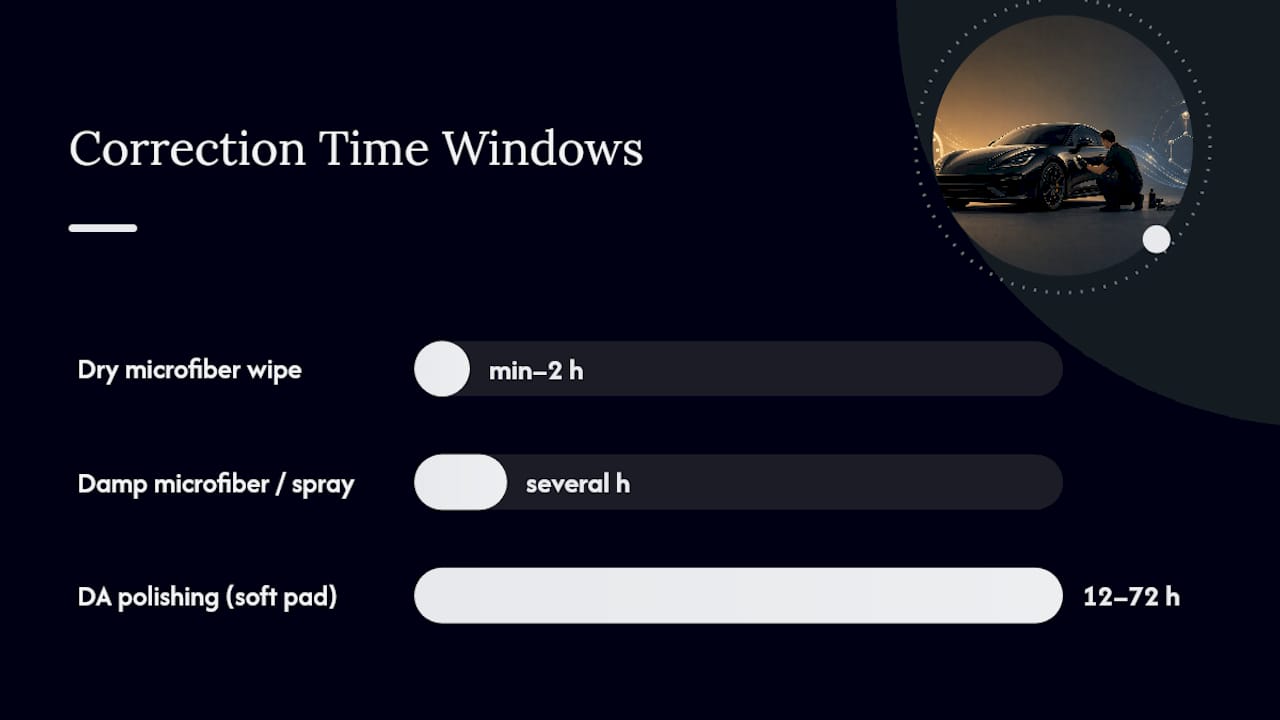
Days to months after full cure: At this stage the coating has fully hardened and DA polishing with a firmer pad and cutting compound may be needed to level the spot down to the surrounding coating. If polishing strips the area back to bare clear coat, a spot recoat is the safer route.
A workflow like this only holds up if you check the manufacturer’s technical data sheet first. Cure windows vary enough between brands that a timeline safe for one product can damage another. Professional workflows built around ceramic coating troubleshooting consistently start with the least abrasive option and escalate only when necessary, because pulling out a compound too early risks cutting through the coating and into clear coat that took years to build up.
- Never skip straight to machine polishing on a spot that’s less than a few hours old
- Always re-inspect under your LED light between every polishing pass
- Reapply a spot recoat only after confirming the panel is clean, dry, and free of polish residue
How to Level Ceramic Coating and Prevent High Spots From Forming
Prevention comes down to application technique, and it’s almost entirely avoidable once you build the right habits.
Work small sections at a time, roughly one panel or a quarter of one, and apply the coating in thin, even passes rather than a heavy single swipe. A soft, wide applicator block spreads product more evenly than a small sponge and reduces the odds of pooling near edges and creases. Fresh edgeless microfiber towels matter more than most people think. A towel that’s already saturated with cured product from an earlier panel will redeposit that residue instead of leveling the new one, so change towels often during a full vehicle application.
Every product has its own flash and cure schedule, and the manufacturer’s TDS controls the correction window, not a generic online rule of thumb. Working in shade with moderate temperature and humidity keeps flash times predictable, while direct sun or a humid garage can cut that window in half without warning.
- Apply thin, even coats and level immediately, section by section to reduce high spot risk
- Use a soft, wide applicator and swap microfiber towels frequently
- Control the environment: shade, moderate temperature, low humidity
- Inspect every panel under at least two light sources before letting it cure
Pro Tip: After the coating cures, wash with a pH-neutral shampoo built for coated paint. Harsh degreasers or high-alkaline soaps can strip a coating’s hydrophobic layer well before its rated lifespan, and a pH-neutral shampoo formulated for coated cars keeps that layer intact longer.
How CDC Auto Detailing Handles High Spots in the Field
Charles runs on-site triage the same way every time: inspect under an LED panel first, feel for tack second, then decide between a spot polish and a full recoat based on how many hours or days have passed. Mobile jobs add a wrinkle, since garage lighting and outdoor temperature swings both affect cure time, so timing the inspection matters as much as the fix itself. When booking a correction, send clear photos of the affected panel along with the exact date and time the coating was applied. That detail alone often determines which method gets used on-site.
What I’d Actually Trust My Own Car To
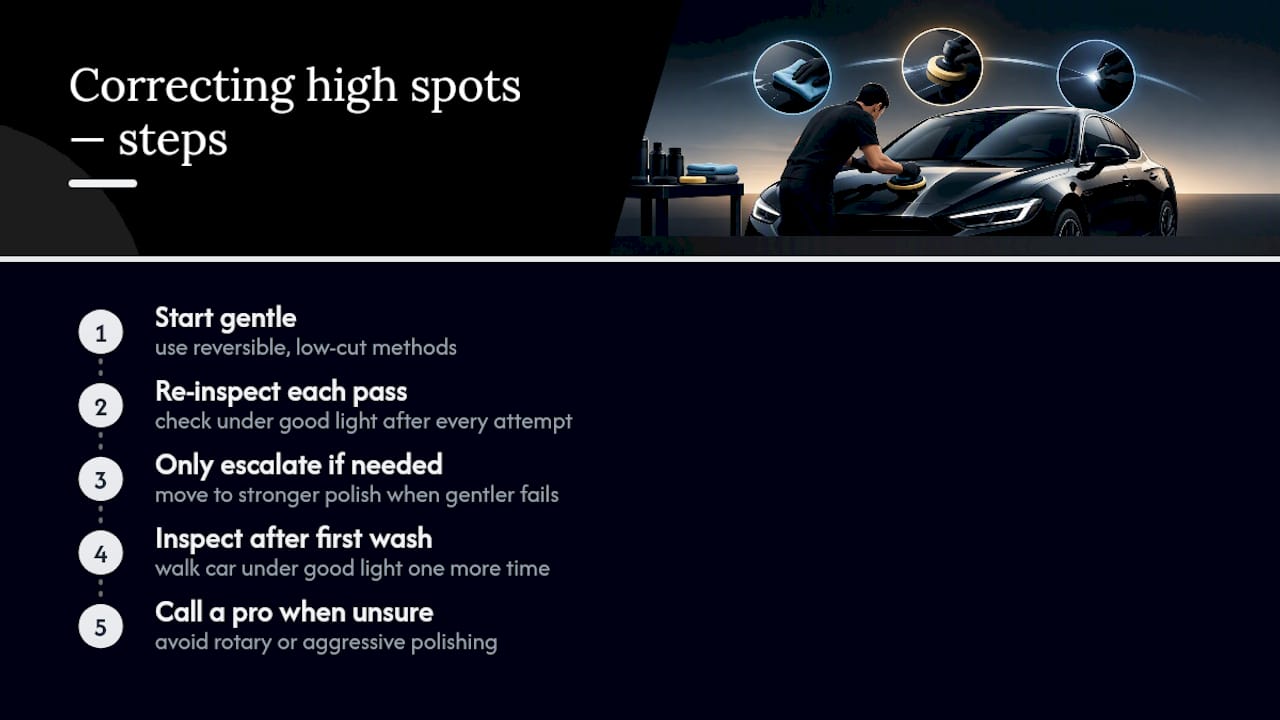
Most high spots respond to patient, incremental correction. Full strips are rarely necessary if you catch the problem early and resist the urge to reach for a heavy compound on the first pass. Aggressive polishing on a whim is how people burn through clear coat they can’t get back.
My advice: treat every correction attempt as reversible until proven otherwise. Start gentle, re-inspect, and only escalate when the gentler step genuinely fails. After the first wash following any coating job, walk the car under good light one more time. If something still looks off and you’re not confident in the fix, that’s the moment to call a professional instead of grabbing a rotary polisher.
— Charles
Get a High Spot Corrected the Right Way
A professional mobile service can provide expert inspection and correction for ceramic coating flaws, matching the repair method to the coating’s cure time and ensuring proper leveling or preparation for recoating.

If a high spot has already cured and you’d rather not risk it yourself, the ceramic coating service page walks through the 3 Year, 5 Year, and 8 Year Packages, each of which includes the paint prep and leveling work that prevents this problem from coming back. Spot corrections and recoats fall under the same booking process as a new application, and mobile visits across South Jersey come with the same LED-lit inspection Charles uses on every job. Book a visit through the detailing packages page and send photos of the affected panel along with the application date so the technician arrives ready to fix it, not diagnose it from scratch.
Where to Check Before You Touch the Panel
Before attempting any fix, confirm your product’s flash and cure times on its own technical data sheet, since timelines vary by brand. Gtechniq’s coating guidance covers bonding behavior and aftercare limits, while Detail King’s correction guide breaks down the staged polishing approach professionals rely on.
Sources
- 3M ceramic coating TDS (TDS-39901-3M-Ceramic-Coating_R1.pdf)
- High spots in your ceramic coating? – IGL Coatings Blog
- How to Fix High Spots in Ceramic Coatings – Detail King
- Everything You Need to Know About Ceramic Coatings | Gtechniq
FAQ
How Do You Get High Spots Out of a Ceramic Coating?
Wipe the area with a clean microfiber if you’re still within the product’s flash window, since the coating hasn’t hardened yet. Once it’s cured for hours or days, correction typically requires hand buffing, then DA polishing with a soft pad, escalating only as needed based on Detail King’s staged workflow.
What Are the Signs a Ceramic Coating Is Failing?
Water no longer beads tightly and instead sheets flat across the surface, and the paint loses its glossy, slick feel between washes. Contamination sticking to the surface more easily and a dulling of the reflective finish are both common indicators the coating has broken down or worn thin.
What Do High Spots in Ceramic Coating Actually Look Like?
They appear as raised, uneven patches that catch light differently than the surrounding coating, often showing up as a rainbow or oil-slick sheen under direct sun or LED inspection. They form when excess product isn’t leveled before it cures, leaving that section noticeably thicker than the rest of the panel.
What’s the Downside of Ceramic Coating?
Coatings chemically bond to clear coat and add gloss and chemical resistance, but they don’t prevent rock chips or deep scratches the way paint protection film does. Application mistakes like high spots or streaking are also possible if the product isn’t leveled correctly during install, which is why professional application reduces the risk of correction work down the line.
Can I Prevent High Spots on My Next Application?
Yes, working in small sections with thin coats, swapping microfiber towels often, and following the product’s flash and cure guidance nearly eliminates the risk. Cdcautodetailing builds this leveling process into every ceramic coating package it applies.