
Protecting a convertible top comes down to four steps, done in order: identify the material, clean the whole top gently, apply a protectant made for that material, and repeat on a schedule. Skip the first step and you can pick the wrong product. Skip the second and the protectant seals dirt in. This guide covers fabric and vinyl tops, the soft top waterproofing step, how often to do it, and the habits that quietly ruin a top.
TL;DR
- Test the material first: a water droplet rubbed into the top soaks in on fabric and smears on vinyl, and each needs its own products.
- Clean the entire top with a pH-neutral, bleach-free cleaner and a very soft brush, then rinse until no suds remain.
- Waterproof a clean, fully dry fabric top with several light coats of protectant, then give it 24 hours to cure.
- Rinse monthly, wash every 1 to 2 weeks if the car lives outdoors, and re-protect every 4 to 6 weeks.
- Avoid pressure washers, wand-type car washes, stiff brushes, hot wax and stowing the top wet.
Table of Contents
- Know what your top is made of
- Why protecting the top pays off
- Step 1: Clean the whole top first
- Step 2: Waterproof a fabric soft top
- Caring for a vinyl top
- How often to clean and protect
- Mistakes that damage a convertible top
- DIY or hire a detailer
- Protect the rest of the car at the same visit
- Let us handle it in South Jersey
- FAQ
- Sources
Know what your top is made of
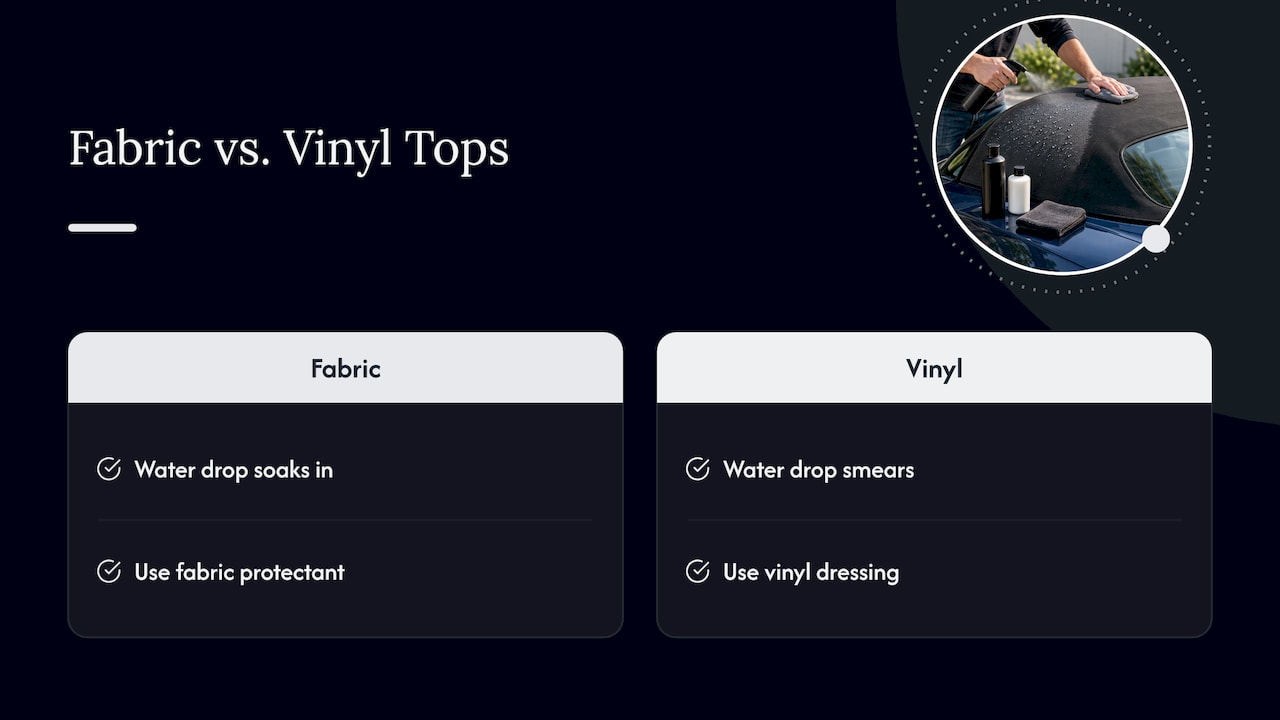
Convertible tops are generally either fabric (cloth) or vinyl, and the material dictates the care it needs. That matters because a fabric protectant on vinyl, or a vinyl dressing on fabric, does not do what the label promises.
The quick test: put a small drop of water on the top and rub it in. If it soaks in, the top is almost certainly fabric; if it smears, it is vinyl. Your owner’s manual or the dealer can confirm it for your exact model.
What a fabric top actually is
A fabric top is not a single sheet of cloth. Fabric tops are laminates that can include a top layer of solution-dyed acrylic plus a surface treatment that resists soil, water and oil-based stains. That surface treatment is what makes water bead. It wears down with sun, washing and time, which is why protection is a recurring job and not a one-time fix.
What vinyl needs
Vinyl does not soak up water, but it has its own weakness: vinyl tops can become vulnerable to drying, cracking and fading. For vinyl, the goal is a gentle cleaner and a UV-protective product made for vinyl tops, not a fabric waterproofer.
Why protecting the top pays off
A top takes sun, rain, tree sap, bird droppings and road film every day it is outside. Dirt left on the surface is not only cosmetic. According to JD Power, failing to remove dirt and debris leads to leaks, a poor appearance and early replacement.
The Porsche Club of America makes the money argument plainly: conditioning is a preventative investment, and protecting the top costs far less than replacing it. Here in South Jersey, where summers are humid and the cars sit under pollen, sap and shore-area salt air, a top that is cleaned and sealed regularly simply stays in better shape.
Step 1: Clean the whole top first
Protectant only works on a clean surface. Choose a calm, dry day, because the PCA advises planning cleaning, protecting and drying for a period with no rain or wind. If you work in a garage, keep it ventilated.
- Rinse the roof with a gentle stream of water to lift loose grit.
- Apply a pH-neutral, bleach-free cleaner made for convertible tops.
- Scrub with a very soft-bristle brush, side to side and then north to south. Use straight, controlled lines, not hard circles, so you do not fray the fibers.
- Rinse thoroughly until no suds remain.
Two details separate a good job from a patchy one. First, do not spot clean. JD Power recommends cleaning the entire top surface so the color and texture stay uniform over the life of the car. Second, rinse longer than feels necessary. Autoglym notes that rinsing is the most critical stage, because leftover soap residue impairs the beading of any protectant applied later.
We wrote a separate walkthrough on how to clean a convertible top without pressure washers or bleach if you want more detail on this stage.
Step 2: Waterproof a fabric soft top
Soft top waterproofing is a protectant job, not a sealant-in-a-can miracle. The sequence matters more than the brand on the label.
Prepare and mask
The top must be clean and completely dry. Before spraying, mask the surrounding areas: tape and newspaper protect adjacent paint, glass and trim from overspray. Pay attention to the rubber seals and the paint along the header and rear deck, since overspray there is a nuisance to remove.
Apply in light coats
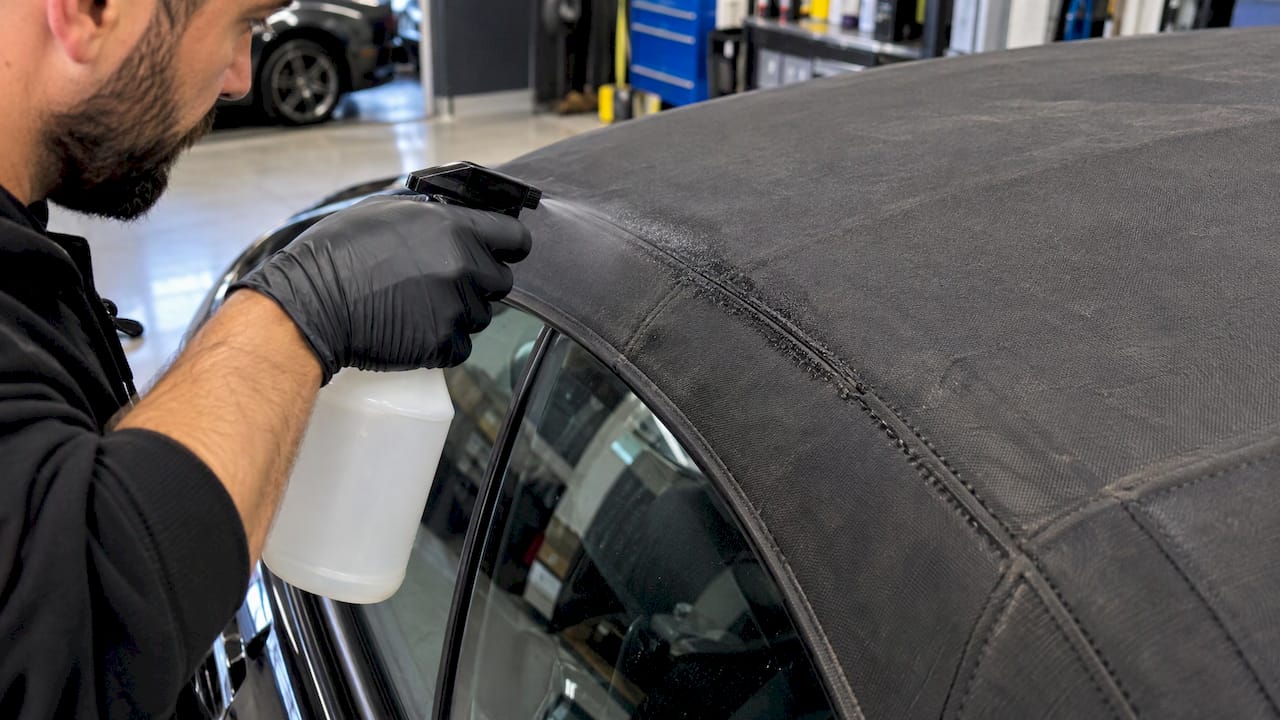
One heavy coat tends to run, stain and dry unevenly. A better approach is three light coats of fabric protectant, then 24 hours to dry. Hold the can at the distance on the label, overlap your passes and let each coat settle before the next. Keep the top up and the car out of rain during the curing day.
Check the seams
Seams are where leaks start, because water wicks along stitching. Manufacturers often treat seams with a fabric guard to minimize wicking, so give the stitching extra attention as you apply protectant, still in light coats.
Know when it is time to redo it
Protection fades. Fabric tops can lose repellency over time, and if the fabric looks noticeably wet after rain and needs to dry out, it may be susceptible to stains. Water that soaks in instead of beading is your cue to clean and re-treat.
Caring for a vinyl top
Vinyl follows the same order: clean the whole top, rinse well, let it dry, then protect. Use a cleaner and protectant labeled for vinyl convertible tops, and apply the protectant evenly with a soft applicator. The aim is to slow the drying, cracking and fading described above, so choose a product that lists UV protection and follow its directions on drying time.
If your vinyl top has gone gray or chalky, a thorough, gentle clean followed by a vinyl protectant often brings back much of the depth of color. Deep cracks do not reverse, which is why early, regular care matters more than any rescue product.
How often to clean and protect
A practical rhythm, based on guidance from Chemical Guys:
| Task | Typical frequency |
|---|---|
| Rinse the top | At least monthly |
| Wash the top | Every 1 to 2 weeks if parked outdoors or in a high-pollution area |
| Reapply protectant | Every 4 to 6 weeks |
Between sessions, watch for the warning signs: fading, mold or mildew, stains, debris packed along the folds, frayed seams and leaks. A garaged weekend car can sit at the relaxed end of that range. A daily driver parked under trees belongs at the tight end.
Mistakes that damage a convertible top
Ford’s owner guidance is a good checklist of what to skip. Avoid stiff-bristle brushes, abrasive materials or cleaners, hot waxes, high-pressure or wand-type car washes, and lowering or stowing the top while it is wet. Ford specifically warns that high-pressure or wand-type washes can damage the top’s seals and cause water leaks.
A few more habits that follow from the same logic:
- Never fold a damp top. Trapped moisture is how mildew starts in the creases.
- Do not use household cleaners or bleach. Harsh chemistry strips the surface treatment you are trying to preserve.
- Do not rush the drying. Protectant applied to a damp top will not bond evenly.
- Remove bird droppings and sap quickly, with water and a soft cloth, before they bake in.
- Skip aggressive circular scrubbing. It frays fibers and leaves visible wear patterns.
If you see a leak, mildew that returns after cleaning, or torn stitching, that is a repair question for a convertible top shop or your dealer. Cleaning and protectant cannot fix a failed seal or a split seam.
DIY or hire a detailer
A careful owner can do all of this at home. The catch is time and conditions: a clean, dry, windless stretch, masking tape, patience for three coats and a full day of curing. Many people would rather hand it to someone who does it every week.
That is where a mobile service helps. We come to your driveway or workplace in South Jersey, so you do not have to find the dry weekend or carry the car anywhere. Our guide to how mobile detailing works explains the process, and our detailing best practices show what a properly protected car looks like beyond the top.
Our perspective on convertible tops
Most damaged convertible tops we hear about were not neglected for years. They were cleaned the wrong way once: a pressure wand at a car wash, a stiff brush, a household cleaner. The surface treatment goes, and everything after that is catch-up.
We believe in careful, whole-surface cleaning first and protection second, because a vehicle is a long-term asset and the top is one of its most expensive parts. Our approach is built on personalized care for each vehicle, professional-grade materials and documented processes, which also helps when it is time to resell.
Doing the work at your home is part of it. A top cleaned and dried in your own driveway, without a rushed trip through a tunnel wash, is a top that lasts longer. And the rest of the car deserves the same thinking: paint, glass and interior protected on a plan, not in a panic.
Charles
Protect the rest of the car at the same visit
A protected top on tired paint and a sun-baked cabin only solves a third of the problem. Open-top driving exposes the interior to sun and weather, so it makes sense to treat the whole car together. Our guide to protecting your car interior covers the cabin side, and our overview of how to select a detailing package helps you match services to the car.
If you want longer-lasting paint protection, our ceramic coating options come in 3, 5 and 8 year packages, priced at $1,000 to $1,200, $1,500 to $1,700 and $2,200 to $2,400. Window tint is available too: GeoShield carbon tint is $350 and ceramic tint is $500, which also helps reduce cabin heat in a car that spends its summers in the sun.
Let us handle it in South Jersey
We are a mobile detailing service based in Pitman, New Jersey, serving vehicle owners across South Jersey. Our Exterior Detail starts at $175, and our Interior Detail starts at $275. Mobile detailing carries an additional fee from $100, and there is a $100 booking charge. For bundled work, see our detail packages, which run from $375 for Bronze to $1,500 for Gold, all listed as starting prices. Weekly or monthly upkeep is available through the Exterior Maintenance Plan at $100 per week or $200 per month per vehicle.
When you book, tell us you have a convertible and what material the top is, and we will plan the visit around it.
Ready to book? Visit CDC Auto Detailing to schedule an appointment in South Jersey.
FAQ
How long does a convertible top last?
It depends on the material, the climate, where the car is parked and how well it is maintained. Dirt left on the top can lead to leaks and early replacement, according to JD Power. Regular cleaning and protection are the biggest factors you control, and a garage helps.
Can I use a regular car wash on a convertible?
Touchless or hand washes aimed at the body are fine for many cars, but check your owner’s manual first. Ford warns that high-pressure or wand-type washes can damage the seals and cause leaks. Hand cleaning with a soft brush is the safer route for the top itself.
How do I make a faded black convertible top look better?
Start with a thorough, gentle cleaning of the whole top, since residue and grime make a top look duller than it is. Then apply a protectant made for your material, vinyl or fabric, in light coats. Deep fading or cracking is a wear problem that protectant will slow, not reverse.
How often should I reapply protectant?
Many guides suggest every 4 to 6 weeks, with washing every 1 to 2 weeks for outdoor-parked cars, per Chemical Guys. Redo it sooner if water stops beading and the fabric looks soaked after rain.
Can I waterproof a soft top myself?
Yes. Start with a clean, dry top, mask the paint, glass and trim, apply three light coats and allow 24 hours to dry. Choose a dry, windless day. If you would rather not take on the prep and curing time, we can do it at your home.
Sources
- Caring for Your Car’s Convertible Top, CarGurus
- Convertible Top Care, Gold Eagle
- How to Wash Soft Top Convertibles, JD Power
- Eight Tips to Take Care of Your Porsche Convertible, Porsche Club of America
- The Deep Clean, convertible soft top cleaning guide
- How to Clean and Protect Soft Tops, Autoglym
- How-to guide, Wolfsteins
- How to Clean and Protect Convertible Tops, Chemical Guys
- How do I clean the convertible top, Ford