
TL;DR:
- Protective coatings like ceramic and PPF provide specific exterior vehicle protections against environmental damage.
- Combining ceramic coatings with paint protection film offers comprehensive defense tailored to driving habits and conditions.
- Mobile detailing enables professional-grade coating applications conveniently at your home or office.
Most South Jersey vehicle owners assume all car coatings are basically the same. Slap on a product, get some shine, done. But that thinking leaves your paint exposed to road salt, coastal humidity, and UV rays that fade and corrode faster than you’d expect. The real story is more nuanced, and getting it right means understanding what each coating type actually does, what it doesn’t do, and how mobile detailing makes professional-grade protection available right in your driveway. This guide cuts through the noise so you can make a confident, informed decision for your vehicle.
Table of Contents
- What are protective coatings and why do they matter?
- How do protective coatings work?
- Ceramic vs. PPF: Which coating fits your needs?
- Mobile detailing: Bringing expert protection to your driveway
- Our perspective: What most South Jersey owners get wrong about coatings
- Protect your investment: Expert coatings and mobile detailing in South Jersey
- Frequently asked questions
Key Takeaways
| Point | Details |
|---|---|
| Local protection matters | South Jersey vehicles face unique challenges like road salt and strong UV that coatings are designed to address. |
| No one-size-fits-all | Ceramic and PPF serve different needs; match your choice to your driving style and exposure. |
| Mobile detailing advantages | Mobile pros deliver premium coatings with expert prep and correction at your home or business. |
| Preparation is key | Skipping paint correction can undermine even the best coating—professional prep improves all results. |
| Combined solutions work best | For ultimate defense, many car enthusiasts use both ceramic coating and PPF on different parts of their vehicle. |
What are protective coatings and why do they matter?
Protective coatings are specialized layers applied to your vehicle’s exterior to shield the paint, glass, and trim from environmental damage. They are not magic force fields. They are engineered materials, each designed with specific strengths.
The three main types you’ll encounter are:
- Ceramic coatings: A liquid polymer that chemically bonds with your factory paint, creating a hard, hydrophobic (water-repelling) surface. Great for gloss, UV resistance, and making washes faster.
- Paint protection film (PPF): A thick, clear thermoplastic urethane film applied over the paint. It physically absorbs rock chips, scratches, and road debris. Some versions are self-healing, meaning minor surface scratches disappear with heat.
- Self-healing coatings: A newer category that blends PPF technology with flexible topcoat properties. These are often used on high-impact zones like hoods and bumpers.
Here’s where the myths start. Many owners believe ceramic coatings are scratch-proof. They are not. Ceramic and PPF help counter local threats like salt and UV, but neither eliminates the risk of scratches from keys, shopping carts, or road debris.
South Jersey presents a specific set of challenges. Winter road salt eats at unprotected clear coats. Summer UV intensity fades paint noticeably within a few seasons. Coastal humidity accelerates oxidation. If your car sits outside, or you put heavy highway miles on it, these factors hit harder than most people realize.
“Coatings don’t replace good maintenance. They extend how long good maintenance actually lasts.”
Who benefits most? High-mileage commuters on the AC Expressway or Route 55, anyone parking outdoors year-round, and owners who want to protect resale value on newer vehicles. Even fleet operators are turning to ceramic coatings to protect paint across multiple vehicles at once.
Pro Tip: Avoid DIY ceramic kits from big-box stores. Without professional paint correction beforehand, you risk sealing in swirl marks and contaminants permanently. The prep work is where professional results are actually won or lost.
How do protective coatings work?
Understanding the mechanics helps you set realistic expectations and get the most out of your investment.
Here is the three-stage interaction that happens every time a coating does its job:
- Bonding: Ceramic coatings use SiO2 (silicon dioxide) molecules that penetrate the microscopic pores of your clear coat and cure into a rigid layer. This is not a wax sitting on top. It becomes part of the surface.
- Resisting: That cured layer repels water, UV rays, bird droppings, tree sap, and road grime. Water beads up and rolls off, carrying contaminants with it. This is the hydrophobic effect in action.
- Self-healing or sacrificial action: PPF works differently. Instead of bonding, it sits as a physical barrier. When a rock hits your hood at highway speed, the film absorbs and disperses that energy. Self-healing PPF uses elastomeric polymers that return to their original shape after minor abrasion, typically activated by sunlight or warm water.
Ceramic coatings bond with paint for gloss and easy cleaning while PPF absorbs impacts, meaning these two technologies are genuinely complementary, not competing.
Here’s a quick look at how each coating performs against common South Jersey threats:
| Threat | Ceramic coating | PPF | Self-healing PPF |
|---|---|---|---|
| UV fading | Excellent | Good | Good |
| Road salt | Very good | Excellent | Excellent |
| Rock chips | Minimal protection | Excellent | Excellent |
| Bird droppings | Very good | Good | Good |
| Swirl marks | Reduces risk | Minimal | Low to moderate |
| Gloss enhancement | Excellent | Moderate | Moderate |
The gloss improvement from ceramic is measurable. Many professionally coated vehicles show noticeably deeper color and reflection compared to uncoated paint. Cleaning time drops significantly too, since contaminants struggle to stick. You can explore ceramic coating application steps to see exactly what professional prep and installation involves, or check out paint protection examples from real vehicles to see the difference firsthand.
Ceramic vs. PPF: Which coating fits your needs?
This is the question most South Jersey owners wrestle with, and the honest answer is: it depends on how you drive and where you park.
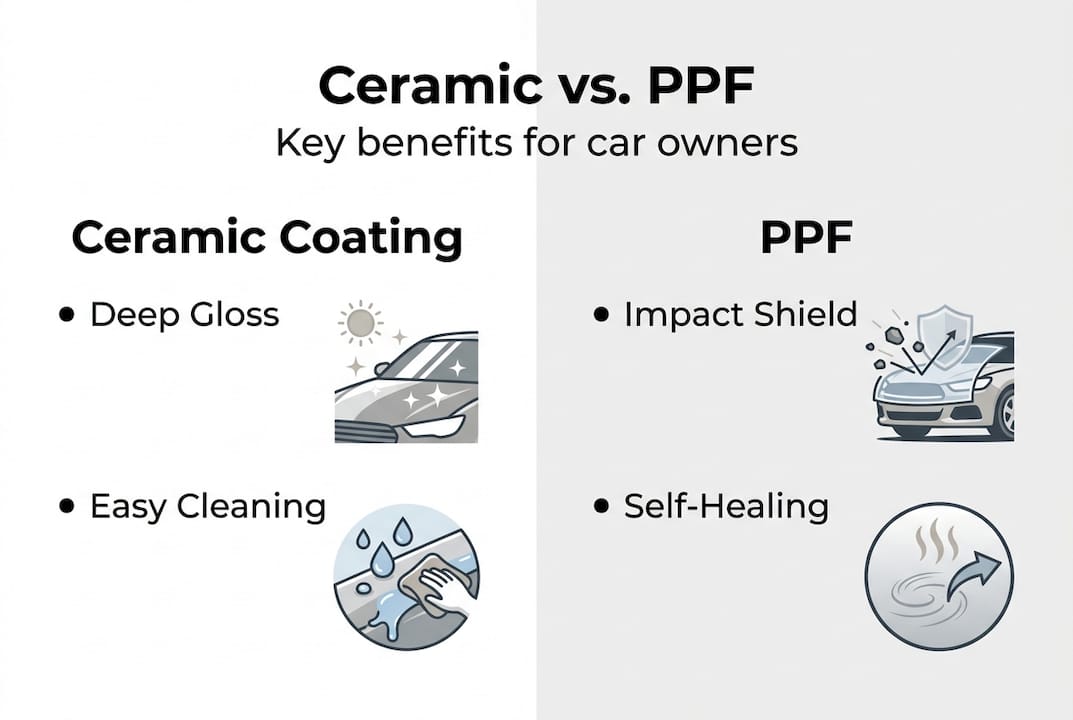
Ceramic suits daily shine and easy upkeep, while PPF defends against physical impacts like highway chips. Neither is universally better. They solve different problems.
Here’s a side-by-side comparison:
| Factor | Ceramic coating | PPF |
|---|---|---|
| Primary benefit | Gloss, UV protection, easy cleaning | Physical impact resistance |
| Lifespan | 2 to 5 years | Up to 7 years |
| Best for | Daily drivers, show cars, fleet vehicles | Highway commuters, new cars, high-value vehicles |
| Limitation | Won’t stop rock chips | Less gloss enhancement than ceramic |
| Cost range | Moderate | Higher upfront |
Now let’s match coating type to driver profile:
- Urban commuter in Cherry Hill or Vineland: Ceramic is your best value. Stop-and-go traffic means fewer rock chips but lots of UV exposure, bird droppings, and car wash swirl risk.
- Highway driver on I-295 or the AC Expressway: PPF on the front bumper, hood, and mirrors is a smart move. High-speed debris is your biggest threat.
- Outdoor parker year-round: Ceramic handles UV and salt spray well, but pairing it with PPF on vulnerable panels gives you a real advantage.
- Car enthusiast or collector: Combine both. Ceramic on the full vehicle for gloss and protection, PPF on high-impact zones for physical defense.
The myth worth busting here is that you have to choose one or the other. Many serious owners in South Jersey use both, layering ceramic over PPF for maximum coverage. Mobile detailing in South Jersey makes it easy to get a professional consultation and figure out the right combination for your specific vehicle and lifestyle. You can also browse paint protection film examples to see what full and partial PPF coverage looks like on real cars.
Mobile detailing: Bringing expert protection to your driveway
The biggest barrier to getting a quality coating used to be logistics. Take time off work, drop your car at a shop, wait days. Mobile detailing has changed that equation entirely.
Here is what the professional mobile coating process looks like from start to finish:
- Consultation: A mobile detailer assesses your paint condition, driving habits, and goals. This step determines which coating or combination makes sense for your vehicle.
- Paint decontamination: Clay bar treatment and chemical decontamination remove embedded iron particles, road tar, and bonded contaminants that washing alone can’t touch.
- Paint correction: This is the step most DIYers skip and most shops rush. Machine polishing removes swirl marks, light scratches, and oxidation so the coating bonds to flawless paint. Mobile services prioritize paint correction before coating, and this is exactly why professional results look so different from amateur applications.
- Coating application: Whether ceramic, PPF, or both, the product is applied in controlled passes and allowed to cure properly.
- Aftercare guidance: You’ll get specific instructions on when to wash, what products to avoid, and how to maintain the coating for maximum lifespan.
Pro Tip: Schedule your coating appointment during mild weather, ideally spring or fall in South Jersey. Extreme heat or humidity can affect cure times and bonding quality. Ask your detailer about their setup for temperature-controlled application.
Mobile detailing is surging among professionals and enthusiasts because it respects your time without sacrificing quality. Explore mobile auto care examples to see how busy South Jersey drivers are protecting their vehicles without ever leaving home or the office.
Our perspective: What most South Jersey owners get wrong about coatings
After working with hundreds of vehicles across South Jersey, one pattern stands out clearly. Owners either expect too much from a single coating or skip the prep entirely, then blame the product when results disappoint.
The biggest mistake is treating coatings like a one-time fix. A ceramic coating applied over contaminated or swirled paint will seal those flaws in permanently. You’ll have a glossy car with trapped imperfections underneath. That’s not protection. That’s expensive regret.
The second mistake is chasing “superhero” marketing claims. Neither ceramic nor PPF is a full suit of armor, and matching protection to your actual usage always outperforms buying the most expensive option without a plan.
What real-world mobile detailing experience reveals is that the South Jersey climate is genuinely tough on vehicles. Salt, UV, and humidity work together in ways that accelerate paint degradation faster than owners expect. Pairing the right coatings with proper prep and maintenance is what actually delivers long-term results. For fleet operators, the same logic applies at scale, and ceramic coatings for fleets show how consistent protection across multiple vehicles pays off over time.
Protect your investment: Expert coatings and mobile detailing in South Jersey
If you’ve made it this far, you already know more about protective coatings than most South Jersey vehicle owners. Now it’s time to put that knowledge to work.

At CDC Auto Detailing, we bring professional-grade ceramic coating service and paint protection film service directly to your driveway, office, or anywhere in South Jersey. Every application starts with thorough paint correction so your coating bonds to a flawless surface. Whether you drive a daily commuter or a weekend show car, our mobile detailing solutions are built around your schedule and your vehicle’s specific needs. Reach out today to book a consultation and find the right protection plan for how you actually drive.
Frequently asked questions
Will protective coatings make my car scratch-proof?
No coating is truly scratch-proof. Coatings reduce damage from everyday hazards but won’t protect against deep scratches from keys, sharp debris, or heavy impacts.
How long does ceramic coating last compared to PPF?
Ceramic coatings typically last 2 to 5 years, while PPF generally outlasts ceramic with a lifespan of up to 7 years, provided both receive proper maintenance.
Is mobile application of coatings as effective as shop installation?
Yes. Reputable mobile services match studio quality when prep and aftercare are done correctly. Mobile detailers prioritize paint correction and best practices before installing any premium coating.
Do I need both ceramic coating and PPF?
Not always, but many professionals combine ceramic and PPF for maximum coverage, especially for high-impact areas and vehicles driven daily on South Jersey highways.
Recommended
- How to Apply Ceramic Coating for Long-Lasting Car Protection
- Ceramic Coatings: How They Safeguard Car Paint
- Why use self-healing coatings for vehicle paint protection
- Top paint protection film examples to safeguard your car
- Roof Coatings | Commercial Roofing Services, Storm Restoration & Inspections