
Most vehicle owners believe paint protection is a one-time application that gradually degrades until replacement. Self-healing coatings challenge this assumption by automatically repairing minor damage, extending paint life through continuous regeneration. These innovative coatings use advanced polymer chemistry to detect scratches and restore surface integrity without human intervention. For South Jersey drivers facing road salt, UV exposure, and environmental contaminants, self-healing technology offers a proactive defense that traditional coatings cannot match. This article explains how these coatings work, compares available types, and provides practical guidance for selecting the right protection for your vehicle.
Table of Contents
- How Self-Healing Coatings Work To Protect Your Vehicle
- Types Of Self-Healing Coatings And Their Advantages For Vehicles
- Innovations In Polymer-Based Self-Healing Coatings For Paint Protection
- Practical Benefits And Considerations For Choosing Self-Healing Coatings
- Explore Expert Self-Healing Coating Services At CDC Auto Detailing
- What Are The Common Questions About Self-Healing Coatings?
Key takeaways
| Point | Details |
|---|---|
| Automatic repair capability | Self-healing coatings detect and repair minor scratches without manual intervention, maintaining paint integrity continuously. |
| Two primary categories | Extrinsic coatings use embedded capsules while intrinsic coatings rely on reversible chemical bonds for damage repair. |
| Polymer-based superiority | Advanced polymer matrices offer repeatable healing cycles, recyclability, and enhanced durability compared to conventional options. |
| Climate adaptability | Modern formulations respond to temperature triggers and environmental conditions common in South Jersey driving. |
| Professional application matters | Certified installers ensure proper coating selection and application for maximum protection performance and longevity. |
How self-healing coatings work to protect your vehicle
Self-healing coatings represent a fundamental shift in automotive paint protection technology. Unlike static barriers that simply resist damage, these intelligent materials actively respond to surface injuries. When a scratch or impact occurs, the coating initiates repair mechanisms that restore both appearance and protective function.
The science behind this technology involves three primary mechanisms. Capsule-based systems embed microscopic containers filled with healing agents throughout the coating matrix. When damage breaks these capsules, the contents flow into the scratch and polymerize, filling the gap. Reversible bond systems use chemical connections that can break and reform repeatedly, allowing the material to flow back together after separation. Microvascular networks create channels within the coating that deliver healing compounds to damaged areas on demand.
Polymer chemistry drives these innovations. Dynamic covalent bonds allow molecular chains to disconnect and reconnect under specific conditions like heat or UV exposure. Supramolecular interactions create temporary connections between molecules that reform after disruption. These mechanisms enable coatings to restore mechanical and electrochemical functions after scratches compromise the surface.
Hybrid composites combine organic polymers with inorganic particles to enhance both healing capability and physical toughness. The organic component provides flexibility and self-repair function while inorganic elements add scratch resistance and UV stability. This combination addresses the traditional tradeoff between hardness and healing ability.
Pro Tip: Self-healing works best on minor scratches and swirl marks. Deep gouges that penetrate through the coating to bare paint still require professional correction before recoating.
The repair process typically occurs within hours to days depending on temperature and damage severity. Warmer conditions accelerate molecular movement and healing speed. Some advanced formulations incorporate photo-responsive molecules that heal faster under sunlight, making them ideal for vehicles stored outdoors. Understanding these mechanisms helps vehicle owners set realistic expectations and choose appropriate certified installer services for their protection needs.
Compared to traditional static coatings, self-healing options extend protection lifespan significantly. Conventional barriers gradually accumulate microscratches that compromise appearance and allow moisture penetration. Self-healing coatings continuously repair this damage, maintaining both aesthetic quality and barrier protection functions throughout their service life.
Types of self-healing coatings and their advantages for vehicles
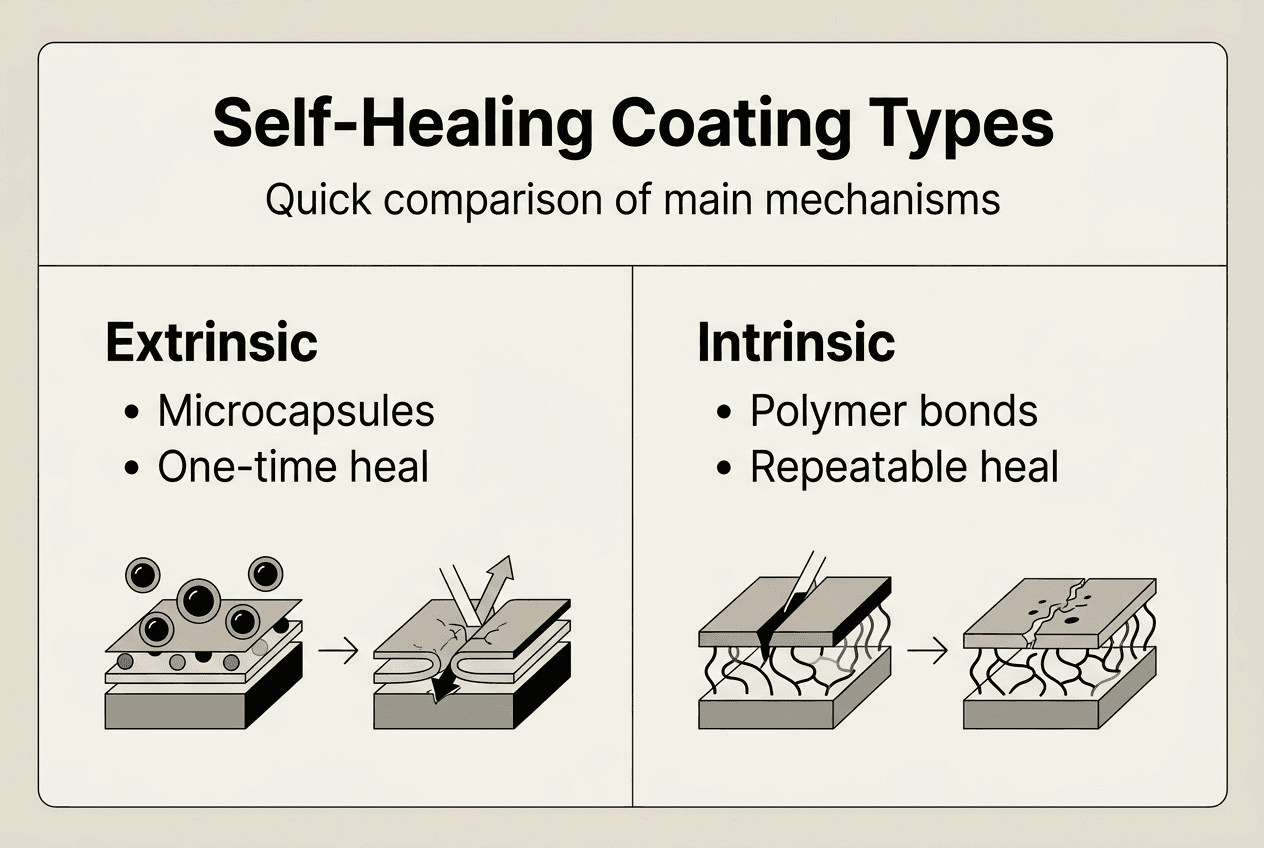
The automotive coating industry classifies self-healing technologies into two main categories based on healing mechanism design. Each type offers distinct advantages for different vehicle protection scenarios and owner preferences.
Extrinsic healing systems incorporate separate healing agents stored within the coating structure. Microencapsulated designs embed tiny spheres filled with repair compounds throughout the polymer matrix. When damage ruptures these capsules, the contents release and fill scratches. Hollow fiber systems create a network of channels containing healing liquids that flow to damaged areas. These approaches provide substantial healing capacity for deeper scratches but have limited reusability since capsules cannot refill after rupture.
Intrinsic healing systems build repair capability directly into the polymer chemistry. Reversible covalent bonds allow molecular chains to break and reconnect repeatedly without external healing agents. Hydrogen bonding systems use weak intermolecular forces that reform spontaneously after separation. These designs enable multiple healing cycles at the same location, though they typically work best on shallow surface damage.
| Feature | Extrinsic coatings | Intrinsic coatings |
|---|---|---|
| Healing mechanism | Capsules or reservoirs release repair agents | Reversible chemical bonds reform automatically |
| Repair depth | Handles deeper scratches effectively | Best for shallow surface damage |
| Reusability | Limited by capsule depletion | Multiple healing cycles possible |
| Application complexity | More complex formulation and application | Simpler chemistry and installation |
| Durability | Excellent initial protection | Superior long-term performance |
Vitrimeric systems represent an emerging hybrid approach that combines properties of both categories. These coatings use special crosslinked networks that can rearrange their structure under heat without breaking down. This allows both self-healing and recyclability, addressing environmental concerns while maintaining protection performance.
Pro Tip: For daily drivers in South Jersey, intrinsic coatings often provide better value due to their repeatable healing capability and resistance to the freeze-thaw cycles common in the region.
Polymer-inorganic hybrids add another dimension to coating selection. These formulations incorporate ceramic nanoparticles or silica compounds into self-healing polymer matrices. The inorganic phase enhances scratch resistance and chemical stability while the organic component maintains healing function. This combination suits vehicles requiring maximum durability alongside self-repair capability.
Choosing between coating types depends on vehicle usage patterns and protection priorities. Show cars stored indoors benefit from extrinsic systems that handle occasional deeper scratches. Daily drivers exposed to constant environmental stress perform better with intrinsic coatings that heal repeatedly. Understanding these distinctions helps owners select appropriate coating brands and protection strategies for their specific needs.
Innovations in polymer-based self-healing coatings for paint protection
Recent advances in polymer science have dramatically improved self-healing coating performance for automotive applications. Modern formulations address previous limitations in healing speed, durability, and environmental adaptability while introducing new capabilities like recyclability and multi-stimulus response.
Polymer-inorganic hybrid composites represent the current frontier in coating technology. These materials combine flexible polymer chains with rigid inorganic nanoparticles to achieve properties impossible with either component alone. The polymer matrix provides self-healing through dynamic bonds while ceramic or silica particles add hardness and UV resistance. Healing triggers include heat, light, pH changes, or mechanical stress, allowing the coating to respond automatically to damage conditions.
Vitrimeric systems offer a breakthrough in sustainability alongside protection performance. These crosslinked networks can rearrange their molecular structure at elevated temperatures without degrading. This property enables both self-repair of scratches and complete recycling at end of life. For environmentally conscious vehicle owners, vitrimers provide guilt-free protection that does not compromise performance.
| Polymer matrix | Healing mechanism | Protection duration | Environmental resistance | Cost factor |
|---|---|---|---|---|
| Epoxy-based | Reversible Diels-Alder bonds | 3-5 years | Excellent chemical resistance | High |
| Polyurethane | Hydrogen bonding networks | 2-4 years | Good flexibility and impact resistance | Medium |
| Silicone hybrid | Supramolecular interactions | 4-6 years | Superior UV and temperature stability | Premium |
| Polyimine | Dynamic covalent exchange | 3-5 years | Outstanding moisture resistance | Medium-high |
Dynamic covalent chemistry enables the most advanced healing capabilities. These systems use chemical bonds that can reversibly break and reform under specific conditions. Disulfide exchanges respond to heat, allowing scratches to heal when the vehicle warms in sunlight. Imine bonds react to moisture and pH changes, providing healing in humid conditions. Diels-Alder reactions use temperature cycling to repair damage through molecular rearrangement.
Supramolecular interactions offer another pathway to self-healing. These non-covalent bonds between molecules are weaker than traditional chemical bonds but reform spontaneously after separation. Hydrogen bonding, metal-ligand coordination, and pi-pi stacking all enable healing at room temperature without external triggers. This makes supramolecular coatings ideal for vehicles that cannot rely on heat activation.
Pro Tip: Ask installers about the specific polymer matrix and healing mechanism in their coatings. Understanding these details helps predict performance in your local climate and usage conditions.
The superiority of polymer-based self-healing systems over traditional materials stems from their molecular design. Conventional coatings rely purely on physical barriers that degrade irreversibly. Self-healing polymers actively maintain their structure through continuous repair, effectively extending paint life and reducing maintenance frequency. This active protection approach aligns with modern expectations for smart materials that adapt to environmental challenges.
Current research focuses on multi-responsive systems that heal through multiple pathways simultaneously. A coating might combine heat-activated covalent exchange with moisture-triggered hydrogen bonding, providing redundant healing mechanisms. This redundancy ensures protection performance across varying conditions, making coatings more reliable for diverse climates and usage scenarios. South Jersey vehicle owners benefit particularly from these advances given the region’s temperature extremes and coastal humidity.
Practical benefits and considerations for choosing self-healing coatings
Understanding technical mechanisms matters less than knowing how self-healing coatings improve your vehicle ownership experience. These practical advantages translate coating science into real-world value for South Jersey drivers.
Key benefits include:
- Automatic scratch repair eliminates the need for frequent paint correction, saving time and money on professional detailing
- Extended paint longevity preserves vehicle resale value by maintaining factory finish appearance for years longer than conventional protection
- Reduced maintenance frequency means fewer wash-related scratches and less time spent on appearance upkeep
- Enhanced corrosion resistance protects against road salt and coastal moisture that accelerate paint degradation
- Improved gloss retention maintains showroom shine despite environmental exposure and normal wear
These advantages over traditional coatings become apparent within months of application. Vehicle owners report fewer visible swirl marks after washing and sustained gloss levels that would typically fade. The coating continuously works to maintain appearance without owner intervention.
Selecting the right coating requires evaluating several factors:
- Assess your vehicle usage patterns and exposure conditions to determine healing mechanism needs
- Research available coating brands and their specific polymer chemistry to match your climate
- Verify installer certification and experience with the chosen coating system
- Compare warranty terms and coverage to understand long-term protection guarantees
- Calculate total cost including application, maintenance products, and expected lifespan
- Review independent testing data and customer experiences with specific formulations
South Jersey’s climate presents specific challenges that influence coating selection. Winter road salt requires excellent chemical resistance. Summer heat and UV exposure demand photo-stable formulations. Coastal humidity favors moisture-resistant polymer matrices. Freeze-thaw cycles test coating flexibility and adhesion. Matching coating properties to these conditions ensures optimal protection performance.
Maintenance practices significantly impact self-healing effectiveness. Regular washing removes contaminants that can interfere with healing mechanisms. Using pH-neutral shampoos prevents chemical degradation of polymer bonds. Avoiding automatic car washes eliminates harsh brushes that cause damage beyond healing capacity. Periodic inspections identify areas needing professional attention before minor issues become major problems.
Pro Tip: Schedule annual coating inspections with your installer to assess healing performance and address any areas showing wear. This proactive approach maximizes coating lifespan and maintains consistent protection.
Authenticity matters when selecting self-healing products. The market includes numerous coatings claiming self-healing properties without genuine molecular mechanisms. Verify that chosen brands provide technical documentation of their healing chemistry. Ask installers to explain the specific mechanisms in their products. Legitimate self-healing coatings will have published research or patent information supporting their claims.
Professional application ensures coating performance meets expectations. Proper detailing preparation removes contaminants and corrects existing paint defects before coating application. Controlled environmental conditions during curing prevent premature damage. Certified installers understand these requirements and have the equipment to execute them correctly. While DIY application might seem cost-effective, professional installation provides warranty protection and performance guarantees worth the investment.
Explore expert self-healing coating services at CDC Auto Detailing
Applying the insights from this article starts with connecting to qualified professionals who understand self-healing coating technology. CDC Auto Detailing brings certified expertise in advanced coating systems to South Jersey vehicle owners seeking maximum paint protection.
Our team specializes in popular self-healing ceramic coating brands that combine proven polymer chemistry with real-world durability. We guide clients through coating selection based on vehicle type, usage patterns, and protection priorities. Every application includes comprehensive paint correction to ensure optimal bonding and appearance.

Our ceramic coating services in Pitman, NJ extend beyond basic application. We provide detailed maintenance guidance, periodic inspections, and warranty support to maximize your coating investment. Mobile service brings professional-grade protection to your location, eliminating the inconvenience of shop visits.
Understanding how auto detailing works helps you appreciate the preparation required for successful coating application. Our process addresses every factor that influences coating performance, from surface contamination removal to environmental control during curing. This attention to detail ensures your self-healing coating delivers the protection and longevity you expect.
What are the common questions about self-healing coatings?
How long do self-healing coatings last on vehicles?
Quality self-healing coatings typically last 3 to 6 years depending on polymer type and environmental exposure. Intrinsic coatings with reversible bonds often outlast extrinsic capsule-based systems because they can heal repeatedly at the same location. Proper maintenance and periodic professional inspections extend lifespan significantly.
Are self-healing coatings suitable for all car paint types?
Self-healing coatings work on all modern automotive paint systems including single-stage, basecoat-clearcoat, and ceramic-infused factory finishes. The coating bonds to the clearcoat layer, providing an additional protective barrier regardless of underlying paint chemistry. Older vehicles with oxidized or failing paint require correction before coating application for proper adhesion.
Can minor scratches always fully heal on their own?
Self-healing coatings repair scratches that remain within the coating layer itself, typically up to 2-3 microns deep. Deeper damage that penetrates to the underlying clearcoat or paint requires professional correction. Healing speed and completeness depend on scratch severity, ambient temperature, and the specific polymer chemistry used in the coating formulation.
What maintenance is needed for optimal coating performance?
Maintain self-healing coatings through regular washing with pH-neutral shampoos and microfiber wash media to prevent contamination buildup. Avoid automatic car washes with harsh brushes that exceed coating healing capacity. Apply coating-safe detail sprays between washes to maintain hydrophobic properties. Annual professional inspections identify any areas needing attention before minor issues compromise protection.
How do self-healing coatings compare cost-wise to traditional coatings?
Self-healing coatings cost 30 to 50 percent more initially than conventional ceramic coatings due to advanced polymer chemistry and application expertise required. However, they reduce long-term maintenance costs by eliminating frequent paint correction needs and extending protection lifespan. Total cost of ownership often favors self-healing options for vehicles kept longer than 3 years.
Do self-healing coatings work in cold weather conditions?
Most self-healing mechanisms slow significantly below 50°F but resume normal function when temperatures rise. Some advanced formulations incorporate multiple healing pathways, including mechanisms that function at lower temperatures. South Jersey’s climate allows adequate healing during spring through fall, with winter damage repairing once temperatures moderate. Garage storage during extreme cold optimizes year-round performance.