
Door cup paint protection is a small, clear piece of paint protection film (PPF) that sits in the recess behind each door handle. It takes the scratches from fingernails, rings, keys and bag straps, so your paint doesn’t. It is one of the cheapest, least visible upgrades you can make to a car, and it works best when it is cut for your exact vehicle and installed on clean, fully prepared paint. This guide covers what the film does, what to check before you buy, how installation works, how to care for it and how to get it done in South Jersey.
TL;DR
- Door cups are the recessed pockets behind the handles. They collect swirls and scratches every time someone reaches in to pull the door open.
- Clear PPF over the cup is nearly invisible and takes those marks in place of your clear coat.
- Check the exact year and trim fit, film material, a self-healing top coat and a written warranty before you commit to any kit or installer.
- Aftercare follows the film maker’s instructions. Plan on keeping the handles dry and free of high-pressure water for a couple of days or longer.
- We install paint protection film in South Jersey and come to you. Ask us to include the door cups in your PPF package.
Table of Contents
- What door cup paint protection actually does
- Door cup film versus other options
- What to check before you buy or book
- How door cup film is installed
- Care and curing: the first days matter
- What door cup protection costs
- Our perspective
- Protect your door cups with CDC Detailing
- Choosing the right level of protection
- FAQ
- Sources
What door cup paint protection actually does
The door cup is the shallow dish in the body panel behind the handle. Every time you pull the handle, your fingers, rings, keys or a purse strap drag across that paint. Over months it becomes a web of fine scratches that catches the light, and it is often the first place a car starts to look tired.
3M’s paint protection film FAQ says door handle cavities can be protected from rings, keys, belt buckles and purses. The same film also helps against scratches, chips and stains on other panels. Film makers sell dedicated door cup pieces for the same reason. For example, XPEL describes its universal door cup as a durable polyurethane film with a clear-coat finish. It is virtually invisible and intended to prevent chips, scratches and scuffs, including from rings when you open the door.
In practice, the film is a sacrificial layer. Light scratches land on the film, not on your factory clear coat. Many modern films can also recover from light marks on their own, which we cover below.
Who benefits most
Almost every driver benefits, but a few situations make it close to a must:
- Daily drivers with several people in them. More hands means more scratches.
- Drivers who wear rings or carry keys on a lanyard or belt. Metal on paint is the classic cause of cup damage.
- Dark paint colors. Fine scratches show up most on black, deep blue and dark gray.
- Anyone planning to sell or trade in. Clean door cups tell a buyer the car was looked after.
- Lease returns. Cup scratches are a common small flaw at lease turn-in.
Door cup film versus other options
There are a few ways to protect the area, and they differ in looks and durability. Autixio’s door handle guide separates clear PPF, silicone cup guards and PVC strips. In that guide, clear PPF is the least visually intrusive. Silicone is softer and can be repositioned. PVC is inexpensive but may need replacing sooner in extreme heat.
Here is how that breaks down in everyday terms:
| Option | Look | Best for | Things to know |
|---|---|---|---|
| Clear PPF (TPU) | Nearly invisible | Anyone who wants a factory look | Vehicle-specific cut gives the best coverage |
| Silicone cup guard | Visible, soft texture | Quick, repositionable protection | Sits on top of the paint and shows |
| PVC strip | Visible, often stiff | Lowest upfront cost | May need earlier replacement in hot conditions |
For most owners who care about the look of the car, clear PPF is the choice. It also matches the film you may already want on the hood, fenders and mirrors, so one install can cover everything at once.
What to check before you buy or book
Not all door cup film is equal. AP Motor Co’s guide to choosing a PPF kit says to check the exact vehicle year and trim, film material and thickness, a self-healing top coat, a written warranty, edge style, installation instructions and fit or return terms. Use that as your checklist.
Film material and thickness
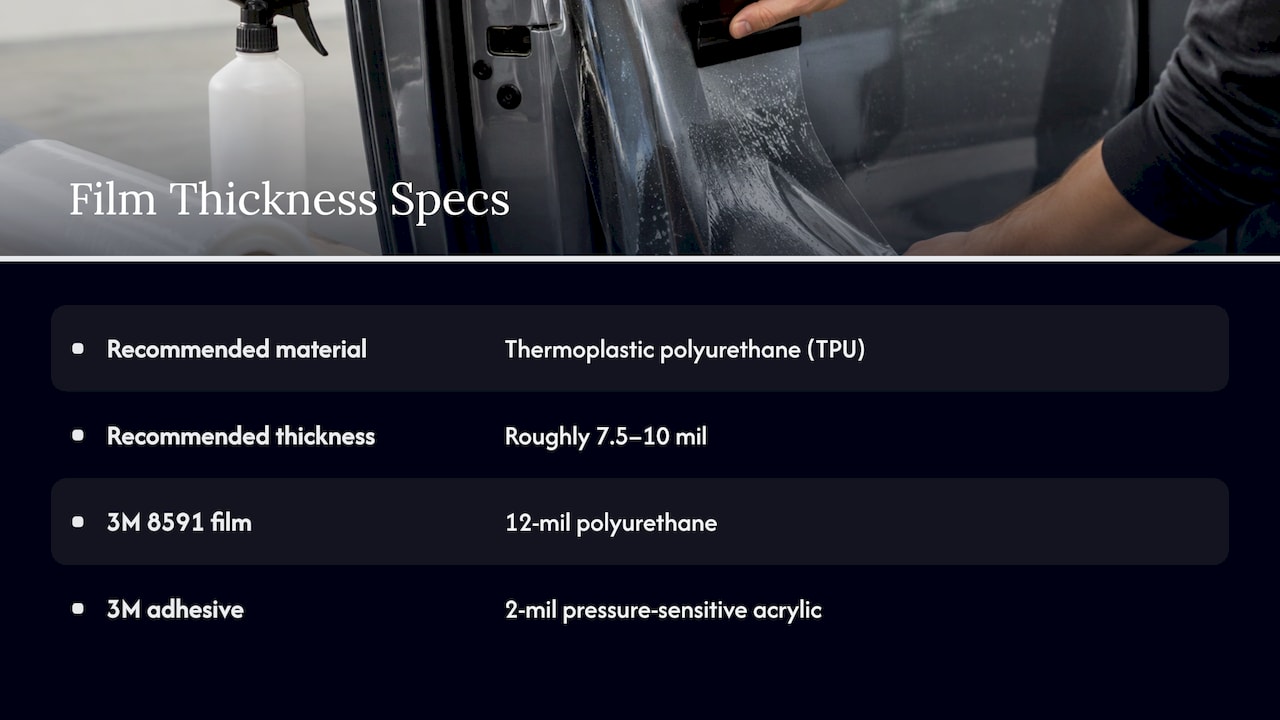
The same guide recommends thermoplastic polyurethane (TPU) rather than PVC or vinyl. It points to roughly 7.5 to 10 mil thickness, a self-healing topcoat, and a written warranty against yellowing, cracking and peeling. Thickness matters in a door cup because the film has to bend into a curved pocket without lifting at the edges.
Film makers also publish specs. 3M’s 8591 film, for example, is a 12-mil polyurethane film with a 2-mil pressure-sensitive acrylic adhesive. It is flexible, die-cuttable and sold die-cut or pre-masked, and it has no clear coat, which suits non-visible surfaces. Some films are sold with a glossy or matte finish, so confirm the finish matches how you want the car to look.
Exact fit for your vehicle
A cup that is too small leaves bare paint along the edges, and one that is too large wrinkles. Pre-cut patterns exist for most models. 3M’s brochure says its PSC software offers PPF cutting patterns for most vehicle models, and it presents door edge guards, door handles and door cups as separate coverage areas in its protection packages. When you get a quote, confirm in plain words whether door cups, handle surrounds and door edges are all included or priced separately.
Warranty and its limits
Before you pay, ask what the warranty covers and in writing. A manufacturer warranty is often about the film itself. For instance, Rvinyl’s 3M Pro Series door cup listing states that its manufacturer warranty covers only the value of the product and excludes labor, paint damage, installation costs and other incidental expenses. That is how many film warranties are written, so read the terms before you install anything.
Self-healing is also worth understanding. It applies to light surface marks, not to cuts through the film, according to TeslaDIYRepair’s PPF aftercare guide. The same guide advises against generic heat gun settings and against pointing pressure at film edges. If you want the full picture on how self-healing films work, our page on self-healing paint protection film walks through it.
How door cup film is installed
Installation is simple in concept and unforgiving in detail. The recess is small, curved and often has a lip, so a clean surface and a steady hand matter.
- Wash and decontaminate. Remove dirt, wax and road film from the cup and the area around it.
- Wipe with alcohol. Rvinyl’s DIY guide lists 70% isopropyl alcohol and microfiber towels among its supplies, along with slip solution and a small rubber squeegee. A hair dryer or heat gun is optional.
- Wet the surface and the adhesive side. Slip solution lets you slide the film into position before it grabs.
- Position the vehicle-specific piece. XPEL’s directions call for a mix of 1 quart of water with 3 drops of dishwashing liquid. You spray it on the adhesive, slide the film into place and squeegee the water out.
- Squeegee from the center outward. This pushes out the water and any air.
- Warm curved sections gently. A little heat helps the film conform to the curve. Then dry the edges and let the film cure.
The how-to is the same on most cars, but the details change by manufacturer and by vehicle. If you are curious how the full process runs on a whole vehicle, see our paint protection film workflow and our PPF installation explained guides.
The DIY route
Door cup kits are among the more approachable DIY films. Rvinyl lists 3M Pro Series door cup wraps at $4.98 per unit, so materials cost very little. The trade-off is time, patience and risk. A crooked piece, trapped dust or an overheated edge means peeling it and starting again. If you want to see what is involved, we have a DIY paint protection film guide and an installation guide for DIYers.
Most owners who start with a door cup kit find that the real value is in perfect prep and a clean, dust-free space. A professional installer works in controlled conditions, which is why many owners hand the job over, especially when they are also protecting larger panels.
Care and curing: the first days matter
The first days after installation decide how well the edges seal. Cure times vary by film, so the product’s own instructions always win.
- Rvinyl says to avoid washing or using high-pressure water near the handles for at least 48 hours.
- UPPF-USA’s FAQ recommends waiting 3 to 5 days after installation before washing.
- TeslaDIYRepair’s guidance, drawn from film makers, gives examples of 48 hours for one XPEL film and at least 72 hours for certain 3M films.
The safest plan is to follow the longest window your installer or film maker gives you. After that:
- Use a pH-neutral shampoo and soft microfiber. UPPF-USA advises avoiding harsh chemicals and abrasive soaps.
- Keep pressure washer nozzles away from film edges.
- Don’t scrub the cup with a dry towel, which can drag grit across the film.
- Trim long fingernails and take care with rings when you open the door. The film is there for the occasional slip, not for constant abuse.
With that care, UPPF-USA says PPF can last up to 10 years. Real life varies with sun, climate and washing habits. If you want a good look at keeping a protected car looking sharp, our exterior detailing service is built for exactly that. It also helps at sale time, and a guide to photographing a car for sale shows how much clean details matter in listing photos.
What door cup protection costs
Materials for a DIY door cup set are cheap, as noted above: a per-door-cup price under $5 for a well-known film. Professional installation costs more because you are paying for prep, a precise cut, controlled conditions and labor. Door cups are usually quoted as part of a bigger package, such as front-end coverage or full-vehicle PPF, and the pricing depends on the vehicle and the coverage you choose.
We don’t publish a price for paint protection film because it depends on the vehicle and the coverage. Our mobile service has two published fees: a $100 booking charge, and a mobile detailing additional fee that starts from $100. You can see them on our detail packages page. For a PPF quote, contact us with your year, make, model and the panels you want covered.
Our perspective
We see the same thing on cars across South Jersey: the door cups are the first place the paint shows age. Nobody notices when it starts, and then one sunny day you see a halo of fine scratches around each handle.
That is why we treat door cups as part of any paint protection plan, not as an afterthought. The film is thin, nearly invisible and designed to take the daily wear that would otherwise land on your clear coat. When it is cut for your vehicle and put on a properly prepared surface, it does that job quietly for years.
We prefer to do it on its own schedule and with the right surface prep, which is why we come to you. A mobile appointment lets you keep the car at home while we work, and lets us document the process for resale and long-term asset protection.
If you are already thinking about protecting the hood, fenders or mirrors, add the cups at the same time. It is the same film, the same prep and the best value per square inch on the car.
Charles
Protect your door cups with CDC Detailing
We are a mobile detailing service based in Pitman, New Jersey, serving vehicle owners across South Jersey. We install paint protection film and can come to your home or workplace.
When you request a paint protection film quote, tell us your vehicle and mention the door cups. If you want a clean base first, our detail packages start at $375 for the Bronze Package. Ceramic coatings are also available if you want slick, easy-to-wash paint around the film. See our ceramic coating options. To get started, use the contact form on our website.
Choosing the right level of protection
Door cups are the starting point. Many owners go on to add more coverage. You can browse types of paint protection to compare options. A rough guide:
- Door cups and handles only. Best for owners on a budget, leased cars or older vehicles where the cups are the main wear point.
- High-impact areas. Add the front bumper, hood edge, fenders and mirrors to take rock chips on the highway.
- Full front end or full vehicle. Best for new vehicles, dark colors and long-term owners.
- Film plus ceramic coating. Film takes the impacts, and a coating on top makes washing easier.
Whichever you pick, get the coverage list in writing so you know whether the cups, handle surrounds and door edges are included.
FAQ
Do door cup protectors really prevent scratches?
Yes, they take the scratches from rings, keys, fingernails and bag straps in place of your paint. 3M’s FAQ says door handle cavities can be protected from these. Deep gouges can still cut through the film, so use normal care.
Is door cup film visible?
Clear TPU film is designed to be virtually invisible once installed. Edges can show slightly on some cars, which is why a vehicle-specific cut and careful installation matter. Silicone guards and PVC strips are more visible.
How long should I wait before washing the car after installation?
Follow the film maker’s instructions. Guidance ranges from 48 hours to 3 to 5 days depending on the film. Avoid high-pressure water near the handles during that time, and ask your installer for the exact window for your film.
Can I install door cup film myself?
Yes, kits are made for DIY, and materials cost under $5 per unit for a well-known film. The job needs clean paint, slip solution, a small squeegee and patience. If you would rather not risk a crooked or contaminated piece, a professional install in a controlled setting is a good option.
Sources
- 3M Paint Protection Film FAQ
- XPEL Universal Door Cup
- How to choose a PPF kit
- Door Handle PPF and Cup Protectors guide
- 3M Paint Protection Film 8591
- 3M Pro Series door cup protection wraps
- Why door cup protection is a smart DIY project
- UPPF FAQ
- Tesla PPF installation and aftercare
- How to photograph a car for sale