
Yes, mobile detailing works in winter, but not every service works on every day. Interior cleaning is nearly weather-proof. Exterior washing needs water that can be removed before it freezes. Coatings, paint protection film and window tint need stable temperatures, so they often belong on a mild day or under a roof. Below is how to tell which is which, so you book the right service for the right week.
TL;DR
- Interior detailing is the safest winter mobile service. Outdoor washing is the one that depends on the forecast.
- A practical washing range is roughly 35°F to 50°F. Near or below freezing, the question is whether water can be dried off before it turns to ice.
- Window tint, ceramic coating and PPF cure slowly in the cold. Expect extra days before you roll windows down or wash the car.
- Road salt does its damage in wheel wells, seams and the underbody, so a winter detail is about removing it, not just shine.
- Ask your detailer how they decide to go ahead, change the service or reschedule. A good one has a clear answer.
Table of Contents
- Can you detail a car outdoors in winter?
- What temperatures are workable?
- Why interior detailing is the winter workhorse
- Washing the outside without freezing the car
- Where the wash water goes
- Coatings, tint and film: the cold-weather limits
- What a mobile detailer has to do to work in the cold
- Perspective: how we think about winter jobs
- A simple winter plan for your vehicle
- Book a winter detail with us
- FAQ
- Sources
Can you detail a car outdoors in winter?
Often, yes. The better question is what has to be true on the day. Detail Compass frames it as a set of checks covering the worker, the site, the products, the equipment and the drying plan. Work proceeds when each passes; it is held, moved or postponed when a required condition fails or is unknown (Detail Compass).
That matches how experienced people think about it. Temperature alone is not the deciding factor. Drive Smart Tools points to wind, humidity, sunlight, how cold the vehicle already is, whether temperatures are falling, and whether the work is indoors. The controlling issue is whether water can come off before it freezes, and whether the car will then sit outside with wet seals, handles, mirrors or locks.
For a car owner in South Jersey, where winter days often swing from the 20s overnight to the 40s by afternoon, that means timing matters as much as the date. A job booked for early afternoon on a sunny day is a different job from the same appointment at 8 a.m. on a windy morning.
What temperatures are workable?
A useful working range for washing is 35°F to 50°F. Chemical Guys notes that below 32°F water can freeze on the vehicle, and that below 20°F it advises avoiding a wash unless setup, tools and time are adequate. It also notes that midday sun can warm panels enough to help stop water from freezing.
AAA’s Northeast publication gives the same advice in plain terms: outdoor winter washing is best saved for a relatively mild day or the warmest part of midday, and a heated garage keeps wash water from icing up and helps avoid frozen doors (AAA Northeast).
Here is how that translates into decisions:
| Condition | What it usually means for the job |
|---|---|
| 35°F to 50°F, dry, some sun | Normal exterior wash is realistic |
| Around freezing, light wind | Rinseless method, small sections, immediate drying |
| Below 32°F with falling temperatures or ice on the ground | Interior work, or wait |
| Below 20°F | Avoid washing unless there is a covered, adequate setup |
These are working ranges, not guarantees. Panel temperature, product temperature and air temperature can all differ, which is why Detail Compass advises evaluating them separately and following each product’s label for application, drying, curing and storage.
Why interior detailing is the winter workhorse
Winter is hard on interiors. Salt tracked in on boots dries into white crusts on carpet, wet floor mats hold moisture against the floor pan, and closed windows trap smells. None of that depends on outdoor water.
Our Interior Detail starts from $275, and it is the service we would point most owners to between December and February. Vacuuming, carpet and mat extraction, and a wipe-down of the surfaces you touch every day all work with the car parked in a driveway on a cold day. Because the focus is on the cabin, there is far less water to deal with outside.
If you are not sure what a full interior-and-exterior job covers, what a full-service detail includes lays it out.
Washing the outside without freezing the car
When the forecast allows an exterior wash, technique matters more than usual. AAA’s guidance includes a few points worth remembering:
- Wash one section at a time instead of wetting the whole car.
- Use warm water, not hot. Hot water on a cold windshield can crack the glass.
- Dry the car before the water can freeze. Wet door seals can freeze shut.
DetailerBase recommends switching to a rinseless wash near freezing, which keeps water off the ground and reduces ice buildup under and around the vehicle. That matters for the driveway as much as for the car: ice where you walk is a hazard.
Shopmonkey warns that washing with water in freezing temperatures can leave frozen water spots and cracked paint (Shopmonkey). It also notes that road salt collects in wheel wells, underbody components and seams. Those are the places a quick pass with a hose or a drive-through wash tends to miss, and where corrosion starts.
After any winter wash, the last steps are the ones owners skip: dry door jambs and seals, wipe the handles and mirrors, and, if possible, let the car sit somewhere above freezing before it goes back out. If you want a routine for between professional visits, our guide on keeping your car clean in winter covers it.
Where the wash water goes
This part is rarely discussed and it matters. Wash water can carry sediment, detergents, oils, grease and heavy metals, and the EPA says it can contribute pollutants to stormwater if it is not captured and treated (EPA). The EPA’s example for a small job is a bermed wash area and a wet/dry vacuum, with sewer-authority permission needed for a sanitary sewer connection.
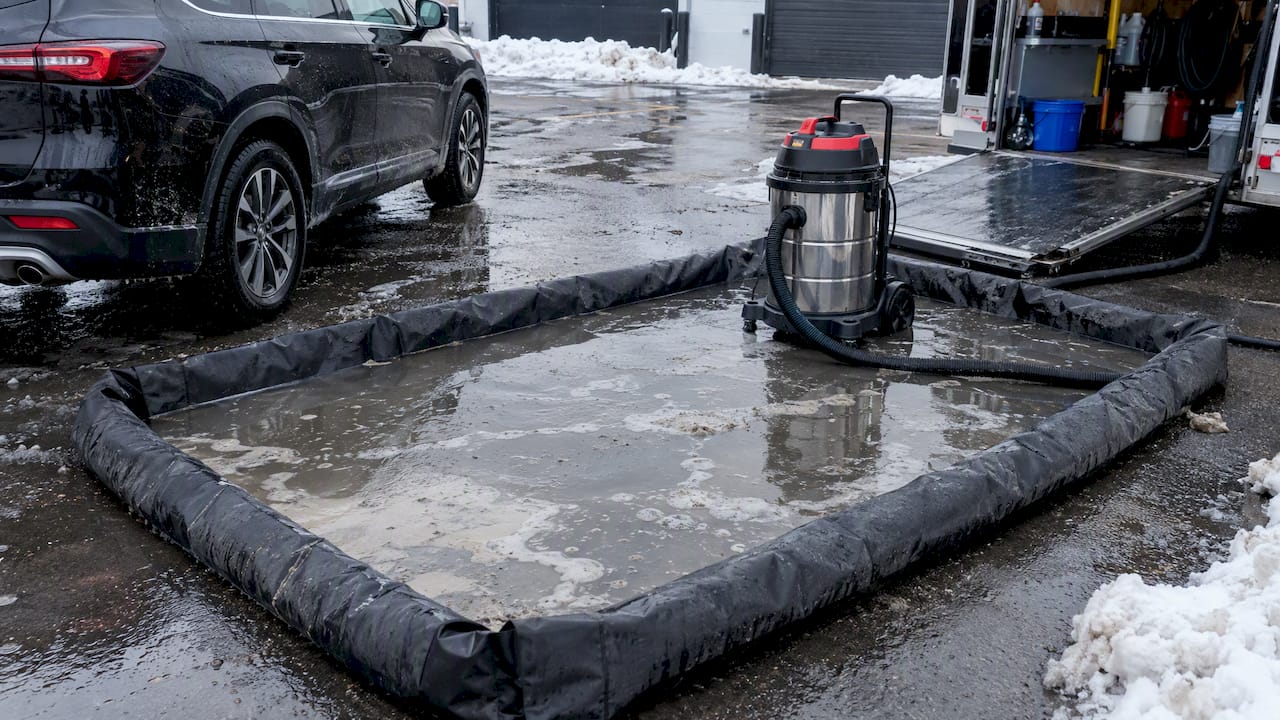
Rules differ by municipality, and the example of a city that treats uncontrolled commercial wash water as illegal is San Diego’s stormwater guidance. The principle applies anywhere: a professional mobile detailer should have a plan for runoff, and in winter that plan doubles as ice control. Ask about it when you book.
Coatings, tint and film: the cold-weather limits
This is where winter changes the most. Paint correction, coatings and PPF are products that cure or bond, and cold slows both. Ideal Image notes that professional shops use climate-controlled bays for services like coatings and PPF, and says those jobs should be done indoors.
Ceramic coating
Coating products have their own temperature and cure instructions, and the label governs. Detail Compass advises following each product’s label and manual for application, drying, curing and ventilation. In practice that means a coating is applied on a mild day or in a sheltered space, and then kept dry and unwashed for the period the manufacturer specifies.
Our ceramic packages run $1,000 to $1,200 for 3 years, $1,500 to $1,700 for 5 years and $2,200 to $2,400 for 8 years, on the ceramic coating page, with a 10% booking charge. Many owners ask whether winter is a bad time to start. It is not a bad time to protect the car, since the salt season is exactly when a coating earns its keep. It is a time to be flexible about the appointment date. For what changes after the coating is on, read our winter maintenance tips for ceramic-coated vehicles and how ceramic coatings protect your car from winter in Pitman, NJ.
Paint protection film
PPF installers adjust their solutions to the environment. 3M’s instructions note that more slip agent is required in hotter environments, while more isopropyl alcohol tack solution is often needed in colder ones (3M). That is a skilled adjustment, and it is one more reason film goes on best in a controlled space. Details are on our paint protection film page.
Window tint cure time in winter
This is what people search for most, and the honest answer is: longer than the summer number. One installer-side source says that below 50°F (10°C) tint takes about a week to cure, because the cold slows moisture evaporation (Protector Automotive). The same source says not to roll newly tinted windows down for at least 5 to 7 days, to skip washing the car for about a week, and to use only gentle, ammonia-free cleaner if you must clean.
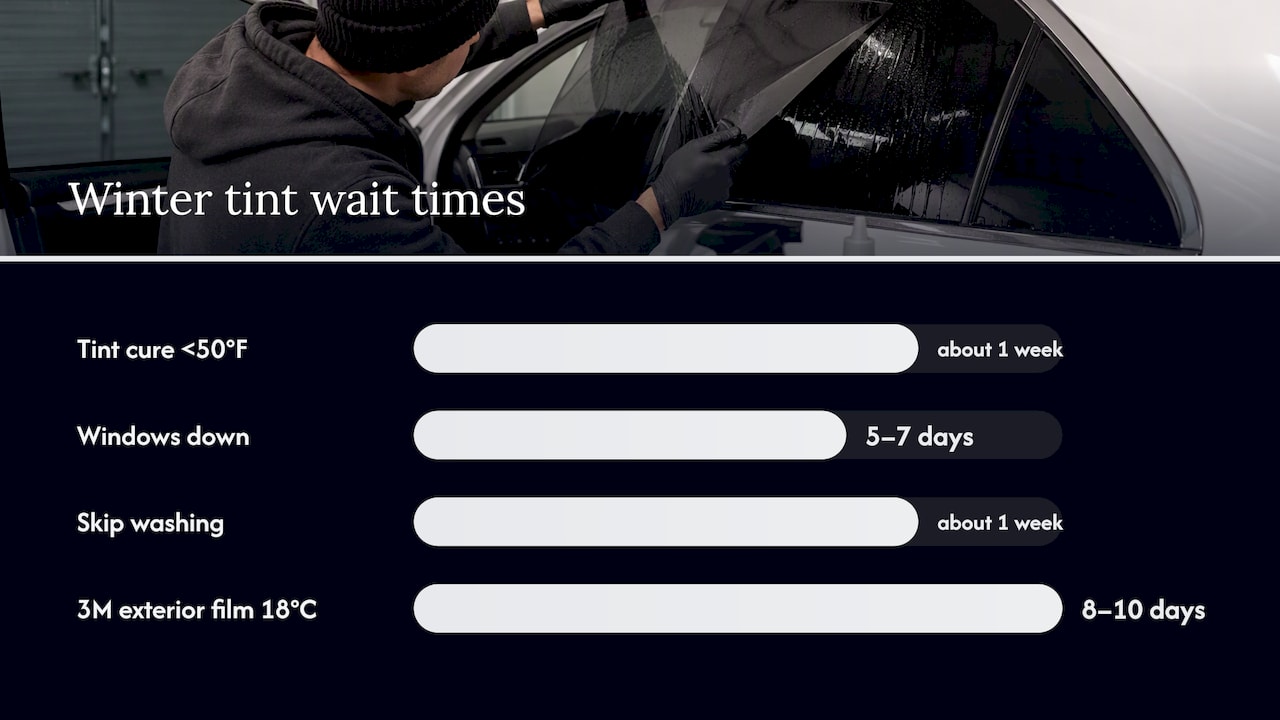
Film makers are more cautious still for exterior film. 3M’s guidance for an exterior window film says to avoid installation if the exterior temperature is expected to fall below 0°C (32°F) within 15 days afterward, and that final adhesion can take 8 to 10 days at 18°C (about 64°F) (3M Prestige 50 data sheet). That sheet is for a UK exterior architectural product, not automotive interior film, so treat it as a sign of how temperature affects adhesion, not as your car’s timeline.
What to do in practice:
- Plan on at least a week before rolling windows down, and longer if the first week stays cold.
- Do not wash the car or scrape the inside of the glass during that window.
- Expect a hazy or slightly wavy look at first. It usually clears as moisture leaves the film.
- Park in a garage if you can, which helps the film dry.
Our pages on the tint cure plan and rain after window tinting go deeper. Our tint options are GeoShield Carbon Tint at $350 and GeoShield Ceramic Tint at $500, on the window tinting page. Winter is also a quiet season for tint, and a chance to book before the heat of summer.
What a mobile detailer has to do to work in the cold
Winter work is harder on the detailer and the equipment, and that affects you as a customer.
Chemicals. Many professional chemicals are emulsions that can be ruined if they freeze, and DetailerBase advises bringing sensitive products indoors every evening. CurbCar adds that freezing weather can make chemicals thicken or work less well, and recommends winter-safe products and avoiding water-heavy exterior work below freezing (CurbCar).
People. OSHA recommends frequent short breaks in warm, dry areas and monitoring workers’ condition, and it places responsibility on employers under the General Duty Clause to provide a workplace free from recognized hazards (OSHA). Detail Compass points out that wind and wetness raise cold-stress risk, and that wet clothing increases heat loss even above freezing. A detailer who stops and reschedules when it gets too cold is following good practice, not being unreliable.
Access and power. A job that needs a safe place to work, water, power and a drying plan can be called off if any of those is missing. That is why a mobile fee exists at all: it covers the cost of bringing a working setup to you. Ours starts from $100, with a $100 booking charge, as listed on our detail packages page.
Perspective: how we think about winter jobs
We get asked every year whether it is worth booking a mobile detail when the weather turns. Our answer is that the service is not the question; the day and the scope are. A detail brought to your driveway saves you the trip, and in winter that convenience is worth more, because nobody enjoys sitting in a shop lobby when it is 30 degrees out.
But we do not treat the forecast as an inconvenience to work around. If a job calls for a wash and the water would freeze on the paint, the right move is to change the scope or move the date, and we would rather tell you that up front than press on. For coatings, tint and film, we plan the appointment around conditions that let the product cure properly, because a rushed install costs more to fix than a week of waiting.
The owners who get the most from winter are usually the ones who treat it as protection season. Road salt works on paint, seams and wheel wells all winter, and a coating or a maintenance routine makes every wash afterward easier. Our approach is simple: tell us how you use the car, where it is parked at night, and what you want it to look like in March. We will tell you what can happen now and what should wait.
— Charles
A simple winter plan for your vehicle
You do not need to do everything. This is a sensible order:
- Early winter: an interior detail to clear salt and moisture, and a decision on protection (coating, or a wax-type layer) before the heavy salt weeks.
- Mid winter: wash only on mild midday windows, or choose a rinseless method. Skip the rest and keep the interior clean.
- Late winter: once the salt is mostly done, an exterior detail to remove what built up in seams and lower panels. Our Exterior Detail starts from $175.
- Spring: a fuller reset. See preparing your vehicle for spring.
If you drive a high-mileage vehicle, high-mileage vehicle care tips are a good companion to this plan, because older vehicles often collect more road salt in worn seals and suspension areas.
Packages and plans
If you would rather bundle things, our packages start at $375 for Bronze, $600 for Silver, $1,000 for Silver+ and $1,500 for Gold, all from-prices. An Exterior Maintenance Plan runs $100 per week or $200 per month per vehicle, which suits owners and fleets who want salt removed on a regular schedule. If you are choosing between tiers, how to select an auto detailing package walks through it.
Book a winter detail with us
We bring professional detailing to your home or workplace across South Jersey, from interior cleaning to ceramic coatings, window tint and paint protection film. Tell us what the vehicle needs and where it is parked, and we will recommend what is realistic this week. See our detail packages or reach us through cdcautodetailing.com to schedule. Fleet managers can look at our fleet washing service.
FAQ
Can you detail cars in winter?
Yes, with limits. Interior detailing can go ahead in nearly any weather. Exterior washing needs a day when water can be dried before it freezes, and coatings, tint and film need conditions suited to the product. If those conditions are missing, a good detailer changes the service or reschedules.
How cold is too cold for a mobile car wash?
A practical range is 35°F to 50°F. Below 32°F water can freeze on the vehicle, and below 20°F Chemical Guys advises avoiding a wash unless the setup, tools and time are adequate. Wind, sun and whether the car is indoors can shift that line.
How long does window tint take to cure in winter?
Below 50°F, expect about a week or more, because moisture leaves the film more slowly. Keep the windows up for at least 5 to 7 days and avoid washing the car for about a week. Your installer’s instructions for the specific film take priority.
When should you not wash your car?
Skip an outdoor wash when water is likely to freeze before the car dries, especially in strong wind, falling temperatures or when ice is forming on the ground. In very cold weather, use a heated indoor facility or wait for milder weather.
Is a ceramic coating worth it before winter?
It can be. Road salt collects in seams, wheel wells and the underbody, and a coating makes salt easier to rinse off. The coating still has to be applied and cured in suitable conditions, so schedule it for a mild day or a sheltered space.
Sources
- Mobile detailing in winter: check each job, Detail Compass
- Is It Bad to Get a Car Wash in Cold Weather?, Drive Smart Tools
- How Cold Is Too Cold For A Car Wash?, Chemical Guys
- Can You Wash Your Car in Winter?, AAA Northeast
- Mobile detailing winterization, DetailerBase
- How To Weather-Proof Your Auto Detailing Business, Shopmonkey
- Stormwater Best Management Practice: Municipal Vehicle and Equipment Washing, EPA
- Think Blue car washing guidance, San Diego
- When Is It Too Cold to Wash Your Car, Ideal Image
- 3M paint protection film instructions
- Can You Tint Windows in the Cold?, Protector Automotive
- 3M Prestige 50 Exterior Window Film
- How Weather Impacts Mobile Car Detailers, CurbCar
- Winter Weather: Cold Stress, OSHA
- High-mileage vehicle care tips