
TL;DR:
- Not all coatings labeled as “self-healing” can repair light scratches, as only those with flexible polymer chemistry achieve true healing.
- These coatings activate above 120°F through heat or ambient conditions to temporarily flow and fill minor marks, but deep scratches require paint correction.
Not every coating labeled “self-healing” actually heals. That’s the first thing you should know before spending hundreds of dollars protecting your car’s paint. A true self healing ceramic coating uses polymer-based chemistry to repair light scratches and swirl marks under heat or ambient conditions. Standard automotive ceramic coating does not do this. The two are fundamentally different products, and the marketing around them tends to blur that line. This article breaks down exactly how self-repairing ceramic coating technology works, what the different product types can and cannot do, and how to make a smart decision for your vehicle.
Key Takeaways
| Point | Details |
|---|---|
| Not all ceramics self-heal | Only coatings with flexible polymer chemistry can repair light scratches. Standard ceramics harden and crack instead of healing. |
| Heat drives the process | Most self-healing coatings activate above 120°F. Sunlight, warm water, or controlled heat triggers repair of superficial marks. |
| Product tiers vary widely | Durability ranges from 2 years to 7 or more years depending on formulation. Matching the product to your lifestyle matters. |
| Damage type determines results | Only scratches that don’t penetrate the coating layer can self-repair. Deep gouges are permanent regardless of product claims. |
| Professional application pays off | Correct surface prep, curing windows, and activation methods directly affect how well the coating performs over time. |
How self-healing ceramic coatings work
The term “ceramic coating” is used loosely in the auto care industry. Traditional ceramic coatings are made from silicon dioxide (SiO2) or titanium dioxide (TiO2). These form an extremely hard, glass-like layer on top of your paint. That hardness is the point. It resists chemical etching, UV damage, and light abrasion better than bare paint or wax. However, hard and brittle are two sides of the same coin. When a hard ceramic coating gets scratched, it stays scratched.
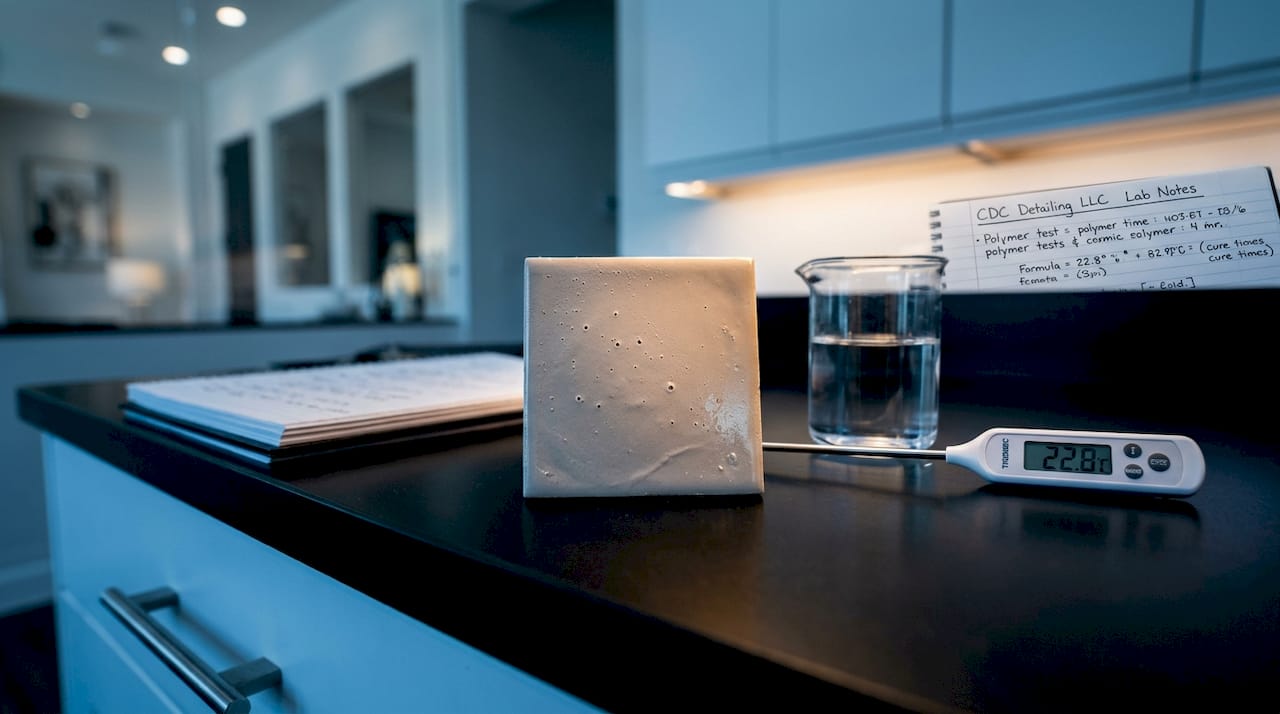
Self-healing coatings take a different approach. Instead of relying purely on hardness, they use flexible polymer chemistry, often silicon-based or hybrid nano-systems, to create a layer that can move and flow at a microscopic level. Heat-activated polymer mobility allows the coating’s surface to temporarily “relax,” fill in shallow scratches, and lock back into place as it cools. The practical result is that light swirl marks from car washes or minor contact scratches can disappear with nothing more than a hot afternoon.
Heat-activated vs. ambient-activated systems
Most self-healing products on the market are heat-activated. They require surface temperatures above 120 to 160°F to trigger the healing response. Parking your car in direct sunlight, running warm water over the surface, or using a heat gun (carefully) can all activate this process. For owners in South Jersey and similar climates with warm summers, natural sun exposure often handles activation on its own.
Ambient-activated systems work differently. Products like Solar Gard’s Clearshield Pro ACTIV start repairing light marks in under a minute at room temperature, without any external heat source. This makes them particularly useful for vehicles stored in garages or parked in cooler climates where immediate ambient activation fills the gap that heat-dependent products leave behind.
A note on material science: the most advanced self-healing films, particularly paint protection films (PPF), use an elastomeric topcoat with shape memory polymers engineered directly into the material. This is distinct from traditional ceramics and is why flexible silicon chemistry outperforms brittle ceramic formulas when it comes to actual scratch recovery.
Pro Tip: Immediately after a car wash on a sunny day is the best natural activation window. The water cools the surface briefly, and then direct sunlight raises the temperature quickly, giving the coating exactly the thermal cycle it needs to heal.
What cannot be healed is just as important to understand. Deep scratches that penetrate the coating layer entirely, reaching the clear coat or base coat beneath, are beyond what any self-healing product can address. The polymer can only flow within its own layer. Once the damage goes deeper, you need paint correction, not just heat.
Types of self-healing coating products
The market for self-repairing ceramic coatings has grown into a spectrum of formulations. Understanding where each type sits helps you compare products honestly rather than relying on marketing language.
| Coating Type | Self-Healing Mechanism | Typical Durability | Best For |
|---|---|---|---|
| Silicon-based flexible coating | Heat-activated polymer flow | 2 to 7+ years | Daily drivers, warm climates |
| Hybrid nano-ceramic system | Heat regeneration of micro-scratches | 4 to 5 years | Enthusiasts wanting ceramic hardness plus some healing |
| Self-healing PPF | Shape memory polymer topcoat | 5 to 10 years | Maximum protection, higher investment |
| Standard ceramic with sealant additive | Minimal, surface-level only | 2 to 5 years | Budget-conscious owners wanting ceramic benefits |
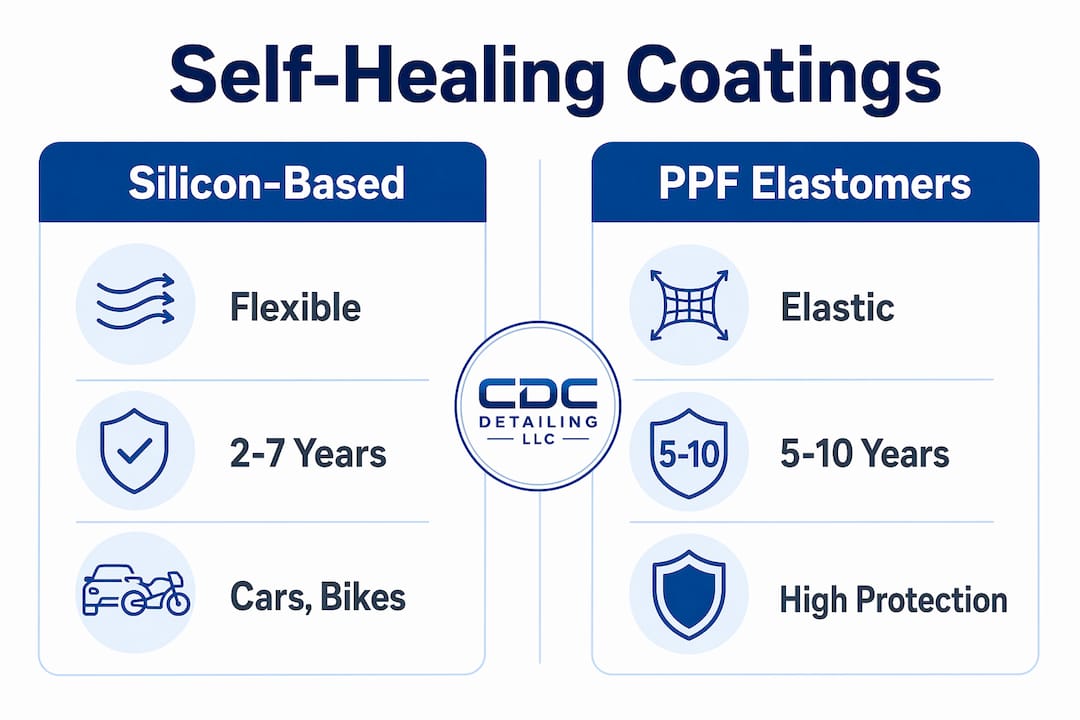
Revivify’s product line is a useful reference point for silicon-based coatings. Their tiered lineup ranges from 2 years (SH Lite) to 7 or more years (CarbonX), with heat-activated healing across the range. This kind of tier structure reflects a real truth in the industry: durability comes at a cost, and selecting the right durability tier depends on your vehicle usage, parking situation, and maintenance habits.
For a hybrid approach, Innovacar’s SiNH Hybrid Coat uses heat regeneration targeting micro-scratches, with film thickness between 1000 and 3000 nm and a claimed 4 to 5 year lifespan. This positions it between a traditional ceramic and a pure silicon formula. You get more hardness than a flexible coating, with more healing ability than a standard ceramic.
A few things to look for when comparing products:
- Hydrophobic performance. The best ceramic coating options maintain strong water beading throughout their lifespan, not just in the first year.
- Warranty specifics. Some warranties require professional application to be valid. Others cover the coating material but not labor for reapplication.
- Healing speed. Some products advertise healing in under 60 seconds under ambient conditions. Others require sustained sun exposure for 20 to 30 minutes. That difference matters in real life.
- Compatibility. Not all self-healing coatings work on top of existing paint protection film without a compatibility check from the manufacturer.
For a deeper look at leading coating brands and whether their claims hold up, Cdcautodetailing has done the comparison work already.
Application, activation, and maintenance
Getting the most from any self-healing coating starts before the product even touches your car. Surface preparation is not optional. Contamination, swirl marks, or oxidation left under the coating will be sealed in permanently.
Here is a standard professional application sequence:
- Thorough wash and decontamination. Clay bar treatment removes bonded contamination that a wash cannot lift.
- Paint correction if needed. Any scratches or swirls in the paint itself should be polished out before coating. The coating protects; it does not hide.
- Panel wipe with IPA solution. This removes polish residue and oils so the coating bonds directly to the clear coat.
- Coating application in a controlled environment. Temperature, humidity, and dust levels all affect how the product lays down and begins to cure.
- Initial leveling and flash time. Most professional coatings require specific wait times between application and buffing, often measured in minutes, and vary by product and ambient temperature.
- Curing window. Ceramic Pro CX15, for example, requires 12 to 24 hours without water contact for full activation of its hydrophobic and self-healing properties.
The curing window is where many owners make mistakes. Exposing a freshly coated car to rain, condensation, or even morning dew during the initial cure can create water spotting that bonds permanently to the surface. The coating cures around those spots.
Activation after curing is an ongoing maintenance behavior, not a one-time event. Heat activation strategy directly influences how consistently the coating heals over time. Vehicles that rarely see direct sun may need occasional warm water treatment to trigger the healing cycle. This is especially relevant in fall and winter months. Cdcautodetailing has practical guidance on cold-weather coating care that addresses this gap.
Pro Tip: Do not use waterless wash products on a self-healing coating during the first 30 days. The wiping action can generate enough friction to scratch the still-consolidating polymer layer before it has reached full hardness.
For long-term care, stick to a pH-neutral car wash soap, avoid automatic brushed car washes entirely, and consider a ceramic coating-specific spray detailer for between-wash maintenance. Full guidance on preserving coating performance covers the specifics of what products to use and how often.
Realistic expectations and what coatings cannot fix
There is a version of the self-healing coating pitch that sounds almost too good: scratches vanish in the sun, your paint looks new for years, and you barely have to wash your car. That version is exaggerated.
Here is what these coatings genuinely do well:
- Eliminate most car wash swirl marks over time through regular heat activation
- Maintain a deeper, glossier appearance longer than wax or paint sealant
- Protect against UV fading, light chemical etching, and environmental fallout
- Reduce the frequency of paint correction needed over the life of the vehicle
Here is what they cannot do:
- Repair deep scratches or gouges that reach the clear coat or below
- Protect against rock chips (this is where PPF has a clear advantage)
- Heal damage caused by aggressive chemicals or improper washing
- Last indefinitely without any maintenance
Comparing self-healing coatings to PPF is worth doing honestly. PPF with a self-healing topcoat provides significantly more physical protection against rock chips and road debris. Ceramic coating, even the best ceramic coating options with self-healing properties, sits at a thinner layer and focuses more on chemical protection and appearance. For vehicles that see a lot of highway miles or gravel roads, layering a self-healing coating over PPF on high-impact areas gives you both chemical resistance and physical protection. For details on the pros and cons of each, the decision usually comes down to budget and how the vehicle is used.
My take after years of working with these coatings
I have applied and evaluated self-healing coatings on dozens of vehicles across different climates, usage patterns, and budgets. Here is what I have learned that most product reviews will not tell you.
The heat activation claims are real, but they are also context-dependent. I have seen silicon-based coatings on vehicles parked outdoors in New Jersey summers heal wash swirls almost invisibly over a few sunny days. On a garage-kept weekend car, that same coating barely activated at all because it rarely hit the temperature threshold. Neither outcome was a product failure. It was a lifestyle mismatch.
The durability tier conversation matters more than people realize. I have watched owners buy a 7-year coating for a vehicle they lease for 3 years and then wonder why it seemed like overkill. I have also watched people buy entry-level 2-year products for daily drivers that rack up 30,000 miles a year and feel let down by year 18 months. Match the product to your actual situation.
My honest opinion on industry hype: the “self-healing” label has become a sales tool in some cases. A coating with genuine shape memory polymer chemistry is a fundamentally different product from a slightly flexible ceramic that technically recovers minor marring. Ask specifically about the activation mechanism and what scratch depth the product addresses before committing.
— Charles
Professional ceramic coating services from Cdcautodetailing
If you are ready to move from research to application, Cdcautodetailing brings professional-grade ceramic coating services directly to you across South Jersey. The team applies durable ceramic paint protection using products matched to your vehicle, driving habits, and local conditions, with proper surface prep and curing protocols that make or break long-term performance. Whether you want a heat-activated silicon formula or a hybrid nano-system, getting the application right from day one protects your investment. Explore Cdcautodetailing’s ceramic coating services to see available options, or check out the Deptford-area service page if you are nearby. Book a consultation and get coating advice tailored to what your car actually needs.
FAQ
What is a self healing ceramic coating?
A self healing ceramic coating is a flexible polymer-based protective layer applied to vehicle paint that repairs light scratches and swirl marks when exposed to heat or ambient temperatures. Unlike standard ceramic coatings, it uses polymer mobility to flow and restore surface smoothness at a microscopic level.
How does self healing coating work on a car?
Most self-healing coatings activate above 120 to 160°F, where polymer chains in the coating temporarily flow to fill shallow scratches and then lock back as the surface cools. Some ambient-activated systems begin repairing marks within minutes without any heat source.
Can a self healing coating fix deep scratches?
No. Self-healing is limited to superficial damage that does not penetrate through the coating layer. Scratches that reach the clear coat or base coat require paint correction, not heat activation.
How long does a self healing ceramic coating last?
Durability varies significantly by product tier. Silicon-based coatings range from 2 to 7 or more years depending on formulation, while hybrid nano-systems typically claim 4 to 5 years. Actual lifespan depends on climate, maintenance habits, and how frequently the vehicle is exposed to abrasion.
Is a self healing coating better than paint protection film?
They serve different purposes. Self-healing ceramic coating excels at chemical protection, UV resistance, and gloss maintenance. Paint protection film (PPF) provides superior defense against rock chips and physical impact. For maximum protection, many owners apply both, using PPF on high-impact areas and a ceramic or self-repairing ceramic coating over the full vehicle.