
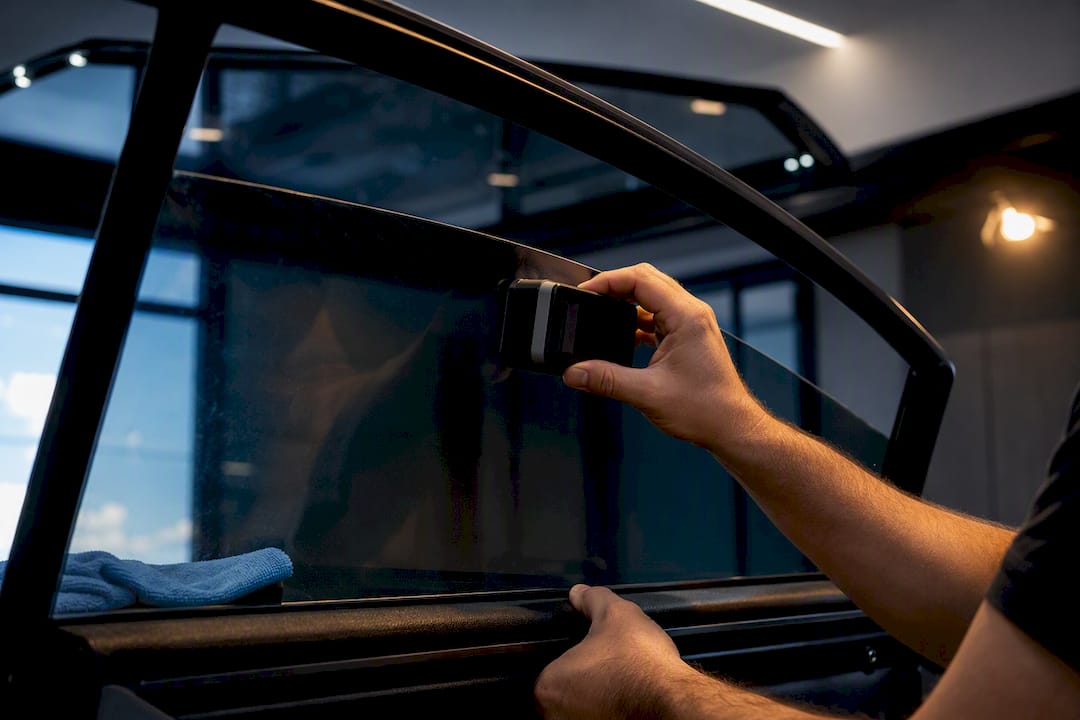
Ceramic rejects heat without touching Autopilot cameras, phone key signals, or LTE. Check your state’s VLT law before you order anything.
TL;DR:
- Ceramic film is the best choice for Teslas because it offers strong heat rejection without interfering with radio, Bluetooth, or Autopilot signals.
- Legal VLT limits combined with the specific Tesla model and glass geometry determine the maximum tint darkness that can be applied without risking inspection failure.
- Factory glass, especially on the front side and roof, provides limited thermal protection, making aftermarket ceramic tint crucial for reducing heat inside the vehicle.
- Professional installation tailored to Tesla’s unique window shapes, curves, and rear glass is essential to prevent bubbles, peeling, or damage, with warranties typically lasting 5 to 10 years.
- Proper care, including avoiding abrasive cleaners and giving tint time to cure, is necessary to maintain clarity and prevent damage; DIY is viable mainly for flat side windows.
Table of Contents
- What Is the Recommended VLT Setup for a Tesla?
- Which Tint Film Actually Works Best on a Tesla?
- How Do You Choose the Right Film and Installer?
- What Does Tesla Window Tinting Cost and How Long Does It Take?
- What Makes CDC Auto Detailing Worth Trusting for Tesla Tint
- Does Tesla’s Factory Glass Already Block Heat?
- Will Tint Interfere With Autopilot or the Cameras?
- How Do You Keep Tinted Tesla Windows Looking Good?
- The Real Priority Most Tint Advice Misses
- Book Tesla Window Tint Installation With CDC Auto Detailing
- Sources
What Is the Recommended VLT Setup for a Tesla?
The comfort math on a Tesla is different from a gas car because there’s no engine heat to mask cabin warmth on a hot day, and the glass area is enormous, especially with the panoramic roof. That’s why tint choices here matter more than on the average sedan.
Professional shops that specialize in Tesla work tend to land on a similar formula. A common professional configuration runs clear ceramic at 70%+ on the windshield strip, 35% on front doors where legal (or 70%+ clear ceramic in strict states), and 15 to 20% on the rear sides and rear glass.
Two setups cover almost every owner:
- Balanced daily driver: windshield strip 70%+, front sides 35%, rear sides and rear glass 20%, roof left factory or with a light 70% ceramic layer.
- Privacy-forward: front sides pushed to the legal max, rear sides and rear glass at 20% to disappear visually into the factory-tinted rear glass, roof at 50 to 70% ceramic for glare control.
Front doors and rear privacy glass are the priority zones. Front glass comes from the factory at roughly 75 to 80% VLT, which is essentially untreated for heat, while factory rear glass sits around 20 to 25% VLT but still lets a surprising amount of infrared heat through despite looking dark. Adding ceramic film over that factory privacy glass is where owners see the biggest jump in rear seat comfort for the least visual change, since you’re layering heat rejection onto tone that already matches.
Which Tint Film Actually Works Best on a Tesla?
Not all films behave the same once you factor in a Tesla’s sensor suite and glass geometry. Here’s how the four common options stack up.
- Ceramic: the standard choice for Tesla work. It carries no metal particles, so it doesn’t interfere with radio signals, phone key Bluetooth, or Autopilot’s radar and camera systems, and it delivers strong heat rejection at a clear, glare-free finish. Expect a higher price per window than dyed film, but it’s the only category that checks every box for a Tesla.
- Carbon: a solid middle ground with decent heat rejection and better fade resistance than dyed film, but it doesn’t match ceramic’s infrared performance and tends to look slightly duller over time.
- Dyed: the cheapest option and the one to skip as a primary solution. It fades within a few years, blocks glare more than actual heat, and offers little of the thermal benefit owners are usually chasing.
- Metallic: strong heat rejection on paper, but avoid it on a Tesla entirely. The metal content can interfere with radio and sensor signals, which is exactly the failure mode you don’t want on a car this dependent on cameras and wireless key detection.
Ceramic films can reject 50 to 97% of infrared heat depending on grade, a range wide enough that it’s worth asking your installer which specific product and IR rating they’re quoting before you commit.
How Do You Choose the Right Film and Installer?
Legal VLT limits aren’t measured on the film alone. They’re measured as combined glass plus film transmittance, which is why a 35% film on Tesla’s factory glass doesn’t produce a flat 35% reading at inspection. That combined number is what a police officer’s meter reads and what determines whether your front windows pass.
State tint laws vary widely, and front side windows are almost always the strictest part of the law. Some states allow as dark as 20% up front; others require 70% or lighter. Verify your state’s rule before ordering film, not after installation.
Once you know your legal ceiling, work through this checklist with any installer:
- Confirm the film is ceramic or carbon, not metallic or a generic dyed product marketed as “premium.”
- Ask whether they use a plotter-cut pattern specific to your Tesla model and year, rather than a hand-cut generic template.
- Get the warranty length in writing. Reputable ceramic installations carry multi-year coverage.
- Ask about their experience specifically with Tesla frameless doors and the one-piece rear glass, which behave differently than a standard sedan’s rear window.
- If you’re tinting the roof, ask how they handle the curve. Heat shrinking technique matters more here than on flat glass.
Pro Tip: Ask to see the actual roll label before installation. A shop confident in what they’re selling will show you the ceramic product name and IR rejection spec without hesitation.
Red flags worth walking away from: anyone recommending metallic film for a Tesla, no written warranty, or a price so far below the local market that it signals a corner being cut somewhere in materials or labor.
What Does Tesla Window Tinting Cost and How Long Does It Take?
Pricing scales with how much glass you’re covering and how complex that glass is. A single front window in ceramic typically runs in the same range as a partial rear package, while a full front side plus rear plus roof combination sits at the top of the price spectrum. Expect ceramic front-window work to fall somewhere in the $250 to $600 installed range depending on your market and the specific package.
The technical difficulty is real. Tesla’s frameless doors flex slightly when open, the rear glass is one continuous curved piece rather than a flat panel, and the panoramic roof adds a compound curve most cars don’t have. Experienced installers rely on plotter-cut patterns and heat-shrinking techniques to get clean seals on those curves, and that skill set is exactly what separates a $300 job that lasts a decade from one that bubbles within a year. Warranties on quality ceramic installs typically run 5 to 10 years.
DIY is genuinely possible for the flat side windows. Precut kits cost a moderate amount in materials, and a confident first-timer can expect to spend 4 to 6 hours on a full set. Where DIY gets risky is the rear glass and roof. Those curves punish inexperience, and a botched rear install often costs more to strip and redo than a professional job would have cost up front.
- Single front window (ceramic): budget end of the range
- Full front side + rear + roof package: top of the range, varies by market
- DIY materials only: $40 to $200, plus your own time
What Makes CDC Auto Detailing Worth Trusting for Tesla Tint
Tesla work rewards installers who’ve actually handled the model’s quirks: frameless doors, curved one-piece rear glass, and a roof that punishes a rushed heat-shrink job. That’s the gap most general auto shops haven’t closed.
Cdcautodetailing publishes a dedicated window tint guide along with a VLT color chart so owners can see shade options before booking, backed by mobile service that comes to the vehicle rather than the other way around.
A shop that’s done the reps on Tesla-specific glass knows the rear window isn’t a flat panel you cut and shrink like any sedan. It’s one continuous curved piece, and rushing the heat gun there is how bubbles show up six months later.
- Plotter-precut patterns matched to Tesla model and year, not hand-cut templates
- Heat-shrink technique built for the curved rear glass and panoramic roof
- Written warranty terms provided before the vehicle leaves
Does Tesla’s Factory Glass Already Block Heat?
Tesla’s factory glass isn’t doing as much thermal work as its dark appearance suggests. Front side windows come in at roughly 75 to 80% VLT, close to untreated clear glass, so the sun hits your arms and the dashboard nearly as hard as it would through a windshield with no tint at all.
Rear glass tells a different story visually but not thermally. Factory rear “privacy glass” sits around 20 to 25% VLT, dark enough to obscure passengers, but that darkness comes mostly from tinted glass, not from infrared-blocking technology. It still lets a meaningful amount of heat radiate through, which is why rear seat passengers often report a hot, stuffy feel even with the “privacy” glass Tesla ships from the factory.
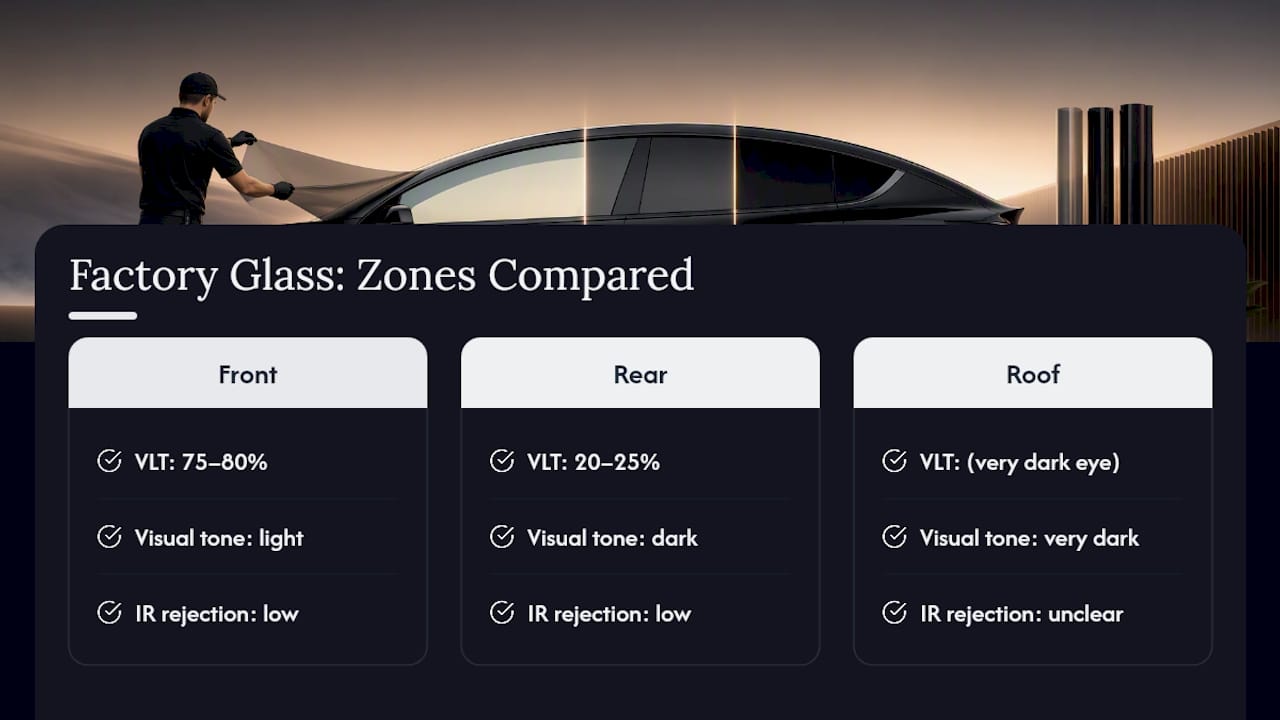
The roof is the biggest wildcard. Tesla’s panoramic glass roof measures very dark to the eye, but dark glass and IR-blocking glass are not the same thing, and a lot of that heat load radiates straight down onto rear passengers’ heads and shoulders.
Front doors and the roof are where aftermarket ceramic delivers the most noticeable improvement, because factory glass in those two zones is doing the least actual heat rejection despite how they look. Rear glass benefits too, just from a smaller starting gap since the tone already reads dark.
Will Tint Interfere With Autopilot or the Cameras?
The short answer: not if you use the right film. Tesla’s Autopilot suite relies on forward and side cameras mounted behind the glass, plus radar and ultrasonic sensors elsewhere on the body, none of which read through window glass the way a metallic tint could disrupt a radio signal.
Ceramic and carbon films are non-conductive and non-metallic, so they don’t create the electromagnetic interference that can degrade radio reception, phone key detection, or Bluetooth pairing. Ceramic films don’t interfere with phone keys, Bluetooth, or LTE, which extends logically to the camera-based Autopilot system since it isn’t reading a wireless signal through the glass at all.
Metallic film is the actual risk here, and it’s the reason installers who know Tesla vehicles steer owners away from it entirely. The metal content in that film category can degrade radio-frequency signals passing through the glass, which is the same mechanism that can affect phone key detection and potentially other wireless systems on the vehicle.
Placement matters too. A front windshield strip that’s cut too low, or side film applied in a way that fogs or bubbles directly over a camera housing, can cause real optical interference regardless of film type. That’s a cutting and installation issue, not a film chemistry issue, and it’s another reason a plotter-precut pattern matched to your exact Tesla model matters more here than on a car without cameras built into the glass.
How Do You Keep Tinted Tesla Windows Looking Good?
New tint needs time to cure, and rushing that window is the single most common way owners damage a fresh install. Give ceramic film several days before rolling the windows down, and avoid washing the glass directly for at least the first few days to let the adhesive fully bond.
Once cured, stick to ammonia-free glass cleaner. Ammonia breaks down the adhesive layer over time and can cause the tint to haze or lift at the edges months before it should. A proper streak-free glass cleaning method also matters for keeping the tint itself clear, since abrasive wiping technique can introduce fine scratches on the film surface that show up as glare under direct sun.
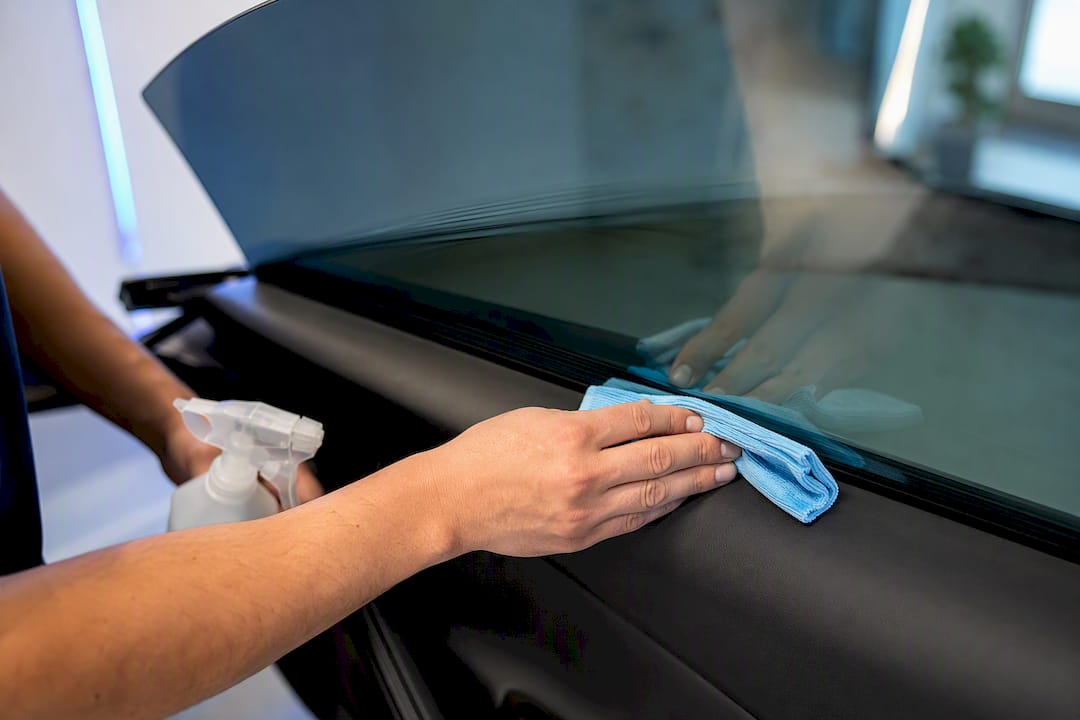
Skip razor blades or anything abrasive near the tinted surface, including on the inside of the glass where residue from cleaning products can build up unnoticed. Microfiber cloths and a light touch preserve the finish far longer than scrubbing.
Watch the edges, particularly on the rear glass and roof where curves put more stress on the film’s seal. Early lifting at a corner is far cheaper to fix under warranty than waiting until moisture gets underneath and the whole panel needs to be stripped and redone. A quick visual check every few months catches this before it becomes a bigger job.
The Real Priority Most Tint Advice Misses
Most tint guides treat film selection as the whole decision. It isn’t, not on a Tesla. The film chemistry question (ceramic versus everything else) gets settled quickly once you know metallic is off the table for signal reasons and dyed fades too fast to be worth it. The harder, more consequential decision is who cuts and installs it.
A Tesla’s frameless doors and one-piece curved rear glass punish generic templates and rushed heat work in ways a Camry never would. I’d rather see an owner pay a fair price for a shop with actual Tesla reps under their belt than chase the cheapest ceramic quote from someone who’s never worked around a panoramic roof. The warranty length an installer is willing to put in writing tells you more about their confidence than anything in their sales pitch.
Get the legal VLT number right for your state first. Everything else, film grade, installer skill, roof coverage, is a comfort and durability decision layered on top of a decision that’s non negotiable.
— Charles
Book Tesla Window Tint Installation With CDC Auto Detailing
Cdcautodetailing brings Tesla-specific tint packages directly to your driveway in South Jersey, which means no dropping the car off and arranging a ride home for what should be a same-day job. Our balanced daily driver and privacy-forward configurations map straight onto the setups covered above, precut ceramic film matched to your model and year, front, rear, and roof coverage options, and a written multi-year warranty that comes with the paperwork, not just a verbal promise.
Booking starts with a quick look at your Tesla’s model and year so we can confirm the plotter pattern, followed by an on-site measurement and a walk-through of VLT options before any film gets cut. You’ll get the warranty card the same day the install wraps. If you’re also weighing paint protection or a ceramic coating for the exterior, we can bundle that into the same mobile visit. Visit our window tinting guide to see the full VLT chart and get a quote scheduled for your Tesla.
Sources
- Tesla Window Tint Guide: Best Film, Legal Limits & DIY Tips | Tesla DIY Repair
- Best Window Tint Recommendations for Tesla | Lacuna Automotive
- Tesla Window Tinting & PPF — The Complete Owner’s Guide