
Yes, you can put window film over factory tint. Factory tint is pigment inside the glass, so the film bonds to the glass surface like it would on any other window. The catch is that the two layers stack their darkness, and in New Jersey the law on front windows is stricter than almost anywhere else. Below: what happens to the shade, what you gain, what the law says, and when we’d tell you to leave the glass alone.
TL;DR
- Film over factory-tinted glass is a normal job. Factory tint is tinted glass, not a film, so there is nothing to bubble or peel underneath.
- Darkness multiplies. A 20% film over a 20% factory rear window lands near 5%, which is hard to see through at night.
- Factory tint adds darkness but does little against heat and UV. A quality ceramic film is what changes that.
- In New Jersey, aftermarket film on the windshield and front side windows is prohibited without a medical exemption. Rear glass has no darkness limit.
- Never layer new film over old aftermarket film. Remove it first.
Table of Contents
- Factory tint and aftermarket tint are different things
- What happens to the shade when you stack film on factory glass
- Why add film to glass that is already dark
- New Jersey law: where this gets tricky
- Never stack film on film
- How a good install on factory glass goes
- Carbon or ceramic on factory glass
- Our perspective on tinting over factory glass
- Booking tint with CDC Detailing
- Before you decide: a short checklist
- FAQ
- Sources
Factory tint and aftermarket tint are different things
The confusion starts with the word “tint.” Factory tint, sometimes sold as privacy glass on SUVs, trucks and vans, is color mixed into the glass when it is made. It is permanent, it cannot be peeled, and it mostly just darkens the window. Aftermarket tint is a multi-layered polyester film applied to the inside surface of the glass after the car is built.
That difference decides everything else. Film over film is a problem. Film over pigmented glass is not, because the film’s adhesive is made to grip glass.
How to tell which one you have
Look at the top edge of a rear side window. With the window cracked a little, you can often see the edge of a film layer, or a thin clear gap between the film and the top of the glass. That is aftermarket film. If the color runs uniformly to the very edge of the glass and you see no film edge, it is factory-pigmented glass.
Two more clues:
- Factory tint is usually on the rear doors, the cargo area and the back glass only. The front doors and windshield are typically clear or very light.
- Used car with purple, bubbling or peeling rear windows? That is old aftermarket film that has failed, not factory glass.
If you are not sure, ask us to look at it when you book. A shop can also read the glass with a light meter and tell you its visible light transmission (VLT).
What happens to the shade when you stack film on factory glass
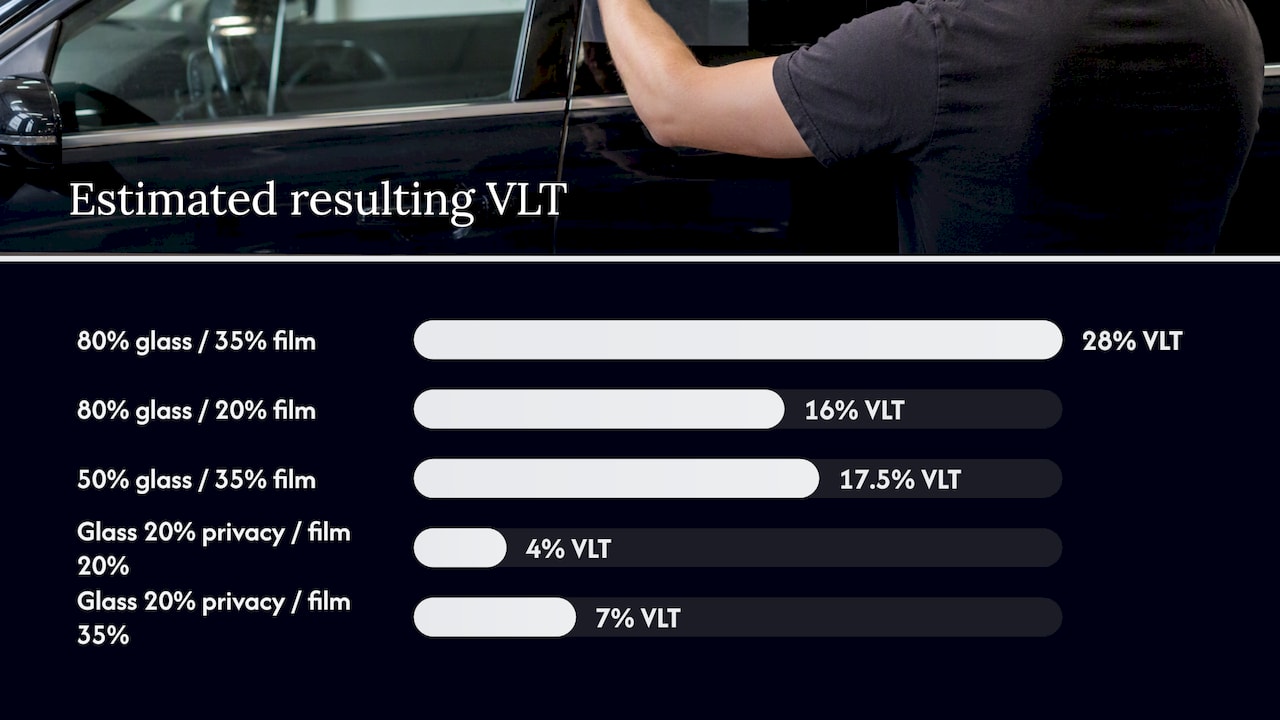
VLT is the percentage of visible light that passes through. Lower means darker. Factory glass commonly sits around 74 to 85% VLT on a light-privacy setup, though many privacy-glass vehicles are darker at the rear. The film’s rating is multiplied by the glass rating, not added.
Rough math:
| Glass | Film | Approximate result |
|---|---|---|
| 80% | 35% | 28% |
| 80% | 20% | 16% |
| 50% | 35% | 17.5% |
| 20% (privacy glass) | 20% | 4% |
| 20% (privacy glass) | 35% | 7% |
These are estimates. Actual numbers shift with film type, glass color and how the meter reads, which is why we meter the glass before we choose a film rather than guess from the box.
The last two rows are the ones that surprise people. Enthusiast forums are full of owners who put a 20% film over a vehicle’s factory rear glass and ended up with something close to limo tint. In daylight it looks sharp. Backing out of a driveway at night, or checking a blind spot in rain, it can be a real hazard.
The practical rule: pick the film for the result you want after stacking, not the number you saw on a friend’s car. If your rear glass is already dark, a lighter film often gives you the heat and UV benefit with almost no change to how the window looks.
Why add film to glass that is already dark
Because dark is not the same as protective. Factory pigment is there for looks and privacy. It is not designed for significant heat or UV protection. Quality aftermarket film is a different product: 99% UV rejection and, depending on the grade, 50% to 90% infrared rejection, and high-end nano-ceramic film can absorb over 60% of total solar energy.
So a factory-tinted SUV can still have a hot back seat, a fading dashboard and a rear-seat passenger getting sun on their skin. Adding a clear-to-light ceramic film to that glass addresses those problems without making it much darker. We go deeper on this in our pieces on heat rejection versus darkness and UV protection from window tint.
Film on factory glass also makes sense when:
- The factory shade is uneven between the rear doors and the back glass, and you want them to match.
- You want the glass held together better. Film adds a layer that helps hold broken glass in place.
- You have a vehicle with a large rear glass area, like a minivan or SUV, where the heat load is high.
New Jersey law: where this gets tricky
New Jersey is the state where “just match the front to the back” gets drivers in trouble. Under N.J.S.A. 39:3-74, aftermarket tint on the windshield and front side windows is prohibited for most drivers, whatever the VLT. The rear side windows and rear window may be tinted to any darkness.
That means:
- Rear glass on an SUV, truck or van with factory tint: film is legal, however dark the stack ends up. Darkness is a safety and comfort decision here, not a legal one.
- Front side windows: no film for general use, even a clear one meant only for UV. Factory front glass is what it is.
- Windshield: same rule.
The one path for front glass is a medical exemption. The MVC explains that you may have the windshield or front side windows sunscreened only with a medical exemption, and it lays out the application steps on its site. According to Recording Law, an exempted vehicle must still stay within ceilings of 70% VLT on the windshield and 60% on the front sides. If you have a condition that makes sun exposure a medical issue, talk to your physician first, then follow the MVC’s process. We can only install what the law allows, so we do not tint front glass without that paperwork.
We keep a separate page on New Jersey tint laws and a shade and VLT chart if you want to compare percentages side by side.
A note on out-of-state cars: rules differ by state, and what is legal where you bought the car may not be legal on a New Jersey-registered vehicle. Check the state where the car is registered.
Never stack film on film
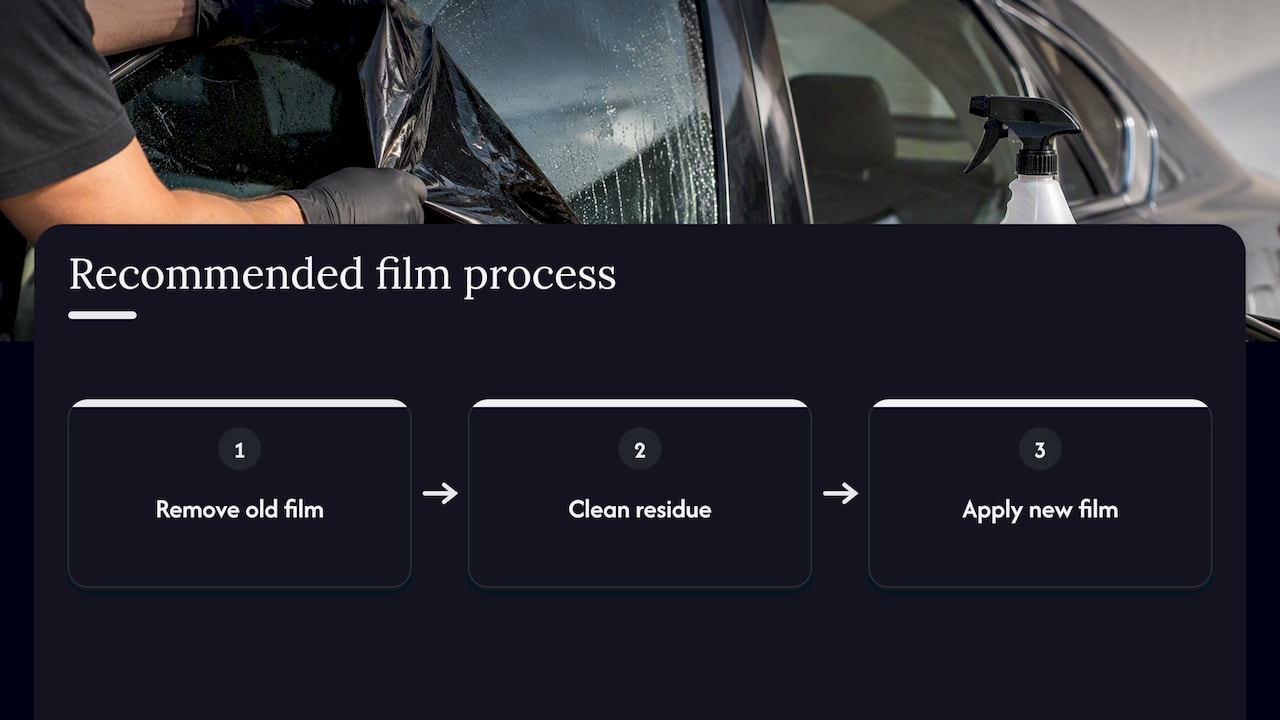
Everything above assumes the factory glass is bare. If your car already has aftermarket film, the answer flips. Most pros advise against layering new film over old film: the adhesive is engineered to bond to glass, not to another film, so you get poor adhesion, bubbles and often a voided warranty.
The right move is to remove the old film, clean off the adhesive residue, and start on bare glass. Removal adds labor, so mention it when you book.
The same goes for the trend of building darkness in layers, sometimes called stacking. It risks poor night visibility, and it can push total VLT below what the law allows, which creates a liability for both the owner and the installer. Better performance comes from better film technology, not extra layers.
How a good install on factory glass goes
Factory glass is a fresh surface, but it still needs care. Our process on rear glass looks like this:
- Identify the glass. Confirm it is factory-pigmented, not old film, and meter it.
- Choose the film for the final result. We pick a shade based on the stacked VLT, not the film’s number alone.
- Clean the interior surface thoroughly. Dust, oils and a dashboard haze all show up as specks under film.
- Cut and fit the film. Back glass often has a curve and defroster lines that need heat shaping.
- Apply, squeegee and cure. Small water pockets can show for a few days as the film dries. Leave the windows up for the period your installer gives you.
On a vehicle with a lot of privacy glass, the back window is the one to watch. Defroster lines and the black dotted frit band at the edge need clean edges and patient work.
Carbon or ceramic on factory glass
For factory-tinted glass, the film type matters more than the percentage. We offer two on our window tinting page:
- GeoShield CARBON TINT, $350. A solid choice for looks, UV protection and a matte, non-metallic appearance.
- GeoShield CERAMIC TINT, $500. Built for stronger heat rejection. If heat is your main complaint, this is the one. Our article on what ceramic window tint is and why it works covers the technology.
On already-dark factory glass, ceramic is often the better use of money, because the glass already supplies the darkness and the film supplies the performance. For a full rundown of what tint does for a car, see the real benefit of tinting car windows in 2026.
Our perspective on tinting over factory glass
Most people who call us about this are asking the wrong question. They want to know how dark they can go. The better question is what they want the glass to do.
We look at it from the seat of the person riding in the car. A kid in the back of an SUV in July, on the Black Horse Pike, doesn’t care whether the glass is 5% or 20%. They care whether the sun is on their legs. A film that rejects heat does that. A darker film does not, necessarily.
So we start with the glass. We read it, we see what the factory gave you, and we usually steer people toward a lighter, higher-performance film on privacy glass rather than the darkest one they can legally have. The result looks cleaner and you can still see at night. And in New Jersey, where the front windows are off limits for most drivers, we say so plainly rather than take a job that sets you up for a ticket or a failed inspection.
We are a mobile service, so this is something we can usually look at at your home or workplace. It is the same careful, one-vehicle-at-a-time approach we use for every detail.
— Charles
Booking tint with CDC Detailing
We are a mobile detailing company based in Pitman, serving South Jersey. If you are tinting rear glass, see our window tinting options: GeoShield CARBON TINT at $350 and GeoShield CERAMIC TINT at $500. Other published fees include a $100 booking charge and a mobile service fee starting at $100, listed on our packages page. Tell us what your vehicle has, factory privacy glass or old film, and we will say what will work before you commit.
If the interior is getting a refresh anyway, pairing tint with an interior detail means the glass and cabin are clean before the film goes on.
Before you decide: a short checklist
- Check the top edge of each window to confirm factory glass or old film.
- Ask for the VLT of the glass to be metered, and for an estimate of the finished stack.
- Remember that New Jersey does not permit aftermarket film on the windshield or front side windows without an MVC medical exemption.
- If the car has old film, plan for removal first.
- Choose film for heat and UV performance, then pick the shade you can live with at night.
FAQ
How dark is 20% tint over factory tint?
It depends on the glass, but on factory privacy glass around 20% VLT, a 20% film brings the total to roughly 4 to 5%. That is limo-dark and difficult to see out of at night. If your glass is already dark, a lighter film gives you the heat and UV benefit with a smaller change in appearance.
Can you tint over factory tint in New Jersey?
On rear side windows and the rear window, yes, with no legal darkness limit. On the windshield and front side windows, aftermarket film is prohibited unless you hold a medical exemption from the MVC. Check the MVC’s instructions before booking any front-glass work.
Can you remove factory tint?
No. Factory tint is pigment in the glass itself, so there is no film to peel. The only way to remove it is to replace the glass, which is rarely worth the cost. A lighter film over it is the practical way to improve performance, and if you want a clearer look you can pick a film that adds little darkness.
Can you double layer tint?
We advise against it. Adhesive is made to bond to glass, not film, so a second layer over old aftermarket film tends to bubble, can void the warranty and may drop your VLT below the legal limit. Remove the old film and install one new film on clean glass.
Will film on factory-tinted glass block more heat?
Yes, if you choose a heat-rejecting film. Factory pigment mostly darkens the glass, while a quality ceramic film is made to reject infrared heat and UV. The gain comes from the film’s technology, not from how dark the stack looks.
Sources
- New Jersey Window Tint Laws (2026): Legal VLT Limits, Recording Law
- Window Sun-screening For Medical Reasons, NJ MVC
- Car Window Tinting: What To Know Before You Buy, Family Handyman
- Is It Bad To Put Tint Over Tint?, Tint Wiz