
To remove road salt from the underside of a vehicle, loosen the dried brine with low-to-moderate water pressure, break it down with a car-safe cleaner, scrub what you can reach, rinse from several angles, and dry the underbody before you park. Rinsing alone is not enough. The brine New Jersey crews spread leaves a sticky film, and that film keeps working on bare metal long after the storm.
Below is the method, the schedule, the mistakes to avoid, and an honest look at when it makes sense to hand the job to a mobile detailer.
TL;DR
- Salt on the underbody is a maintenance problem, not a cosmetic one. It reaches brake lines, suspension parts and seams you cannot see.
- Plain water often leaves the brine film behind. Use a cleaner made to dissolve salt, then rinse from several angles.
- Wash the underside about every two weeks while roads are being treated, and dry it afterward.
- Sand mixed with salt chips the factory coating, so winter cleaning beats waiting for spring.
- If you do not have a driveway, a hose and the time, we do this as part of mobile detailing across South Jersey.
Table of Contents
- Why salt on the underside does so much damage
- Why rinsing with a hose is not enough
- How to remove salt from the undercarriage, step by step
- How often to wash the underside
- Car wash undercarriage sprays versus doing it properly
- Trucks, work vehicles and fleets
- Our perspective: treat it as maintenance, not a luxury
- DIY or hire a pro: how to decide
- What we offer for salt season
- Mistakes that cost owners the most
- FAQ
- Sources
Why salt on the underside does so much damage
New Jersey treats roads before and during storms. The state transportation department uses rock salt wetted with liquid calcium chloride or a salt brine blend, and it pre-treats roads with brine before precipitation starts. That pre-treatment can stay on the pavement for several days depending on traffic.
That matters because brine travels. AAA Mid-Atlantic’s automotive services manager told NJ101.5 that brine gets into places rock salt does not reach, such as suspension parts, wheel wells and the underbelly. He also pointed out that rain does little for the underside: driving through wet, salted pavement pushes the same solution right back up under the car.
Two things make it worse:
- Moisture and oxygen. Salt speeds up the rusting reaction. Winter road salt mixes with moisture and oxygen and causes rust, especially on the undercarriage and wheel wells, according to a South Jersey body shop.
- Sand. The same shop explains that winter sand abrades and chips the factory undercoating. Each chip becomes an entry point for salt and water to reach bare metal.
Consumer Reports lists the parts at risk: brake lines that can fail from advanced corrosion and suspension components that can get sluggish when buildup is ignored. Brake lines are a safety item, so this is more than a resale issue, though it hurts resale too.
Modern vehicles are better protected than older ones. The AAA representative noted that manufacturers have improved corrosion dipping over the last decade. Better coatings buy you time. They do not make a car immune, especially once sand has chipped them.
Why rinsing with a hose is not enough
This is the mistake we hear most. Liquid de-icers based on calcium or magnesium chloride leave a sticky residue. Trucking industry coverage of fleet corrosion programs notes that rinsing with water often fails to remove this paste, and without a proper neutralizing or detergent-based step it can spread the residue deeper into crevices.
A garden hose also lacks the flow and angle to flush a chassis. Commercial drive-over systems are built around specialized nozzles and salt-neutralizing formulas; one vendor describes systems delivering 40 gallons per minute, which is far beyond a residential hose. You will not match that at home, but you can get most of the benefit with the right sequence and patience.
How to remove salt from the undercarriage, step by step
This follows the same order professional guides use. Low-to-moderate pressure, a car-safe cleaner, scrubbing, a multi-angle rinse and thorough drying are the core of it.
What you need
- A hose with an adjustable nozzle, or a pressure washer you can keep at a moderate setting
- A dedicated salt-neutralizing cleaner or a car-safe degreaser
- A long-handled brush and a wheel-well brush
- Ramps or jack stands rated for your vehicle (never work under a car held only by a jack)
- Gloves and eye protection
- Microfiber towels, and ideally a leaf blower or compressed air for drying
The steps
- Park on level ground and let the underbody warm up if it is frozen. Do not spray a frozen undercarriage in below-freezing air. Water that does not drain will refreeze in door sills, brake components and locks. Pick a day above freezing or use a heated garage.
- Loosen the debris. Work from the center outward with low-to-moderate pressure. Avoid blasting straight at sensitive joints, seals, electrical connectors and wiring.
- Apply the cleaner. Cover the frame rails, floor pan edges, control arms, subframe, wheel wells and the area behind the bumpers. Let it dwell for the time on the label. This is the step that breaks the chemical bond of dried brine.
- Agitate. Use the long brush on every surface you can safely reach. Pay attention to seams, where two panels meet and salt packs in.
- Rinse from several angles. Go front to back, side to side, and up into wheel wells. Flush drain holes in the rocker panels and door bottoms so cleaner and loosened salt exit instead of sitting inside.
- Dry. Drive-dry is not enough. Use towels where you can, then blow out crevices and let the car sit with doors open for a few minutes. The aim is to leave no standing moisture to fuel the rust cycle.
What to skip
A few ideas circulate on forums that we would not follow. Spraying motor oil on the underside is one: it traps dirt, can contaminate brakes, exhaust and rubber parts, and makes later cleaning harder. If you want a protective layer, use a product made for underbody use and apply it to clean, dry metal, ideally with someone who knows your vehicle.
How often to wash the underside
The numbers vary by source, so choose by conditions:
| Source | Guidance |
|---|---|
| Elmer’s Auto Body, South Jersey | Wash the car, particularly underneath, every two weeks in winter |
| Consumer Reports | Not every wash, but at least once a season, more if you drive through mud or live where roads are salted |
These do not conflict. One is a minimum for any car, the other is what you do when roads are actively treated. For a South Jersey daily driver, a practical rhythm is:
- Every two weeks from the first treatment of the season through the last, with the underside included
- After any storm where roads were pre-treated and then wet for days
- One thorough clean in early spring, after the last salting, when you can also inspect and dry everything properly
If you want a spring checklist for the rest of the car, our guide on preparing your vehicle for spring covers the exterior side, and how to keep your car clean in winter covers the months in between.
Car wash undercarriage sprays versus doing it properly
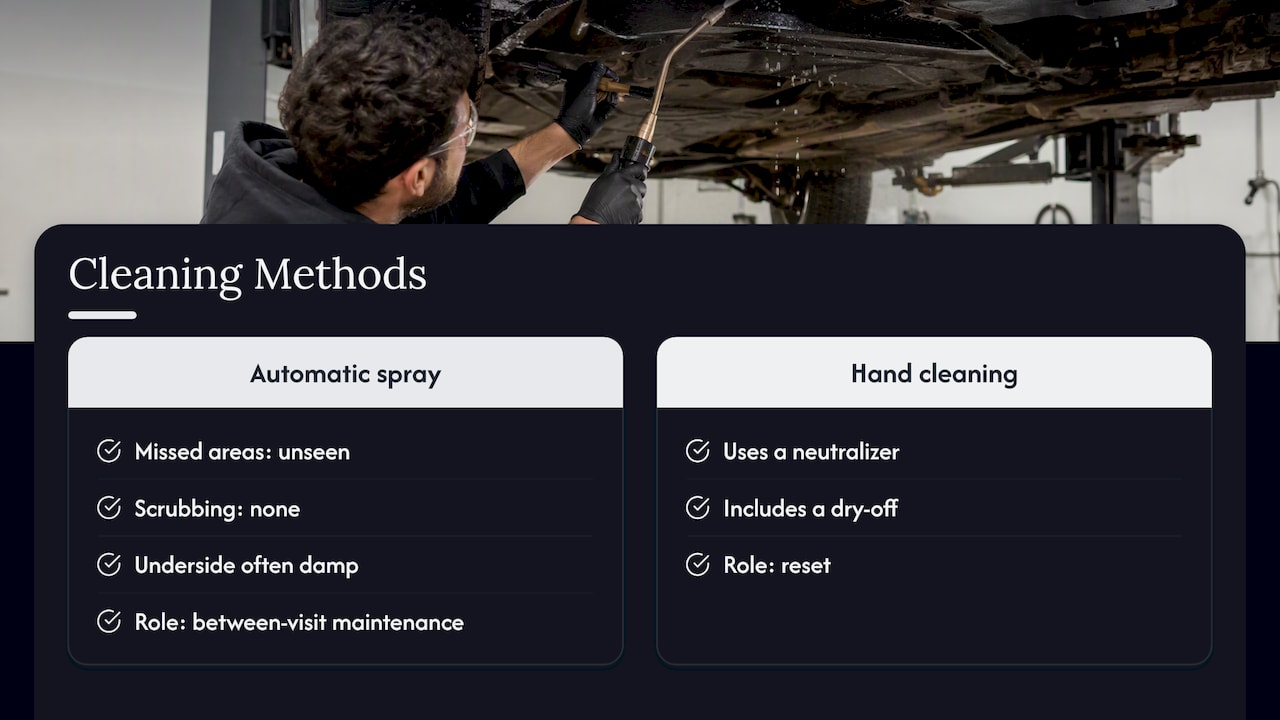
An automatic wash with an undercarriage option helps. AAA describes it as high-pressure nozzles that spray water and cleaning solution up into hard-to-reach areas. Erie Insurance goes further and rates the claim that it prevents rust as a fact, because the spray removes mud, salt and similar debris.
It is a good between-visits option when it is freezing and you cannot work at home. Its limits are real, though. You cannot see what it missed, it does not scrub, and the underside is often still damp when you drive away. A drive-through is maintenance. A hand cleaning with a neutralizer and a dry-off is a reset.
Trucks, work vehicles and fleets
Trucks with open frames, plow mounts, hitches and leaf springs hold salt in more places than a sedan. Fleet operators know this: trade coverage describes de-icing chemicals, mainly chlorides, as notorious for causing truck corrosion. For a truck you drive daily, do the six steps above with extra time on the frame, brake and fuel line routing, suspension mounts, and the inside of the bed’s cross members.
For a fleet, the question is scheduling rather than technique. Washing a dozen trucks one at a time in a driveway does not work. We cover that on our fleet washing page and in our write-up of what commercial vehicle detailing involves.
Our perspective: treat it as maintenance, not a luxury
We are a mobile detailing company based in Pitman, and we work on vehicles across South Jersey. Here is how we see this topic.
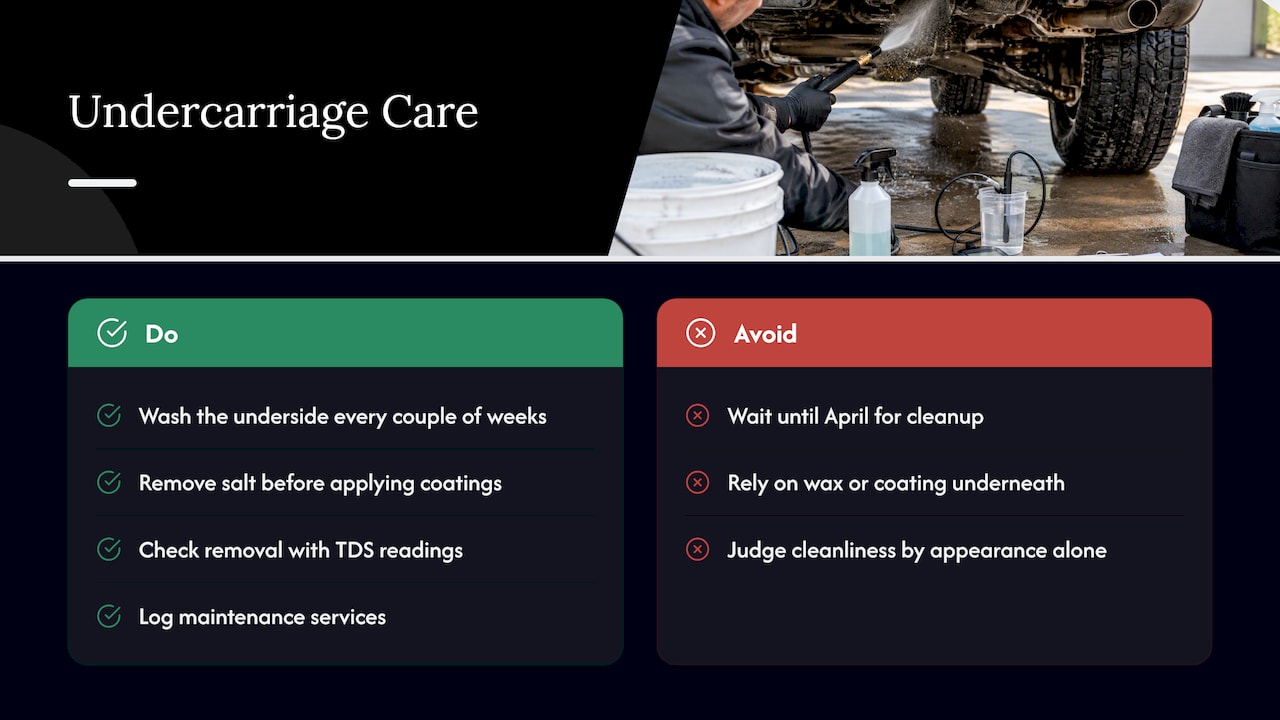
Most owners think about salt when the car looks white and crusty. By then the visible film is the least of it. The damage happens in places nobody photographs: inside frame rails, behind liners, at the seams under the doors. We would rather see a customer do a basic, repeatable underside wash every couple of weeks than a dramatic cleanup in April.
We also think owners get the order wrong. They buy a coating or a wax and expect it to protect the underside. Paint protection and ceramic coating do their job on painted surfaces. The underbody is its own problem, and it starts with getting the salt off. We have written about how we check for salt removal with TDS readings, because “it looks clean” is not a measurement.
One more point: records matter. If you ever sell, a documented maintenance history carries weight with buyers, and clean metal underneath is something a buyer or inspector can verify. Keeping a log of services helps, and this French-language guide to why a vehicle service record matters explains the idea well even if the specifics are for France. Our pieces on how detailing affects resale value go deeper on the US side.
— Charles
DIY or hire a pro: how to decide
Do it yourself if you have a driveway or garage, a spring-to-fall free weekend morning, ramps, and you are comfortable working carefully around brake and electrical parts. Cost is a bottle of cleaner and some time. One national vendor reports that professional hand detailing that includes thorough undercarriage cleaning typically runs $100 to $200, which gives you a rough benchmark for the price of paying someone.
Hire it out if you live in an apartment, you drive a truck with a lot of exposed frame, you have several vehicles, or your schedule makes a biweekly routine unrealistic. A mobile service comes to you, so you do not lose an afternoon at a shop.
Skip nothing about drying either way. Whoever does the work, the car should leave with the underside as dry as possible.
What we offer for salt season
We come to your home or workplace anywhere in South Jersey. Our published prices are:
| Service | Price |
|---|---|
| Exterior Detail | from $175 |
| Interior Detail | from $275 |
| Bronze Package | from $375 |
| Silver Package | from $600 |
| Exterior Maintenance Plan | $100 per week per vehicle, or $200 per month per vehicle |
Mobile service carries an additional fee from $100, and there is a $100 booking charge. Packages and plans are on our detail packages page, and the exterior detail page shows what that service covers. If you want the underside included, tell us when you book and we will scope it for your vehicle. Those prices are starting points, and the final quote depends on your vehicle and what you need.
For owners who want longer-term protection on painted surfaces, we also install ceramic coatings and paint protection film. Those protect paint from the chips and abrasion that sand and gravel cause. They do not replace washing the underside.
Mistakes that cost owners the most
- Waiting until spring. Salt works all winter. Sand makes it worse, so consistent winter cleaning is what stops the cycle, as the South Jersey body shop notes.
- Rinsing only. Without a neutralizing or detergent step, you may leave or spread the residue.
- Washing in freezing weather and parking. Trapped water refreezes. Wash above freezing, dry well, and let the car air out.
- Aiming a pressure washer at seals and connectors. Keep pressure moderate near joints.
- Ignoring the wheel wells and rocker drains. These collect the most packed salt.
- Skipping the dry. Moisture left behind restarts the rust process.
FAQ
Is salt bad for the undercarriage of a car?
Yes. Salt mixed with moisture and oxygen speeds up rust, and brine reaches suspension parts, wheel wells and seams. Left alone it can attack brake lines and suspension components. Newer vehicles have better factory coatings, but sand can chip those and expose bare metal.
Can I just rinse the salt off with water?
Water helps loosen loose debris, but it often leaves the sticky film from liquid brine, and it can push residue deeper. Use a salt-neutralizing cleaner or a car-safe degreaser, scrub where you can reach, rinse from several angles, then dry.
How often should I wash the undercarriage in winter?
A South Jersey body shop recommends washing about every two weeks, including underneath, when roads are treated. Consumer Reports suggests at least once per season as a minimum. In New Jersey, every two weeks while roads are salted, plus a thorough early spring clean, is a sensible routine.
How long does salt stay on your car?
Until you remove it. Rain does not clear the underside and actually keeps re-wetting salt that is already there, so the film can sit through the whole season. The longer it sits damp, the longer it has to attack metal.
Does an undercarriage car wash prevent rust?
It helps. It sprays away salt, mud and debris, which are what drive corrosion. It works best alongside a periodic hand cleaning and a thorough dry, because a drive-through cannot scrub or confirm what it missed.
Sources
- Road salt can corrode cars if left untreated (NJ101.5)
- Winter Readiness FAQ (NJDOT)
- Salt, Sand, and Snow (Elmer’s Auto Body)
- Are Car-Wash Extras Worth It? (Consumer Reports)
- Fleets Implement Techniques to Fight Corrosion From Salts (TT)
- Salt Corrosion Undercarriage Cleaner (SafeWash Technologies)
- How to Clean Undercarriage Road Salt Off a Car (Garage Boy)
- What Car Wash Features Do You Really Need? (AAA)
- Myths and Facts About Car Washes (Erie Insurance)