
For most New Jersey drivers, a tint strip across the top of the windshield is not legal. The statute bans non-transparent material on the front windshield and has no general allowance for a top strip. The only route to aftermarket windshield tint is a medical exemption from the Motor Vehicle Commission (MVC), and even then the film must stay within set limits. If you are tinting a car in South Jersey, the safe plan is to leave the windshield alone and tint the windows where the law lets you. We install that kind of tint every day, so we know where that line falls.
TL;DR
- New Jersey’s law, N.J.S.A. 39:3-74, bars any sign, sticker or other non-transparent material on the front windshield. Its text has no ordinary top-strip exception.
- Aftermarket tint on the windshield is tied to an MVC medical exemption. Under the exemption, film may go only above the AS-1 line and must keep at least 70% light transmittance.
- Front side windows follow the same logic: tint needs the exemption, with a 60% transmittance floor.
- Two 2026 bills would write a top-six-inch or AS-1 allowance into the statute. Check the legislature’s site before you rely on either.
- Rear windows and the film you choose still matter. Book a shade that suits your car and your daily driving, not one that invites a stop.
Table of Contents
- What the New Jersey statute actually says
- Is there any legal tint strip on a windshield?
- Why drivers get mixed answers
- What the 2026 bills would change
- Consequences of an illegal windshield tint strip
- How to get the look and comfort without risking a ticket
- Photosensitivity and the medical exemption: who it is for
- Perspective
- Our window tinting in South Jersey
- Quick reference: what to remember
- FAQ
- Sources
What the New Jersey statute actually says
The rule is N.J.S.A. 39:3-74. It says no one may drive with any sign, poster, sticker or other non-transparent material on the front windshield, the wings, deflectors, side shields, corner lights next to the windshield, or the front side windows. The one carve-out is a certificate or other article that a statute or regulation requires you to display.
Notice what is missing. Many states write a line like “the top four or five inches may be tinted.” The New Jersey text does not. Some websites say a strip is fine because the strip is common in other states. In New Jersey the statute itself does not say so, and that is why drivers online get “mixed answers,” as one forum thread on the topic puts it.
In plain terms:
- Windshield: no non-transparent material, with the exemption route described below.
- Front side windows: the same ban applies to the windows beside the driver and front passenger.
- Things people forget: a decal or sticker counts as non-transparent material, too. If you have an old parking or promotional sticker in the way, it is worth removing decals from car windows properly before an inspection or a stop.
Is there any legal tint strip on a windshield?
Yes, but only through the medical exemption, and the rules are narrow.
The MVC issues a medical exemption certificate for drivers with a qualifying need for sun screening. A driver without that certificate does not get the strip. The MVC’s own guidance, form MR-15, says unauthorized materials are subject to removal and fines, and that the certificate is required.
For a vehicle that does have the exemption, the regulation at N.J.A.C. 13:20-1.2 sets the limits:
| Location | Limit for an exempted vehicle |
|---|---|
| Windshield | Sun-screening material goes only on the portion above the AS-1 line. Together with factory glazing it may not reduce visible light transmittance below 70%. |
| Front side windows | Together with factory glazing, transmittance may not fall below 60%. |
| Top six inches of front side windows | Readily removable material may be affixed between sunrise and sunset, if transmittance stays at 35% or more with the factory glazing. |
| Reflectance (windshield and front sides) | Visible light reflectance capped at 8% under N.J.A.C. 13:20-1.3. |
These numbers describe the combined effect of the film and the glass already in your car, not the film alone. A film sold as 70% can drop the total below 70% once it sits on factory glass, because the glass has its own tint.
What the AS-1 line is
Look at the upper corner of your windshield for a small marking, often “AS-1” in the glass. The MVC’s sun-screening regulations document defines the AS-1 line as the mark on a sheet of glazing that shows the windshield area needed for driving visibility. The part of the glass above it is the portion where the exemption allows sun-screening material. Below it, the glass must keep at least 70% luminous transmittance.
The practical lesson: the “strip” you see on cars from other states follows a line on the glass. In New Jersey, you can only place film there if you hold the exemption, and you must keep it within the limits above.
Why drivers get mixed answers
Three things blur the picture.
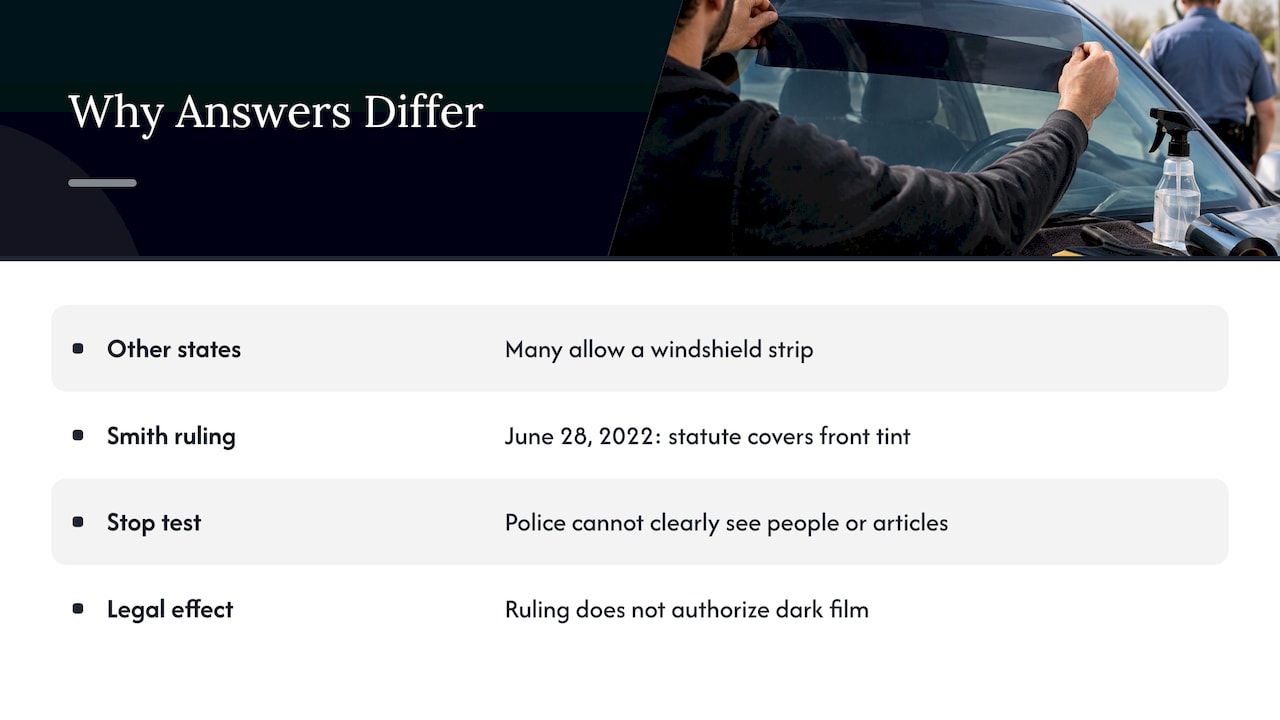
Other states’ rules leak into search results. Many states allow a strip, and plenty of videos and shops describe those rules as if they were universal.
Enforcement is about visibility. In State v. David L. Smith, decided June 28, 2022, the New Jersey Supreme Court held that the statute applies to tint on the front windshield or front side windows. It also held that an officer has reasonable and articulable suspicion of a violation only when those windows are so darkly tinted that police cannot clearly see people or articles inside. That ruling is about when a stop is justified. It does not turn the statute into a permission slip for dark film. A car can be pulled over for a clearly visible violation and still be stopped for other reasons, and the film itself remains unauthorized.
Legislators have noticed the gap. More on that next.
What the 2026 bills would change
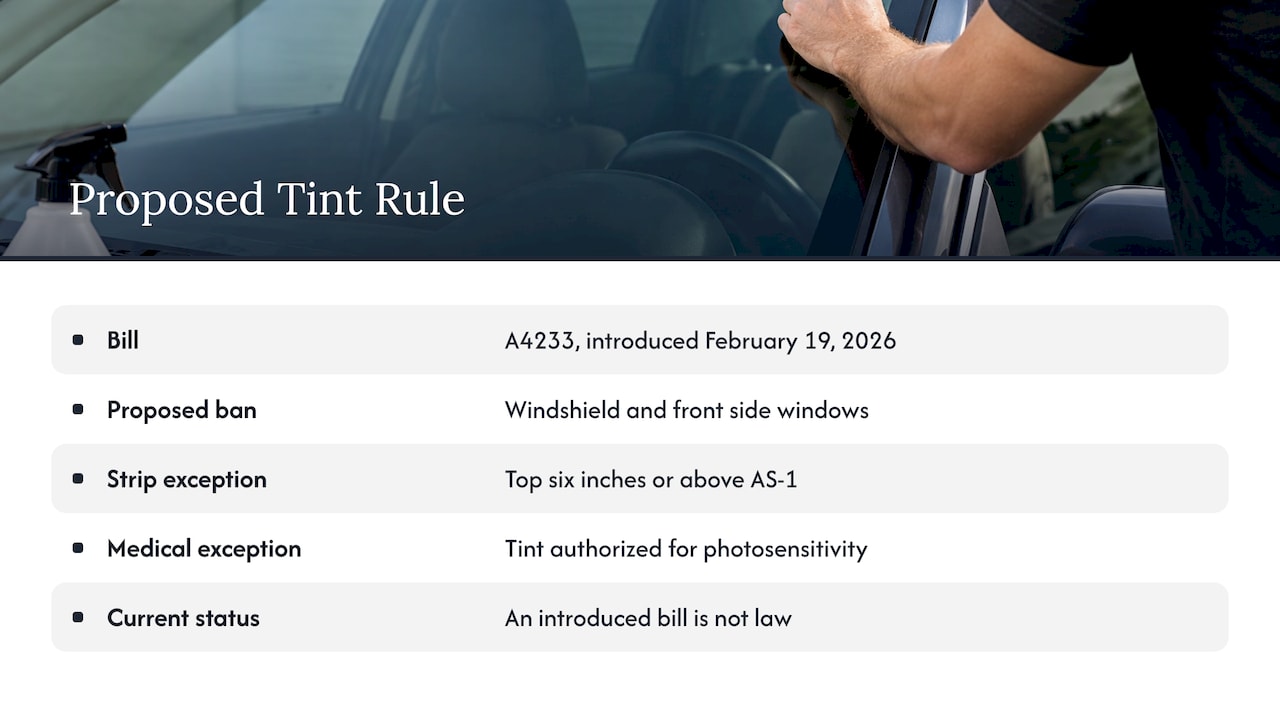
Two bills in 2026 aim to make the rule explicit. A4233, introduced February 19, 2026, would amend N.J.S.A. 39:3-74 to clarify that tint on the windshield and on the front side windows is prohibited. It would carve out the top six inches of the windshield, or the area above the AS-1 marking, and tint authorized for photosensitivity under the medical statute.
If a bill like that becomes law, a top strip would become a written, general allowance. Until then, the safest reading is the one in the current statute. A bill that has been introduced is not law. Before you tint, look up the bill’s current status on the New Jersey Legislature’s site, since status changes as sessions move.
Consequences of an illegal windshield tint strip
The MVC’s guidance says unauthorized materials are subject to removal and fines. In practice that means three kinds of cost:
- A stop and a citation if the film is dark enough that officers cannot see inside, or if the situation draws attention for another reason.
- Paying to take the film off. Removing a windshield strip costs time and often leaves adhesive on the glass.
- Paying to tint again once you know what is legal.
None of that is worth risking for a cosmetic strip. If you want glare reduction or a clean look, there is a better path, covered below.
How to get the look and comfort without risking a ticket
What most people want from a windshield strip is less glare and less heat in the eyes. You can address that without adding film to the windshield.
Step 1: Decide what you want the tint to do
Heat rejection, UV protection, privacy and appearance are separate goals. Ceramic films are made for heat and UV; darker shades are mostly about privacy. Our guides to window tint UV protection and ceramic window tint explain how those goals differ.
Step 2: Check which windows the law covers
The windshield and the front side windows are the regulated front glass under N.J.S.A. 39:3-74. Our New Jersey tint laws overview walks through the whole car, and the car tint color chart shows what different shades look like.
Step 3: Keep the 70% number in mind
The 70% transmittance figure shows up for the windshield under the exemption rules. If you have a legitimate medical need, bring the certificate to the installer and have them work to the combined glass-plus-film number. Our piece on choosing window tint and the 70% limit covers why the combined number matters.
Step 4: Ask whether the car already has factory tint
Factory privacy glass already lowers transmittance. Layering film on top changes the total. See can you tint over factory tint before you pick a film.
Step 5: Pick the film and have it installed professionally
Carbon and ceramic films both suit a daily driver. A professional install avoids bubbles, edge lifting and contamination, and a shop that knows the New Jersey rules will not put film where it does not belong. We come to you, which suits busy owners who cannot spend a day in a waiting room.
Photosensitivity and the medical exemption: who it is for
The exemption exists for drivers with a medical need for sun screening, and the MVC issues the certificate. This is a step the law gives to the state, so it is the MVC you contact to apply. Start with the MVC’s MR-15 guidance and with your own doctor, who decides whether you qualify. Once you hold the certificate, keep it in the vehicle and have the work done within the limits in the table above. We can install to those limits with the certificate in hand.
Perspective
Most of the tint questions we hear in South Jersey start with a strip on the windshield and end with a different goal: the car is too hot, the glare is tiring, or the driver wants a cleaner look.
Our view is simple. The windshield is the one piece of glass where New Jersey leaves almost no room, so the best result comes from doing the rest of the car well. A properly installed carbon or ceramic film on the windows you are allowed to tint does more for comfort than a strip ever would, and it does so without a stop or a removal bill.
We also think the film should be matched to the car, the driver and the law, not to a trend. That is why we talk through the shade, the factory glass and the exemption rules before any film goes on, and why we come to your home or workplace to do it.
Charles
Our window tinting in South Jersey
We are a mobile detailing and protection business based in Pitman, New Jersey, and window tinting is one of the services we install. We publish two film options: GeoShield CARBON TINT at $350 and GeoShield CERAMIC TINT at $500. Both are listed on our window tinting page, where you can book.
If you want to compare shades first, the window tint color chart and car tinting levels guide show how each level looks and what the percentages mean. For pricing detail, see what window tinting costs in South Jersey. If you are in the Glassboro area, our Glassboro window tinting page has local details. Fleet managers can ask us about tinting alongside our fleet washing work.
Quick reference: what to remember
- Statute: N.J.S.A. 39:3-74 prohibits non-transparent material on the windshield and front side windows.
- Strip: the statute text offers no general top-strip allowance. Medical-exemption vehicles may use film above the AS-1 line at 70% or more combined transmittance.
- Front sides: 60% combined transmittance under the exemption rules.
- Reflectance: no more than 8% on the front glass for exempted vehicles.
- Enforcement: the Smith decision ties stops to tint so dark officers cannot see inside.
- Pending law: A4233 would make a top six inches or above-AS-1 allowance explicit. Check its status before relying on it.
FAQ
Is window tint illegal in NJ?
Not across the board, but it is illegal on the front windshield and front side windows unless you hold a medical exemption. N.J.S.A. 39:3-74 bars non-transparent material on that glass. Exempted vehicles must still meet transmittance limits of 70% for the windshield and 60% for the front sides.
Can you have a strip of tint on your windshield in New Jersey?
The statute has no ordinary top-strip exception, so for most drivers the answer is no. A vehicle with an MVC medical exemption may carry film above the AS-1 line if combined transmittance stays at 70% or higher. Bills introduced in 2026 would add a written strip allowance, but they are not law until enacted.
Is 35% or 20% tint darker?
20% is darker. The percentage is how much visible light passes through, so a lower number means a darker film. A 35% film lets 35% of light through and a 20% film lets 20% through. Remember that the combined number with your factory glass is what counts.
Are there states that allow full windshield tint?
Rules differ by state, and this article covers New Jersey only. In New Jersey, full windshield tint is not allowed for ordinary drivers, and the exemption route has a 70% floor and a placement limit above the AS-1 line. Any out-of-state rule does not carry over once your car is registered here.
Sources
- N.J.S.A. 39:3-74, windshields must be unobstructed
- N.J.A.C. 13:20-1.2, light transmittance
- NJ MVC sun-screening regulations
- NJ MVC MR-15 guidance
- State v. David L. Smith, A-4-21
- Assembly Bill A4233 (2026)