

TL;DR:
- A professional deep clean combined with weekly maintenance using a few vetted products offers the most effective way to keep a car interior clean. Proper tools, surface-specific cleaning techniques, and routine schedules prevent embedded soil buildup and avoid costly restorations. Professional detailers use advanced equipment to address deeply ingrained grime, making periodic deep resets essential for long-term interior care.
The fastest path to a genuinely clean cabin is a two-step model: hire a professional for a deep reset when soils are embedded, then maintain the results with two to four vetted DIY products and a compact tool kit. That combination beats either approach alone because a pro can extract what consumer tools cannot, and consistent weekly maintenance prevents the buildup that makes another deep clean necessary.
- Deep reset: Book a professional mobile detailer when you see staining, odors, or ground-in grime. Expect a full interior detail to run roughly two to four hours and cost more than a DIY kit, but the result is a surface that’s genuinely clean rather than just wiped.
- Routine maintenance: A spray detailer, a dedicated leather or fabric cleaner, a glass cleaner, and three to four quality microfiber towels handle 90% of weekly upkeep.
- TL;DR: For a neglected interior, book a pro first. For a car that’s already clean, Chemical Guys Total Interior Cleaner & Protectant or Meguiar’s Quik Interior Detailer Cleaner covers most maintenance needs.
Table of Contents
- What are the best interior car cleaning options right now?
- How we define “best” and what we tested for
- Best cleaners and kits by category
- What tools actually make the biggest difference?
- How to clean each surface safely
- Quick maintenance vs. deep clean: which workflow fits your situation?
- When does a professional detailer make more sense than DIY?
- Which option fits your situation?
- How long do interior cleaning products actually last?
- Key Takeaways
- Why the “miracle bottle” mindset keeps your car dirtier than it should be
- Cdcautodetailing brings the deep clean to your driveway
- Useful sources and further reading
What are the best interior car cleaning options right now?
Here’s the short version before the full breakdown.
Best all-purpose spray detailer: Gyeon Interior Detailer (or Chemical Guys Total Interior Cleaner as the widely available alternative). Both handle dashboards, door panels, and plastics in one pass.
Best kit for enthusiasts: Griot’s Garage Ultimate Interior Kit. It ships with dedicated brushes, applicators, and multiple specialized cleaners so you’re not improvising tools.
Best budget maintenance pick: Meguiar’s Quik Interior Detailer Cleaner. Under $10, found at every auto parts store, and genuinely good for light-duty weekly wipe-downs.
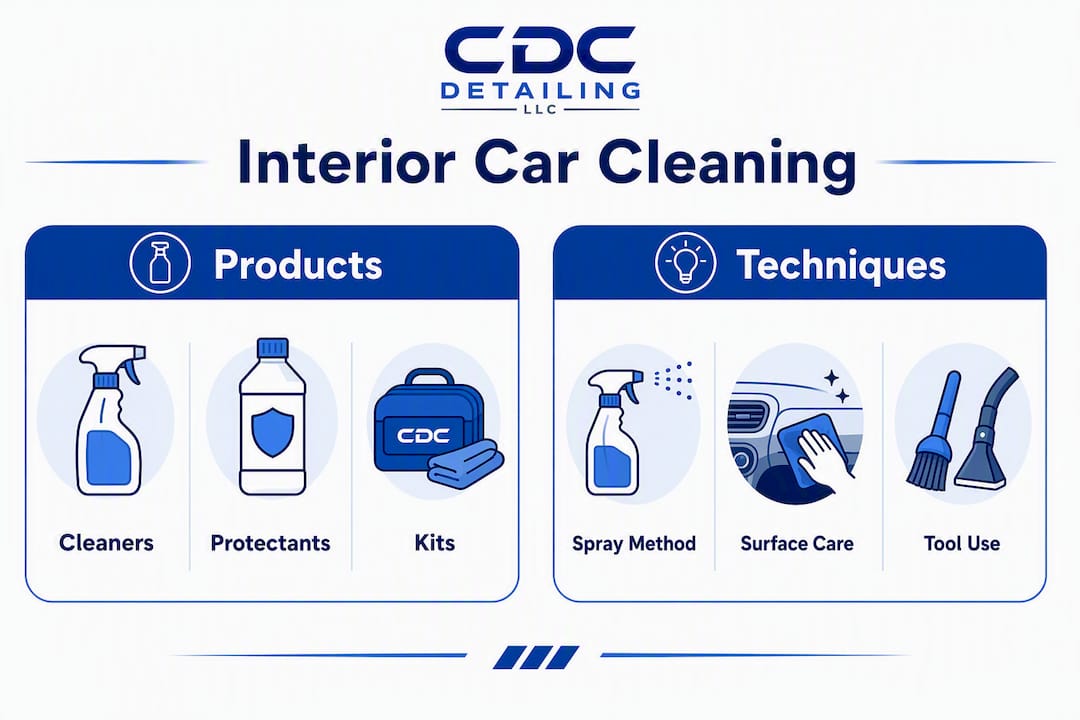
Best for glass and carpet together: Stoner Car Care interior detailing kit. Stoner built its reputation on streak-free glass, and the kit layout reflects that strength.
Best premium set: Adam’s Polishes Elite Interior. The sprayer quality alone separates it from most consumer bottles, and the formulas are tuned for enthusiasts who care about surface feel.
Best protectant/finish: Armor All Podium Series Protectant. If you want a finished, show-style look on dashboards and trim with a pleasant scent, this is the pick.
Best professional option: Cdcautodetailing mobile detailing service (South Jersey). When the job is beyond a spray bottle, a professional reset with extraction, steam, and protected finishes is the right call.
Pros and cons at a glance:
- Spray detailers — (Meguiar’s, Gyeon, Chemical Guys): fast, low effort, safe on most surfaces. Trade-off: limited on heavy stains or embedded odors.
How we define “best” and what we tested for
“Best” here means the product or service that delivers the cleanest result on the widest range of surfaces without causing damage, leaving residue, or requiring professional-grade equipment to use correctly.
The evaluation framework covers six dimensions:
- Surface compatibility: Does it work safely on leather, vinyl, soft-touch plastics, Alcantara, fabric, carpet, glass, and screens? Products that require you to avoid entire surface categories score lower.
- Finish left: Matte and dry finishes are generally preferable for factory interiors. A high-gloss finish on a dashboard creates windshield glare and attracts dust faster. Experts note that many owners mistake a shiny finish for a clean one, but the two are not the same.
- Streaking on screens and glass: Screens are the most damage-prone surface in a modern interior. Products with high alcohol content or silicone can permanently damage anti-glare coatings.
- Cleaning power vs. aggressiveness: Professional detailers recommend starting with the least aggressive product and escalating only when needed. High-pH cleaners (above 10) work well on carpets but can strip soft-touch coatings.
- Ease of use: Spray-and-wipe simplicity matters for real-world maintenance. A product that requires a five-step process won’t get used consistently.
- Scent: Strong artificial fragrances mask odors temporarily. Products with neutral or mild scents indicate cleaner chemistry.
Pro tip on patch testing: According to Road & Track’s testing panel, kits vary significantly in what they include and how they perform across surface types. Before applying any new product to a full panel, mist it onto a microfiber towel and test on a hidden area first. This is especially important for soft-touch rubberized plastics and Alcantara, which can discolor or pill with the wrong formula.
Pro Tip: Never spray directly onto a screen or piano-black trim. Mist the product into a folded microfiber towel, wipe gently, then follow with a dry buff pass. This prevents cleaner from seeping into seams and electronics.
Best cleaners and kits by category
Car & Driver’s tested roundup found product prices running from under $10 to nearly $30 per bottle, which shapes the value math considerably when you’re comparing a single spray to a full kit.
| Product | Best for | Price/value | Surface compatibility | Ease of use | Kit vs. single | Finish left | Scent |
|---|---|---|---|---|---|---|---|
| Cdcautodetailing | Full deep reset, South Jersey | Professional pricing | All surfaces, pro-grade | Done for you | Full-service | Pro finish | Neutral/clean |
| Chemical Guys Total Interior Cleaner & Protectant | Multi-surface kit with protection | Mid-range kit | Broad: plastics, vinyl, leather, fabric | Easy | Kit with cleaners + protectants | Light sheen | Mild |
| Griot’s Garage Ultimate/Starter Interior Kit | Enthusiasts building a home kit | Higher upfront, strong value | Broad with dedicated cleaners per surface | Moderate | Full kit: brushes, applicators, multiple cleaners | Matte/dry | Mild |
| Meguiar’s Quik Interior Detailer Cleaner | Quick maintenance wipe-downs | Under $10, best budget | Plastics, vinyl, dash; avoid screens | Very easy | Single product | Light sheen | Mild |
| Stoner Car Care interior detailing kit | Glass + carpet combo | Mid-range | Strong on glass; good on carpet | Easy | Kit: targeted cleaners | Streak-free on glass | Neutral |
| Adam’s Polishes Elite Interior | Premium multi-surface performance | Premium | Leather, plastics, fabric, glass | Moderate | Multi-product set | Matte/dry | Light |
| Armor All Podium Series Protectant | Dashboard/trim finish and scent | Budget-mid | Hard plastics, vinyl, trim | Very easy | Single product | High gloss | Fragrant |
Chemical Guys Total Interior Cleaner & Protectant
The kit format is the real advantage here. You get cleaners and protectants for multiple surfaces in one purchase, which removes the guesswork of buying individual products. The Total Interior Cleaner handles dashboards, door panels, vinyl, and fabric in a single formula. The trade-off is that the included protectant leans toward a light sheen rather than a true matte finish, which some factory interiors may not need. Good for owners who want one box that covers most situations without spending time researching individual products.
Griot’s Garage Ultimate/Starter Interior Kit
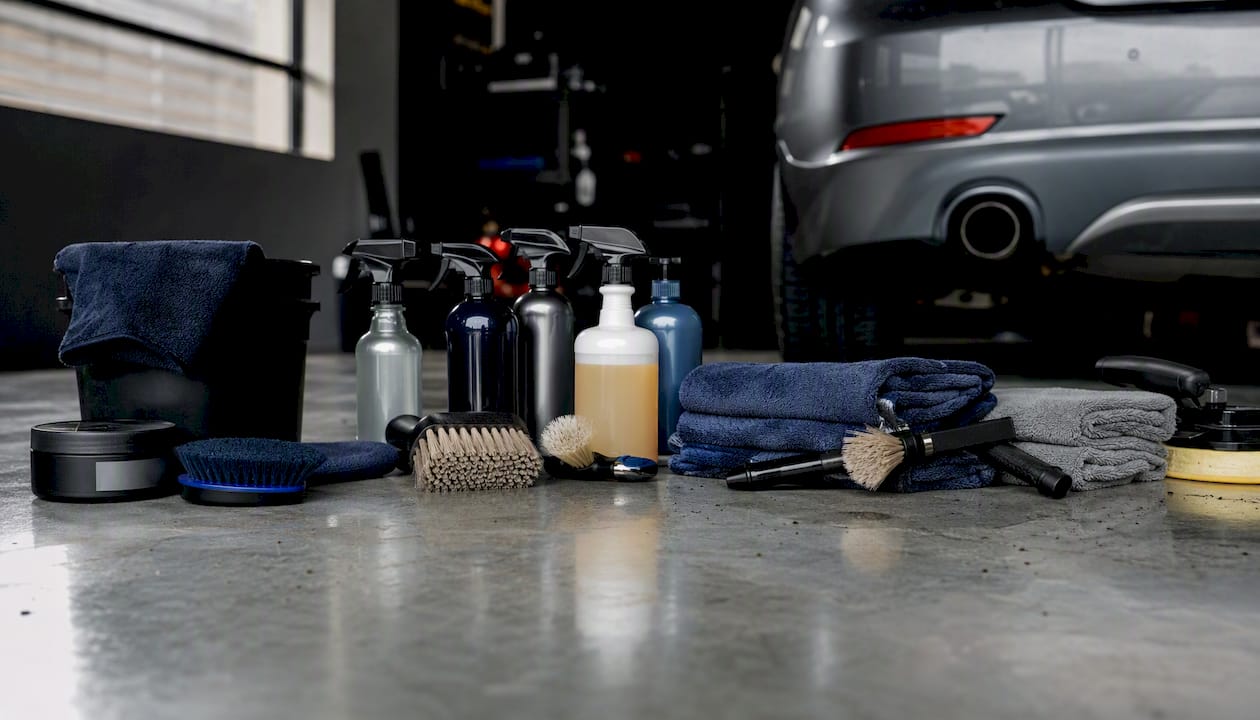
Griot’s stands out for the sheer number of brushes and applicators included. Most consumer kits ship with a bottle and a cloth. Griot’s gives you dedicated tools for vents, seams, and upholstery, which is the difference between cleaning a surface and actually cleaning it. The enthusiast-level kit is the right choice if you’re building a home detailing setup you’ll use for years. The starter kit is a reasonable entry point if you want to test the brand before committing.
Meguiar’s Quik Interior Detailer Cleaner
Available at Walmart, AutoZone, and virtually every auto parts retailer, this is the most accessible product on the list. The spray-and-wipe format takes under a minute per panel. It won’t lift embedded stains or odors, but for a weekly wipe-down on a reasonably maintained interior, it does the job cleanly. Car & Driver’s testers noted that wipes and quick-detailer sprays score highest on speed but struggle when grime is heavier, sometimes leaving residue that attracts dust.
Stoner Car Care interior detailing kit
Stoner built its name on Invisible Glass, one of the most consistently recommended automotive glass cleaners available. The interior kit carries that glass-cleaning strength into a broader package. If your biggest frustration is streaky windshields and grimy carpet, this kit addresses both without requiring you to source products separately.
Adam’s Polishes Elite Interior
The sprayer mechanism on Adam’s bottles is noticeably better than the generic triggers on most consumer products, which matters when you’re misting product into a microfiber towel rather than blasting it onto a surface. The formulas are tuned for enthusiasts who want a dry, residue-free finish. Higher price point, but the per-use cost is reasonable given the concentration.
Armor All Podium Series Protectant
Armor All’s Podium Series is a step above the original Armor All formula, with a more controlled finish and a noticeably pleasant scent. The high-gloss finish it leaves is the main limitation: it looks great on a show car but creates dashboard glare on a daily driver. Best used on lower trim pieces and door panels rather than the top of the dash.
What tools actually make the biggest difference?
Professional test results consistently show that tools are often the limiting factor in DIY results. A $30 spray applied with a cheap cloth will underperform a $10 spray applied correctly with the right brush and microfiber. Here’s how to think about the tool investment:
Minimum effective kit:
- Vacuum with crevice and brush attachments (critical for seats, seams, and floor mats before any liquid touches the interior)
- Three microfiber towels: one for application, one for buffing, one for glass only
- A soft-bristle detailing brush for vents and seams
- Foam applicator pads for protectants
Enthusiast upgrade:
- Dedicated vent brush and stiff-bristle carpet brush
- Microfiber applicator pads for leather and soft-touch surfaces
- Portable carpet/upholstery spot extractor (Bissell Little Green or similar)
- Swabs for tight seams around buttons and trim
Pro-grade tools:
- Hot water extractor or steam cleaner for fabric seats and carpet
- Multiple microfiber towel grades (300 GSM for glass, 400+ GSM for surfaces, waffle-weave for drying)
- Drill brush attachments for carpet agitation
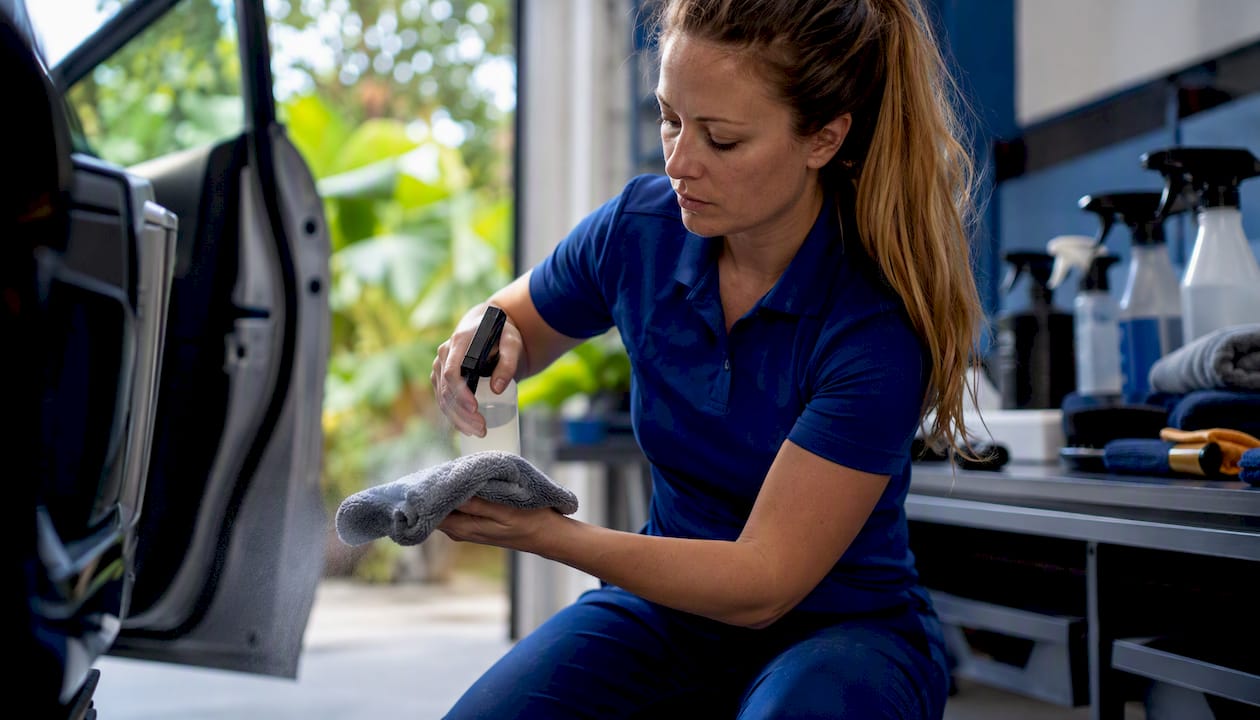
The controlled application technique matters as much as the tool itself. Professional guidance is consistent: mist product into the towel, not onto the surface. This prevents over-spray from reaching electronics, seams, and screens. For what professional detailers actually carry in their kits, the tool list is longer than most DIYers expect.
How to clean each surface safely
Different surfaces in your car need different approaches. Using the wrong product on the wrong material is the most common cause of permanent damage.
Dashboards and hard plastics
- Vacuum loose debris and dust with a brush attachment.
- Mist a pH-neutral all-purpose detailer (Chemical Guys Total Interior Cleaner, Meguiar’s Quik Interior Detailer) into a microfiber towel.
- Wipe in straight passes, not circles, to avoid pushing grime into texture.
- Follow with a dry microfiber buff pass.
- Apply a protectant only if the factory finish is matte; skip it on soft-touch rubberized panels.
Soft-touch and rubberized plastics
These are the most damage-prone hard surfaces in a modern interior. High-alkalinity products above pH 10 can strip the soft-touch coating permanently, leaving a shiny, sticky patch. Use only pH-neutral detailers, test first on a hidden area, and avoid any product labeled as an APC (all-purpose cleaner) at full strength.
Leather seats
- Vacuum seams and crevices first.
- Apply a dedicated leather cleaner (not a multi-surface spray) to a soft applicator pad.
- Work in small sections with light circular pressure.
- Wipe clean with a damp microfiber towel.
- Follow immediately with a leather conditioner to restore moisture. Cleaning without conditioning dries the leather over time.
Fabric seats and upholstery
- Vacuum thoroughly, including under seat cushions.
- Pre-treat stains with a targeted upholstery cleaner; let it dwell for two to three minutes.
- Agitate with a soft-bristle brush in straight lines.
- Extract with a spot extractor or blot firmly with a clean microfiber towel.
- Allow to dry fully before sitting on the seat to prevent re-soiling.
Carpet and floor mats
Remove mats and clean them separately. Stiff-bristle brushes and an extractor make a significant difference on carpet. For heavy staining, a diluted APC (follow the product’s recommended dilution ratio) is appropriate here, since carpet is more tolerant of higher pH than soft-touch plastics.
Glass and screens
Glass: Use a dedicated automotive glass cleaner (Stoner Invisible Glass is the benchmark). Two-towel method: wipe with one damp microfiber, buff dry with a second clean one. Never use household glass cleaners with ammonia on tinted windows.
Screens: This is where most damage happens. Use only a screen-safe, alcohol-free cleaner or a lightly dampened microfiber with no product at all. Never spray anything directly onto a screen. Gyeon’s alcohol-forward formula is designed to be residue-free and safe on screens when applied via towel, but even then, a single wipe with minimal product is the rule.
Alcantara
Alcantara requires a dedicated Alcantara cleaner or a very diluted, pH-neutral fabric cleaner. Brush in one direction only, using a soft-bristle brush. Never use silicone-based protectants on Alcantara; they mat the fibers.
Pro Tip: For screens and piano-black trim, less is always more. A barely-damp microfiber with no product removes fingerprints without risking coating damage. Add product only when a dry wipe leaves residue.
Quick maintenance vs. deep clean: which workflow fits your situation?
The 10–20 minute weekly routine
This is the routine that keeps a clean car clean. It requires a spray detailer, a glass cleaner, two microfiber towels, and a vacuum.
- Remove trash and loose items.
- Vacuum seats, floor, and mats (five minutes).
- Mist detailer into a towel; wipe dash, door panels, and center console.
- Clean glass with a dedicated glass cleaner and a dry microfiber.
- Spot-treat any new stains on fabric or carpet immediately.
Total time: 10–20 minutes. This is the routine that makes a professional deep clean a once-a-year event rather than a quarterly necessity. For time-saving techniques, these interior cleaning hacks cover the shortcuts that actually work.
The DIY deep clean (two to four hours)
- Remove all floor mats, seat covers, and loose items.
- Vacuum the entire interior thoroughly, including under seats and in all seams.
- Pre-treat carpet and upholstery stains; let dwell.
- Clean hard surfaces (dash, console, door panels) with an all-purpose detailer.
- Clean leather or fabric seats with dedicated cleaners; condition leather after.
- Extract carpet and upholstery with a spot extractor.
- Clean all glass surfaces last (glass picks up overspray from earlier steps).
- Apply protectants where appropriate; allow to dry before use.
A structured step-by-step interior cleaning workflow can help you stay organized through the full process.
When to stop and call a pro:
- Odors that persist after cleaning (pet, smoke, mildew)
- Stains that don’t lift after two treatment attempts
- Mold or mildew visible on fabric or carpet
- Heavily soiled seats that need hot-water extraction
- Any surface where you’re unsure of the material or safe chemistry
When does a professional detailer make more sense than DIY?
A professional interior detail is not just a more thorough version of what you do at home. Pros bring equipment that consumer tools cannot replicate: hot-water extractors that pull soils from deep in carpet fibers, steam cleaners that sanitize without saturating, and odor-elimination treatments that address the source rather than masking it.
Detailing shops report that a professional reset makes long-term maintenance straightforward, while delayed cleaning allows oils and grime to embed in ways that become genuinely difficult to reverse.
What a professional interior detail typically includes:
- Full vacuum including under seats and in all crevices
- Hot-water extraction or steam cleaning for fabric and carpet
- Leather cleaning and conditioning
- Hard-surface cleaning and protectant application
- Glass cleaning (interior)
- Odor treatment (ozone or enzyme-based, depending on the source)
- Door jamb cleaning
Cost and timeline guidance: A professional interior detail for a standard passenger vehicle typically costs significantly more than DIY approaches, varying based on vehicle size, condition, and the services included. Heavily soiled vehicles or those requiring odor treatment will be at the higher end. Most full interior details take two to four hours. For a detailed breakdown of what to expect to pay, this interior cleaning price guide covers current South Jersey market rates.
Questions to ask before booking:
- Do you have experience with my specific materials (Alcantara, perforated leather, soft-touch plastics)?
- What extraction equipment do you use?
- Is odor treatment included, or is it an add-on?
- Do you carry liability insurance for interior damage?
- Is this a mobile service, or do I need to bring the vehicle to a shop?
- What’s your process if a stain doesn’t fully lift?
Pro Tip: Before a pro arrives, remove all personal items, trash, and loose gear from the vehicle. A cleaner interior means the detailer spends time cleaning surfaces rather than organizing your belongings, which can reduce the job time and cost.
Which option fits your situation?
- Family car with kids and pets: — Chemical Guys Total Interior Cleaner & Protectant kit or Stoner Car Care kit for broader coverage, plus a spot extractor for inevitable spills. Book a professional deep clean once or twice a year.
One-line recommendation: Start with a professional reset if the interior is genuinely dirty, then maintain it weekly with a spray detailer, a glass cleaner, and quality microfiber towels.
How long do interior cleaning products actually last?
Most spray detailers and all-purpose cleaners have a shelf life of two to three years when stored correctly. “Correctly” means a cool, dry location away from direct sunlight and temperature extremes. A garage that swings between 20°F in winter and 110°F in summer will degrade product chemistry faster than the label suggests.
A few practical rules:
Seal caps tightly after every use. Exposure to air oxidizes some formulas and causes others to separate. A bottle left open between uses may still spray, but the cleaning performance drops.
Watch for separation or color change. If a product that was once uniform starts showing layers or changes color, the formula has degraded. Using a degraded product can leave residue or, in the case of leather cleaners, strip conditioning agents unevenly.
Wipes dry out. Pre-moistened wipes are the most shelf-life-sensitive format on this list. Once a canister is opened, the wipes at the bottom dry out within a few weeks unless the lid seals tightly. Buy smaller canisters if you use wipes infrequently.
Protectants and conditioners: Leather conditioners and surface protectants tend to have longer shelf lives than cleaners, often three to four years sealed. Once opened, use within 18 months for best performance.
Label the open date. A simple piece of tape with the month and year you opened a bottle saves you from guessing whether a product is still effective. Products used past their prime often leave more residue than a fresh formula, which defeats the purpose.
Key Takeaways
The most effective approach to interior car cleaning is a professional deep reset followed by consistent weekly maintenance with two to four vetted products and quality microfiber tools.
| Point | Details |
|---|---|
| Pro reset first | Book a professional detail for neglected, stained, or odor-affected interiors before starting a DIY routine. |
| Test every new product first | Apply to a hidden area before full use, especially on soft-touch plastics, Alcantara, and screens. |
| Tools matter as much as products | A vacuum, multiple microfiber towels, and the right brushes determine results more than brand-name liquids alone. |
| Spray into the towel, not the surface | This prevents over-spray damage to screens, electronics, and seams on every surface type. |
| Cdcautodetailing mobile service | For South Jersey vehicle owners, Cdcautodetailing provides professional mobile interior detailing as the recommended deep-reset option. |
Why the “miracle bottle” mindset keeps your car dirtier than it should be
Most car owners approach interior cleaning the same way: buy a new product, spray it on, and expect the cabin to look showroom-fresh. When it doesn’t, they assume they need a stronger product. That’s the wrong direction.
The real variable is almost never the chemistry. It’s the sequence, the tools, and the frequency. A $10 spray detailer applied weekly with a clean microfiber towel will keep an interior in better condition than a $50 premium cleaner used twice a year. The premium product doesn’t overcome the embedded grime that built up in the months between uses.
There’s also a finish misconception worth addressing directly. A high-gloss, slick-feeling dashboard does not mean the surface is clean. It often means it’s coated in silicone or wax that’s trapping dust and creating glare. The factory finish on most modern interiors is intentionally matte or satin. Products that restore that factory look, rather than adding a layer of shine on top of it, are doing the better job.
The professional detail argument is similar. Owners often delay booking a pro because the interior “isn’t that bad.” But oils from skin, food residue, and UV degradation accumulate gradually. By the time the interior looks bad, the soils are embedded in ways that consumer tools genuinely cannot address. A professional reset at the right time, before the damage is visible, is far less expensive than restoration after the fact.
The mixed model, a professional deep clean once or twice a year combined with a consistent weekly routine, is what actually works over the long term. Not the strongest product. Not the most expensive kit. Consistency and the right sequence.
Cdcautodetailing brings the deep clean to your driveway
DIY kits handle maintenance well. What they can’t replicate is the extraction power, steam capability, and material expertise of a professional detail. Cdcautodetailing is a mobile detailing service based in Pitman, New Jersey, serving vehicle owners across South Jersey. The service comes to you, which means no drop-off, no waiting room, and no coordinating a ride home.
A typical interior deep reset with Cdcautodetailing includes full vacuuming, hot-water extraction for fabric and carpet, leather cleaning and conditioning, hard-surface treatment, and glass cleaning. For owners considering long-term interior protection, ceramic coating services are also available as a follow-up to a deep clean. To see the full range of what a professional interior detail covers, explore the service options and book a visit for your vehicle.
Useful sources and further reading
The recommendations in this article draw on a combination of hands-on product testing, professional detailing guidance, and manufacturer specifications. Here are the primary sources:
- Best Car Interior Cleaners for 2026, Tested — Car & Driver: Product test roundup covering price ranges, cleaning performance, and surface compatibility across multiple categories. A product test source.
- Best Interior Cleaners of 2026, Tested by Experts — Road & Track: Expert-tested roundup that differentiates convenience kits from enthusiast kits with dedicated surface cleaners. A product test source.
- How to Clean Your Car’s Interior — Consumer Reports: General-audience guidance on interior cleaning sequences and product safety. An editorial guidance source.
- Chemical Guys Complete Interior Deep Clean & Protect Kit: Manufacturer product page detailing kit contents, included tools, and surface coverage claims
- Interior cleaning step by step — Cdcautodetailing: Step-by-step workflow for a thorough interior clean, including preparation and surface-specific guidance.