
TL;DR:
- Only flexible polymer-based ceramic coatings can self-heal scratches when heat activates dynamic bond flow. Hard 9H coatings resist scratches but lack self-repair capabilities, making them less effective for everyday minor damage. Proper surface prep, application, and maintenance are essential to maximize the benefits of self-healing coatings over traditional options.
Not every ceramic coating heals itself. That’s the single most important thing to understand before spending hundreds of dollars on paint protection. The ceramic coating self healing technology you see marketed everywhere is real and impressive, but it only exists in a specific category of coatings built with flexible polymer chemistry. Standard hard ceramic coatings, the kind rated 9H for hardness, resist scratches well but cannot repair themselves. This article cuts through the confusion, explains the actual science, and gives you everything you need to choose, apply, and maintain the right coating for your car.
Table of Contents
- Key takeaways
- How ceramic coating self healing actually works
- Self-healing vs. traditional coatings: which actually protects better
- Applying and maintaining self-healing ceramic coatings
- Where self-healing coating technology is heading
- My honest take on self-healing ceramics after years in the field
- Get expert ceramic coating service in South Jersey
- FAQ
Key takeaways
| Point | Details |
|---|---|
| Not all ceramics self-heal | Only flexible elastomeric or silicon-based formulations can repair surface scratches with heat. |
| Heat activates the healing | Sunlight, warm water, or a heat gun triggers polymer flow to seal micro scratches. |
| Hardness and healing trade off | Softer flexible coatings heal better; harder 9H coatings resist scratches but cannot self-repair. |
| Professional prep matters | Surface decontamination before application directly determines how long your coating performs. |
| Market growth signals quality advances | Demand through 2035 is pushing manufacturers toward hybrid coatings with both hardness and healing. |
How ceramic coating self healing actually works
The phrase “self healing” sounds like science fiction, but the chemistry behind it is straightforward once you see it explained clearly.
Traditional ceramic coatings are built from silicon dioxide (SiO2) particles that cure into a hard, glass-like layer over your paint. They are tough and chemically resistant, but that rigidity is also their limitation. When a light scratch cuts through the surface, the brittle matrix cannot flow back together. The scratch stays.
True self-healing coatings take a fundamentally different approach. Instead of a rigid glass structure, they use flexible silicon or elastomeric polymer networks. These polymer chains have what chemists call “dynamic bonds,” connections that can break and reform when energy is applied. That energy source is almost always heat. Here is how the process unfolds:
- A light scratch or swirl mark disrupts the polymer chains at the surface.
- Heat is applied, whether from direct sunlight, warm water, or a heat gun set to low.
- The elevated temperature gives the polymer chains enough energy to move and flow.
- The dynamic bonds re-form across the damaged area, essentially filling and sealing the scratch.
- As the coating cools, the repaired surface hardens back to its normal state.
Two main mechanisms exist in the market. The first is an intrinsic polymer network, where the coating material itself contains the dynamic bonds and can self-repair without any added agents. The second is a microcapsule system, where tiny capsules of healing agent are embedded in the coating and rupture when the surface is scratched, releasing material that fills the damage. Intrinsic polymer designs are more common in premium automotive applications because they can heal repeatedly over the life of the coating.
Scratch repair efficiency ranges from around 50% to nearly 100% depending on the polymer chemistry, ambient temperature, and how deep the scratch goes. Shallow swirl marks from washing respond almost completely. Deeper scratches from keys or road debris are a different story; those typically require targeted heat and may not fully disappear.
The key trade-off to understand is that hardness and healing ability work against each other in coating chemistry. A coating optimized for maximum hardness (9H ratings) sacrifices the polymer flexibility needed for self-repair. A coating built for healing is inherently softer.
Pro Tip: If a product claims to be both 9H hard AND fully self-healing, read the fine print. Marketing language sometimes conflates scratch resistance with scratch repair. These are not the same thing.
Self-healing vs. traditional coatings: which actually protects better
This is the question most car owners get wrong because they assume harder always means better. The honest answer is that it depends on what you are trying to protect against.
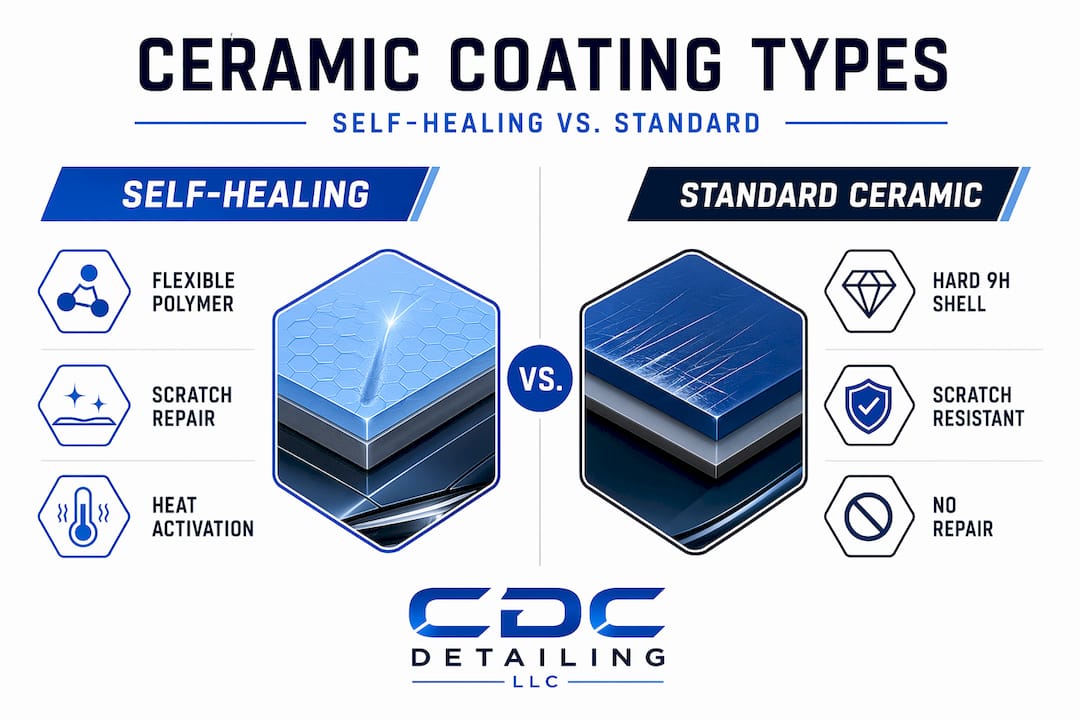
Standard brittle 9H ceramic coatings resist scratches well but lack the flexible polymer networks necessary for self-repairing. They are excellent at blocking chemical contamination, UV rays, and surface oxidation. A well-applied hard ceramic can outlast a self-healing coating in pure chemical resistance tests. The problem is that real-world driving involves parking lot door dings, automatic car washes, and accidental brush marks. All of those leave visible damage on a hard ceramic.
Self-healing ceramic coatings built on flexible silicon chemistry, like those from Revivify Coatings, move with the paint instead of cracking or chipping under impact. That flexibility means they maintain a glossy, flawless appearance longer under everyday conditions, even if they are technically softer.
Here is how the main options stack up:
| Protection Type | Scratch Resistance | Self-Healing | Chemical Resistance | Durability Range | Typical Cost |
|---|---|---|---|---|---|
| Hard ceramic (9H) | High | None | Excellent | 3 to 5 years | Moderate |
| Self-healing ceramic | Moderate | Yes (heat activated) | Good | 2 to 7+ years | Moderate to high |
| Paint protection film (PPF) | Very high | Yes (most grades) | Moderate | 5 to 10 years | High |
| Sealants and waxes | Low | None | Low | 3 to 6 months | Low |
A few things stand out in that comparison. Paint protection film is the only option that handles deep scratches better than a self-healing ceramic. If your priority is rock chip protection on the hood and front bumper, PPF wins. If your priority is maintaining gloss and handling light surface damage across the full car without constant maintenance, a self-healing ceramic finish is the smarter and more economical choice.
The cost advantage of self-healing ceramics over full-car PPF is significant. Most vehicle owners find that combining PPF on high-impact areas (hood, mirrors, bumpers) with a self-healing ceramic over the full car gives the best of both worlds without the full PPF price tag.
For a deeper look at how these options compare in practice, the pros and cons breakdown at Cdcautodetailing covers real-world scenarios worth reading before you decide.
Applying and maintaining self-healing ceramic coatings
Getting the most out of a self-repairing ceramic coat starts before the product ever touches your car. Surface preparation accounts for more of the final result than the coating brand itself.
Here is what proper prep and application looks like:
- Wash and decontaminate thoroughly. Iron contamination, tar, and bonded surface debris must be removed before application. A clay bar treatment after washing is standard practice for any quality ceramic job.
- Correct the paint first. Any scratches, swirls, or oxidation present before application will be locked under the coating. Machine polishing before coating is not optional if you want a flawless result.
- Control the environment. Application in direct sunlight or extreme heat causes the coating to flash cure too quickly, leaving high spots and uneven coverage. A shaded garage with moderate temperature is ideal.
- Apply in small sections. Work panel by panel, spreading a thin even layer and buffing off the residue within the manufacturer’s window, usually 1 to 5 minutes depending on conditions.
- Respect the cure schedule. Professional-grade silicon coatings allow driving within one hour of application, with full cure completing within two days. Avoid washing, rain exposure, and anything that contacts the surface during those first 48 hours.
Once the coating is cured, activating the healing process is simple. Light swirl marks from a car wash? Leave the car parked in direct sunlight for 20 to 30 minutes. More stubborn surface scratches? A heat gun on low, kept moving at about six inches from the surface, will activate the polymer flow in seconds. Warm water from a hose works for minor marks too.
The mistakes most owners make come down to two things. First, they ignore minor contamination buildup and wash the car with harsh soaps that degrade the coating. pH-neutral shampoos specifically designed for coated cars extend the life dramatically. Second, they assume the coating is permanent. Even 7-year-rated flagship products benefit from an annual inspection and a maintenance spray to reinforce the top layer.
Pro Tip: Work with a certified installer, not just a shop that offers ceramic coating as an add-on. Certification programs, like those Cdcautodetailing holds for Revivify coatings, include product-specific training that directly affects how well the coating bonds and performs.
For a step-by-step breakdown of the full process, the ceramic coating application guide at Cdcautodetailing is a useful reference whether you go DIY or professional.
Where self-healing coating technology is heading
The self-healing material market is forecast to grow steadily through 2035, with the automotive sector driving the largest share of that demand. Vehicle owners want protection that stays attractive without constant upkeep, and self-healing chemistry is the clearest path to that outcome.
Several trends are shaping what the next generation of durable ceramic coatings will look like:
| Trend | Current State | Expected Direction by 2030 |
|---|---|---|
| Hybrid thermal activation | Separate hard and healing layers | Single-layer coatings combining both properties |
| Smart coatings | Experimental stage | Coatings that respond to UV or pressure triggers, not just heat |
| Environmental compliance | Solvent-based formulas common | Waterborne and low-VOC options becoming standard |
| Consumer DIY grade | Limited performance gap vs. pro | Narrowing, with better shelf-stable retail products |
The most exciting development is research into coatings that activate healing through UV light rather than heat. This would make the process more reliable in cold climates where sunlight provides minimal warmth. Automotive coatings remain the largest consumer segment of self-healing materials, which means manufacturers are investing heavily in solving exactly these kinds of limitations.
Regulatory pressure is also pushing the industry toward cleaner formulations. This is actually good news for consumers. Waterborne ceramic chemistries have historically lagged solvent-based options in performance, but recent formulations are closing that gap fast.
My honest take on self-healing ceramics after years in the field
I’ve been asked hundreds of times which coating is “the best,” and the answer I give now is very different from what I would have said a few years ago. The marketing around 9H hardness ratings convinced a lot of people, myself included early on, that harder meant better protected. What I’ve learned working on real cars is that hardness ratings are nearly meaningless for everyday paint protection.
What actually matters is how the coating holds up after six months of weekly washes, parking lots, and road grime. In my experience, flexible silicon-based coatings consistently outperform marketed hard ceramics in maintaining that showroom look over time. The self-healing ability is not a gimmick. I’ve watched swirl marks from a careless car wash disappear within 30 minutes of parking a coated car in the sun.
The biggest misconception I encounter is that owners expect self-healing to be invisible maintenance. They assume the coating handles everything and they can skip regular washing. It doesn’t work that way. You still need to wash correctly, avoid abrasive products, and do an annual maintenance check. The coating rewards good habits. It does not replace them.
— Charles
Get expert ceramic coating service in South Jersey
If this article has you thinking seriously about protecting your car, you’re already ahead of most vehicle owners who wait until paint damage appears.

Cdcautodetailing is a certified Revivify installer serving Pitman, New Jersey and the surrounding South Jersey area. The team applies professional self-healing coatings with the prep work, product knowledge, and attention to detail that determines whether a coating performs for two years or seven. Explore the full range of ceramic coating services available, or check out the breakdown of popular self-healing brands to see what Cdcautodetailing recommends and why. Ready to book? Contact the team directly to schedule your application.
FAQ
What is ceramic coating self healing?
Ceramic coating self healing refers to a category of automotive coatings that use flexible polymer or silicon chemistry to repair minor surface scratches when heat is applied. Unlike hard 9H ceramic coatings, these formulations contain dynamic bonds that allow the coating to flow back together after light damage.
Does all ceramic coating self-heal?
No. Standard ceramic coatings built with rigid silicon dioxide chemistry cannot self-repair. Only coatings specifically formulated with flexible elastomeric or silicon polymer networks have true self-healing capability.
How does self healing work on a coated car?
Heat activates the process. Sunlight, warm water, or a low-setting heat gun raises the temperature of the coating enough for the polymer chains to move and reseal the damaged area. Shallow scratches and swirl marks typically heal within 20 to 30 minutes of heat exposure.
How long do self-healing ceramic coatings last?
Durability depends on the product tier. Entry-level silicon-based coatings typically offer around two years of protection, while flagship professional-grade coatings are rated for seven or more years when properly maintained.
Can self-healing coatings fix deep scratches?
Not reliably. The healing mechanism works best on micro scratches and light swirl marks that affect only the coating layer. Scratches that cut through to the primer or bare metal require professional paint correction regardless of what coating is applied afterward.