
The safest way to clean Alcantara car seats is to dry brush away loose dirt, blot any fresh spill right away, and spot clean with the lightest possible dampness, working from the outer edge inward. Alcantara’s own care guidance stresses acting fast, and treating a stain within 30 minutes of it happening gives you the best shot at lifting it clean. Never soak the material or point a steamer at it. When a mark won’t budge, a shop like CDC Auto Detailing can finish the job without risking the texture.
TL;DR:
- Using specific Alcantara or synthetic suede cleaners without excess liquid provides the best stain removal results without damaging the fabric.
- Lightly dampening a microfiber cloth and working from the outer edge inward minimizes the risk of over-wetting and preserves the nap’s even texture.
- Actively treating stains within 30 minutes greatly improves the chances of complete removal, especially for oil, ink, and dye transfer.
- Removable Alcantara covers can be machine washed at low temperatures with a mild detergent and must be air-dried to avoid distortion.
- Professional cleaning is recommended for set-in stains, large discolored areas, or high-value interiors to prevent accidental damage and ensure proper nap restoration.
Table of Contents
- Tools, materials, and what to avoid
- Step-by-step cleaning workflow for everyday dirt and light stains
- Stain-specific treatments for oil, ink, food, and dye transfer
- Can you machine wash removable Alcantara covers?
- How to restore the nap and keep Alcantara looking new
- When to call a professional detailer instead of DIY
- A mobile detailer’s take on keeping Alcantara looking right
- Professional Alcantara care from CDC Auto Detailing
- FAQ
- Sources
Tools, materials, and what to avoid
Alcantara is a microfiber suede alternative, so the right toolkit matters more than the right amount of elbow grease. Keep these on hand and you can handle most everyday dirt and small spills without calling in backup.
- A soft-bristled brush and a dedicated suede-style brush for lifting dust and raising the nap.
- A vacuum with a soft brush attachment, never a bare hose nozzle.
- Several clean microfiber cloths, distilled water, a small spray bottle, and cotton swabs for tight corners.
- A small amount of isopropyl alcohol, used sparingly and only for specific stains.
For deeper cleaning, foaming cleaners made specifically for Alcantara and synthetic suede tend to outperform general-purpose cleaners because they put less liquid into the fabric. Community testing of SONAX Upholstery & Alcantara Cleaner found it lifted oil and grease with brush agitation and no color shift when used as directed. Skip steam cleaners, wet-vac extraction, stiff or abrasive brushes, bleach, and strong detergents: all of them push moisture or chemicals deeper into the nap than Alcantara can handle. A broader rundown of interior-safe cleaning supplies covers the basics if you’re building a kit from scratch.
Step-by-step cleaning workflow for everyday dirt and light stains
Work one panel at a time. Alcantara’s backing can absorb moisture faster than it evaporates, so treating a whole seat at once makes it easy to over-wet a spot without noticing until it’s too late.
- Vacuum and dry brush the panel first to remove loose dust and grit before any liquid touches it.
- Test your cleaner or water on a hidden seam or the seat’s underside to check for color change.
- Blot any fresh spill immediately with a dry microfiber cloth, pressing rather than wiping.
- Lightly dampen a clean cloth, wring it until it’s almost dry, and dab the stain starting from the outer edge and working toward the center.
- Rinse or swap the cloth often so you’re never reapplying the dirt you just lifted.
- Repeat in short cycles, checking progress each time rather than scrubbing continuously.
- Let the panel air dry completely before touching it again or moving to the next section.
- Brush the nap once it’s fully dry to restore the even texture.
Most stains need several passes rather than one hard scrub. Practical testing on Alcantara upholstery found that several light dabbing cycles usually lift a mark, while a single aggressive pass tends to leave a halo or shiny patch instead. Work in sections roughly the size of your palm, and stop to reassess after every two or three cycles rather than pushing through on momentum.
Pro Tip: If a spot still looks damp after blotting, let it air dry fully before deciding whether it needs another round. Judging a “wet” stain against a “dry” one almost always leads to over-treating it.
Stain-specific treatments for oil, ink, food, and dye transfer
Different stains call for different first moves, and matching the treatment to the chemistry saves the fabric from unnecessary handling.
- Oil or grease: Scrape or blot off any solids first, then apply a small amount of isopropyl alcohol to a cloth (never directly on the fabric) and dab gently, following with a water-dampened cloth to rinse the area.
- Ink or makeup: Test ethyl alcohol or a dedicated solvent on a cotton swab in a hidden spot, apply sparingly to the stain, then dab with a slightly damp cloth to lift any residue.
- Food or drink spills: Blot immediately, then switch to a barely damp cloth and repeat short dabbing cycles until no more color transfers to the cloth.
- Dye transfer or stubborn discoloration: Avoid scrubbing harder. If color persists after a few careful attempts, stop and treat it as a job for a professional rather than risking the nap.
Acting within the first 30 minutes of a spill makes the biggest difference, according to Alcantara’s manufacturer guidance, since that window is when a stain is least likely to reach the foam backing underneath. For a quick-response reference while you’re still in the car, Mobiledetailing covers similar first-response moves for upholstery in general.
Can you machine wash removable Alcantara covers?
Removable Alcantara covers can go in the washing machine, but only under specific conditions. Wash at a low temperature with a mild detergent, and skip the spin cycle entirely since spinning can distort the fabric and seams.
- Cover or protect any Velcro fittings before washing so they don’t snag the nap during the cycle.
- Air-dry the cover fully, away from direct heat, rather than using a tumble dryer.
- Once dry, brush the surface gently to realign the nap.
- Never run a steam iron directly on the material.
Alcantara’s own washing instructions confirm this low-temperature, no-spin approach for removable pieces. Non-removable interior panels can’t go through a washing machine at all, so they need the panel-by-panel, low-moisture approach described above instead.
How to restore the nap and keep Alcantara looking new
Alcantara’s texture comes from its raised nap, and that nap can flatten or shift direction with handling. Brush it in one consistent direction with a soft suede brush, and recheck it whenever a panel looks slightly shinier or darker than the rest, that’s usually a sign the grain has shifted rather than that the fabric is damaged.
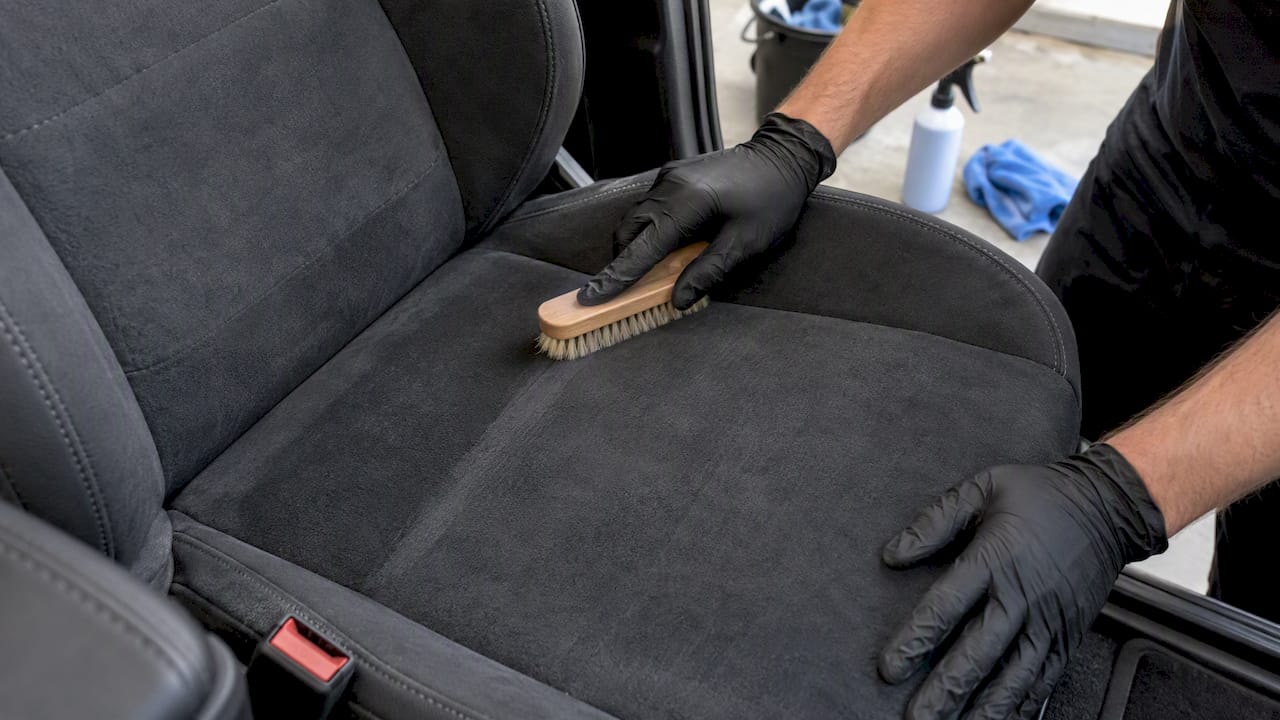
Letting a panel dry completely before brushing or sitting on it again prevents the faint “halo” rings that show up when moisture dries unevenly. A simple cadence keeps the interior in good shape without much effort: dry brush weekly, spot clean only when something actually spills, and plan on one deeper clean a year.
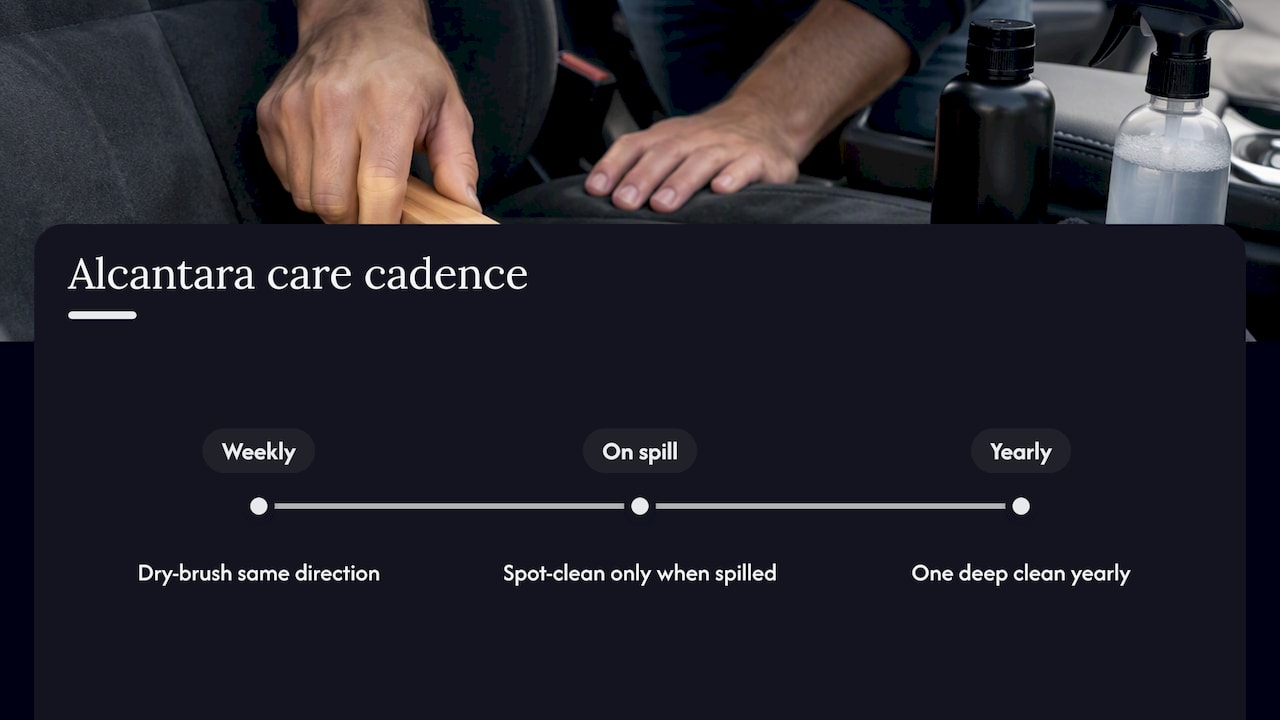
Pro Tip: Brush in the same direction every time. Switching directions between cleanings is one of the easiest ways to end up with a seat that looks patchy even when it’s perfectly clean.
When to call a professional detailer instead of DIY
Some situations call for more than a cloth and patience. Set-in stains that survive several careful attempts, large matted or discolored areas, suspected moisture reaching the foam backing, or a high-value interior where a mistake would be costly are all good reasons to bring in a professional rather than keep experimenting.
Professional detailers typically use controlled spray-extraction at low temperatures, work panel by panel to limit moisture spread, and use nap-restoration techniques most owners don’t have access to. Before booking, it’s worth asking a detailer whether they use low-temperature extraction, how they control moisture panel by panel, whether they can show before-and-after documentation, and what guarantee backs their work. Our own notes on what detailers actually use on interior fabrics cover more of that process.
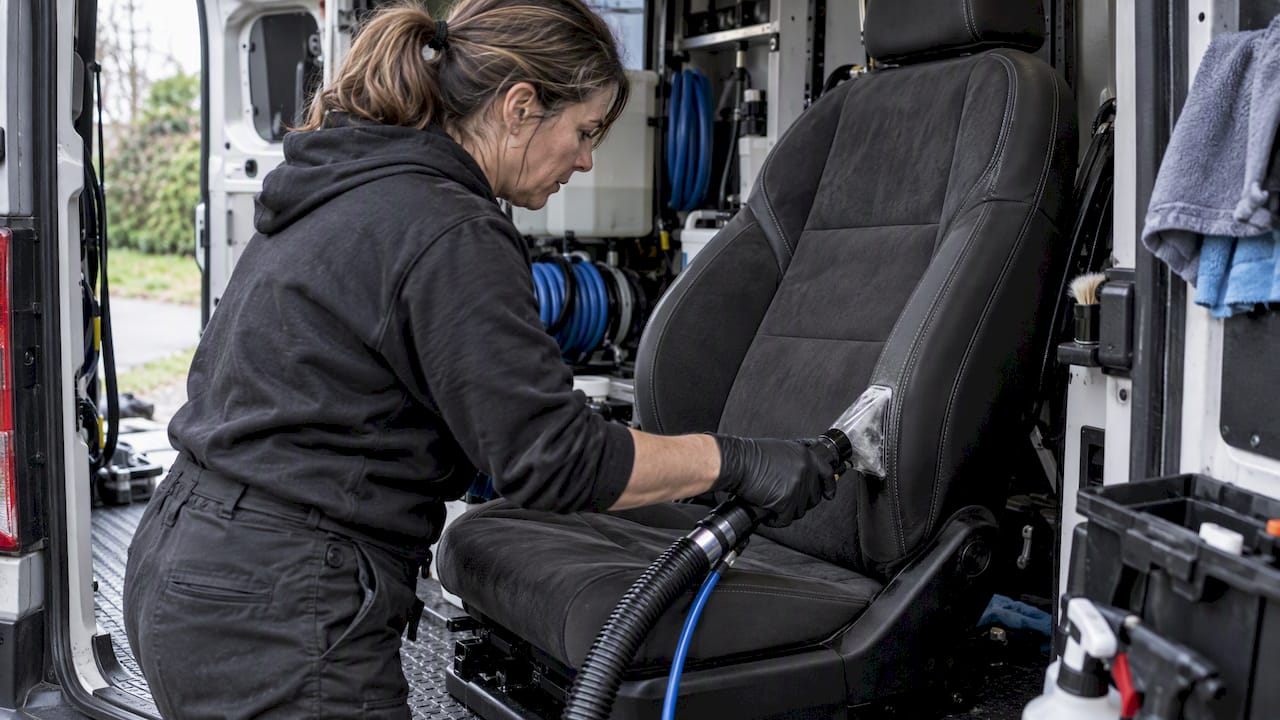
A mobile detailer’s take on keeping Alcantara looking right
Most DIY damage comes from one habit: getting impatient and over-wetting a spot, then scrubbing to compensate. Working small sections, with tools staged before you start (soft brush, vacuum, two cloths, a small spray bottle of distilled water, cotton swabs), keeps a job controlled instead of chaotic. When in doubt, stop, test, and let it dry before deciding your next move.
— Charles
Professional Alcantara care from CDC Auto Detailing
If a stain has outlasted your patience or you’d rather not risk a luxury interior on a DIY attempt, CDC Auto Detailing handles Alcantara with the same panel-by-panel, low-moisture control described above, built into a full interior detail rather than a quick wipe-down. That matters most for owners with set-in stains, premium trim, or simply no spare afternoon to spend testing cleaners on a hidden seam.

An Interior Detail includes the nap restoration work that keeps Alcantara from developing permanent shine or matting over time. If your seats need more than a spot treatment, book an appointment through our interior detail page and let a technician handle the parts that are hardest to get right alone.
FAQ
What is the best cleaner for Alcantara?
A foaming cleaner formulated specifically for Alcantara or synthetic suede works best because it limits how much liquid soaks into the fabric. Testing of SONAX Upholstery & Alcantara Cleaner found it lifted oils and grease with brush agitation and no reported color change when used as directed.
How do you bring Alcantara back to life?
Start with a thorough dry brush and vacuum to remove embedded dust, then spot clean any marks with minimal moisture, working outward to center. Once the panel is completely dry, brush the nap in one consistent direction to restore the even texture and reduce shine or halo patches.
Is it okay to steam clean Alcantara?
No, steam cleaning is not recommended for Alcantara. Manufacturer guidance and detailer experience both point to steam pushing moisture into the backing material, which can cause lasting damage to the nap and the foam underneath.
Can Alcantara be washed?
Removable Alcantara covers can be machine washed at about 30°C with a mild detergent, as long as you skip the spin cycle and air-dry fully afterward. Non-removable interior panels cannot be machine washed and need panel-by-panel, low-moisture spot cleaning instead.
Sources
- How to remove stain on Alcantara – Stain removal instructions – Alcantara
- How to Clean Alcantara: Safe Methods for Everyday Dirt – CleaningBro
- Sonax Alcantara Cleaner: Honest Review · CarCareTruth