
Yes, you can have your car detailed in the parking lot while you are at your desk. A mobile detailer brings the products and tools to your workplace, works on the vehicle while you are inside, and you walk out to a clean car. What makes it go smoothly is not the detailing. It is the groundwork: permission from your employer or property manager, a suitable parking spot, a plan for water and power, and a clear scope of work. This guide covers each of those, plus timing, cost and how a business can arrange it for several vehicles at once.
TL;DR
- Ask your employer or property manager first. Written approval for a specific day, spot and time window prevents most problems.
- A detailer needs a flat parking space with room to open all doors, plus an agreement on water, power and wash water runoff.
- Interior work, exterior work and protective treatments take very different amounts of time. Match the service to the hours you will actually be on site.
- Our published rates start at $175 for an exterior detail and $275 for an interior detail, plus a mobile service fee from $100 and a $100 booking charge.
- Businesses with several vehicles can schedule them in a rotation so nobody loses their car for long.
Table of Contents
- What detailing at work actually looks like
- Step one: get permission before you book
- What a detailer needs at your workplace
- How to prepare your car for a workday detail
- How long it takes and what affects it
- What it costs
- Arranging detailing for several vehicles
- Our perspective
- Book a detail where you work
- FAQ
- Sources
What detailing at work actually looks like
Mobile detailing at work is the same craft as a shop detail, done where your car already sits for eight hours. The detailer arrives with the supplies, sets up beside your vehicle and works through an agreed scope. Typical scopes fall into three groups:
- Interior detail: vacuuming, wiping and conditioning surfaces, cleaning glass, and dealing with seats, carpets and mats. Our Interior Detail service covers this, and our guide to what a full interior detail involves explains the steps.
- Exterior detail: a careful wash, decontamination and finishing of paint, glass, wheels and trim. See Exterior Detail and our overview of what exterior detailing is.
- Protective treatments: ceramic coatings, paint protection film and window tint. These need more time, cleaner conditions and more planning, so they are rarely a good fit for a casual workday parking lot appointment. We usually discuss these case by case before booking.
The appeal is simple. You do not drop the car off, arrange a ride or lose a Saturday. For busy professionals this is the main reason people choose mobile service, and we cover examples of mobile auto care for busy professionals separately.
Step one: get permission before you book
The most common reason a workplace detail goes wrong is that nobody asked. Parking lots are usually controlled by an employer, a landlord or a property management company, and each may have its own rules about outside contractors, liability and cleaning activity on the premises.
Before you book, confirm these points:
- Who controls the lot. If you rent space in an office park, the property manager, not your boss, may be the one who decides.
- Whether outside vendors are allowed. Some sites require a certificate of insurance from any contractor. Ask the detailer whether they can provide one, and ask your manager whether the site wants one.
- Whether washing is allowed at all. Some lots prohibit car washing outright, which pushes the job toward waterless methods or interior-only work.
- Where you may park. A designated corner spot or an end-of-row space is easier on everyone than a tight middle slot.
- What time works. A midday window when the lot is quiet may be better than the morning rush.
- Who the contact is on the day. Give the detailer a name and phone number in case security asks questions.
Get the answer in an email. A two-line message saying “approved for Thursday, spot 14, 10 a.m. to 2 p.m.” is enough to show a guard or facilities manager if anyone asks.
What a detailer needs at your workplace
A good mobile detailer can adapt to most parking lots, but a few conditions make the difference between a great result and a rushed one.
Space and access
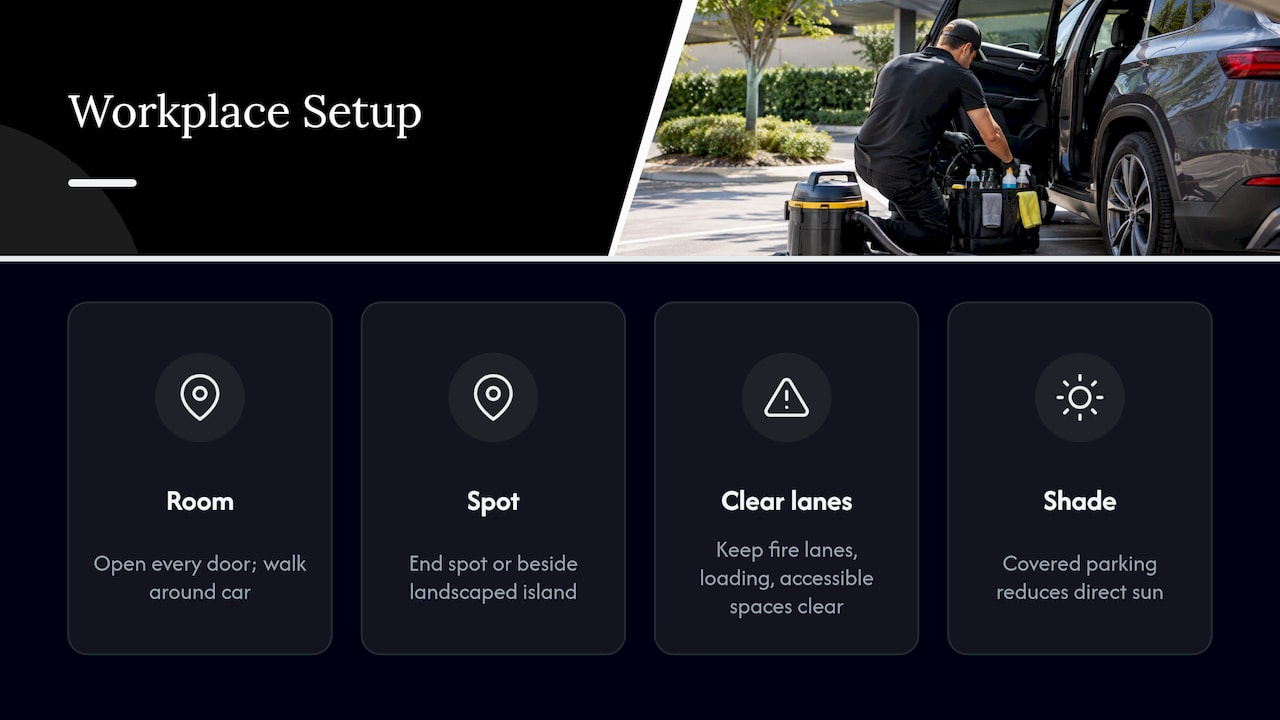
The detailer needs enough room to open every door fully and walk around the car. A space beside a landscaped island or an end spot beats a narrow slot between two vehicles. The work area should not block fire lanes, loading zones or accessible spaces. Covered parking helps in summer heat, because working on a hot panel in direct sun makes products dry too fast.
Water and electricity
Mobile setups typically carry their own water and power, but you should ask your detailer what they bring and what they would like from the site. Do not assume the building’s outdoor spigot or outlets are available. Facilities teams often control them, and using them without approval can cause problems. Agree this in advance and put it in the same email as your parking approval.
Where the wash water goes
This is the part many people overlook. Storm drains in most parking lots lead to local waterways, not to a treatment plant. The U.S. Environmental Protection Agency notes that nearby storm drains lead to local waterbodies, and it recommends practices such as limiting detergent, using biodegradable water-based products and directing wash water to grass or gravel rather than the street. It also suggests using kits that protect storm drains from wash water.
In New Jersey, the state environmental agency has been explicit in at least one setting: its guidance for marinas says unpermitted vehicle wash wastewater discharges must be eliminated through options such as capture and haul-away, an approved sanitary sewer connection or a separate permit. That guidance is written for marinas, so it is not a rule for your office lot, but it shows how the state thinks about wash water. Local ordinances and your property’s own rules may also apply, so ask your facilities contact or township office what is allowed on your site.
The practical takeaway: choose a detailer who contains or captures runoff, or who uses low-water or waterless methods when the site calls for it. Our guide to waterless car wash methods explains when that approach works well.
Weather
Rain, high wind and freezing temperatures change what can be done outside. Interior work is much less weather sensitive than paint work. Ask your detailer how they handle a bad forecast, and agree on a backup day or an interior-only plan before the appointment, not that morning.
How to prepare your car for a workday detail
A little preparation saves time, and time is what you are paying for.
- Clear personal items. Remove loose papers, bags, gym clothes, child seats if you can, and anything valuable. Detailers should not have to decide what is trash.
- Take out the clutter you cannot replace. Garage openers, parking passes, work badges and medications should come with you.
- Leave the keys. Agree on how the detailer gets them. Handing them over in person is simplest; some offices prefer the reception desk.
- Flag problem areas. Spilled coffee, pet hair, a stained seat, tree sap or bird droppings. Point them out before the work starts, ideally with a text and a photo.
- Mention known damage. Scratches, curb rash and chips are best documented beforehand so everyone agrees on the starting condition.
- Be reachable. Keep your phone on in case a question comes up halfway through.
Walking the car with your detailer before and after is good practice anywhere. At a workplace you may not be able to be there for the whole thing, so a quick check at the start and a photo review at the end is a fair compromise.
How long it takes and what affects it
Times vary with vehicle size, condition and the service you choose. A lightly used sedan will go faster than a family SUV with ground-in crumbs or a work truck with heavy soil. As a rule of thumb for planning, a standalone interior or exterior detail fits into a long lunch break plus a bit more, while our larger packages and protective treatments are better suited to a half day or a full day.
What stretches the schedule:
- Heavy pet hair, stains or odors
- Neglected paint with bonded contamination or swirl marks
- Large vehicles such as trucks and vans
- Tight parking that slows movement around the car
- Weather interruptions
- Last-minute changes to scope
If your employer only allows a short window, tell the detailer up front. They can choose a scope that fits, and you can book a longer appointment for the rest.
What it costs
Our published prices are listed on our site, and they are starting points that depend on vehicle and condition. You can see the full list on our detail packages page.
| Service | Our published price |
|---|---|
| Exterior Detail | from $175 |
| Interior Detail | from $275 |
| Bronze Package | from $375 |
| Silver Package | from $600 |
| Silver+ Package | from $1,000 |
| Gold Package | from $1,500 |
| Exterior Maintenance Plan | $100 per week or $200 per month, per vehicle |
| Mobile detailing services additional fee | from $100 |
| Booking charge | $100 |
The mobile fee and booking charge apply on top of the service you choose. If you are considering a ceramic coating, the three published options are the 3, 5 and 8 year packages, at $1,000 to $1,200, $1,500 to $1,700 and $2,200 to $2,400, and the ceramic coating booking charge is 10%. Window tint is $350 for GeoShield Carbon Tint and $500 for GeoShield Ceramic Tint, detailed on our window tinting page. For a price breakdown of interior work specifically, see how much a full interior detail costs in 2026.
One way to keep the per-vehicle cost sensible: if several coworkers book the same day, ask us whether the mobile fee can be handled across the group. We will tell you what is possible for your location.

Arranging detailing for several vehicles
Fleet managers and office managers face a different problem: not one car, but ten, and no one wants half the team without a vehicle.
A workable approach:
- Pick one standing day and window. Recurring service is easier to approve and easier to remember than ad hoc visits.
- Rotate vehicles. Stage three or four vehicles at a time near the work area, so the detailer moves from one to the next without waiting.
- Group by service. Do all the interior-only jobs together, then the exterior jobs. Setup time is shared.
- Prioritize by use. Customer-facing vehicles and those going to long-haul routes go first.
- Assign one coordinator. One person handles keys, approvals and sign-off.
- Inspect and record. Photo each vehicle before and after. This helps with resale value records and with spotting damage early.
For regular exterior upkeep, our Fleet Washing service and the Exterior Maintenance Plan are designed for this kind of repeat schedule. If you are weighing options, our commercial vehicle cleaning service comparison and the guide to key types of fleet detailing lay out what to ask for. We also explain what commercial vehicle detailing is and why it matters and the advantages for fleets.
Business owners often ask whether this is worth it. A clean vehicle fleet is visible to customers every day, which is why we wrote about the role of detailing in business image and auto detailing in business success.
Our perspective
We started as a mobile service because most people we meet do not have a free afternoon. Their car sits in a lot all day anyway. The sensible thing is to bring the work to the car.
Our experience is that workplace detailing succeeds or fails on preparation. When the parking spot is agreed, the scope is clear and the water question is settled, the detail itself is the easy part. We would rather spend ten minutes up front planning than rush a job in the last hour of a lunch break.
We also think the scope should match the setting. Interior and exterior details suit a workday well. Protective work such as ceramic coatings, paint protection film and window tint rewards a controlled setup and a longer window, and we will tell you plainly which of those suits your site. Our approach is personalized care for each vehicle, using professional-grade materials, with a documented process that helps when you resell or want to protect the vehicle over the long run.
If your employer is hesitant, send them our contact details. We are happy to answer questions about equipment, runoff and timing before anything is booked.
Charles
Book a detail where you work
We are a mobile detailing company based in Pitman, New Jersey, serving South Jersey. If you have approval from your employer or property manager, tell us the address, the parking arrangement and the hours you will be there, and we will suggest the right service for the window. You can compare our detail packages or contact us through our main site to start.
If you manage a fleet, ask about a recurring schedule so the whole team is covered on one predictable day.
FAQ
Can I have my car detailed in my employer’s parking lot?
Only with permission. Your employer or the property manager decides whether outside contractors and washing are allowed. Ask in writing, name the date, parking spot and time window, and share the answer with your detailer.
Does the detailer need access to my building’s water or power?
Not necessarily, since mobile setups usually bring their own supplies, but confirm this when you book. If the detailer wants to use a site spigot or outlet, get approval from facilities first. Also settle how wash water will be contained so it does not run into storm drains.
How long will I be without my car?
It depends on the service and the vehicle. You normally hand over the keys and get them back when the work is done, so for a workday appointment that is a few hours at most for a standard interior or exterior detail. Larger packages and protective treatments take longer and may need a dedicated day.
Should I tip for a workplace detail?
Tipping is up to you and not required. Many customers tip when the detailer handled a tough job or worked in difficult weather. If you are unsure, ask the detailer how they prefer to be thanked.
Can a business book detailing for a whole fleet at one location?
Yes, that is a common use of mobile service. Choose a standing day, stage a few vehicles at a time and name one coordinator. We offer fleet washing, and we can discuss the right schedule for your vehicles.
Sources
- EPA, Stormwater Best Management Practice: Vehicle Maintenance and Washing (2023)
- NJDEP, Basic Industrial Stormwater General Permit Guidance for Marinas