
On-site fleet detailing brings the crew, water and equipment to your lot, yard or job site and cleans your vehicles where they park, so no unit has to leave service for a trip to a wash. A good process has six parts: a scoping and scheduling step, site setup with wash water control, an exterior wash, an interior detail, a final inspection with photos, and a repeat schedule that fits how hard the vehicles work. If you manage vans, work trucks or service vehicles in South Jersey, our fleet washing service is built around that routine.
TL;DR
- Start with a unit-level list of vehicles, who can release each one, and which time windows they are free. Detail in agreed batches.
- Control the wash water before the first hose is turned on. Storm drains are for rain, and rules on vehicle wash water are strict.
- Exterior: pre-rinse, evenly diluted detergent, careful hand washing, rinse before anything dries. Interior: air, vacuum, glass, spot cleaning.
- Finish with a walk-around check, photos and a short report per vehicle.
- Most fleets land between every two and eight weeks for exteriors and roughly quarterly for full interiors, depending on use.
Table of Contents
- What on-site fleet detailing actually is
- Step 1: Scope the fleet and build a schedule
- Step 2: Set up the site and control the wash water
- Step 3: Wash the exterior
- Step 4: Detail the interior
- Step 5: Inspect, document and hand back
- Step 6: Set the repeat cycle
- What it costs to do this with us
- Get your fleet on a schedule
- FAQ
- Sources
What on-site fleet detailing actually is
A basic fleet wash removes road film from the outside of a vehicle. Fleet detailing goes further: it adds interior cleaning, spot treatment of stubborn contamination and a documented check at the end. The two often run together on the same visit. Trade guidance reported by Fleet Maintenance notes that routine grime calls for regular soap-and-water washing, while waxing and polishing do not have to happen at every visit. That split is useful for budgeting: frequent light washes, with deeper work on a slower cycle.
If you want a map of the different service types before you decide, our overview of the seven key types of fleet detailing lays them out.
Step 1: Scope the fleet and build a schedule
The process begins before anyone arrives. You need a list of the vehicles to be serviced, and the list should use the identifiers you already use, such as unit numbers, not “the white van by the fence.” Vehicles move, and a unit number does not.
For each unit, settle three things:
- When it can be unavailable. A route truck that returns at 4 p.m. cannot be detailed at 2 p.m.
- Who can release it. A driver can hand over keys without having authority to approve extra work. Name one person who can release vehicles and one who can approve changes.
- What is in scope. Exterior only, interior only, or both, plus any graphics or add-ons.
Work in batches your lot can support. If six vans can be parked together in the wash area at once, plan six, not twenty. Finish and hand back one batch before starting the next so you always know which vehicles are done and which are not.
For a longer treatment of this step, see our guide on how to schedule fleet detailing for maximum efficiency.
Step 2: Set up the site and control the wash water
On arrival, the crew checks in with your site contact, confirms which vehicles are actually available that day and sets up in a designated area. This is also where mobile work is most regulated, so it deserves care.
Wash water carries soap, oil, brake dust and road grime. Official guidance is consistent that it should not run into storm drains. A stormwater brochure for mobile businesses from a California regional program tells operators to locate storm drains, block or seal inlets, contain the wash area with items such as sandbags, mats or berms, and send wastewater to a sanitary sewer with permission, or to landscaping where it fully soaks in. Maryland’s environment department puts the rule bluntly in its stormwater hotspot guidance: discharging vehicle service wastewater to surface water or storm systems is prohibited without a discharge permit, and the alternatives are a sanitary sewer connection that complies with the sewer authority or a holding tank hauled to a permitted facility.
Those are California and Maryland documents, and New Jersey municipalities and sewer authorities set their own details. As a fleet manager, the practical question for any provider is simple: where does the wash water go on my lot? You should get a clear answer before the first visit. Our page on work truck detailing, costs, safety and wash water rules goes deeper on this.
Also take photos of each vehicle’s existing condition before work starts. Dents, scratches and cracked trim that predate the visit are then on record, which protects you and the crew.
Step 3: Wash the exterior
A sound exterior sequence is not complicated, but each step has a way to go wrong.
Pre-rinse. Loose dirt, mud and salt come off first so they are not dragged across paint.
Detergent. Trade guidance in Cleaner Times says detergent has to be diluted correctly and applied evenly, whether you brush or use a touchless wash, and rinsed before it dries. Too strong or left to dry, it streaks and can dull finishes.
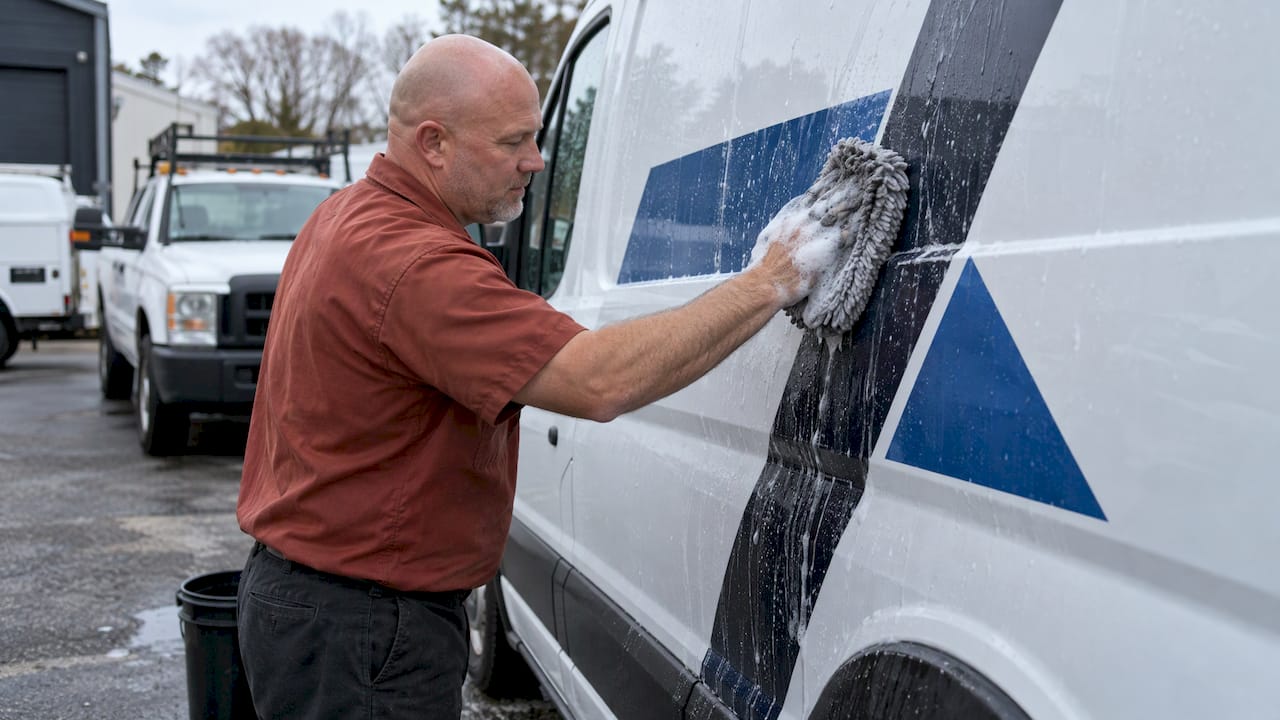
Hand washing where it matters. Detailers quoted by Fleet Maintenance prefer hand washing for deep cleaning, and warn that brushes can push grit across paint and leave swirl marks. For a fleet, that means a touchless or soft-contact approach on painted panels and hand work on the heavily soiled areas.
Graphics and decals. Branded vans and trucks carry vinyl that harsh chemicals can damage. The same Cleaner Times guidance advises caution with strong chemicals on vinyl graphics, and says tar and adhesive residue call for specialty detergents or processes, not simply stronger soap.
Damaged paint. If a unit has chips or scratches, clean gently around them and avoid harsh chemicals or pressure washing near compromised paint. The Fleet Maintenance article also advises dealing with chips and scratches promptly, since bare metal rusts.
If a vehicle’s condition differs a lot from the agreed scope, the crew should stop and go through your approval contact, not decide alone. That is why Step 1 names who can approve extra work.
Step 4: Detail the interior
Interior work on a work vehicle is mostly about dust, debris, glass and spills. Fleet Maintenance’s truck cab guidance describes the order: blow dust and debris out with pressurized air, then vacuum, clean interior glass with glass cleaner and microfiber, and spot-clean spills and marks.
Two habits from that guidance make the difference between visits:
- Clean spills promptly. The article’s expert notes that a few minutes on a soda spill can prevent much longer cleanup later.
- Between full details, a weekly dust-off and vacuum keeps cabs presentable.
For surfaces and sequence in more detail, our interior car cleaning workflow and 7-step interior detailing checklist walk through it.
Step 5: Inspect, document and hand back
A fleet job is not finished when the last towel is wrung out. The final step is a walk-around of every vehicle, looking for missed spots, streaks and leftover residue, then a record you can keep.
A useful closeout for a fleet manager includes:
| Item | Why it matters |
|---|---|
| Which units were serviced | Confirms the batch is complete |
| Which units were not, and why | Keeps a missed unit from disappearing |
| After photos, exterior and interior | Shows the finished condition |
| Damage or maintenance flags | Dents, leaks or worn tires spotted during the visit |
| Handoff to your contact | Closes the batch before the next one starts |
The record also feeds your own maintenance planning: a detailer is often the first person to notice a weeping fluid or a worn tire on a vehicle that is otherwise sitting still.
Our fleet detailing workflow for managers sets out these steps as a standard operating procedure you can adapt.
Step 6: Set the repeat cycle
How often depends on use, roads, salt and how much access your vehicles have to a wash. Fleet Maintenance reports recommendations from washing trucks every two to four weeks, to every four to six weeks for owner-operators with limited access to facilities, to at least monthly normally and twice monthly in winter. Its cab-care article quotes one expert suggesting a full detail about every three months, with wipe-downs every few weeks in between where driver satisfaction matters.
In South Jersey, winter road salt is the factor that most often pushes a fleet to the shorter end of that range. A simple starting point:
- Customer-facing vehicles: exterior wash every two to four weeks, full detail quarterly.
- Heavy-duty or off-road units: exterior every two to four weeks, with interior as conditions require.
- Low-mileage or garaged units: monthly or every six weeks is usually enough.
Review it after the first two or three cycles. If the same units come back visibly dirty at the next visit, shorten the interval for those units alone.
What it costs to do this with us
Published prices on our site are for individual vehicles: an Exterior Detail starts at $175 and an Interior Detail starts at $275. Mobile detailing carries an additional fee starting at $100. For regular upkeep we offer an Exterior Maintenance Plan at $100 per week per vehicle or $200 per month per vehicle, listed on our detail packages page. Fleet Washing has no published price, since it depends on the number and type of vehicles and the site, so you ask for a quote.
How we see it
A fleet wash that only looks clean from the road is not much use to a manager. What we want is a repeatable routine: the same steps on every unit, a record of what was done and a schedule that fits the work each vehicle does.
Coming to your lot is a big part of that. Vehicles stay where your people can reach them, downtime stays short and the work is done in batches you have agreed in advance. Our process is documented, because documentation is what lets a manager trust the next visit as much as the last.
We serve vehicle owners and businesses across South Jersey from Pitman, from single work trucks to agricultural and commercial fleets. If you can tell us how many units you have and when they are free, we can build the schedule around you.
Charles
Get your fleet on a schedule
If you manage vehicles in South Jersey and want the routine above run on your own lot, send us your unit count, location and preferred days through our fleet washing page. We are a mobile service based in Pitman, so the equipment comes to you.

If you are comparing approaches, fleet cleaning versus individual detailing looks at cost and quality side by side.
FAQ
What is fleet detailing?
Fleet detailing is the cleaning and care of a group of commercial vehicles on a set schedule, covering the exterior, the interior or both. It goes beyond a drive-through wash by adding hand work, spot treatment and a record of what was done for each vehicle.
How long does an on-site fleet detail take?
It depends on the vehicle type, how dirty the units are and whether the visit includes interiors. A light exterior wash on a van takes far less time than a full interior and exterior detail on a heavy truck, which is why batching and a unit-level schedule matter. We quote after hearing your fleet size and scope.
Do my vehicles have to leave the lot?
No. In an on-site process the crew sets up in a designated area of your property, and the main requirement is a spot where wash water can be controlled and directed properly. Vehicles move to that spot in batches and return to service when released.
How often should a business schedule fleet detailing?
Trade guidance cited above ranges from every two to four weeks for exterior washing of trucks to about quarterly for full cab details, with winter salt and heavy use pushing toward shorter intervals. Start there and adjust after a few cycles.
Sources
- Detailing commercial vehicle exterior, Fleet Maintenance
- Truck cab detailing and cleaning best practices, Fleet Maintenance
- Fleet Washing Techniques, Cleaner Times
- Mobile Businesses stormwater brochure
- Stormwater Hotspot Guidance, Maryland Department of the Environment