
To remove salt stains from car carpet, vacuum out the dry crystals first, then dissolve what is left with a warm water and white vinegar mix, and pull it all out with a wet/dry vacuum or extractor. Repeat until the carpet dries with no white ring. The order matters. Spray liquid on loose salt and you push it deeper into the pile.
That is the short version. Below you will find the full method, the mistakes that make stains come back, how to tell when a stain is too far gone for a DIY fix, and what we do about it as a mobile detailer in South Jersey.
TL;DR
- Vacuum dry salt first. Wetting loose crystals creates a brine that sinks into the carpet backing.
- Use a 50/50 mix of distilled white vinegar and hot water, spot-test it on a hidden area, and extract it right away.
- Rinse with plain water and extract again. Leftover moisture and salt keep the carpet feeling damp and bring the white ring back.
- Do the job soon after the first snow. Salt left in carpet all winter is harder to remove and can damage the fibers.
- If the carpet is stiff, crusted or smells musty after two rounds, a professional extraction is the safer route.
Table of Contents
- Why road salt stains carpet and keeps coming back
- What you need before you start
- Step-by-step: how to get salt out of automotive carpet
- Quick reference: what works for which situation
- Does vinegar remove salt buildup? Are salt stains permanent?
- Mistakes that make salt stains worse
- When salt is deeper than a DIY fix can reach
- Perspective: what we see in South Jersey cars
- How to keep salt from building up again
- Other household fixes, and where they fall short
- What a professional salt-stain cleanup involves
- DIY or pro: how to decide
- FAQ
- Sources
Why road salt stains carpet and keeps coming back
Salt gets in on your shoes. Every time you step in, a little slush comes with you. It melts, soaks into the carpet, and when the water evaporates the salt stays behind as a pale, crusty ring. You see it most along the edges of the floor mats and under the pedals, where boots land and slide.
In New Jersey this is not a minor issue. The state’s transportation department says it uses rock salt wetted with liquid calcium chloride or a salt brine blend, and that pretreated roads can hold that brine for several days before a storm hits. If you drive in South Jersey in winter, you are tracking some of it into your car.
Two things make salt harder than an ordinary spill:
- It is hygroscopic. According to professional detailing guidance, salt pulls moisture from the air. That is why a carpet can look dry yet feel clammy, and why surface cleaning alone often fails against crystals embedded in the backing.
- It is not just cosmetic. The same guide notes that road salt is highly alkaline and, over time, can stiffen and fray carpet fibers. A white stain you ignore in December can be a rough, brittle patch by March.
So the goal is not to cover the stain or lighten it. The goal is to physically remove the salt from the carpet.
What you need before you start
You do not need a closet of chemicals. Most of this is already in your garage or kitchen.
- A stiff-bristled brush (a carpet or upholstery brush, not a wire brush)
- A vacuum, ideally a wet/dry shop vacuum or a small carpet extractor
- Distilled white vinegar
- Hot tap water (hot enough to work with, not boiling)
- A spray bottle
- Clean microfiber towels
- A bucket of clean water for rinsing
- Optional: a dedicated carpet or upholstery cleaner for stubborn spots
Pull the floor mats out first and treat them separately. Rubber and carpeted mats trap a lot of salt, and if you leave them in while cleaning the carpet underneath, you will re-contaminate it.
Step-by-step: how to get salt out of automotive carpet
Step 1: Remove the dry salt
This is the step most people skip, and it is the one detailers point to most often as the mistake. Applying liquid to loose crystals turns them into a concentrated brine that drives minerals deeper into the pile and backing, which makes extraction harder.
Brush the stained area with a stiff brush to break up the crust and lift crystals. Then vacuum thoroughly. Work in a few directions: along the nap, against it, and across it. Go over it twice. You will often pull out more white grit than you expect.
Do not scrub so hard that you fuzz or fray the carpet. You are loosening crystals, not sanding.
Step 2: Mix the vinegar solution and spot-test
The most common household solution is a 50/50 mix of distilled white vinegar and hot water. Cars.com describes this remedy, and it works because the mild acidity helps dissolve mineral deposits so they can be extracted from synthetic fibers.
Before you spray anything on a visible area, test a hidden spot, such as under a seat or at the edge of the carpet beneath the door sill. Vinegar can affect sensitive dyes. Wait a few minutes, blot with a white towel, and look for color transfer or fading. If the color holds, go ahead.
Use distilled vinegar, not cleaning vinegar with added strength, and not apple cider vinegar, which can leave color behind.
Step 3: Apply lightly, not soaking
Mist the solution over the stained section. You want the carpet damp, not saturated. Oversoaking is the second most common error: the more water you put in, the more it carries salt down into the foam and padding beneath, where you cannot reach it.
Let it sit for a few minutes so the salt dissolves. Then agitate gently with the brush, working in small sections of roughly a square foot at a time.
Step 4: Extract, do not just blot
This step does the real work. A wet/dry vacuum or small extractor pulls dissolved salt out of the carpet. Blotting with a towel only moves some of it to the surface. Detailers on enthusiast forums give the same advice: pick up as much dry salt as you can, then lightly mist with water and suck up as much as possible, as quickly as possible.
Press the nozzle firmly against the carpet and pull slowly. Watch the vacuum canister or hose. If the water coming out is cloudy or white, there is more salt to remove.
Step 5: Rinse with plain water and extract again
Vinegar residue and dissolved salt both need to come out. Lightly mist the area with clean water, then extract again. Cold or room-temperature water works well for the rinse. Repeat the rinse and extract cycle two or three times on heavy stains.
If you do not have an extractor, use a shop vacuum with a wet-pickup setting. A regular household dry vacuum is not made for liquid, so do not use one.
Step 6: Dry completely
Because salt attracts moisture, a half-dry carpet can bounce back. Open the doors, park somewhere with airflow, and run a fan if you can. Towel-press the area with dry microfiber. In winter, a garage with a small heater or a dry sunny day helps a lot. A damp carpet also grows mildew, so do not close the car up until it feels dry to the touch.
Check again the next day. If a white ring reappears as the carpet dries, there is still salt deeper down. Repeat steps 3 to 6.
Quick reference: what works for which situation
| Situation | What to do | What to avoid |
|---|---|---|
| Light white film on carpet edges | Brush, vacuum, 50/50 vinegar mist, extract | Soaking the area |
| Crusted ring along the mat edge | Brush and vacuum twice, then vinegar and extraction, repeat 2 to 3 times | Spraying cleaner on top of loose crystals |
| Salt on carpeted floor mats | Remove from car, shake out, vacuum, treat the same way, dry outside | Putting damp mats back in the car |
| Carpet feels stiff or clammy days later | Rinse and extract again, dry with airflow | Closing the car up while damp |
| Dark or colored carpet with fading risk | Spot-test first, use a diluted mix | Stronger acids or bleach |
| Cloth seats with salt marks | Treat with a gentle cleaner and light extraction | Heavy scrubbing on fabric |
Does vinegar remove salt buildup? Are salt stains permanent?
Vinegar helps, but it is not magic. Its main job is to dissolve mineral deposits so they can be pulled out, and the extraction does the heavy lifting. Water alone also dissolves salt, which is why a light water rinse with strong suction can work on fresh stains. Vinegar tends to help most with the pale residue left after salt has dried.
Are the stains permanent? Not if you treat them in time. Salt itself is water soluble. The permanent damage comes from leaving it in the carpet. Per the detailing guide cited above, alkaline salt can stiffen and break down fibers over time, and dyed carpet can lose color where de-icing chemicals sit. BISSELL also notes that road salt and de-icing chemicals can bleach fibers. If the color is already gone, cleaning removes the white residue but cannot bring the color back.
Mistakes that make salt stains worse
- Wetting before vacuuming. It creates brine and pushes it down.
- Using too much water. It soaks the padding, takes forever to dry, and can bring salt back to the surface.
- Skipping the rinse. Vinegar and dissolved minerals left behind can leave residue.
- Using bleach or strong cleaners. Chlorine bleach removes color by oxidation, so it has no place on dyed automotive carpet.
- Scrubbing aggressively with wire or hard bristles. You will fuzz the pile and make the area look worse than the stain did.
- Treating the stain as a one-time job. If you drive in salt every day, the next snowy week puts it all back.
When salt is deeper than a DIY fix can reach
Sometimes a second or third pass gets you nowhere. Here are signs that the salt is in the padding or backing:
- The white ring returns every time the carpet dries
- The carpet feels stiff, crunchy or rough
- There is a musty or damp smell even after drying
- You see rust spots near seat bolts or floor pan seams
- The stain covers most of the driver footwell after several winters
At that point you need more suction and more controlled water than a household vacuum gives you. Professional detailers use commercial extractors and steam. A winter-focused detailing guide on handling the slow season lists steam and extraction for carpets and upholstery as a core winter service for this exact reason.
Rust near the floor pan is a different story. If you see corrosion, moisture trapped under the carpet may be the cause, and a body shop or mechanic should check it.
Perspective: what we see in South Jersey cars
We work on vehicles throughout South Jersey, and salt in the carpet is one of the most common interior complaints once winter ends. The pattern is consistent. Owners clean the visible stain, it looks fine, and two weeks later the white edge comes back. The salt was never extracted, only moved around.
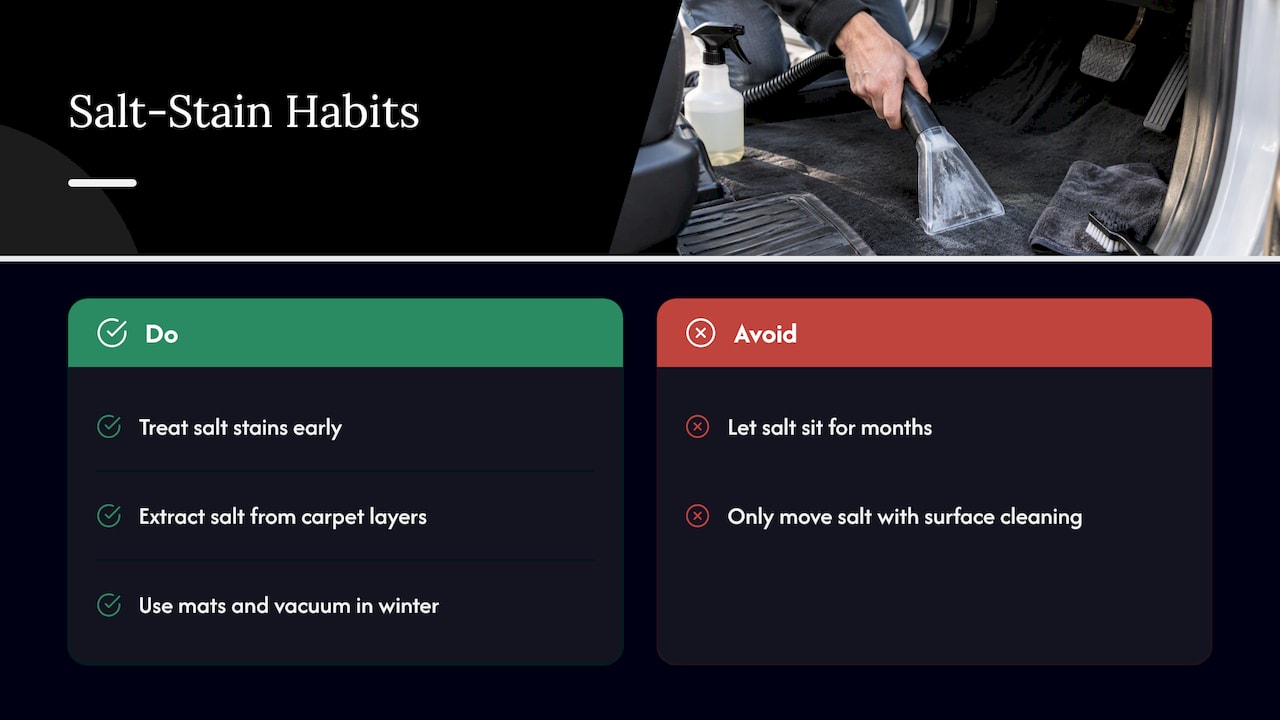
Our advice comes down to three habits. First, deal with it early, because salt that sits for months is harder to remove than salt that sat for days. Second, treat the carpet as a layered material: the surface is only part of it, so extraction matters more than scrubbing. Third, think about prevention as much as cleanup. Good floor mats, a clean mat edge, and regular interior vacuuming through winter make the spring job much smaller.
If you are comfortable with the DIY method above, use it. It works on most light to moderate stains. If you would rather not spend a Saturday on your knees in the footwell, that is what a mobile interior detail is for. We come to your driveway or workplace, so you do not have to arrange a drop-off.
— Charles
How to keep salt from building up again
Cleaning is half of it. These habits cut the work next time:
- Use deep-channel all-weather mats in winter, and take them out to shake and rinse every week or two.
- Knock your boots against the door frame or a curb before you get in.
- Vacuum weekly during salt season. Dry salt is much easier to remove than dissolved salt.
- Wash the underside of the vehicle after salt-heavy storms. Our guide to removing road salt from the car’s undercarriage covers why that matters for rust.
- Protect the paint before winter. See our page on mobile road salt protection with front clip PPF and ceramic coating in NJ.
- Follow a winter routine. We cover the basics in how to keep your car clean in winter.
For other spots you find while you are in there, our guides on removing stains from car seats naturally and step-by-step car stain removal cover the rest of the cabin. If you want to see how a pro sequences an interior, read our interior car cleaning workflow.
Other household fixes, and where they fall short
A few other remedies come up in forums and cleaning guides.
Dish soap and warm water. A few drops in warm water can lift general dirt. Soap does not dissolve salt any better than water does, and if you do not extract it, it leaves a sticky residue that attracts dirt. If you use it, rinse well.
Baking soda. Good for odors, but it is alkaline, so it does not do much against alkaline salt residue. It will not fix a white ring.
Commercial carpet and upholstery cleaners. These are fine for the follow-up pass, particularly ones that say they handle mineral or de-icer residue. Check the label for automotive carpet and test a hidden spot first. Some enthusiasts also use a mild all-purpose cleaner with hot water and a wet vacuum.
Just water. For a fresh, light stain, hot water and strong extraction can be enough. The Spruce’s cleaning experts note that melting salt leaves a calcium chloride residue that can damage carpets, which is why you should not leave it.
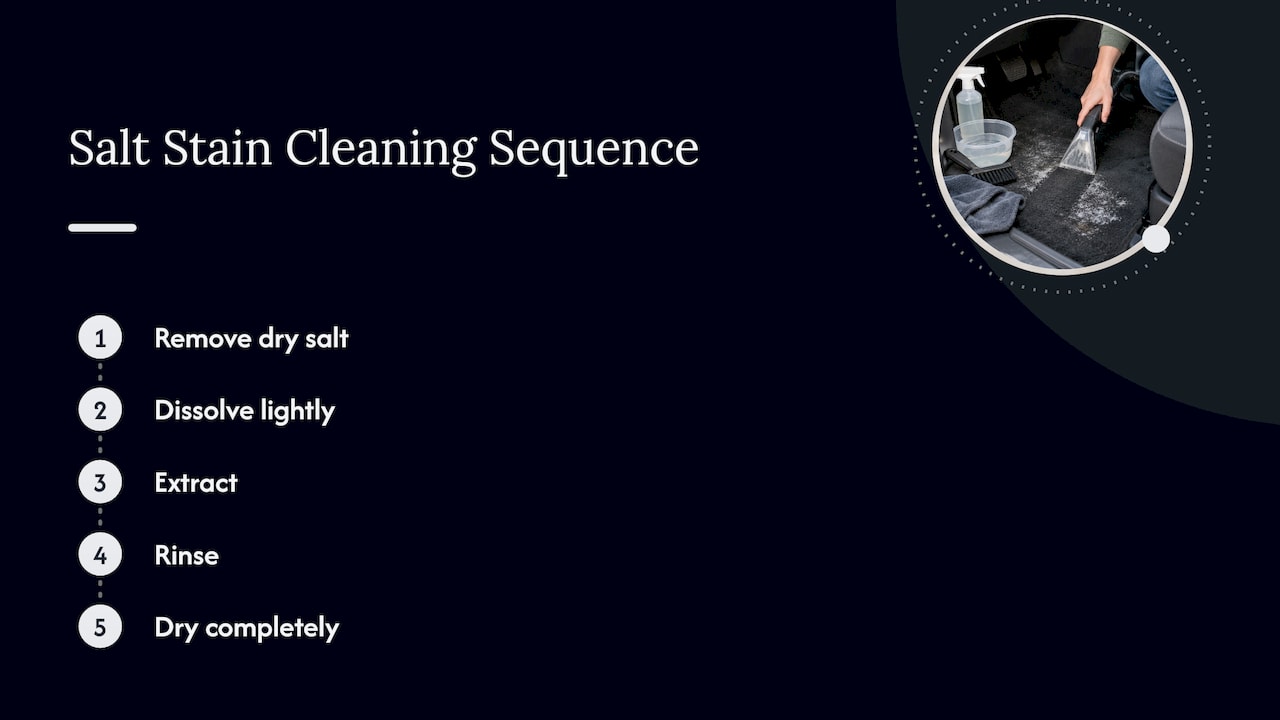
Whatever you choose, the sequence is the same: remove dry, dissolve lightly, extract, rinse, dry.
What a professional salt-stain cleanup involves
A professional visit does the same job with better equipment and more control. In general, it looks like this:
- Mats removed, shaken and treated separately
- Thorough dry vacuum of carpet, seams and under the seats
- Pre-treatment of heavy salt areas
- Hot-water extraction in controlled passes
- A rinse pass to take out leftover residue
- Airflow and drying so the carpet does not stay damp
Our Interior Detail starts from $275, and our detail packages run from $375 for Bronze up to $1,500 for Gold. Mobile detailing carries an additional fee starting at $100, and there is a $100 booking charge, both listed on the packages page. Tell us about the salt problem when you book, and we will tell you what the vehicle needs, whether that is a targeted interior detail or a fuller package. We come to you anywhere in our South Jersey service area, and you can start at cdcautodetailing.com.
If the car is also being used for work, fleet washing is worth a look for keeping multiple vehicles on a regular schedule through winter.
DIY or pro: how to decide
| Factor | DIY | Professional |
|---|---|---|
| Cost | Low if you own a shop vacuum | From $275 for an interior detail, plus mobile and booking charges |
| Time | A few hours, plus drying | Handled for you at your location |
| Best for | Light to moderate white rings, fresh stains | Heavy crust, stiff carpet, odors, multiple winters of buildup |
| Risk | Oversoaking, dye fading if you skip the spot-test | Lower, with extraction equipment and experience |
| Equipment | Wet/dry vacuum, brush, vinegar | Commercial extractor and steam |
A sensible middle path: try the method once on the worst area. If the white ring is gone after two or three cycles and the carpet dries soft, you are done. If not, stop before you soak the padding and book help.
FAQ
How do you get salt out of automotive carpet?
Brush and vacuum the dry salt first. Then mist the area lightly with a 50/50 mix of distilled white vinegar and hot water, agitate gently, and extract with a wet/dry vacuum. Rinse with plain water, extract again, and let the carpet dry completely with airflow.
Are salt stains permanent?
Not usually, if you remove the salt before it does lasting damage. Salt dissolves in water, so the white residue can be extracted. Dye loss and stiff, frayed fibers from long exposure are harder or impossible to reverse, so deal with it sooner rather than later.
Does vinegar remove salt buildup?
It helps. Diluted white vinegar dissolves mineral residue so you can pull it out, but extraction does most of the work. Spot-test a hidden area first because vinegar can affect some dyes, and always rinse with plain water afterward.
Can I use a regular vacuum on wet carpet?
No. A standard household vacuum is not designed for liquids and can be damaged or become a shock hazard. Use a wet/dry shop vacuum or a carpet extractor for the liquid steps, and a dry vacuum only for the first pass on dry salt.
Why does the white stain come back after it dries?
Salt left in the backing or padding wicks back up as the carpet dries, leaving a new ring. Repeat the light rinse and extraction cycle, and make sure the carpet dries fully. If it keeps returning after several rounds, book a professional extraction.
Sources
- How to Remove Salt Stains from Car Carpet: Pro Guide, BonnetPro
- Cars.com
- Winter Readiness FAQ, NJDOT
- Removing Winter Salt From Carpet, Autogeek forum thread
- How to Clean Car Carpet, BISSELL Blog
- Handling the winter slump, DetailerBase Guides
- How to Clean Salt Stains, The Spruce