
Self-healing paint protection film (PPF) is a clear urethane film with a flexible top layer that softens with heat and settles back into shape. Light scratches and swirl marks fade out. Rock chips, gouges and cuts that go through the film do not heal, but the film takes the hit instead of your paint. If you want to keep a new or high-value vehicle looking new in South Jersey, it is the most physical protection you can put on a car. Below is what the healing does, where it stops, what affects lifespan, and how to decide.
TL;DR
- Self-healing PPF has an elastomeric top coat that reflows with heat, roughly 40 to 80°C or direct sunlight, which erases minor scratches and swirls.
- It does not fix deep cuts, and the healing ability is not guaranteed for the whole life of the film.
- Installation quality (pattern cutting, edge work, curing) decides how long the film looks good, so DIY is a gamble on complex panels.
- Full-front coverage is the usual starting point; ceramic coating on top or alongside is a common pairing.
- We install paint protection film in Pitman and across South Jersey, and we come to you.
Table of Contents
- What self-healing PPF actually is
- How the healing works
- What it fixes and what it doesn’t
- How long does it last?
- Why installation decides the outcome
- Self-healing PPF vs. ceramic coating
- What we think about self-healing PPF
- What does it cost?
- Is it worth it?
- Care tips that protect the healing
- Book a film consultation
- FAQ
- Sources
What self-healing PPF actually is
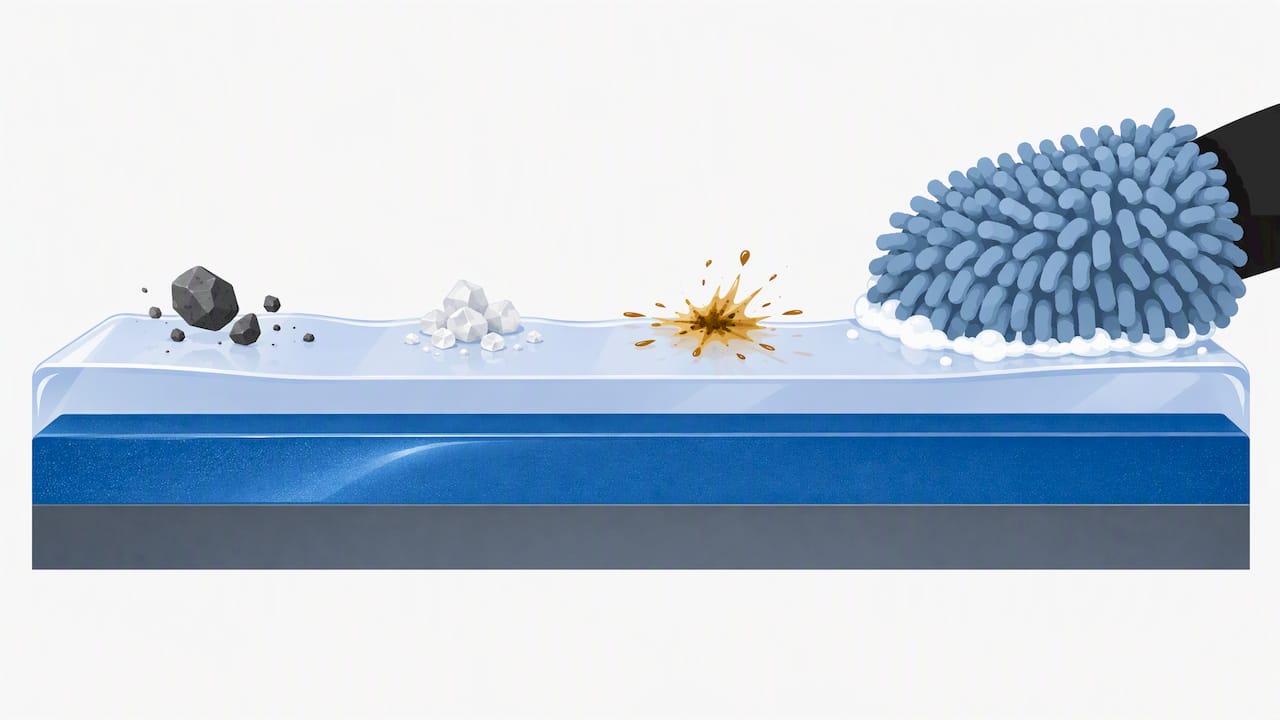
PPF is a multi-layer thermoplastic urethane (TPU) film. According to a film manufacturer’s product page, most films are about 8 mil (roughly 200 µm) thick and are rated for 10+ years of durability. A detailing directory’s overview describes the typical build: a clear coat, an elastomeric polymer layer, an adhesive and a release liner. The clear coat on top provides the self-healing behavior.
Think of it as a sacrificial skin. Sand, road salt, bug acid and the wash mitt that dragged grit across your door all hit the film first. The paint underneath stays untouched.
How the healing works
The top coat is an elastomer, meaning it is a polymer that can deform and return to its original shape. A fine scratch is a groove pushed into that surface. When the film warms up, the polymer chains become mobile and the surface flows back level, so the groove disappears. The manufacturer describes the trigger as heat in the 40 to 80°C range or direct sunlight.
In practice that means:
- Sunlight: a car parked outside on a warm New Jersey afternoon will slowly clear light marks. In cooler months it takes longer.
- Warm water: pouring warm water over a marked panel speeds things along. Installers commonly recommend this, and it is gentle on the film.
- Heat gun: a professional can use controlled heat on a stubborn mark. This is not a job for a hair dryer and guesswork, because overheating can damage the film or its adhesive.
Some newer constructions are built to heal at lower temperatures. One film maker says its top coat can self-heal at ambient temperature, though results vary by product and conditions, so ask what your specific film does in winter.
What it fixes and what it doesn’t
| Damage | Will self-healing PPF handle it? |
|---|---|
| Wash swirls and fine hairline scratches | Yes, usually with sun or warm water |
| Light scuffs from a bag, keys or a belt buckle | Usually, if they stay in the top coat |
| Bug and bird-dropping etching | Protects while the film is intact, but wash off promptly |
| Rock chips | The film absorbs and resists many, but a hard strike can still mark it |
| Deep scratches or cuts through the film | No. The film is cut, and the damaged section may need replacement |
| Damage that was already in the paint before install | No. Film will not hide it, and the paint should be corrected first |
Two things come up often. First, “scratch-proof” is not the claim. The film is scratch-forgiving. Second, a Reddit thread of detailers weighing the question often makes the same point: the healing does not necessarily last for the entire life of the film. Treat it as a feature that wears with age and UV, not a lifetime promise.
How long does it last?
Quality films are typically rated for 10+ years. Real life depends on a few things:
- Where the car lives. A garage-kept car ages the film far slower than one parked outdoors under sun and tree sap.
- How it is washed. Gentle hand washing and proper drying beat automatic brushes. Our PPF maintenance timeline covers a schedule for busy owners and fleets.
- Edges and seams. Edges are where failures begin. Lifting edges collect dirt and peel.
- Installation. More on that below.
- The warranty terms. Read the manufacturer warranty for what it covers: yellowing, cracking, bubbling or lifting. Ask the installer how claims are handled.
Why installation decides the outcome
The same film can look flawless or fail in a year depending on the install. Professional installers use digital plotters to cut templates for the exact make, model and year. Panels then need wrapped edges and careful heat work so the film sits down on curves.
The same installer guidance states that DIY application of professional-grade film is strongly discouraged: trapped moisture or poor edge tension often leads to lifting, bubbling and early failure, and climate control matters for adhesion. We wrote about the trade-offs in our DIY paint protection film article and a guide for those who still want to try. Our honest view: a small flat area like a door-edge guard is forgiving. A bumper, mirror or curved hood is not.
The first 72 hours
The adhesive keeps setting after you drive away. Installer guidance says it continues to cure for 48 to 72 hours. During that window:
- Do not wash the car.
- Keep high-pressure water away from the edges.
- Do not pick at lifted corners or tiny water bubbles. Some moisture can evaporate out as the film cures, and your installer will tell you what to expect.
- Park somewhere sheltered if you can.
Self-healing PPF vs. ceramic coating
These are not rivals so much as different tools. PPF is a physical barrier that resists chips and light scratches. A ceramic coating is a thin, hard, slick layer that makes washing easier, adds gloss and resists chemical etching, but it does not stop rock chips. We broke it down in PPF vs. ceramic coating: which protection does your car need, and in what ceramic coatings stop and don’t stop: swirls yes, chips no.
If you want a second perspective on ceramic protection, even for a different surface, this Polish-language guide to ceramic coatings on wheels explains what a coating realistically delivers.
Some film makers now sell a film with a built-in hydrophobic top layer, for example a two-in-one film that pairs a ceramic-style slickness with self-healing. Many owners instead coat standard film with a ceramic product to get easier washing. If you do, ask the installer to confirm the coating is safe for the film you chose.
Which should you choose?
- New car, daily driver on highways like Route 55 or the Turnpike: high-impact areas in film (front bumper, hood, fenders, mirrors), ceramic on the rest.
- Dark paint that shows every swirl: self-healing film on the front end pays off the most.
- Older car with existing chips or faded paint: correct the paint first, then decide; a coating may be the better value.
- Work trucks and fleet vehicles: consider film on the highest-wear panels and a regular wash plan instead of full wraps.
What we think about self-healing PPF
We work on cars that live outdoors, drive South Jersey back roads and farm-adjacent routes, and get washed in driveways, not showrooms. Our view is straightforward: self-healing is a real benefit, but it is the second-most important thing about a film. The first is how it was installed.
We would rather protect the front end properly than cover the whole car badly. We also push owners to treat PPF as one part of a plan: prep the paint, protect it, then maintain it. The film does the heavy lifting against chips. A well-chosen ceramic coating makes upkeep easier. And a regular exterior wash keeps grit from grinding on any of it.
Because we are mobile, we can do the maintenance side where your car already sits, at home or at the shop. For film questions, we would rather walk around the car with you and say which panels matter than sell you a package you don’t need.
— Charles
What does it cost?
Film pricing depends on the vehicle, coverage, film type and prep needed, so we don’t publish a flat figure for our paint protection film service. We quote after we see the car. Cost is driven by:
- Coverage: partial front, full front, or full body.
- Vehicle shape: a flat-faced truck differs from a car with a complex bumper.
- Paint condition: existing defects may need correction before film goes on.
- Film choice: products differ in finish, warranty and added features.
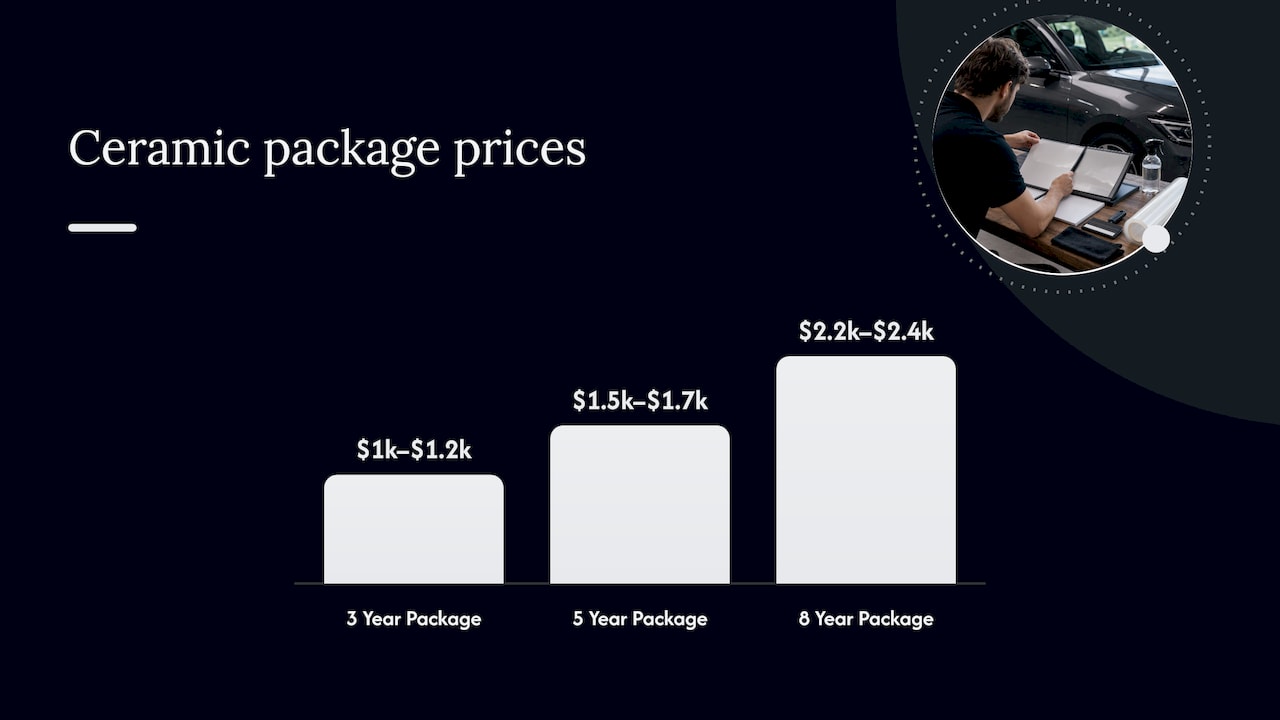
If you also want a ceramic layer, our published ceramic coating packages are a useful comparison point: the 3 Year Package is $1,000 to $1,200, the 5 Year Package is $1,500 to $1,700 and the 8 Year Package is $2,200 to $2,400. A booking charge of 10% applies on ceramic coating. Details are on our ceramic coating page.
For a cheaper step before protection, our Exterior Detail starts at $175 and our Silver Package starts at $600 on the detail packages page. Mobile service carries an additional fee from $100 and there is a $100 booking charge, as listed on that page.
Is it worth it?
It usually is when:
- You are keeping the car for years, or want strong resale presentation.
- The vehicle is new, leased with a tight return condition, or high value.
- You drive a lot of highway miles.
- You hate seeing swirl marks and want a surface that forgives careless washing.
It may not be when:
- The car is old with tired paint and you plan to sell soon.
- You only want gloss and easier washing. Ceramic coating may do that for less.
- You cannot spend on proper installation. A bad install is worse than no film.
Care tips that protect the healing
- Hand wash with a clean mitt and pH-neutral soap, and avoid brush-style car washes.
- Rinse bug and bird residue early rather than letting it bake in.
- Do not use abrasive polishes or compounds on film, and ask the installer before using any chemical you are unsure about.
- Keep pressure washer nozzles back from edges and seams.
- Park in shade or a garage when possible. Heat helps healing, but years of constant UV age any film.
Book a film consultation
We install paint protection film and come to you across South Jersey. If you want to compare film with ceramic coating, or you want a Revivify self-healing coating option explained, contact us through our site and we will go over your car, your driving and your budget.
FAQ
How long does self-healing PPF last?
Quality films are typically rated for 10+ years. Actual life depends on sun exposure, washing habits, installation quality and the warranty terms. The healing feature can fade with age before the film itself fails.
Is self-healing PPF worth it?
For most owners who keep a car several years or drive a lot of highway miles, yes. It protects against chips and fine scratches that paint and coatings alone don’t stop. If you only want gloss and easy cleaning, a ceramic coating may be enough.
What is self-healing paint protection film?
It is a clear thermoplastic urethane film with an elastomeric top coat. When warmed by sun or warm water, the surface reflows and light scratches disappear. Deeper cuts through the film stay.
Can I apply paint protection film myself?
You can try, but installers strongly discourage it for professional-grade film on curved panels. Moisture, tension and cutting errors often cause lifting and bubbling. Professional installation is safer for anything beyond small flat areas.
Sources
- ADEXO: Paint Protection Film (PPF), self-healing urethane shield
- NEOPPF: PPF installation
- Car Detailing Finder: Paint protection film overview
- Avery Dennison PPF: Self-healing protection films
- SunTek Reaction paint protection film
- Reddit r/AutoDetailing