
A clogged sunroof drain is one of the most common reasons water ends up inside a car, and it is often a ten-minute fix. Every sunroof has a tray around the glass, and small drain tubes carry rain from the tray’s corners down and out of the vehicle. When leaves, dirt or needles block a tube, the tray fills and the overflow runs into the headliner, the pillars and the footwells. Below you will find the signs, a safe way to clear the tubes, the mistake that turns a free fix into a repair bill, and what to do about the damp interior afterward.
TL;DR
- Wet footwells, a damp headliner, a musty smell or a sloshing sound when you brake usually point to blocked sunroof drains, not a failed seal.
- Open the sunroof, find the drain openings at the tray corners, pour in about half a cup of water and watch for it to exit under the car.
- Clear a stubborn blockage with soft string-trimmer line, pushed in gently. Skip compressed air: it can pop a tube off its connection behind the trim.
- If water still gets in, or it has reached wiring, stop and see a repair shop. Drain cleaning is cheap; disconnected tubes and electrical damage are not.
- Dry the carpet and padding completely, or the smell and mold will outlast the leak.
Table of Contents
- How a sunroof drain works
- Symptoms of a clogged sunroof drain
- How to find and test the drains
- How to unclog a sunroof drain tube safely
- Rear sunroof drains and panoramic roofs
- Prevent the next clog
- If the sunroof still leaks after you clear the drains
- What a sunroof leak costs to fix
- Dry the interior or the problem comes back
- Perspective: what we see after the leak
- Let us handle the cleanup
- FAQ
- Sources
How a sunroof drain works
A sunroof is not watertight in the way a window is. The glass and seal keep out most rain, but some water always gets past the edges. The frame around the opening is built as a shallow tray that catches it, and drain tubes at the corners send it down through the pillars and out near the wheels or under the body.
That design is why a small blockage matters. Capital One explains that when the drain holes are blocked, water pools in the drainage pan and spills into the cabin. Nothing is broken. The tray is simply doing its job with nowhere to send the water.
Most cars have a drain at each front corner. Many also have a pair at the rear, and panoramic roofs can have more. The rear ones are the ones people forget, and they are the hardest to reach.
Symptoms of a clogged sunroof drain
The signs rarely show up as a dramatic stream of water. They build over a few rainstorms or car washes.
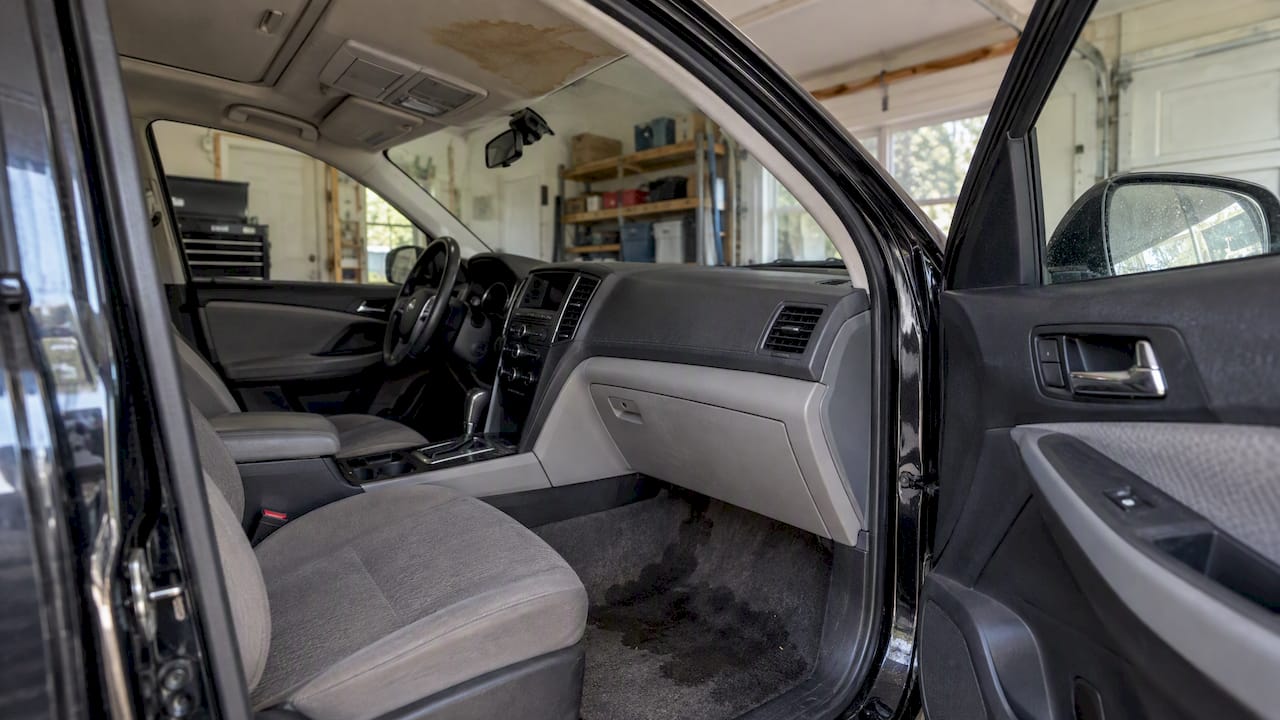
- Damp carpet that stays damp. Front footwells are the classic place, because the front drain tubes run down the A-pillars. Automotive Gearz lists wet footwells and a musty smell after rain among the common symptoms.
- Stains or dampness on the headliner, or drips from the dome light or overhead console.
- Fogged windows that do not clear with the defroster, because moisture is coming off wet material inside.
- A sloshing sound above you when you brake, accelerate or take a turn, as water moves through trapped tubes.
- A mold or mildew smell you cannot trace to an obvious spill.
This is not a new problem. A local TV report from 2017 described how a clogged drain lets water build up in the lines, pool and leak behind the headliner and trim panels. That hidden path is the reason many owners find the damage only when the smell arrives.
Is it the drain or the seal?
A blocked drain is the most likely cause, but not the only one. Capital One also points to cracked or worn seals and a misaligned sunroof track. Paulus Auto Care adds that when the drains are clear, roof seams, glass bonding or antenna mounts nearby can be the source. Its owner, Joshua Paulus, stresses that a leak can come from more than one failure at once, so test before you decide.
A quick pattern check helps:
| What you notice | Likely cause |
|---|---|
| Water in the footwells after rain, sunroof closed | Blocked front drain |
| Water in the cargo area or rear pillars | Blocked or disconnected rear drain |
| Drips right at the glass edge, drains flow freely | Worn seal or misaligned track |
| Leak appears only after a car wash | Partial blockage, or a seal problem |
Treat the table as a starting point, not a diagnosis. The water test below is what separates the cases.
How to find and test the drains
You need a flashlight, a cup of water and ten minutes. Park the car on level ground.
- Open the sunroof fully. Slide the glass back, or tilt it open, so the tray is exposed.
- Look for the drain openings. They are small holes at the tray corners, usually in the front and often in the rear. Look for leaves, needles, grit or a film of dirt sitting in them.
- Remove what you can see. A vacuum with a crevice tool or a damp cloth is enough for surface debris. Do not push it further down.
- Run the water test. NAPA’s guide describes slowly pouring about half a cup of water into each tray corner. Then check outside the car to see water coming out at the drain exits. Exit points are usually behind the front wheels and ahead of the rear wheels, though they vary by model.
- Watch the speed. A healthy drain takes the water and passes it out within moments. If the tray fills, drains slowly, or nothing appears underneath, that corner is blocked or the tube is disconnected.
If the water vanishes but nothing comes out underneath, do not keep pouring. It may be running into the cabin through a tube that has come loose.
How to unclog a sunroof drain tube safely
The tubes are thin, flexible and attached to the tray and the exit points by connections you cannot see. Gentle is the whole strategy.
What works
Both NAPA and Capital One recommend the same tool: string-trimmer line, the thin nylon cord used in a weed trimmer. It is stiff enough to push through a plug of debris and soft enough not to puncture the tube.
- Cut a length of line, about a few feet, and make sure the tip is smooth, not sharp.
- Feed it into the drain opening slowly. Stop if you meet hard resistance that does not give with light pressure.
- Work the line forward in short pushes and a slight twist to break up the blockage. Pull it back out and wipe it.
- Repeat the water test. If water now flows out under the car, you are done.
- Do the same at every corner, even if only one was blocked. Debris collects evenly, and the others are probably close behind.
Some owners also try a thin, flexible plastic or a pipe cleaner on a tube that is only partly blocked. The same rule applies: light pressure, smooth tip, no force.
What to avoid
Compressed air. It is tempting, and it is the most common way to make things worse. NAPA warns that compressed air can pop a drain tube off an internal connection, which then means pulling interior panels apart to reach it. Capital One likewise advises against pressurized air because it can disconnect the hoses. Some manufacturers specify a regulated pressure or an approved tool for particular models, so unless your owner’s manual or the dealer’s service information says so, leave the compressor in the garage.
Wire, coat hangers and sharp tools. They puncture or kink the tube, and a tube with a hole leaks inside the pillar where you cannot see it.
Harsh chemicals. Drain cleaners made for household plumbing are not meant for rubber or plastic automotive tubing near painted surfaces and wiring. Warm water with a little mild soap is enough for most debris.
A good rule: the expense in a sunroof leak is rarely the clog. It is the tube you disconnected trying to clear it.
Rear sunroof drains and panoramic roofs
Rear drains are where the instructions get model-specific. On some vehicles the rear drain tubes run a long way through the body and cannot be cleaned from the tray at all. The procedure depends on the car, so check the service information for yours before assuming you have top access.
Sometimes the blockage is not debris at all. A federal service bulletin for 2015 to 2019 Volkswagen Golf Sportwagen and Alltrack models, filed with NHTSA, describes water leaking from the rear of the panoramic sunroof because foam blocks can pinch the rear drain hoses when there is too much slack. No amount of string line fixes a pinched hose. If you have a persistent rear leak on a panoramic roof, ask a shop to check for a known bulletin on your model and year.
Prevent the next clog
Prevention is mostly about where you park and how often you look.
- Clear debris from the area around the sunroof opening regularly, and when you can, avoid parking under trees.
- In fall and spring, when leaves, seeds and pollen are heaviest, open the sunroof and check the tray corners once a month.
- Run the half-cup water test twice a year. It takes two minutes and tells you about a slow drain before the carpet does.
- Wipe the tray and seal with a damp microfiber cloth whenever you wash the car.
In South Jersey, where pine needles, oak leaves and spring pollen blow into cars all season, this habit pays off. Needles in particular are thin enough to slip into a drain opening and pack the tube.
If the sunroof still leaks after you clear the drains
Then the drain was either not the only problem or the tube is damaged. This is the point to stop, not to try harder.
AutoZone advises seeking professional help when water still gets in after your troubleshooting, particularly if electrical systems are affected. Water from a sunroof can reach wiring and modules behind the headliner and in the footwells, so these are the situations for a repair shop:
- Water reaches the dome light, overhead console, seat sensors or other electronics.
- A tube has come loose behind the headliner or trim.
- The trim near curtain airbags would have to be removed.
- The sunroof is misaligned and needs adjusting.
- You cleared every drain and water still comes in.
The airbag point matters. Pillar and headliner trim often sits over airbag components, and removing it is not a casual driveway job.
A stopgap while you wait
NAPA suggests sealing the sunroof shut with good-quality 2-inch paint masking tape until a proper repair can be made. It is a temporary measure for rain, not a fix, and it is gentle on paint when you remove it.
What a sunroof leak costs to fix
The range is wide, and it depends on what the problem turns out to be. Empire Auto Protect’s 2026 cost breakdown puts drain cleaning at $100 to $250, and leak repairs at $100 to $600. It lists common repairs at $250 to $1,000 and full replacements at $1,000 to $2,500, or $3,000 and up for panoramic or luxury roofs. The same source notes that water reaching wiring or modules can add hundreds of dollars, with body control module replacement bills reaching $300 to $1,200.

Those figures are estimates from one source, and your shop’s quote will differ by model and region. The pattern is what to take away: a cleaned drain costs a fraction of what a flooded module costs. That is the best argument for the water test twice a year.
Dry the interior or the problem comes back
Fixing the drain stops new water. It does nothing about the water already in the car. Paulus Auto Care notes that drying the surface is not enough if moisture has reached hidden material such as padding or headliner insulation, and that leaving it leads to persistent odor and mold.
This is where most owners lose the second round. The carpet feels dry on top, but the pad underneath holds water for weeks. A rough sequence:
- Remove floor mats and, if the car allows, lift the carpet edges to expose the pad.
- Extract as much water as you can with a wet/dry vacuum.
- Move air through the cabin with fans or a dehumidifier, parked somewhere dry, for days rather than hours.
- Check again with your hand pressed deep into the carpet and along the door sills.
- Treat any lingering smell at the source, not with an air freshener.
Our own guides cover this in more detail, including drying wet car carpet to stop mold and the steps for removing headliner stains. Go gently with the headliner: it is glued fabric over foam, and scrubbing hard makes a stain bigger and can make the board sag. If the leak was after rain on a salted winter road, the white rings left behind are a separate job, covered in how to remove salt stains from car carpet.
Perspective: what we see after the leak
We do not usually meet a sunroof leak at the moment it starts. We meet it three weeks later, when the owner has a musty car, a stained headliner and a carpet that will not dry. By then the clog is the cheap part.
The pattern is nearly always the same. Someone notices a damp footwell, dries the top of the carpet with towels and decides it was a one-off. The pad underneath stays wet, the smell builds and the owner starts blaming the last coffee spill. The fix that matters is a good water test before the next storm and a thorough dry of everything the water touched, not just what you can see.
It is also why we are cautious about advice to blast a drain with air. A tube that has come off its connection turns a small chore into a labor job, and the water you thought you removed is still sitting behind the trim.
We are a mobile detailer, not a sunroof repair shop, and we say so plainly. We will not tell you we can fix a disconnected drain tube. What we can do is the interior side: once the leak is fixed, we come to you, deal with the wet carpet, the staining and the odor, and leave the cabin clean and dry. If we spot signs that the source is still active, we will tell you so you can have it checked first.
— Charles
Let us handle the cleanup
Once the drain is clear or the leak is repaired, the interior still needs attention. Our Interior Detail starts at $275 and comes to your driveway or workplace anywhere in South Jersey. The booking charge is $100 and the mobile service fee starts at $100, as listed on our detail packages page. Tell us about the leak when you book so we plan time for the carpet, headliner and odor.

If you are not sure which level of service you need, our guide to choosing a detailing package walks through the options, and seven signs you need professional help can help you decide whether a DIY dry-out is enough.
FAQ
How do I know my sunroof drain is clogged and not the seal?
Pour about half a cup of water into each tray corner with the sunroof open. If the water backs up, drains slowly, or does not appear under the car, the drain is blocked or disconnected. If the water drains freely and the car still leaks, look at the seals, the track alignment and nearby roof seams.
Can I use compressed air to unclog a sunroof drain?
It is best not to. Compressed air can push a tube off its internal connection, and getting to it often means removing interior panels. Soft string-trimmer line pushed in gently, followed by a water test, is the safer approach unless your manufacturer’s service information says otherwise.
How often should I clean my sunroof drains?
Check the tray corners monthly in fall and spring, and run a water test at least twice a year. If you park under trees, check more often. A quick look and wipe each time you wash the car catches most debris before it reaches the tube.
How much does it cost to fix a leaking sunroof?
According to a 2026 estimate from Empire Auto Protect, drain cleaning runs $100 to $250, while repairs commonly run $250 to $1,000. Water that reaches electronics adds to that. Get a written quote from a repair shop for your model.
Why does my car smell musty after the leak is fixed?
Moisture is probably still in the carpet pad or headliner insulation. Surface drying does not remove it, so extract the water, dry the cabin with airflow for days, and have any stubborn odor treated at the source.
Sources
- 3 Reasons Your Sunroof Might Be Leaking, Capital One Auto
- How to Identify and Fix a Leaky Sunroof, NAPA Know How
- How to Fix a Leaking Sunroof, AutoZone
- Clogged Sunroof Drain vs. Leak Repair, Paulus Auto Care
- Sunroof Drains Clogged: Symptoms, Location and Safe Cleaning, Automotive Gearz
- Experts say little-known sunroof problem is costing drivers, ABC News 4
- Water Leak From Rear Of Panoramic Sunroof, service bulletin 60-18-03, NHTSA
- How Much Does Sunroof Repair Cost in 2026?, Empire Auto Protect