
UV damage to a car interior is slow, cumulative and mostly preventable. Sunlight and trapped heat fade the dashboard, dry out leather and plastics, and eventually crack them. The best defense combines three things: blocking light at the glass, keeping the cabin cooler when parked, and cleaning and conditioning surfaces on a schedule. This guide covers what gets damaged first, how fast it happens, and what to do before and after the damage shows.
TL;DR
- Dashboards, steering wheels and leather seats take the worst of it. They fade, dry out and crack with repeated sun exposure.
- Side and rear glass let a lot of UV-A through. One study found about 79% passes through typical tempered side and rear windows.
- Shade, a reflective windshield sunshade, regular cleaning and leather conditioner are the baseline habits.
- Quality window tint can block up to 99% of UV rays, but check your state’s tint law first.
- Early damage (dryness, mild fading) responds to cleaning and conditioning. Deep cracks and splits usually need professional repair or replacement.
Table of Contents
- What UV and heat actually do to your interior
- Can UV rays get through your car windows?
- How fast does it happen?
- Protect your interior: the habits that matter
- Window tint as UV protection
- Already seeing damage? Repair or replace
- A realistic care routine
- Promo: professional interior care, at your door
- Perspective: why we start with the glass
- FAQ
- Sources
What UV and heat actually do to your interior
Two things work on your cabin at once: ultraviolet light and heat. UV breaks down the dyes and the surface layer of materials, which is why colors wash out. Heat drives moisture and plasticizers out of vinyl, plastic and leather, which is why surfaces stiffen. Together they turn a supple dashboard into a brittle one.
AAA’s guidance on summer sun lists the typical results: the dashboard and steering wheel can fade, split or crack, and leather seats can fade, dry out, stiffen and crack. None of it happens in a single afternoon. It builds season after season, and the first signs are easy to miss.
Which surfaces go first
The surfaces facing the sky take the most hits. In roughly the order most owners notice them:
| Surface | What you see first | What it becomes |
|---|---|---|
| Top of the dashboard | Dull, chalky or lighter color, a rough texture | Hairline cracks, then splits near vents and seams |
| Steering wheel | Tacky or glossy patches, fading | Peeling, cracked or hardened grip |
| Leather seats | Lighter color on the seat top and shoulders, dry feel | Stiff, creased leather, then cracks at stress points |
| Door panel tops and rear deck | Uneven color, warped edges | Visible fading and brittle plastic |
| Fabric seats and carpet | Washed-out color where light lands | Permanent patches of faded fiber |
The pattern is useful: if only the sun-facing side of your seats is lighter, you are looking at UV fading, not wear.
Can UV rays get through your car windows?
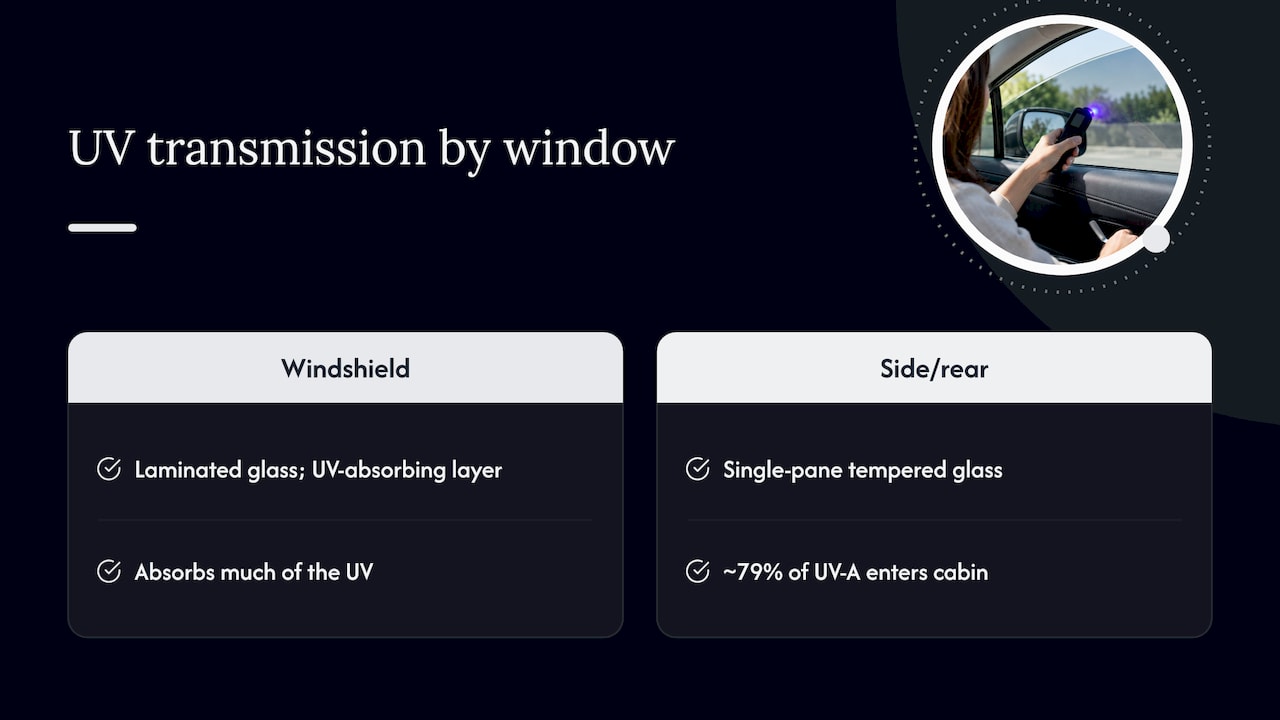
Yes, and the answer depends on which window. Windshields are made of laminated glass, which has a plastic layer that absorbs much of the UV. Side and rear windows are usually single-pane tempered glass without that layer. A 2025 study measuring UV transmission found those windows allow roughly 79% of UV-A to enter the cabin.
That matters for your interior in practical ways. The driver’s door window and the rear glass flood the seats and door panels with UV every time you drive or park. If you have ever noticed the driver’s arm rest or the outer edge of the rear seat looking lighter than the rest, this is why.
How fast does it happen?
The heat builds faster than most people expect. AAA reports that on an 80-degree day a parked car can reach 120°F or higher in about 40 minutes, and interior surfaces in direct sun can climb to nearly 200°F or more.
So one afternoon in the sun will not ruin a dashboard. But a daily commute followed by eight hours in an open parking lot adds up. In South Jersey, with humid summers and long stretches of bright sun, a car parked outside at work every day is on the fast track. Dark dashboards and black or tan leather absorb more heat than light-colored materials, so they tend to show wear sooner.
Sun is not only a summer problem, either. Low winter sun comes in through the windshield at a sharper angle and hits the dash and the front seats directly.
Protect your interior: the habits that matter
None of this is complicated, and the habits stack. AAA’s preventive advice is to park in shade or a garage, use a reflective windshield sunshade, keep the interior clean and condition leather seats regularly.
1. Park smart
Shade is the cheapest protection there is. A garage is best. A tree or the shaded side of a building works too. If you park at the same spot every day, choose the position where the windshield faces away from the afternoon sun.
2. Use a sunshade every time
A reflective sunshade across the windshield keeps direct light off the dash and the front seats, and it keeps the cabin cooler. Get one that fits your windshield edge to edge, since gaps let light and heat through to exactly the surfaces you are trying to protect.
3. Keep surfaces clean
Dust and grime hold heat and abrade surfaces as you wipe them. Wipe the dash and door panels regularly with a soft microfiber cloth and a cleaner made for automotive interiors. Skip glossy, greasy dressings, which can leave a shine that reflects glare onto the windshield and attracts dust.
4. Condition leather on a schedule
Leather loses moisture in heat. Cleaning it and applying a leather conditioner regularly helps avoid cracks and tears. Use a product made for automotive leather, apply it thinly and buff off the excess. Test any new product on a hidden spot first, as coated or perforated leather can react differently.
5. Crack the windows only when safe
Letting a little air out slows the heat buildup, but it is not a substitute for shade, and it should never involve leaving children or pets in a parked car.
Window tint as UV protection
Habits help when you remember them. Tint works every minute the car is in the sun. Quality window film can block up to 99% of UV rays, reduce heat and help preserve the interior. Since the side and rear glass is where most UV gets in, tinting those windows closes the biggest gap.
If you want the details on how film types differ, our guides on window tint and UV protection and what actually works for UV protection go deeper. For shade levels, see our tint levels guide.
Check your state’s law first
Tint is regulated. Federal Motor Vehicle Safety Standard 205 requires at least 70% light transmittance for windows needed for driving visibility, and it bars manufacturers, dealers and repair shops from installing tint that cuts visibility below that level. The same NHTSA interpretation notes that federal law does not regulate changes made by individual owners, who remain subject to state rules on how vehicles are used and operated.
In plain terms: the legal darkness for each window varies by state, and the front side windows are usually the most restricted. Confirm New Jersey’s current rules before choosing a shade. Our window tinting laws explainer is a good place to start.
Already seeing damage? Repair or replace
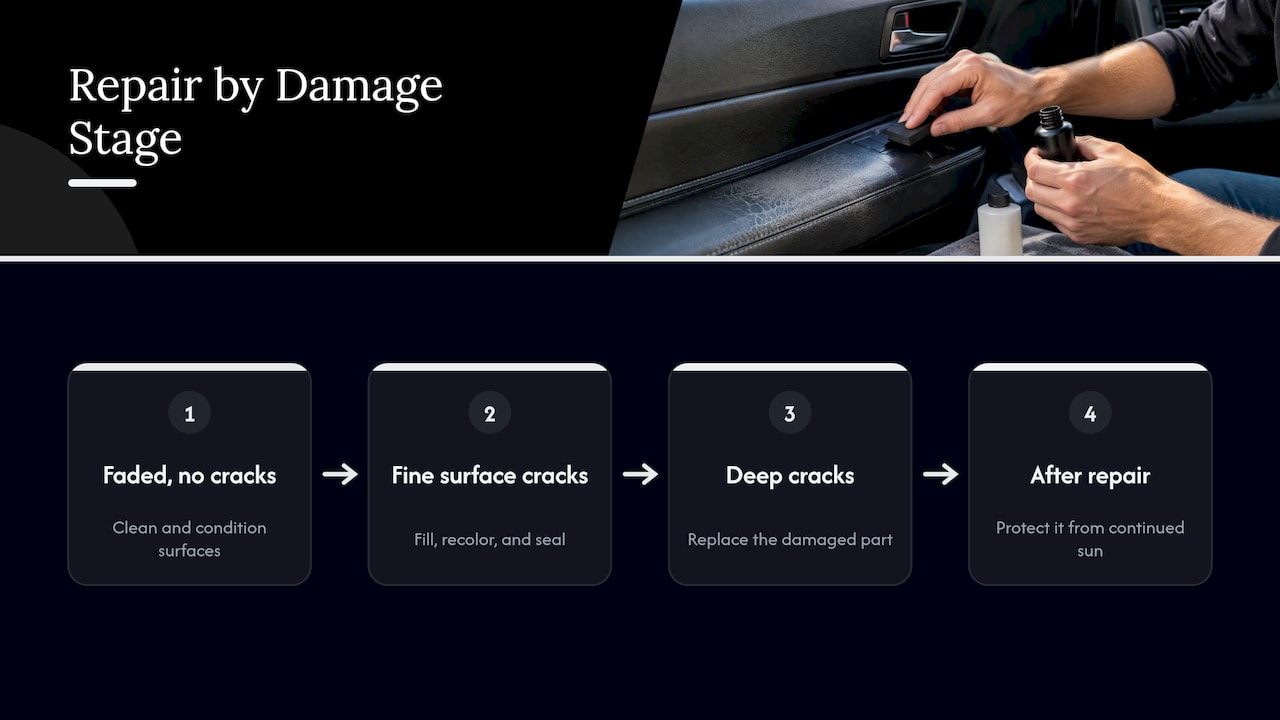
How you respond depends on how far it has gone. Think in three stages.
Stage 1: dull, faded or dry, no cracks. This is the best time to act. A thorough cleaning and conditioning restores a lot of the look and feel of leather, vinyl and plastic, and slows further drying. Fabric fading is usually permanent, but deep cleaning removes the grime that makes it look worse.
Stage 2: fine cracks or surface checking. Leather and dash surfaces with shallow cracks can often be filled, recolored and sealed. This is specialist work. Home repair kits exist, but matching color and grain is difficult, and fillers can shrink or discolor with continued sun exposure, so a deep or highly visible crack is usually better left to an interior repair specialist or upholstery shop.
Stage 3: deep cracks, splits, torn seams or crumbling foam. Repair rarely holds, and the part usually needs replacing: a dash cap, a seat cover or a seat bottom. Ask an upholstery shop or your dealer for a quote. Dashboards with airbags need particular care, so do not glue, cut or cover the airbag area yourself.
Whichever stage you are at, protect the repair afterward. A fresh repair in a car that still bakes in the sun will fail again.
A realistic care routine
This is the routine we would give a customer who parks outside every day:
- Every time you park: sunshade up, and shade when you can find it.
- Weekly or every other week: quick wipe of the dash, console and door panels with a microfiber cloth.
- Every month or two in summer: clean and condition leather seats and the steering wheel.
- Once a year (or at the season change): a full interior detail, including a deep clean of seats, carpets and plastics.
- One time: quality window film on the side and rear glass, within your state’s limits.
Promo: professional interior care, at your door
If you would rather not spend a weekend on your seats, we come to you anywhere in South Jersey. Our Interior Detail starts at $275 and covers a deep clean of the cabin so you can start your protection routine on clean, conditioned surfaces. For long-term UV defense at the glass, our GeoShield window tinting is available as GeoShield Carbon Tint at $350 and GeoShield Ceramic Tint at $500.

Mobile service carries an additional fee starting at $100, and appointments include a $100 booking charge, both listed on our detail packages page. If you want the interior and exterior done together, that page also shows our Bronze, Silver, Silver+ and Gold packages.
Perspective: why we start with the glass
Most of the interior jobs we see are not dirty cars. They are dry cars. The leather is thirsty, the dash has lost its color, and the owner swears they never left it in the sun more than a normal day. That is the point: normal days add up.
Our approach is to treat the interior like a system. First we clean it properly, because grime holds heat and hides the early signs of damage. Then we put the right protection in place. For many of our customers that means quality tint, because it works whether or not you remember to flip up the sunshade.
We are a mobile business, so we do this in your driveway or at your workplace, on your schedule. We document the process, which helps when you resell the car and a clean, uncracked interior is part of the price you ask. Our claim is simple: personalized care for each vehicle, done with professional-grade materials.
Charles
FAQ
How do I fix sun damage on my car interior?
It depends on the stage. Dry or faded leather and plastics usually respond to a deep clean and conditioning. Shallow cracks may be filled and recolored by an interior repair specialist. Deep cracks, splits and torn seams generally mean replacing the part, so get a quote from an upholstery shop or dealer.
Can UV penetrate car windows?
Yes. Windshields are laminated and absorb a good share of UV, but side and rear windows are typically single-pane tempered glass, and research found they let about 79% of UV-A through. Window film is one way to cut that exposure.
Can I leave my car in the sun?
Occasionally, yes, and it will not cause instant damage. The risk is repetition. Parked cars heat up fast, reaching 120°F in about 40 minutes on an 80-degree day, so use shade or a sunshade whenever you can. Never leave children or pets inside a parked car.
Does window tint really protect the interior?
Quality film can block up to 99% of UV rays and reduce heat, which helps preserve dashboards, seats and trim. Choose a shade that is legal in your state. We explain the options in our guide to UV protection with window tint.
Sources
- Easy Steps to Protect Your Car from the Summer Sun, AAA
- Evaluation of UV-A and UV-B transmission through the windows of vehicles, Archives of Dermatological Research
- Car Window Tinting: A Complete Guide, AAA
- Interpretation of FMVSS No. 205, NHTSA