
Yes, a waterless wash is a good fit for a ceramic-coated car, as long as the dirt is light and the product is made for coated surfaces. It handles dust, pollen, fingerprints and the film a car collects in a garage. It is the wrong tool for sand, mud, road salt or anything you can feel gritty under a towel. For those, rinse first or wash the car properly. If you would rather not make that call panel by panel, we maintain coated vehicles across South Jersey and come to your driveway or office.
TL;DR
- Waterless wash suits light dust, pollen, smudges and fingerprints on a coated car. It does not suit heavy dirt, mud, sand or road salt.
- Soil level decides the method. If you can feel grit, rinse first or do a full contact wash.
- Technique matters more than brand: cool panel, plenty of product, a clean microfiber folded into quarters, one direction, a fresh towel face every pass.
- Use only a product whose label says it is safe for coatings, and follow its dilution.
- Our Exterior Maintenance Plan is $200 per month per vehicle and keeps coated paint on a schedule without you doing the work.
Table of Contents
- What a waterless wash actually does on a coating
- When waterless is the right call
- When you should rinse or wash instead
- How to use a waterless wash on a coated car without scratching it
- What this means for your cleaning schedule
- What to avoid on a coated surface
- Why some owners let us handle it
- Our view on keeping a coated car clean
- Book a maintenance visit in South Jersey
- FAQ
- Sources
What a waterless wash actually does on a coating
A ceramic coating is a thin, hard layer bonded to the paint. It does not make the car dirt-proof. What it does is make the surface slicker, so dirt lets go more easily. Our own guide on the benefits of ceramic coating covers that in more detail.
A waterless wash is a spray with lubricating and cleaning agents. You mist it on a panel, and the chemistry lifts light soil and wraps it in a slick film. A microfiber towel then carries the soil off the paint. There is no hose and no bucket. The lubrication is the only thing between the dirt particles and your clear coat or your coating, which is why the amount of product and the state of your towel matter so much.
There are two things people often mix up:
- Waterless wash: sprayed on neat or lightly diluted, wiped off. Meant for the lightest dirt.
- Rinseless wash: concentrate diluted in a bucket of water, applied with a towel or mitt, then dried. It handles somewhat more dirt, but it is still for lightly soiled cars.
Some products serve both purposes at different dilutions. One manufacturer’s page for a dual-use product, for example, lists a 1:15 or 1:10 mix for waterless use and much weaker ratios for rinseless use. The point for you: the dilution on the label is part of the product. Do not improvise a stronger or weaker mix.
When waterless is the right call
The simplest rule, and the one detailers use: pick the gentlest method that can safely remove the dirt that is actually on the car. Soil level is the deciding factor, not how convenient the method is.
Waterless is a sensible choice for:
- Dust that settled overnight or in a garage
- Pollen, which South Jersey gets heavily in spring
- Fingerprints and smudges on doors, trunk lids and around handles
- Light water spots that have not baked on
- The haze a car picks up sitting in a covered parking spot
Spot cleaning works too. A single bird dropping, a few insect remains or a spot of sap can be treated on its own with a little product and a clean towel, rather than wiping a whole dirty panel.
When you should rinse or wash instead
The guidance from the products’ own makers is consistent. One waterless wash system limits its method to lightly dirty vehicles. It says to rinse off sand, mud and heavy grit before wiping, and to stop if you can feel grit.
So choose a rinse and proper wash when you see:
- Mud, sand or caked-on dirt after a rainy week or a trip to the shore
- Road salt residue after a winter storm
- Gravel dust from a farm lane or a job site
- Visible grit when you run a gloved hand over the panel
- Heavy brake dust on wheels
That last one deserves its own rule. Wheels and tires carry brake dust and road grime. Never use a towel from the wheels on the paint, and never the reverse. Your paint towels stay on paint only.
The reason is simple physics. A waterless wash does not float dirt away. It drags it across the surface on a film of lubricant. A coating is hard, but a gritty particle can still leave fine marks in the coating or the clear coat beneath it. Our article on what ceramic coatings do and do not stop goes into swirls and chips if you want the detail.
A quick field test
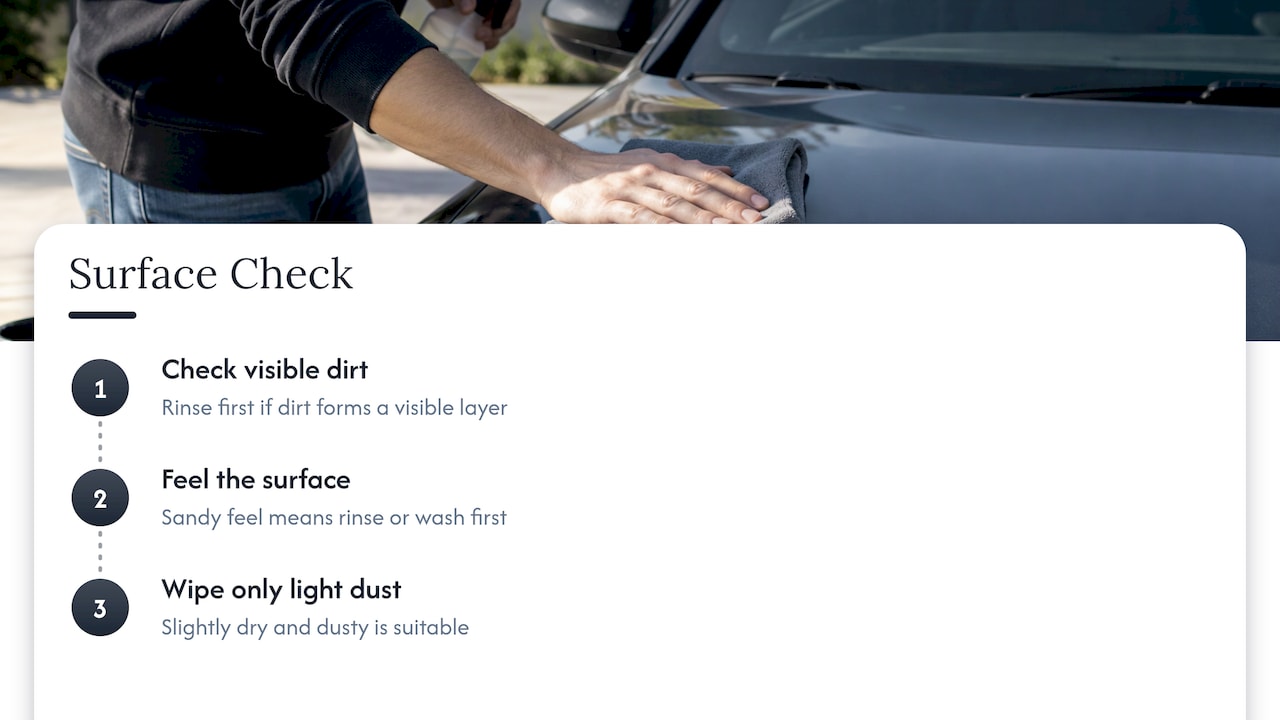
Before you reach for the spray, look at the car from a low angle in good light. If you see a visible layer of dirt, not just dust, rinse first. Then run the back of your fingers lightly over the hood or roof. If it feels sandy, a waterless wipe is the wrong move. If it only feels slightly dry and dusty, you are fine.
How to use a waterless wash on a coated car without scratching it
This is the routine, drawn from the method guidance that product makers publish and from basic detailing practice.
1. Pick the right product
Choose a product that says on its label it is safe for ceramic-coated paint. Some makers publish this for specific products, and it applies to that product, not to every spray on the shelf. Read the label for the surfaces it names (paint, glass, trim, and paint protection film if you have it). Also read the dilution, if there is one.
If your car has paint protection film (PPF, a clear urethane film applied over paint to take rock chips), check the film installer’s care sheet too.
2. Work on a cool panel, out of the sun
Sun and heat dry the product before you wipe it, and then it stops lubricating. One major film maker’s aftercare instructions say to wash only when the film is cool to the touch and out of direct sunlight. The same logic holds for coated paint. In a New Jersey July, that means early morning, evening or a shaded garage.
3. Gather clean towels
You need more than you think. Plan on at least six to eight clean, plush microfiber towels for a mid-size sedan, plus separate ones for the final buff and others for wheels. A towel that has touched the wheels never touches the paint.
4. Start from the top
Work roof first, then glass, hood and trunk, upper doors, then the lower panels. Save the dirtiest areas, the rocker panels and lower bumpers, for last. Each pass you make moves dirt downward, so you do not want it landing on cleaner areas.
5. Spray generously, one section at a time
Most scratches from waterless washes come from too little product. Spray a manageable section, such as half a hood or one door, until the surface is visibly wet. Do not mist and hope. Treat one panel at a time so nothing dries before you wipe.
6. Wipe gently in one direction
Fold a clean microfiber into quarters. Lay it on the panel and wipe in a straight line with light pressure. One method guide recommends exactly this fold and a fresh face for each following pass. When a face looks dirty, turn to a clean one. When all eight faces are used, take a new towel.
Avoid circles. Straight lines make any mark easier to polish out later, though the goal is to cause none.
7. Buff with a separate dry towel
Use a second, clean, dry microfiber to remove the residue and bring up the gloss. Do not reuse the wiping towel for this.
8. Stop if anything drags
If the towel drags, squeaks or you feel grit, stop. Rinse the panel or move to a full wash. Do not push harder.
9. Do not reuse dirty towels
Never put a soiled towel back into clean product or a clean bucket without rinsing it thoroughly first. Used towels go into the laundry pile, washed separately from other fabrics and without fabric softener, which clogs microfiber.
What this means for your cleaning schedule
A coated car in South Jersey sees a lot: spring pollen, summer bugs and tree sap, fall leaves, winter road salt. A realistic mix looks like this:
| Condition | Best method |
|---|---|
| Light dust or pollen, garage-kept car | Waterless wash |
| Fingerprints, smudges, one bird dropping | Waterless wash, spot treat |
| Moderately dusty daily driver | Rinseless wash or rinse then wash |
| Mud, sand, gravel dust, road salt | Rinse first, then a full contact wash |
| Heavy bugs, tar, sap on several panels | Full wash, and detailer attention |
| Wheels and tires | Separate tools, always |
The thing to notice is that waterless wash fills one slot, the lightest one. A coated car that is waterless-washed too often when it should be rinsed gets marred. A car that is only ever hand-washed with dirty mitts gets marred too. The method has to match the dirt.
If you have just had a coating installed, follow your installer’s aftercare timeline for the first washes. Our guide to the prep wash before a coating shows what a properly cleaned surface looks like, and the reason a coated finish needs to start clean.
What to avoid on a coated surface
- Wax over the coating. It can mask the coating’s slickness. We explain what happens in our wax over ceramic coating article.
- Strong solvents and harsh cleaners that are not rated for coatings.
- Dry wiping. Never wipe dust off with no lubricant at all.
- Washing in direct sun or on a hot panel.
- A single towel for the whole car.
Why some owners let us handle it
The routine above works. It also takes a dozen towels, a cool shaded spot, and a call on every panel about whether the dirt is light enough. Busy professionals, fleet managers and anyone with a daily driver parked outdoors under trees often do not have the time.
We come to you. CDC Auto Detailing is a mobile service based in Pitman, New Jersey, serving South Jersey, so your car gets cleaned at home or at work. For a coated car, the useful options are:
- Exterior Detail, from $175.
- The Exterior Maintenance Plan, $200 per month per vehicle or $100 per week per vehicle, listed on our detail packages page.
- For businesses with several vehicles, fleet washing.
Mobile detailing carries an additional fee that starts from $100, and there is a $100 booking charge, both listed on the packages page.
If you are still deciding whether to coat the car in the first place, our ceramic coating packages run from the 3 Year Package at $1,000 to $1,200 up to the 8 Year Package at $2,200 to $2,400. Ceramic coating also carries a 10% booking charge.
Our view on keeping a coated car clean
We coat cars, and we maintain cars that are coated, so this question comes up constantly: can I just spray and wipe?
Our honest view is that a waterless wash is a good tool with a narrow job. For a lightly dusty car it is fast, and it keeps a coated finish looking the way it did on delivery day. What matters is the judgment around it: how much dirt is actually on the paint, how many clean towels you have, whether the panel is cool, whether the product matches the coating.
That judgment is what we bring to each vehicle. Our approach is personalized care for each car, with professional-grade materials and a documented process, so the owner has a record of what was done. For a coating that you paid for to protect your paint and your resale value, a regular, correct maintenance routine is how it keeps earning its keep.
That is why we offer the Exterior Maintenance Plan. Instead of you choosing between a spray and a rinse every weekend, we come on a schedule, assess the real condition of the surface and use the right method for it.
Charles
Book a maintenance visit in South Jersey
If you want your coated car cleaned the right way without spending your Saturday on it, we will come to you. Choose an exterior detail or set up the Exterior Maintenance Plan, and we will take care of the rest, from the first rinse to the final buff.

See prices and book on our detail packages page, or start from cdcautodetailing.com.
FAQ
Is waterless wash good for cars with ceramic coating?
Yes, for light dirt, and with a product whose label says it is safe for coatings. It works on dust, pollen and fingerprints. If the car has mud, sand, salt or any gritty film, rinse first or do a full wash instead.
Can you wash a ceramic-coated car with a waterless wash every week?
You can if the car stays only lightly dusty each time and you use clean towels and plenty of product. When the dirt builds up, switch to a rinse and wash. Many owners alternate methods depending on the weather and where the car is parked.
Is a waterless wash safe on paint protection film?
Use a product whose label names PPF, and follow the film installer’s care sheet. Work on a cool surface, one panel at a time. Keep wheel towels away from the film, since brake dust can scratch it.
Should I wax a coated car after a waterless wash?
No. Wax is not needed over a coating and can change how it behaves. We explain why in our guide on wax over ceramic coating. Keep to coating-safe products and your installer’s maintenance advice.
Sources
- The Reign Method, Reign System
- Q²M EcoWash product page, GYEON
- PPF Aftercare and Warranty Instructions, Ceramic Pro