
Yes, you can put wax on a ceramic coated car, and a single coat will not destroy the coating. But it is rarely a good idea. Wax sits on top of the coating, covers the slick, water-shedding surface you paid for, and holds on to dirt. If you have already done it, it is fixable with a proper wash and a little patience. If you haven’t, there are better products for adding gloss and protection.
That is the short version. Below is the longer one: what wax actually does to a coating, how to tell whether yours has been affected, how to remove wax, and what we recommend for keeping a coated vehicle looking sharp in South Jersey.
TL;DR
- Wax will not usually damage a cured ceramic coating, but it can dull the water beading and make the surface feel less slick.
- Wax is a soft layer that attracts and holds contaminants, which works against what a coating is built to do.
- If wax is already on, a wash with a wax-stripping soap or a prep wipe-down usually restores the surface. Avoid aggressive polishing.
- For extra gloss or protection, use a silica (SiO₂) based spray or booster made for coated paint instead of carnauba wax.
- Routine, gentle washing does more for a coating than any topper.
Table of Contents
- So, can you wax a ceramic coated car?
- What actually happens when wax goes on a coating
- How to tell whether wax has affected your coating
- How to remove wax from a ceramic coated car
- What to use instead of wax
- Washing habits matter more than toppers
- Our perspective
- Choosing a coating that suits how you drive
- Coating your car in South Jersey
- FAQ
- Sources
So, can you wax a ceramic coated car?
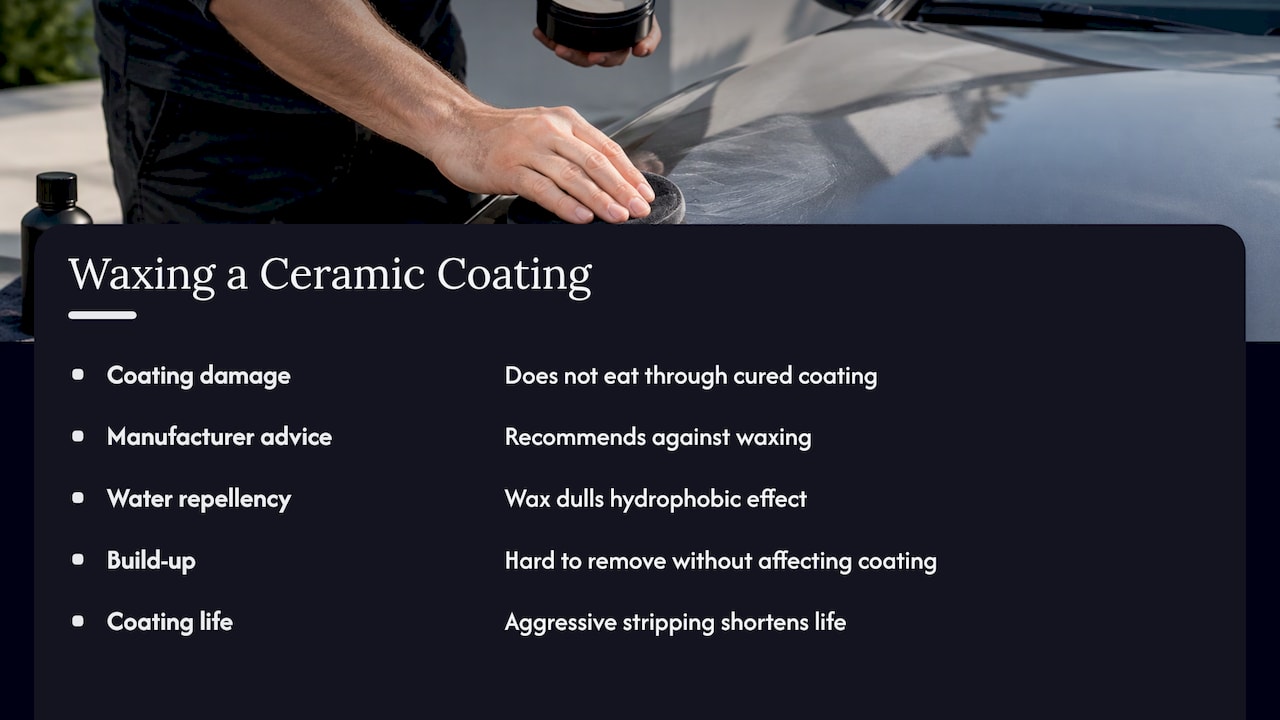
Technically yes. A cured coating is chemically stable, and waxing it will not eat through it. One coating manufacturer’s FAQ says wax will not damage its coating, yet the same company recommends against waxing. The reasons it gives: wax dulls the hydrophobic effect of extremely water-repellent products, and it is a soft finish that contaminants bond to easily.
So the question is not whether you can. It is whether you gain anything. A ceramic coating already provides the gloss and water beading that people wax for. Adding wax is a bit like putting a coat of clear tape over a screen protector: nothing breaks, but you have changed how the surface behaves.
Other published guidance lands in the same place. A materials-coating company’s guide lists the risks as dulling over time as wax collects dirt, build-up that is hard to remove without affecting the coating underneath, and shorter coating life when aggressive stripping is needed later.
What actually happens when wax goes on a coating
Three things tend to happen, in this order.
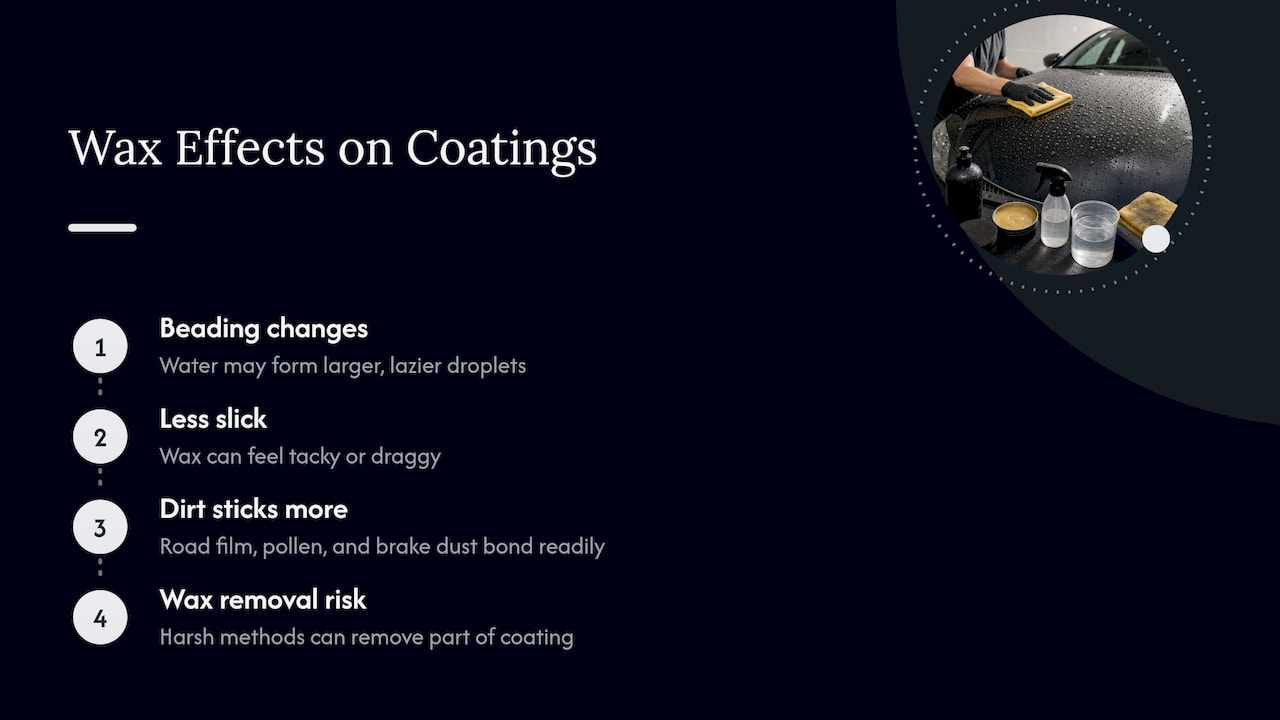
1. The beading changes. Ceramic coatings are valued for water that balls up and rolls off. Wax puts a different surface chemistry on top. Water may still bead, but often more loosely, with larger and lazier droplets. You may notice it most after the first rain or wash.
2. The surface gets less slick. Run a clean hand, in a plastic bag, across a coated panel and it feels glassy. Wax can make that feel slightly tacky or draggy, especially if it was applied too heavily or not fully buffed off.
3. Dirt sticks more. Wax is soft. Road film, pollen, and brake dust bond to it more readily than to a hard coating. Over weeks the panel can look duller than it did before you waxed.
None of these is permanent. They are the result of a layer that can be removed. The real risk comes from what people do next: reaching for harsh chemicals, clay, or a polisher to get the wax off, and removing part of the coating in the process. That is why we suggest the gentlest removal method first.
Streaks, haze and uneven spots
Coatings are thin, and wax applied in direct sun, or left to dry too long, can leave streaky patches. These show up most on dark paint and on hoods and roofs, where sun hits hardest. If you see haze after waxing, treat it the same way as any wax residue: remove it, don’t pile more product on top.
How to tell whether wax has affected your coating
Before you strip anything, check. Wash the car with a pH-neutral shampoo, rinse, and look at how the water behaves.
| What you see | What it likely means | What to do |
|---|---|---|
| Tight, round beads that sheet off quickly | Coating is working normally | Leave it alone and keep up regular washes |
| Larger, slower beads, water clings in patches | Wax or a leftover product layer, or road film | Wash again, then use a prep wipe-down |
| Streaky or hazy look after drying | Wax residue or uneven wax | Remove residue before it builds up |
| Dull and gritty feel even after washing | Bonded contaminants | See a detailer about safe decontamination |
| Water sits flat in sheets that don’t bead anywhere | Coating may be worn or failing, not wax | Have it inspected |
That last row matters. Plenty of owners blame wax for performance loss that is really age or neglect. Even a quality coating is a wear item. One maintenance guide puts a professionally applied coating at two to five years with proper maintenance, and results depend on the product, the prep, and how the car is washed and stored.
How to remove wax from a ceramic coated car
Start gentle and move up only if you need to.
Step 1: Wash with a wax-stripping or degreasing soap
A single ordinary layer of wax often comes off with a good wash using a soap that has cleaning strength. Work in the shade on a cool panel. Use a clean microfiber mitt, wash top to bottom, and rinse thoroughly. A cured coating is built to resist this kind of wash. Wax is not.
Step 2: Do a panel-prep wipe-down
If beading is still off after a wash and dry, a panel-prep spray or a diluted isopropyl alcohol wipe, applied with a clean microfiber towel and flipped often, helps lift leftover oils and wax residue. Follow the product label for dilution. Do not use a full-strength solvent on paint, and keep it off rubber, trim, and plastics.
Step 3: Decontaminate only if needed
If the surface still feels rough after washing, bonded contaminants may be the cause. A fine-grade clay bar with plenty of lubricant is the lowest-risk way to deal with them on coated paint. Clay is slightly abrasive by design, so use plenty of lube and keep refolding to a clean face. Ask a professional if you have never done it.
What to skip
Skip machine polishing to remove wax. Polishing removes a thin layer of the surface itself, which can take coating with it. It is only appropriate when you are already correcting scratches or swirls, and that is a job for someone who can measure and judge the result. If wax is truly stuck, or you are not sure what is on the car, a detailer can assess it and tell you whether the coating needs a refresh. Our guide to removing ceramic coating without damaging your paint covers what happens when it is time to start over.
What to use instead of wax
If what you want is more gloss, more slickness, or more sacrificial protection, there is a better tool than carnauba: a silica-based (SiO₂) spray or booster made to bond with, not smother, a coating. These are often sold as toppers or ceramic detail sprays. Several care guides recommend them for exactly this reason: they are chemically compatible and reinforce the coating rather than sitting on top as a separate wax layer.
A few practical rules:
- Check the label. Look for wording that says it is safe for ceramic-coated vehicles.
- Use a little. Most sprays are applied a few mist sprays per panel and buffed with a clean towel. More product does not mean more protection.
- Match the family. If you applied a coating from a specific line, use the maintenance products that come with it or that the installer recommends.
- Don’t layer on a dirty surface. Wash and dry first.
Synthetic “ceramic waxes” exist too. They are a middle ground, and are usually described as lasting longer than natural carnauba. They are a lower-risk choice than traditional wax, though still a layer on top. If you want to use one, test on a small area, and be ready to wash it off if you don’t like the result.
Washing habits matter more than toppers
The single biggest influence on how a coating looks in year three is how it is washed. Some habits that help:
- Use a pH-neutral shampoo and a clean microfiber mitt. Skip wax-infused or “gloss enhancing” shampoos, which add the same layer you were trying to avoid.
- Pre-rinse first so you are not dragging grit across the paint.
- Avoid brush-style automatic washes. A coating is harder than clear coat, but it can still scratch and swirl. If you use an automatic wash, pick a touchless bay and skip any wax or sealant step at the end. One care brand’s guidance notes that wash-bay wax or sealant steps can alter how a coating performs.
- Dry with a clean towel or an air blower, not a squeegee or chamois.
- Wash out of direct sun, so soap and water don’t dry on the surface.
How often to wash depends on how you drive and where you park. We cover it in how often to wash a ceramic coated car, and our longer guide on maintaining ceramic coatings for lasting protection goes into the routine step by step.
Our perspective
We get this question from owners who have just paid for a coating and want to do right by it. They are usually halfway to a bottle of wax when they ask.
Our advice is simple: let the coating do its job. A coating is the protection. Wax is something you add to unprotected paint, and a coated car doesn’t need it. What a coated car needs is a clean surface, gentle washing, and the occasional compatible booster.
When we apply a coating, we think of it as a long-term plan for the paint, not a one-time shine. That is why we care about the prep, the process, and the aftercare as much as the product. A coating that is properly applied and sensibly maintained can reward you with years of easier washing and a deeper finish.
If wax has already gone on, don’t panic and don’t grab the polisher. Wash it, wipe it, and let us look at it if it still isn’t right. We would rather spend twenty minutes on a wash and wipe-down than see someone strip a good coating over a wax problem.
Charles
Choosing a coating that suits how you drive
If you are reading this before getting a coating, it helps to match the coating to your plans for the vehicle. Our ceramic coating packages are listed by their expected service life:
| Package | Published price |
|---|---|
| 3 Year Package | $1,000–$1,200 |
| 5 Year Package | $1,500–$1,700 |
| 8 Year Package | $2,200–$2,400 |
Ceramic coating also carries a 10% booking charge, listed on our ceramic coating page. Mobile detailing carries an additional fee, which starts from $100 and is listed on our detail packages page. The final price depends on the vehicle, so use those figures as a starting point.
If you want to understand what a coating does and does not do before you commit, start with the benefits of ceramic coating and what ceramic coating can and can’t stop.
Coating your car in South Jersey
We are a mobile detailing service based in Pitman, New Jersey, and we come to you across South Jersey. If you want a coating applied with the prep done properly, or you have a coated car with a wax problem or weak beading, we can look at it where it is parked.
Our ceramic coating packages run three, five, and eight years, and our exterior and interior details can be booked on their own or combined into a package. If you want a recurring clean, our Exterior Maintenance Plan is $200 per month per vehicle, or $100 per week per vehicle.

See the options and book on our ceramic coating page, or get in touch through our site and tell us what is on your paint.
FAQ
Will wax damage ceramic coating?
Not in the usual sense. Published guidance generally agrees that wax does not destroy a cured coating. The trouble is what it does to performance: it can dull water beading, reduce slickness, and trap dirt. The bigger risk is aggressive removal, so use a wash and wipe-down before anything harsher.
Can I use a ceramic spray or booster over my coating instead?
Yes, that is usually the better option. A silica-based spray or booster made for coated vehicles is designed to work with the coating, not sit on it like a separate wax layer. Apply a small amount to a clean, dry panel and buff off the excess.
How do I get wax off a ceramic coated car?
Start with a thorough wash using a soap that has some cleaning strength, then do a panel-prep wipe-down if beading is still poor. Use a fine clay bar with plenty of lubricant only if the surface still feels rough. Avoid machine polishing unless a professional is correcting the paint anyway.
How long does a ceramic coating last without wax?
It depends on the product, the prep, and the washing routine. Maintenance guidance commonly cites two to five years for a professionally applied coating with proper care. Our packages are sold in 3, 5, and 8 year options, and the right one depends on the vehicle and how you use it.
Can I wax a car before a ceramic coating is applied?
It is better not to. A coating bonds best to clean, bare paint, so any wax needs to come off first. That is part of a proper prep wash, which we describe in our ceramic coating prep wash guide.
Sources
- Gtechniq USA: FAQs about Gtechniq
- A&A Thermal Spray: Can You Wax Over Ceramic Coating?
- Houseler: Ceramic Coating Maintenance Schedule + Calculator
- Adam’s Polishes: Maintenance On A Ceramic Coated Vehicle