
If your work truck needs a real refresh, the fastest path is hiring a professional detailer or enrolling in a recurring fleet program rather than attempting a full cabin, bed, and undercarriage job yourself. A qualified detailer delivers a clean cab, odor removal, bed and undercarriage attention, and optional protective coatings in a single visit. Mobile detailing services are available, and readers ready to move forward can request a quote directly.
TL;DR:
- Full details generally take 2 to 4 hours or longer, while coatings and paint protection film often require appointments spanning multiple days for curing.
- Quotes should itemize services and identify extras such as engine bay cleaning, smoke or pet odor treatment, and undercarriage degreasing, which may cost separately.
- Choose weekly, biweekly, or monthly fleet visits according to truck use and customer visibility, then schedule on site to avoid disrupting dispatch.
- Mobile fleet vendors should capture wash water, train staff to handle chemicals with proper protective equipment, and provide insurance documents and inspection checklists.
- Class 7 or 8 trucks often need a dedicated wash rack or commercial bay because mobile setups may lack adequate water and drainage capacity.
Table of Contents
- What truck detailing includes, from the cab to the undercarriage
- How much does work truck detailing cost, and how long does it take
- Setting up a fleet or recurring detailing program
- Questions to ask before choosing a truck detailer or fleet partner
- Why wash water rules and worker safety matter for truck washing
- What truck size and type do to the final price
- How mobile detailing logistics work for work trucks specifically
- Products and techniques built for truck-specific surfaces
- Keeping a work truck clean between professional visits
- Why mobile detailing fits the realities of running a work truck
- Get a quote for your work truck or fleet
- FAQ
- Sources
What truck detailing includes, from the cab to the undercarriage
A proper work truck detail covers far more ground than a basic wash. Interior work starts with a full vacuum, hot water extraction on seats and carpet, odor treatment, and conditioning for dashboard plastics and seat fabric or leather. Exterior work includes a hand wash, wheel and tire cleaning, bug and tar removal, clay bar decontamination, and a light polish to bring back some shine without a full paint correction.
Trucks carry soil patterns that passenger cars rarely see, so a detailer worth hiring treats these zones as standard, not upsells:
- Bed liner scrubbing to clear packed dirt, gravel dust, and cargo residue.
- Tailgate seams and hinges, where grime collects and accelerates rust.
- Running boards and wheel wells, which trap mud and road salt.
- Ladder racks and tie-down points, often skipped in a quick wash.
Underbody and undercarriage cleaning matters just as much as what’s visible. Salt, grit, and oil buildup on the frame and suspension components shorten component life if left alone, and a thorough detail includes a rinse down there, with degreasing available on request for trucks used in heavier work. For a full breakdown of this sequence, our step-by-step truck detailing guide walks through the process we follow on-site.
Once the baseline clean is done, owners often add protective upgrades: ceramic coating for long-term gloss and chemical resistance, paint protection film on high-impact panels, decal removal before a rebrand, or fabric and leather restoration on older interiors showing wear.
How much does work truck detailing cost, and how long does it take
Packages vary by provider, but most professional menus break down into a few recognizable tiers. Understanding what each one typically covers helps you compare quotes apples to apples.
- Express wash: exterior-only, wheels and tires included, usually finished in 30 to 45 minutes.
- Interior-only detail: vacuum, extraction, and surface cleaning, typically 1 to 2 hours depending on soil level.
- Full truck detail: interior and exterior combined, bed and undercarriage attention included, generally 2 to 4 hours or more.
- Protective add-ons: ceramic coating or paint protection film installs, often scheduled as multi-day jobs since they require curing time.
Price is driven less by the truck’s nameplate and more by its condition and use case. A work truck that hauls tools and materials daily will cost more to detail than a lightly used pickup, simply because soil level is higher and bed accessories like toolboxes or liners add time. Paint correction, if the clear coat has heavy swirling or oxidation, adds another line item.
When you get a quote, ask for an itemized breakdown rather than a flat number. Watch for common exclusions like engine bay cleaning, odor treatment for smoke or pet smells, and undercarriage degreasing, since these are frequently priced separately from the base package.
Setting up a fleet or recurring detailing program
A single detail keeps a truck looking good for a few weeks at best. Fleet managers who want consistent presentation and better resale value typically set up a recurring schedule instead of booking one-off visits.
- Weekly service suits trucks in constant customer-facing use, like delivery or service vehicles where brand image matters daily.
- Biweekly service works for moderate-use fleets that need regular upkeep without the cost of weekly visits.
- Monthly service fits trucks used less frequently or kept mostly for internal operations.
On-site logistics matter as much as the schedule. A mobile provider needs enough space to stage the detail rig, access to water and power or the ability to run a closed-loop water recovery system, and a staging area where vehicles can be worked on in sequence without blocking daily operations.
Volume pricing typically scales with vehicle count and visit frequency, and a solid service agreement spells out an inspection checklist and expected response time for scheduling changes. For very large vehicles, like Class 7 or 8 trucks, a dedicated wash rack or commercial wash bay is often more practical than mobile detailing, since those vehicles need more water volume and drainage capacity than a mobile setup can usually provide on-site. Our fleet detailing overview covers how these programs typically get structured.
Questions to ask before choosing a truck detailer or fleet partner
Not every detailer who shows up with a pressure washer is equipped to handle fleet work responsibly. A short vetting process up front saves headaches later.
- Ask how wash water is captured and disposed of. Providers following EPA best management practices use wash racks, sumps, or recovery mats rather than letting runoff reach a storm drain.
- Confirm staff safety training. Ask whether technicians have access to safety data sheets and use proper PPE when handling cleaning chemicals, in line with OSHA guidance.
- Request proof. Before and after photos, insurance documentation, and a sample inspection checklist tell you more than a sales pitch does.
- Compare quotes line by line. Look at itemized services, scheduling flexibility, damage policies, and whether fleet discounts apply at your vehicle count.
Our commercial vehicle cleaning checklist offers a format you can bring to any vendor conversation.
Pro Tip: Ask every potential vendor for their SDS binder on the spot. A provider who can produce it immediately is almost always the more professional choice.
Why wash water rules and worker safety matter for truck washing
Washing a fleet isn’t just a cleaning task, it’s an activity regulated by environmental and labor agencies because of what runs off and what workers are exposed to.
Vehicle washing without containment can send real pollutants into storm drains. EPA guidance on municipal vehicle washing identifies gasoline, diesel, oil, dissolved copper, nutrients, surfactants, and solids as common contaminants in wash runoff, and recommends containing and treating that water through wash racks, sumps, or oil and water separators before it reaches a waterway.
Permitting adds another layer. The proposed 2026 Multi-Sector General Permit directs facilities to perform vehicle cleaning indoors, under cover, or in bermed areas that capture overspray, and to check with the local sewer authority before discharging wash water to a sanitary sewer.
On the labor side, OSHA guidance calls for worker training on hazardous cleaning chemicals, accessible safety data sheets, and proper PPE. In practice, this looks like:
- Water-recovery mats placed under the vehicle during on-site jobs.
- Bermed or curbed wash areas that contain runoff.
- Vacuum capture systems for jobs done away from a fixed wash bay.
What truck size and type do to the final price
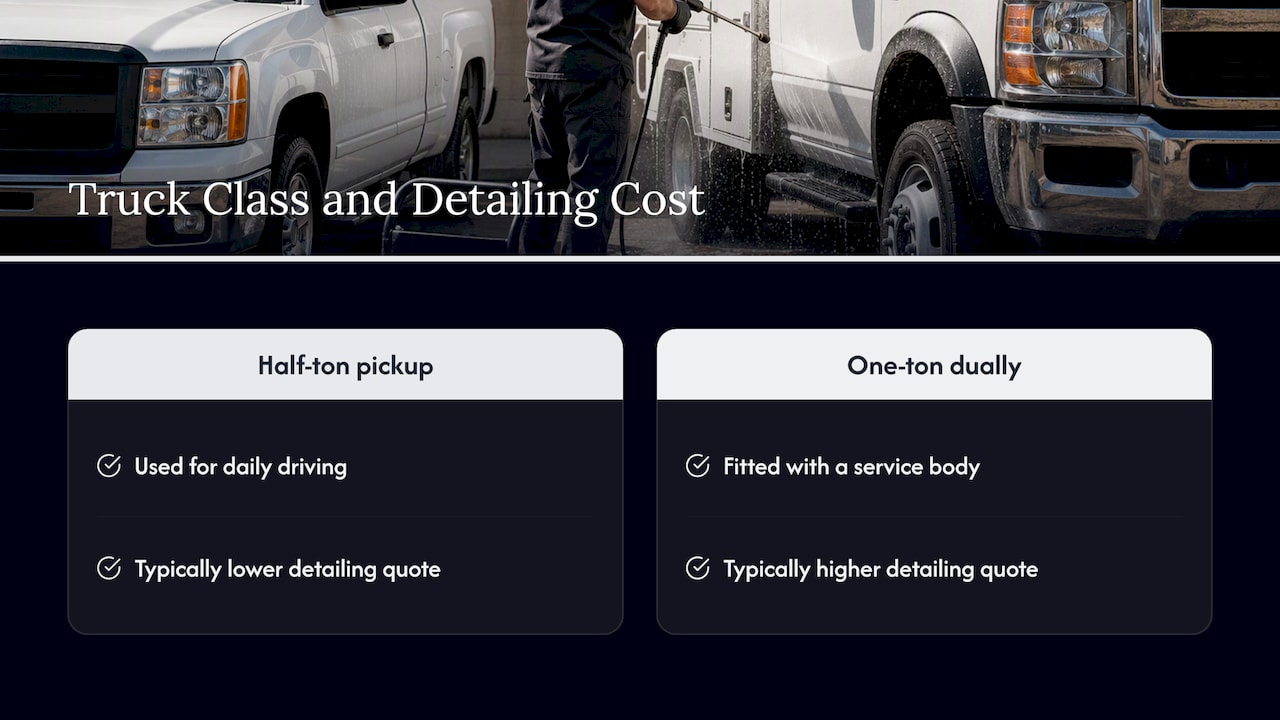
Truck class is one of the biggest cost drivers in any detailing quote, mostly because size changes labor time and material use rather than complexity. A compact pickup used for light commuting takes less time to vacuum, wash, and dress than a crew cab work truck hauling tools five days a week.
Heavy-duty and commercial trucks add cost for a few predictable reasons. Larger cabs mean more seating surface to extract and condition. Full-size beds, especially those fitted with toolboxes, ladder racks, or liners, take longer to clean thoroughly since each accessory has to be cleaned around or removed and reinstalled. Trucks used for construction, landscaping, or delivery work also tend to carry heavier soil loads, more embedded grime in carpet and upholstery, and oil or grease buildup on exterior panels that requires extra degreasing time.
Undercarriage condition plays a role too. A truck that spends time off-road or on salted winter roads accumulates buildup that a standard wash won’t touch, and clearing that properly takes more time than a truck that’s mostly driven on dry pavement. Fleet vehicles with decals or wraps also need careful hand cleaning around graphics rather than automated brush washes, which can lift edges or dull the vinyl over time.
None of this means heavy-duty trucks are prohibitively expensive to detail, but it does mean a quote for a one-ton dually with a service body will typically run higher than one for a half-ton pickup used for daily driving. Asking a provider how they price by class, rather than assuming a flat rate, keeps expectations realistic.
How mobile detailing logistics work for work trucks specifically
Mobile service exists to remove the downtime problem that comes with dropping a truck off at a shop. For a work truck, that downtime has a real cost since the vehicle is usually generating revenue or completing jobs during business hours.
A mobile provider typically needs a reasonably level parking spot, access to water and power, or the ability to bring self-contained water and power via the service vehicle itself. Scheduling around a work truck’s actual duty cycle matters more than with a personal car. Many fleet operators book details for early morning before trucks head out, at midday during a lunch break, or at the end of a shift once the vehicle is parked for the night.
Weather and season affect scheduling too. Exterior work and paint correction need dry conditions, while interior detailing can usually proceed regardless of weather since it happens inside the cab. For multi-vehicle fleets, staggering appointments across a lot, rather than trying to detail every truck in one day, keeps at least part of the fleet available for dispatch at any given time.
Communication is the other piece that separates a smooth mobile job from a frustrating one. A provider who confirms arrival windows, gives a realistic time estimate per vehicle, and flags any extra time needed for heavy soil or add-on services ahead of the appointment saves everyone from guessing.
Products and techniques built for truck-specific surfaces
Truck surfaces take a different kind of abuse than a passenger car’s, so the products and techniques that work best are often different too. Bed liners, whether spray-in or drop-in, need cleaners that cut through packed dirt and cargo residue without degrading the liner’s texture or UV coating. A degreaser formulated for rubberized coatings handles this better than an all-purpose interior cleaner.
Decals and vinyl wraps require hand washing with a pH-neutral soap and a soft wash mitt rather than an automated brush system, since stiff bristles can lift edges or scratch printed graphics. Clay bar decontamination still applies to trucks with wraps, but it has to be done carefully around decal edges to avoid peeling.
Tailgate seams, hinges, and the gaps around a toolbox mount trap moisture and road salt, which accelerates rust if ignored. A detailer working on a truck regularly will flush these areas with a low-pressure rinse and dry them fully rather than leaving moisture trapped in tight spots.
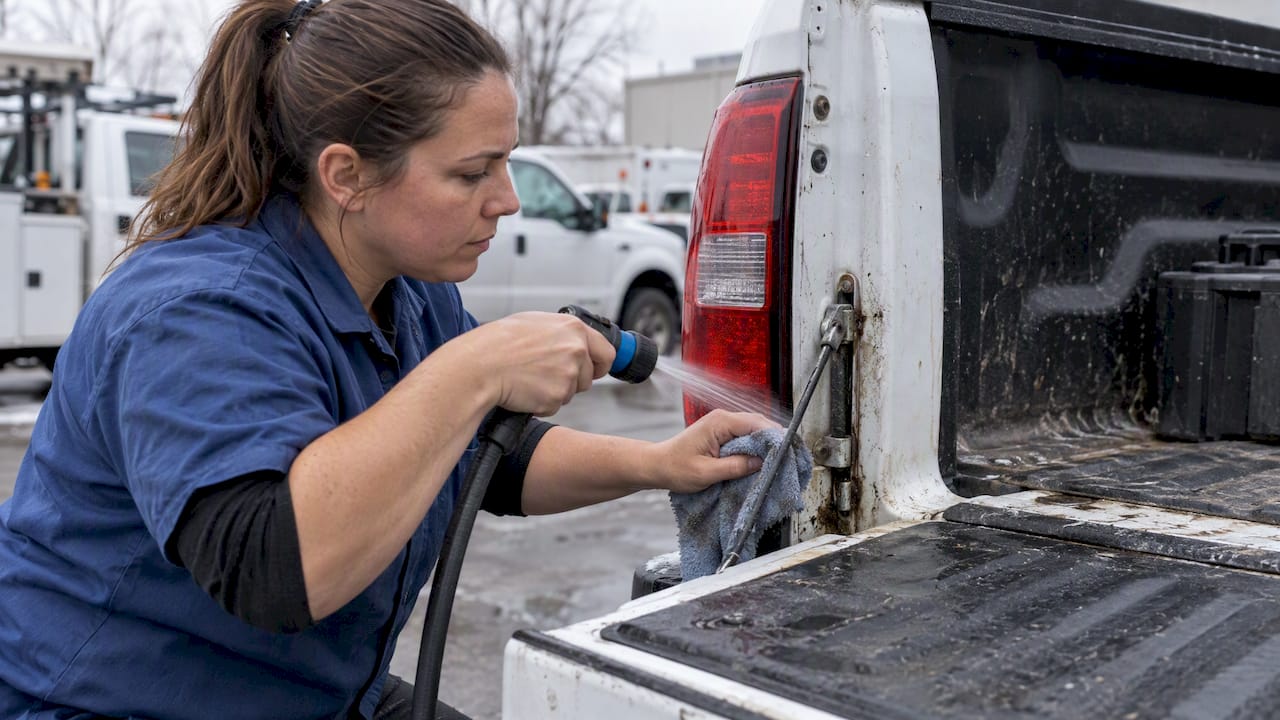
For protective upgrades, prioritizing high-impact zones, like bed rails, the tailgate edge, and the front bumper, with paint protection film or ceramic coating tends to make more practical sense than coating the entire truck, especially for vehicles that see daily wear. Our guide on detailing best practices covers safe product selection in more depth, and fleets running specialized lighting setups can find relevant upfit guidance from Strobe My Ride when scene lights or work lights need to be worked around during a detail.
Keeping a work truck clean between professional visits
A professional detail sets a high baseline, but a few habits between appointments stretch that result much further. Wiping down the interior weekly, especially touchpoints like the steering wheel, door handles, and center console, keeps grime from building into stains that need extraction later.
Rinsing the bed after jobs that involve mud, gravel, or debris prevents material from packing into liner texture or seams, where it’s harder to remove the longer it sits. A quick rinse takes a few minutes and avoids a much longer cleaning session down the road. Keeping floor mats out for shaking and the cab vacuumed on a rough schedule, even a basic handheld vacuum pass, extends the time between full extractions.
On the exterior, a rinse-and-dry after exposure to road salt or heavy mud protects paint and undercarriage components from accelerated corrosion. For trucks with a ceramic coating or paint protection film already applied, sticking to pH-neutral soap and avoiding automated brush washes preserves the coating’s effectiveness longer. Fleet vehicles benefit from a simple inspection habit too: a quick walk-around before and after each shift catches new scratches, leaks, or damage early, which keeps small issues from becoming bigger repair bills.
Why mobile detailing fits the realities of running a work truck
The biggest tradeoff in truck detailing isn’t quality, it’s time. A shop drop-off means a truck sits idle for hours or a full day, and for a vehicle that generates revenue, that downtime adds up fast. Mobile service solves this by bringing the work to the truck’s actual schedule, whether that’s a job site, a lot, or a driveway before a shift starts.
What separates a dependable provider from a rushed one usually comes down to process. A documented checklist, consistent scheduling, and the willingness to walk a fleet manager through what’s included in each visit build the kind of trust that keeps a recurring program running smoothly. Readers evaluating providers should request an on-site estimate and use the vetting checklist above as a starting point.
— Charles
Get a quote for your work truck or fleet
If you’re ready to stop guessing at quotes and get a real number, we can quote a single truck or a full fleet. Our Interior Detail and Exterior Detail services cover one-off jobs, our detail packages bundle both for better value, and our Fleet Washing program is built for recurring schedules and volume pricing.

To get an accurate fleet quote, have your vehicle count, typical soil level, and desired cleaning frequency ready when you reach out. Request a fleet quote or schedule a mobile visit through our fleet washing page and we’ll get back to you with next steps.
FAQ
Is $300 a lot for car detailing?
Whether a price is reasonable depends on what’s included and the vehicle’s condition going in. A basic exterior or interior-only service can cost less, while a full detail covering cab, exterior, and bed work on a heavily soiled truck often costs more.
How much should I tip for a $200 car detail?
Some fleet accounts skip individual tipping in favor of a service agreement that reflects quality expectations directly in the contract.
What does truck detailing include?
A full truck detail typically covers interior vacuuming and extraction, dashboard and seat conditioning, exterior hand washing, wheel and tire cleaning, bed liner scrubbing, and undercarriage rinsing. Many providers also offer optional add-ons like ceramic coating, paint protection film, or decal removal for an additional cost.
Sources
- Stormwater best management practice: Municipal vehicle and equipment washing (EPA)
- Protecting workers who use cleaning chemicals (OSHA)