
What does a window tint color chart actually show you?
Every tint shade on a window tint color chart is defined by its Visible Light Transmission percentage, or VLT. That number tells you exactly how much light passes through the film into your vehicle. A lower VLT means darker tint and less visibility from outside, while a higher VLT keeps things close to clear glass.
Here is how the most common tint shades stack up:
| VLT % | Darkness Level | Privacy | Typical Use |
|---|---|---|---|
| 70%+ | Very light | Minimal privacy | Typically used for windshield UV protection and front windows |
| 50% | Light | Low privacy | Suitable for front windows where maximum visibility is desired |
| 35% | Medium | Moderate privacy | Common choice for all-around daily driving |
| 20% | Dark | Higher privacy | Often applied to rear windows of SUVs and trucks |
| 5% | Very dark (limo) | Provides maximum privacy | Usually applied to rear glass or for show vehicles |
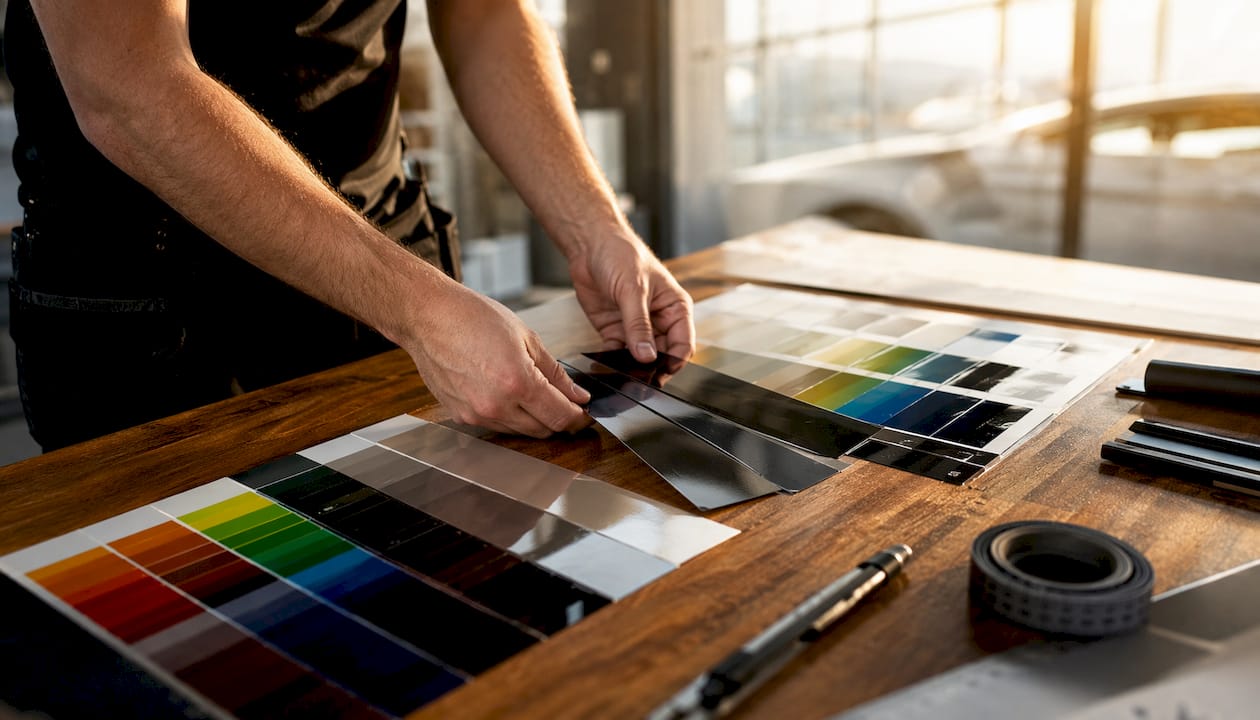
The color of the film matters beyond just darkness. Charcoal and black tints are the most common, giving vehicles a clean, neutral look. Blue and green tints shift the glass tone and can affect how interior colors appear in sunlight. Metallic films carry a slightly reflective sheen. None of these color choices change the VLT number, but they do affect heat rejection and aesthetics differently.
Key characteristics at a glance:
- Very dark tints (commonly called limo tint) block most incoming light, making it nearly impossible to see through from outside; such shades are illegal on front windows in every US state
- Dark tints around 20% VLT are commonly chosen for rear windows on trucks and SUVs, offering strong privacy without complete blackout
- 35% VLT: Legal in most states for daily driving; good nighttime visibility
- 50% VLT: Reduces glare and blocks UV without noticeably darkening the glass
- 70% VLT: Looks nearly identical to factory glass; mainly used for UV and heat protection on windshields
Table of Contents
- US window tint laws by state: what you need to know for 2025–2026
- How to choose the right tint shade for your car
- What film type should you actually choose?
- Common questions about window tint darkness and shade comparisons
- Professional window tinting in South Jersey from Cdcautodetailing
- Key Takeaways
US window tint laws by state: what you need to know for 2025–2026
No federal tint law exists. Every state sets its own legal VLT minimums for front side windows, rear side windows, and back glass, and those limits often differ by vehicle type.

| State | Front Side Windows | Rear Side Windows | Back Glass |
|---|---|---|---|
| California | 70% min | Any darkness | Any darkness |
| New York | 70% min | 70% min | 70% min |
| Florida | — | — | — |
| Texas | 25% min | Any darkness | Any darkness |
| New Jersey | 70% min | Any darkness | Any darkness |
Getting pulled over for illegal tint can mean a fine and a court order to remove the film entirely. The cost of removal plus reinstallation adds up fast. Always verify your state’s current rules through your state DMV before booking an appointment, since limits can change and vary by sedan, SUV, or truck classification.
Pro Tip: Your car’s factory glass already has a base tint level. A professional installer measures that first and factors it into the final VLT calculation, so the installed film percentage and the actual light transmission through the combined glass may differ.
How to choose the right tint shade for your car
The right shade depends on four things: your state’s legal limit, how much you drive at night, how much privacy you want, and whether heat control is a priority.
Balancing legality with visibility is the most common mistake drivers skip. Going darker than 20% on front side windows creates real visibility problems after dark, even if it looks great in daylight. A 35% tint hits the sweet spot for most daily drivers: legal in the majority of states, comfortable at night, and still noticeably private.
Do’s and don’ts for picking your tint shade:
- Do check your state’s VLT minimums for each window position before deciding
- Do consider a lighter shade on front windows and darker on rear glass for a uniform look
- Do ask your installer about your factory glass tint level before choosing a film percentage
- Don’t choose 5% limo tint for any window you need to see through at night
- Don’t assume the same shade is legal on every window of your vehicle
- Don’t prioritize darkness alone; a lighter ceramic film often outperforms a dark dyed film for heat control
For tint shade selection, consulting a professional installer beats guessing. They can show you physical samples against your actual glass in daylight, which is far more accurate than any digital chart.
What film type should you actually choose?
The film technology matters as much as the shade. Here is how the main types compare:
| Film Type | Heat Rejection | UV Protection | Signal Interference | Longevity |
|---|---|---|---|---|
| Dyed | Modest | Good | None | few years |
| Metallic | Good | Good | Yes | — |
| Carbon | Better | Up to 99% UV | None | — |
| Ceramic | Excellent | Up to 99% UV | None | more than three years |
Ceramic film blocks up to 99% of UV rays and rejects significant solar heat without disrupting GPS, cellular, or toll-tag signals. Dyed film costs less upfront but can fade and bubble within a few years. Carbon film is a solid middle ground: no signal issues, good heat rejection, and a clean matte finish.
Metallic films are worth avoiding if your vehicle uses in-glass antennas or relies on keyless entry, since the metal particles can interfere with those systems.
For UV protection and heat control, ceramic and graphene-infused films dominate professional recommendations. The price gap is real, but for drivers keeping their car more than three years, the performance difference justifies it.
After installation, avoid rolling windows down for 3–5 days while the adhesive cures. Use only ammonia-free cleaners on tinted glass. Ammonia-based products degrade the film and cause discoloration over time.
Common questions about window tint darkness and shade comparisons
Is 35% or 20% tint better for daily driving?
35% is the better choice for most drivers. It stays legal in the majority of states, preserves nighttime visibility, and still offers meaningful privacy. 20% works well on rear windows where visibility requirements are less strict.
Can you stack tint film on top of factory tint?
Yes, but the combined VLT will be darker than either layer alone. A professional measures the existing glass tint first and selects a film percentage that keeps the total within legal limits.
Does a lighter tint still block heat?
Absolutely, especially with ceramic film. IR and TSER metrics measure heat rejection across the full solar spectrum, not just visible light. A 50% ceramic film can reject more heat than a 20% dyed film.
What is the darkest legal tint for front windows in most states?
Most states set the front side window minimum at 35% VLT, though strict states like California and New York require 70%. Texas allows 25% on front side windows.
Professional window tinting in South Jersey from Cdcautodetailing
Choosing the right shade and film is only half the equation; following Car Selling Tips underlines the importance of high-quality window tinting installation for car resale value and aesthetics. The installation quality determines whether that tint lasts two years or ten.
Cdcautodetailing brings professional window tinting services directly to you across South Jersey, with no shop wait and no guesswork on legality. The team handles film selection, VLT calculations against your factory glass, and precision installation on curved rear windows where DIY kits consistently fail. Whether you want a 35% ceramic for daily driving or a darker rear-glass setup for an SUV, Cdcautodetailing matches the film to your vehicle, your state’s legal limits, and your performance goals. Ready to get it done right? Book your appointment and get a quote for your vehicle today.
Key Takeaways
Choosing the right window tint requires matching VLT percentage to your state’s legal limits, your visibility needs, and the film technology that delivers real heat and UV protection.
| Point | Details |
|---|---|
| VLT defines darkness | Lower VLT means darker tint; 70% looks nearly clear, 35% is a balanced daily driving choice, and 5% is the darkest ‘limo’ level. |
| State laws vary widely | California and New York require 70% on front side windows; Texas allows 25%. |
| 35% is the daily driver sweet spot | Legal in most states, good nighttime visibility, and decent privacy. |
| Ceramic film outperforms dyed | Ceramic blocks up to 99% UV and rejects more heat with no signal interference. |
| Cdcautodetailing handles it all | Professional mobile tinting in South Jersey with legal VLT guidance and precision installation. |