
Yes, a new car is the best candidate for a ceramic coating, and the best time is within the first few weeks of ownership. The paint is at its best, so the coating locks in a good finish instead of a damaged one. The catch is that “new” paint still needs inspection and a proper wash before anything gets sealed on top of it. This guide covers timing, prep, realistic expectations, South Jersey conditions and what the work costs.
TL;DR
- Coat a new car in the first 1 to 4 weeks, after a decontamination wash and an inspection, and before daily driving builds up road grime and UV exposure.
- You do not need to wait for the paint to cure. Factory paint is baked before the car ships.
- A coating seals in whatever is on the paint, so any swirls or dealer-lot marks should be polished out first.
- Ceramic coating resists chemicals and makes washing easier. It does not make paint scratch-proof or chip-proof.
- Our ceramic coating packages run from 1000 USD to 2400 USD, depending on the durability tier you choose.
Table of Contents
- Why a new car is the ideal candidate
- Do you have to wait for the paint to cure?
- The best timeline for coating a new car
- What “new” paint can still have wrong with it
- What a ceramic coating does and does not do
- South Jersey conditions that make the case stronger
- Dealer coating, DIY kit or a professional installer
- What ceramic coating costs for a new car
- Our perspective: coat early, but prep first
- Caring for a freshly coated car
- Book your new car coating in South Jersey
- FAQ
- Sources
Why a new car is the ideal candidate
A coating is a thin, hard, hydrophobic layer that bonds to the clear coat. It does not repair paint. It protects the finish you have on the day it goes on. That is why timing matters more on a new car than on any other.
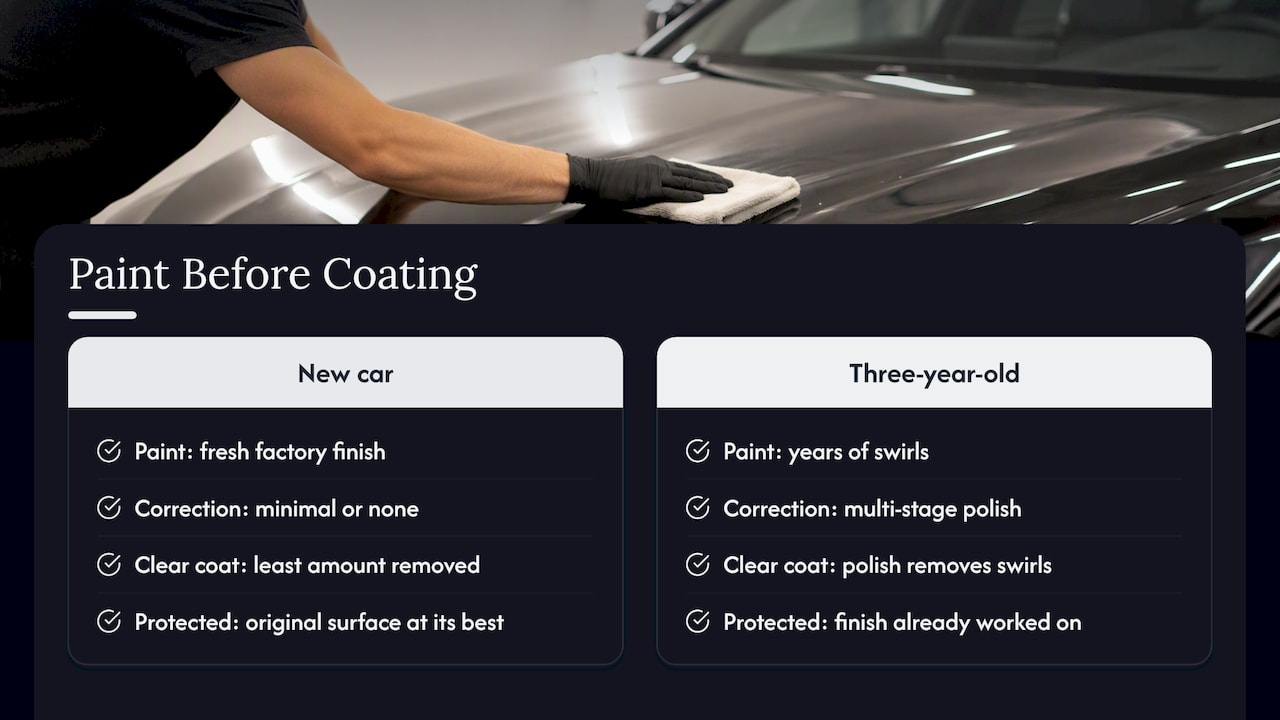
Fresh factory paint has had no time to collect water spots, wash-induced swirl marks or bonded contamination. One detailing guide puts it plainly: a brand new car is the ideal time, because minimal or no correction is usually needed. That keeps the job cheaper and removes the least amount of clear coat.
Compare that with a three-year-old car. Before coating, it needs a multi-stage polish to remove years of swirls. The coating then protects a finish that has already been worked on. On a new car you protect the original surface at its best.
There is also a practical benefit. A coated surface is slicker, so dirt rinses off more easily. If you are a busy owner who washes every couple of weeks, that makes maintenance faster and gentler on the paint. Our overview of the benefits of ceramic coating for cars goes deeper on that side.
Do you have to wait for the paint to cure?
No. This is the most common worry, and it comes from repainted cars, where fresh body-shop paint needs time to release solvents. A new car from the factory is different. Its paint is baked in ovens during assembly and is fully cured before it ever reaches a dealer. Waiting for a “cure period” on a new vehicle only gives the paint more time in the sun, rain and bird traffic without protection.
The exception is a panel that has been repainted at the dealer or after a transport repair. If you know a panel was resprayed, tell your detailer. The installer can then check the paint and advise on timing for that panel.
The best timeline for coating a new car
The goal is to get from delivery to coating quickly, but not so quickly that you skip the prep. Research from one coating guide recommends applying within the first 1 to 4 weeks of ownership. That window leaves time for decontamination and inspection, and it comes before UV oxidation, bird dropping etching and road grime build up.
Here is a realistic schedule, using the same guide’s day ranges:
- Days 0 to 7: wash the car gently with a pH-neutral shampoo. Skip automatic brush washes. Park it indoors or in shade when you can.
- Days 7 to 14: book a professional decontamination wash. This uses an iron remover and clay to lift what a normal wash leaves behind.
- Days 14 to 30: the installer inspects the paint under proper lighting, corrects anything that needs it, and applies the coating.
If you can book the coating sooner than day 14, that is fine, as long as the decontamination and inspection still happen first. What you should not do is delay for months. The longer the car is driven bare, the more correction the paint needs.
What “new” paint can still have wrong with it
A new car is not a perfect car. It has traveled by rail, truck and ship, and then sat on a dealer lot. Several things can be on the paint before you ever drive it:
- Rail dust and industrial fallout. Tiny iron particles that bond to paint during transport. They feel like rough grit after washing.
- Transport and lot contamination. Overspray, tree sap and adhesive residue from protective wrap.
- Dealer-lot swirl marks. Many dealers wash and prep cars quickly, often with poor technique. Swirls are most visible in direct sun on dark colors.
- Minor defects from the factory. Light orange peel, dust nibs or small marks from the line.
This is why an inspection comes before application. Most installers agree that a coating locks in the paint’s condition, so perfecting the paint first is the most critical step. Seal in a swirl and you will not get it out without removing the coating.
If you want to understand what happens in a prep wash, we explain the process in our ceramic coating prep wash guide. For the full sequence from decontamination to curing, see our ceramic coating application process guide.
What a ceramic coating does and does not do
Good expectations make happy owners. Here is where we draw the line.
What it does
- Chemical resistance. Coatings create a barrier against acidic contaminants. A peer-reviewed mechanistic study found that bird droppings can degrade and etch an automotive clear coat. A coating adds a sacrificial layer between the dropping and the paint, buying you time to wash it off.
- Easier washing. Water beads and sheets, and dirt does not grip as tightly.
- Gloss and depth. Coatings add a deep, glassy look, especially on dark and metallic paint.
- UV and oxidation resistance. The layer helps slow fading over the years.
What it does not do
- It is not scratch-proof. It is harder than bare clear coat, but a key, a rogue shopping cart or a dirty wash mitt can still mark it.
- It does not stop rock chips. A thin liquid layer will not stop gravel at highway speed. That is the job of paint protection film.
- It is not maintenance-free. You still need to wash it, and the right method matters.
We wrote a full installer’s verdict on scratch resistance, covering swirls versus chips. If chips are your main worry, the answer is film, usually on the front end, and you can read about our paint protection film service.
South Jersey conditions that make the case stronger
Where you drive changes the math. In South Jersey a new car faces a few specific stressors:
- Road salt. Winter treatment of roads leaves salt on lower panels, in wheel wells and under the car. Salt that is left on speeds up corrosion of metal parts. A smooth, sealed paint surface rinses clean more easily.
- Birds and trees. Farmland, parks and shore-area tree cover mean bird droppings, sap and pollen on parked cars.
- Summer sun and humidity. UV and heat bake contaminants into unprotected clear coat.
- Pine and agricultural dust. Dirt roads and fields leave fine grit that scratches paint when wiped or washed badly.
If you commute on the Atlantic City Expressway, Route 55 or the Turnpike through winter, the front end and lower panels take the worst of it. Ceramic coating on the whole car plus film on the front clip is a common pairing. We cover that combination in our guide to mobile road salt protection in NJ.
Dealer coating, DIY kit or a professional installer
New car buyers get three options. They are not equal.
| Option | Typical upside | Typical downside |
|---|---|---|
| Dealer add-on at purchase | Rolled into your financing, one stop | Often a quick wash and thin application, with limited paint prep, and a markup folded into the price |
| DIY consumer kit | Lowest upfront cost | Skill-dependent. Mistakes such as high spots and trapped swirls are hard to undo |
| Independent professional installer | Paint inspection, correction, controlled application and a coating tier to match your plans | Higher upfront cost than a kit, and you need to book a day |
If you want to try DIY, our guides explain how to apply a ceramic coating and what to expect. Be honest about your time, space and tolerance for rework. A good coating job is mostly preparation.
When a dealer offers a coating package, ask five questions before you sign:
- Who applies it, and where?
- What prep is done: decontamination, clay, polish?
- How many layers, and what is the product name?
- What does the warranty require, and what voids it?
- Can you see the price broken out, and can you decline it?
If the answers are vague, decline and book an independent installer instead. You can do that after delivery, within the same few weeks.
What ceramic coating costs for a new car
Price depends on the coating’s durability tier, the vehicle size and how much paint correction the car needs. A new car usually needs less correction than an older one, which keeps the total down.
These are our published prices for ceramic coating packages:
| Package | Price |
|---|---|
| 3 Year Package | 1000-1200 USD |
| 5 Year Package | 1500-1700 USD |
| 8 Year Package | 2200-2400 USD |
Ceramic coating also carries a 10% booking charge. Mobile detailing services carry an additional fee from 100 USD, because we come to you. See our ceramic coating page for the details on each tier.
How to pick a tier
- 3 Year: a good fit if you lease, or plan to trade in around three years. It gives solid protection and easy washing for the term.
- 5 Year: the common choice for owners who keep a car through a typical loan.
- 8 Year: for owners who keep vehicles long term and want the heaviest protection, such as on a truck, an enthusiast car or a premium model.
The tier name describes expected durability under proper care. Real life depends on how the car is stored, washed and driven. Treat the number as a ceiling that maintenance helps you reach, not a promise.
Our perspective: coat early, but prep first
We detail cars at customers’ homes and workplaces across South Jersey. In our experience, the new car owners who are happiest are the ones who treat a coating as a two-part job: a thorough prep, then the coating.
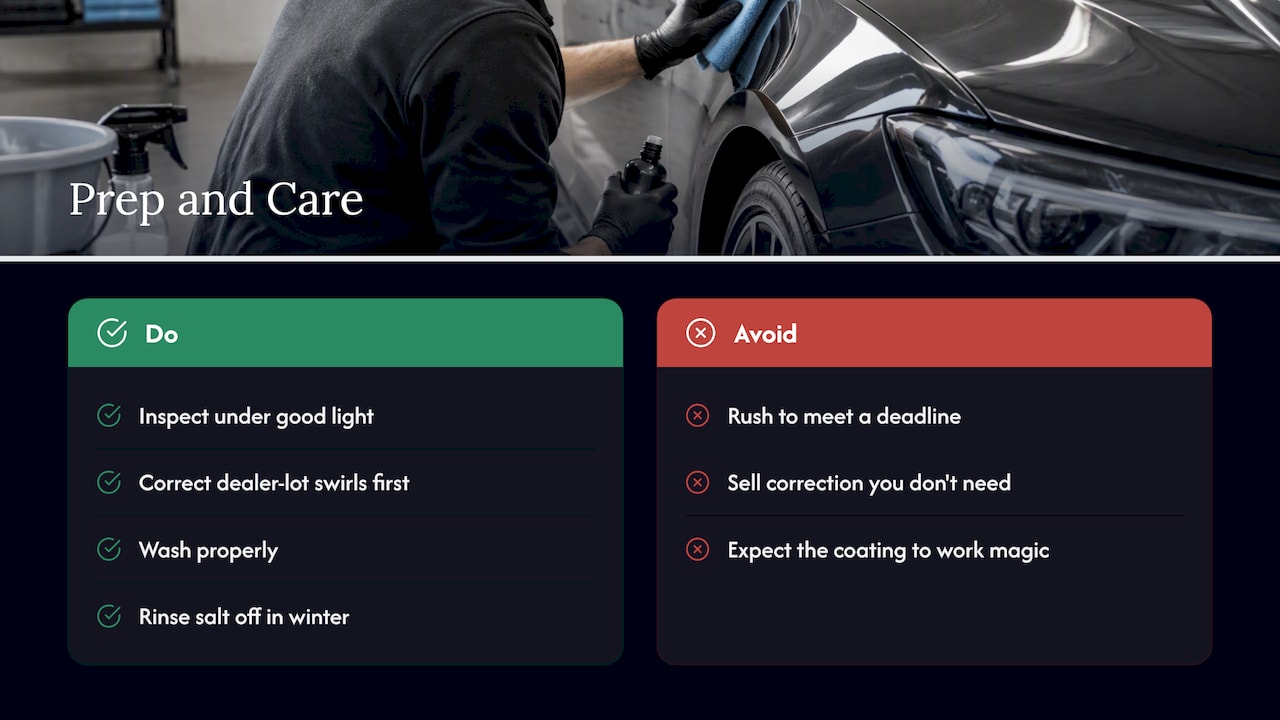
We like to see a new car early, because the paint is usually close to perfect and the work is mostly decontamination and a light polish. We would rather spend an hour inspecting under good light than rush the coating on to meet a deadline. When a dealer-lot swirl shows up, we correct it before sealing. When the car is clean, we say so, and we do not sell correction you do not need.
Being mobile helps here. You do not need to give up your car for a day or arrange a ride. We come to your driveway or office lot, and you can take delivery and book within the same week. Our approach is personalized to each vehicle, our pricing is published, and we document the process, which helps when you later sell or trade the car.
One more thing we tell every customer: a coating is protection, not magic. Wash it properly, rinse salt off in winter, and it will pay you back in easier cleaning and a better-looking car years later.
— Charles
Caring for a freshly coated car
The first weeks and the routine after matter as much as the application.
- Keep it dry at first. Follow your installer’s cure instructions, which often mean keeping the car away from rain and washing for a short period.
- Use a pH-neutral shampoo and a clean microfiber mitt. Avoid brush-style automatic washes, which can mar the surface.
- Rinse salt promptly in winter. Wash more often during salted-road weeks, paying attention to wheel wells and lower panels.
- Remove bird droppings quickly. Do not wipe them dry. Soften with water, then lift.
- Skip waxes and stacked sealants unless your installer says they are compatible.
If you do not have the time, a maintenance plan takes it off your list. Our Exterior Maintenance Plan is 100 USD per week per vehicle or 200 USD per month per vehicle. Details are on our detail packages page.
Book your new car coating in South Jersey
If you have just taken delivery in Pitman or elsewhere in South Jersey, we can inspect the paint, decontaminate it and coat it at your location. Pick a tier on our ceramic coating page and book, or read about our paint correction and ceramic coating services in Pitman. A 100 USD booking charge applies to scheduling. Add tint or film at the same visit if you want the car fully protected from day one, including window tinting.
FAQ
Is ceramic coating worth it on a brand new car?
For most owners who plan to keep the car for several years, yes. The paint is at its best, so little correction is needed, and the coating protects it from the start. If you will trade the car in within a year or two, a shorter tier or just a good wash routine may fit better.
How soon after buying can I ceramic coat my car?
You can coat right away once the paint has been washed, decontaminated and inspected. A common target is the first 1 to 4 weeks. There is no need to wait for the factory paint to cure.
Does a ceramic coating make a new car scratch-proof?
No. It adds hardness and makes washing safer, but it will not stop keys, shopping carts or rock chips. Swirl marks are reduced mostly because the car is easier to wash cleanly. For chip protection on the front end, paint protection film is the right tool.
Should I accept the dealer’s ceramic coating?
Only if the dealer can tell you who applies it, what prep is included, which product it is and what the warranty requires. If the answers are vague or you cannot see the price on its own line, decline. You can book an independent installer within the first few weeks.
Can I wash my car normally after coating?
Yes, after the cure period your installer gives you. Use a pH-neutral shampoo and a clean mitt, and avoid brush-style automatic washes. In winter, rinse road salt off more often.
Sources
- Ceramic Coating Brand New Car, Detailing Scout
- Ceramic Coating on a New Car: Why Day One Is the Best Time, Coateau
- A mechanistic study of degradation of a typical automotive clearcoat caused by bird droppings, Academia