
Wait about 30 minutes after your last basecoat before you spray clear. The real answer is “until the basecoat has flashed off,” which is usually 20 to 40 minutes at room temperature. Spray the clear the same day. If the clear itself needs a second layer, give it the flash time on the data sheet, typically 5 to 15 minutes. Once a clearcoat has sat past roughly 24 hours, plan to scuff it before you recoat.
Those numbers shift with temperature, humidity, and the product in your gun. Below, we explain why, give you a timeline, and cover the question that comes right after the paint job: when can you wax or ceramic coat the new finish?
TL;DR
- Basecoat to clear: about 20 to 40 minutes at roughly 77°F, once the base looks fully dull and is not soft underneath. Metallics can need longer.
- Clear to clear: follow the flash time on your product’s technical data sheet (TDS). Many fall in the 5 to 15 minute range.
- After about 24 hours: a cured clear is chemically inert, so scuff it with fine sandpaper before recoating or the new layer can delaminate.
- Cold or damp garage: treat every published time as a minimum, not a target.
- Protection on top: let fresh paint cure for weeks, not days, before ceramic coating or wax.
Table of Contents
- Why the wait exists: flash-off is about solvents
- Basecoat to clearcoat: the window
- Clear to clear: flash times between coats
- What happens if you wait too long: the 24-hour rule
- Why a driveway or garage job runs longer
- After the paint: when can you wax, seal, or ceramic coat?
- Perspective: what we see on repainted cars
- When protection makes sense, and what we offer
- A quick timeline for a repainted panel
- Common mistakes and how to avoid them
- FAQ
- Sources
Why the wait exists: flash-off is about solvents
Paint does not need time between coats just to “dry.” It needs time to let solvent escape. The first layer releases solvent into the air. If the next layer seals it in too early, the trapped solvent has nowhere to go. It shows up as bubbling, pinholes (often called solvent pop), or a finish that looks glossy on day one and dulls over the following weeks, which is called die-back.
This is why Axalta’s technical data sheet for its HS 8035 clearcoat lists a specific flash-off window rather than telling you to wait until it “feels right.” Other clearcoats from other makers list their own windows, commonly from about 5 minutes to 15 minutes depending on the hardener.
Two terms matter:
- Flash-off: the short pause between coats while solvent leaves the film.
- Cure: the chemical hardening of the whole film, which takes far longer than the surface feeling dry.
Most mistakes come from confusing the two.
Basecoat to clearcoat: the window
A basecoat is color only. It has little strength and no gloss, and the clear goes on top to protect it. The wait before clearing is a balance between two risks.
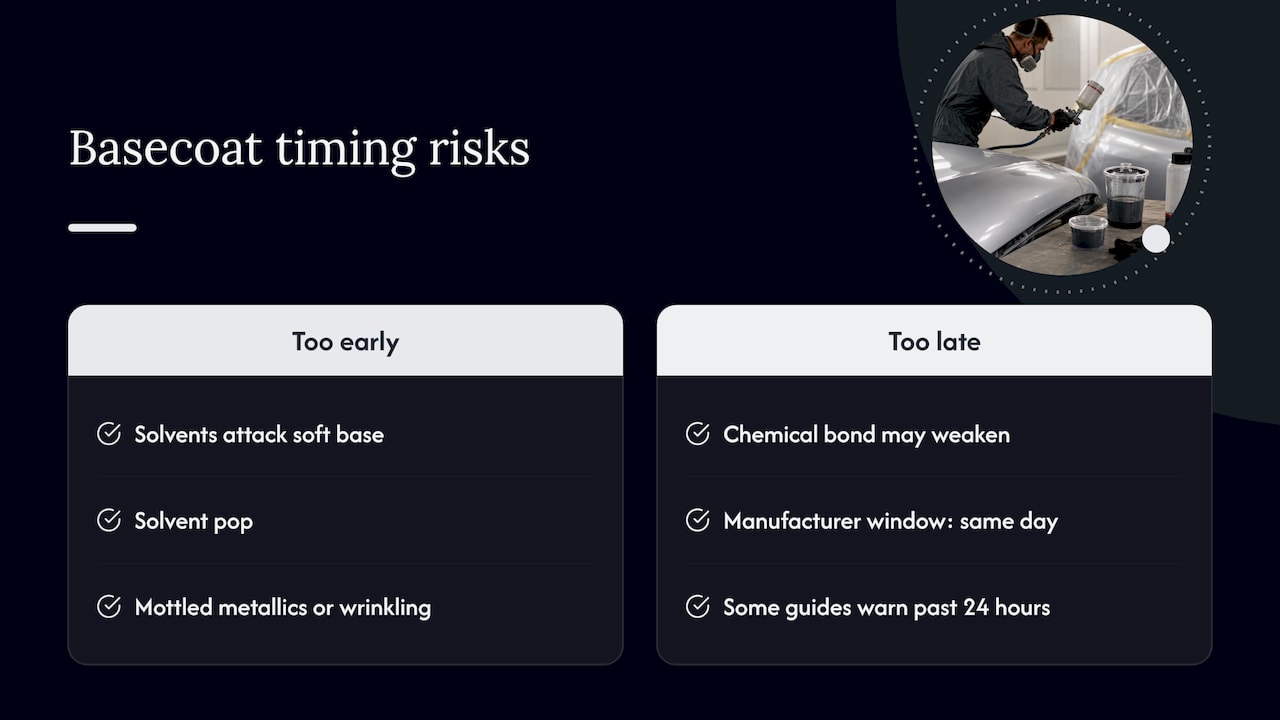
Too early: the clear’s solvents attack a base that is still soft. You get solvent pop, mottled metallics, or a wrinkled surface.
Too late: if the base sits too long, the clear may not bond chemically to it. Some manufacturers set a maximum window, often the same day, and some paint guides warn against going past 24 hours between color and clear without checking the product sheet.
Experienced painters on the AutoBody101 forum describe a typical clear-over-base wait of 20 to 40 minutes at around 25°C (77°F). The usual signal is that the base has fully dulled, assuming it was applied correctly. If it was sprayed too thick, the top can look dull while the layer underneath is still soft, and clearing at that point causes solvent pop. The same thread suggests that urethane metallics may need about three hours before clearing so the clear does not disturb the metallic flake. Treat forum advice as a field report, and let your paint’s TDS settle any disagreement.
A practical basecoat checklist
- Read the TDS for your exact base and reducer. It states the flash time and the recoat window.
- Apply the base in even coats, allowing each to dull before the next.
- After the last coat, wait until the whole surface is uniformly matte, then add a little extra margin if the shop is cool.
- Check an inconspicuous edge or a test panel. If it is still soft or tacky, wait.
- Apply clear within the window the TDS gives, normally the same day.
Clear to clear: flash times between coats
Most 2K clearcoats call for two full coats. According to the research behind this piece, the flash time between coats is typically 5 to 15 minutes, with some products at 5 to 10 and others at 12 to 15, depending on brand and hardener. Applying the second coat before that interval is up traps solvent and costs you gloss over time.
Temperature changes the math. Data sheets are written for around 68 to 77°F. In the TDS cited above, for example, the air-dry figures are given at 68°F: dust-free in 30 to 40 minutes, dry for assembly in 5 to 8 hours, and ready to deliver at 12 hours. Drop ten degrees and those numbers stretch.
| Stage | What it means | Typical timing at about 68–77°F |
|---|---|---|
| Flash-off between clear coats | Solvent leaves before the next coat | About 5 to 15 minutes, per product |
| Dust-free | Airborne dust no longer sticks | About 30 to 40 minutes (HS 8035 at 68°F) |
| Dry for assembly | Can be handled for reassembly | About 5 to 8 hours (HS 8035 at 68°F) |
| Ready to deliver | Can leave the shop with care | About 12 hours (HS 8035 at 68°F) |
| Full chemical cure | Maximum hardness and resistance | About 7 days at 77°F for that product class |
The last row is the number people forget. A panel that is “dry” is still soft inside.
What happens if you wait too long: the 24-hour rule
After roughly a day, most automotive clears have cured enough that fresh clear will not chemically bond to them. Technical guidance for these products calls for scuff-sanding with about 1200 to 1500 grit paper before recoating, so the new layer has something to grip. Skip the scuff and the new clear can peel or delaminate later, sometimes months later. Confirm the exact grit and window on the data sheet for your product.
In practice:
- Within the recoat window: no sanding needed, just apply the next coat after flash-off.
- Past the window: clean, degrease, scuff the entire area evenly, clean again, then recoat.
- Found a run or dust nib the next day: this is a sanding and polishing job, not a “spray a bit more” job.
The forum threads that show up for this keyword often compare wall paint, where you recoat after 4 hours, with automotive clear. They are different chemistries. Wall-paint advice does not transfer to a 2K urethane clearcoat.
Why a driveway or garage job runs longer
TDS times assume roughly 75 to 77°F and moderate humidity. A South Jersey garage in November, or a humid July morning, is a long way from that. Cool air slows solvent release, and high humidity can slow it further. That means:
- Flash times should be longer than the stated minimum, not equal to it.
- The “feel test” can mislead. A surface can feel slick and still hold solvent underneath.
- Bubbling or lifting during the job usually points to solvent that was not released before the next layer, or to temperature and humidity outside the product’s window.
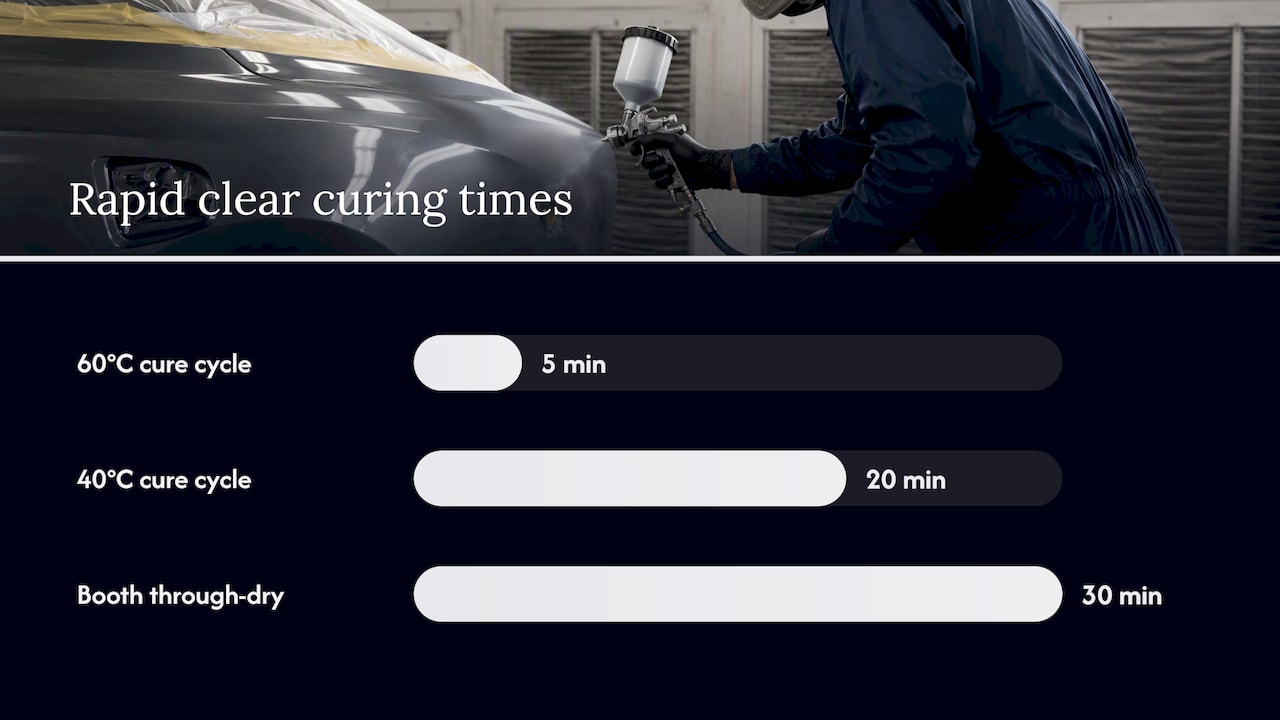
Body shops get consistent results because they bake panels in a booth or use infrared curing. Fast “rapid performance” clears are designed for that kind of high-volume collision work, where a panel can be through-dry in as little as 30 minutes in a booth. PPG’s Rapid Performance Clearcoat page describes one such product needing 5 minutes at 60°C or 20 minutes at 40°C. Those cycles depend on heat you probably do not have at home.
If you do have a choice of hardener, slower products within the recommended temperature range tend to flow out better and show less die-back, which is why show-quality work often uses them.
After the paint: when can you wax, seal, or ceramic coat?
This is where our work starts. A fresh clearcoat can be hard to the touch within a day and still be releasing solvent for weeks. Sealing that film under wax or a ceramic coating too early can trap those solvents, and ceramic coatings are not easy to take off if something goes wrong.
Painters and detailers commonly quote about 30 days before waxing and often 30 to 90 days before ceramic coating, but the correct answer comes from your paint supplier’s instructions and your body shop’s recommendation. Ask the shop three questions:
- What clear and hardener did you use?
- Was the panel baked, or did it air dry?
- What is your earliest recommended date for sealants and coatings?
Until you have an answer:
- Avoid automatic car washes with brushes, which can mar soft clear.
- Hand wash gently with a pH-neutral soap, and skip the pressure washer close to edges.
- Keep bird droppings and tree sap off. Our guide on removing sap from car paint explains how to act before you scratch the clear.
- Do not use abrasive polish or compound until the shop says the paint is ready.
- Park out of heavy tree cover where possible, and avoid covering the car with a tight, non-breathable cover.
When the cure window has passed, the surface still needs proper preparation before a coating goes on. We walk through the steps in our professional ceramic coating process, and coatings have their own timing after application, covered in why fast cure claims mislead.
Perspective: what we see on repainted cars
We are a mobile detailing company based in Pitman, New Jersey, and we serve vehicles across South Jersey. We do not spray clear coat, so this article is about helping you ask the right questions, not about selling you a paint job. What we see is how a repaint holds up when the owner comes to us afterward for protection.
Our view is simple. The paint shop’s data sheet is the authority on cure, and our job begins when the finish is ready. We would rather ask you to wait than lay a coating over paint that is still releasing solvent. A coating applied at the right time looks better and lasts longer, and a delayed appointment costs you nothing compared with a failed finish.
We also document our process, which helps at resale. If your car has been repainted, keep the shop’s paperwork showing the products and dates. When you book with us, tell us the repair dates and panels, and we will plan the prep around them.
— Charles
When protection makes sense, and what we offer
Once your paint has cured, the question becomes how to protect it. Our ceramic coating packages come in three tiers: the 3 Year Package at 1000-1200 USD, the 5 Year Package at 1500-1700 USD, and the 8 Year Package at 2200-2400 USD. Ceramic coating also carries a 10% booking charge. We come to you, and mobile detailing services carry an additional fee from 100 USD.
If you want a different kind of protection for high-impact areas, we also install paint protection film. For a freshly painted car that is not yet ready for a coating, our exterior detail, from 175 USD, can keep the finish clean in the meantime, but tell us about the repaint first so we use methods that are safe on newer paint. Not sure which service fits? See our detail packages or contact us with your repaint date.
A quick timeline for a repainted panel
Use this as a planning aid. Every date gives way to the data sheet and your painter’s advice.
- Minutes 0 to 40: basecoat flashes off. Clear goes on after the base is uniformly matte.
- Between clear coats: the TDS flash time, often 5 to 15 minutes.
- First hour: dust-free for many products. Keep the panel clean and still.
- Hours 5 to 12: dry enough for reassembly or pickup for some products, per the TDS. It is still soft.
- Up to 24 hours: the usual recoat window without sanding. Beyond it, scuff first.
- About 7 days at 77°F: full chemical cure for products in this class, per the data sheet cited above.
- Weeks later: solvent release continues. Ask your painter before waxing or coating, often 30 days or more.
Common mistakes and how to avoid them
Rushing flash time to beat the weather. If clouds are rolling in, it is better to stop and finish the next day, then scuff, than to stack coats too fast.
Trusting the feel test. A skin forms on top while the film underneath is soft. Rely on time, temperature, and the data sheet.
Mixing brands without checking. The base, reducer, clear, and hardener are designed as a system. Different products have different flash times.
Heavy coats to save time. Thick layers hold more solvent and take longer to flash. Two even coats beat one heavy coat.
Skipping the scuff. Recoating cured clear without sanding is the easiest way to get peeling.
Sealing too early. Wax, sealant, or ceramic coating over young paint can cause clouding or hazing, and it is a hassle to correct.
FAQ
How long do you have to wait to clear coat after painting?
For most basecoats, about 20 to 40 minutes at around 77°F, once the base is fully dull and not soft underneath. Metallic urethanes can need longer. Always check the TDS for your product, and clear the same day.
Is there a time limit before I must sand between clear coats?
Yes. Most automotive clears can be recoated without sanding only within roughly 24 hours. After that, scuff with about 1200 to 1500 grit paper before applying new clear. Check your product’s data sheet for the exact window.
What happens if I clear coat too soon?
Trapped solvents can cause bubbling, pinholes, wrinkling, or die-back, where the gloss fades over the following weeks. The damage may not show immediately. Fixing it usually means sanding the clear off and starting that layer over.
When can I ceramic coat a repainted panel?
Wait until the paint has fully cured and your body shop confirms it is ready. Many sources suggest 30 days or longer, and some say 30 to 90. Ask the shop for its recommended date, then call us to schedule the prep and application.
Sources
- Axalta Spies Hecker HS Clear Coat 8035 technical data sheet
- AutoBody101 forum: wait time between base and clear