
TL;DR:
- Fleet detailing is now a critical part of maintenance to reduce costs and extend vehicle life.
- Proper methods and eco-friendly, mobile services improve condition, safety, and resale value.
- Consistent, integrated detailing practices prevent costly damage and minimize fleet downtime.
Most fleet managers think of detailing as something you do when a vehicle looks embarrassing or when a client is coming to town. That assumption is costing South Jersey fleets real money. Modern fleet detailing in 2026 is a performance and asset management discipline, not a cosmetic ritual. With repair costs climbing, vehicles staying in service longer than ever, and driver retention becoming a competitive advantage, the way you care for your fleet’s surfaces directly affects your bottom line. This article covers the trends, methods, and risk scenarios shaping fleet detailing right now, with practical takeaways you can apply across your South Jersey operation.
Table of Contents
- Why fleet detailing is more crucial than ever
- Core methods, chemicals, and best practices shaping 2026
- The rise of mobile, eco-friendly, and integrated detailing services
- Edge cases, risk scenarios, and how to avoid costly mistakes
- Rethinking fleet detailing: More than a cleaning checklist
- Next steps: Professional fleet detailing in South Jersey
- Frequently asked questions
Key Takeaways
| Point | Details |
|---|---|
| Detailing drives ROI | Modern fleet detailing reduces long-term costs, downtime, and boosts asset resale value. |
| Trends are practical | Mobile, eco-friendly, and PM-integrated detailing options fit South Jersey fleet realities. |
| Prevention is key | Consistent detailing schedules and safe methods protect against costly, hidden risks. |
| Choose local experts | Local detailers with fleet specialization deliver flexible, compliant, high-ROI results. |
Why fleet detailing is more crucial than ever
The economics of running a commercial fleet have shifted sharply. Vehicles are staying in service longer, parts cost more, and labor shortages mean every hour of downtime hits harder than it used to. Detailing used to be the first budget line cut when margins tightened. That thinking is now provably backward.
Repair costs rose 3% year over year in 2025, the average fleet vehicle is now held for 96 months, and clean fleets report 10 to 15% better driver retention with fewer unplanned downtime events. Those numbers reframe detailing from a luxury to a maintenance category with measurable ROI.
When you understand the detailing advantages for fleets, the logic becomes clear. Corrosion, grime buildup, and neglected interiors accelerate wear on mechanical components and reduce a vehicle’s residual value. A well-maintained exterior is not just about appearance. It is a protective layer that slows oxidation, prevents rust from taking hold, and keeps your branding sharp on the road.
Here is a quick look at what consistent detailing delivers over a vehicle’s service life:
| Benefit | Impact |
|---|---|
| Corrosion prevention | Extends body and frame life by 2 to 4 years |
| Interior upkeep | Reduces cabin-related driver complaints |
| Brand image | Projects professionalism to clients and the public |
| Resale value | Higher residual at end of service cycle |
| Safety | Clean mirrors, windows, and lights reduce accident risk |
“Fleets that prioritize regular detailing see measurably better retention rates and fewer unplanned downtime events compared to those that treat it as optional.”
The detailing impact on vehicle lifespan is especially relevant when your fleet includes vehicles already past the 72-month mark. Knowing when to schedule fleet detailing can mean the difference between a vehicle that finishes its service cycle strong and one that hemorrhages repair costs in its final years.
Key long-term benefits of consistent fleet detailing:
- Reduced surface corrosion from road salt and moisture
- Improved driver satisfaction and retention
- Stronger brand visibility on every route
- Lower frequency of paint and body repair events
- Better compliance with inspection standards
Core methods, chemicals, and best practices shaping 2026
Knowing why detailing matters is only half the picture. The other half is knowing how to do it right, because the wrong method can cause more damage than skipping it entirely.
The leading practices for 2026 include the two-bucket wash method, clay bar treatment for paint decontamination, ceramic and wax protective coatings, controlled PSI pressure washing, engine bay cleaning, and the use of wrap-safe chemicals for branded vehicles. Each of these addresses a specific failure point in fleet vehicle surfaces.
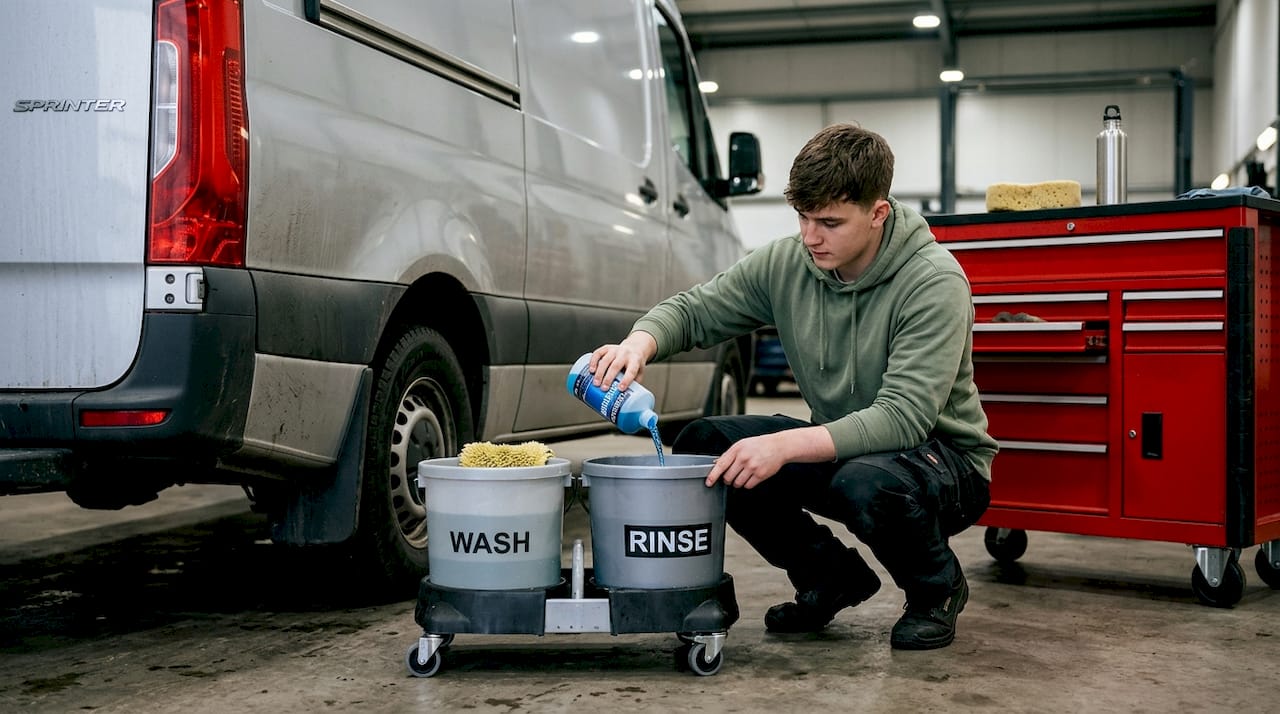
Automated vs. hand wash: which wins for fleets?
| Method | Pros | Cons |
|---|---|---|
| Automated wash | Fast, consistent, low labor | Brush pressure damages paint and wraps |
| Hand wash (two-bucket) | Gentle, thorough, wrap-safe | More time per vehicle |
| Touchless pressure wash | No contact damage | Misses bonded contaminants |
For most South Jersey fleets, a combination approach works best. Touchless or hand wash for weekly maintenance, with full hand-detail sessions scheduled every one to three months.
Here is a step-by-step process that reflects current best practices:
- Pre-rinse to remove loose debris and road salt
- Apply pH-neutral, wrap-safe soap with a two-bucket method
- Clay bar treatment to lift bonded contaminants from paint
- Interior wipe-down, vacuum, and surface treatment
- Apply ceramic coating or wax for long-term protection
- Inspect windows, lights, and mirrors for clarity and safety
For types of fleet detailing that go beyond the standard wash, services like engine bay cleaning and undercarriage treatment are increasingly part of the conversation, especially for diesel vehicles operating in South Jersey’s coastal and suburban corridors.
Pro Tip: Chemical dwell time matters more than scrubbing pressure. Letting a quality degreaser or soap sit for 60 to 90 seconds before agitation does more work than aggressive brushing, and it protects your paint and wrap in the process.
Refer to the diesel fleet checklist for a full breakdown of how detailing integrates with mechanical maintenance for Tri-State operations.
The rise of mobile, eco-friendly, and integrated detailing services
The way detailing services are delivered is changing as fast as the products being used. For fleet managers, this shift is almost entirely good news.
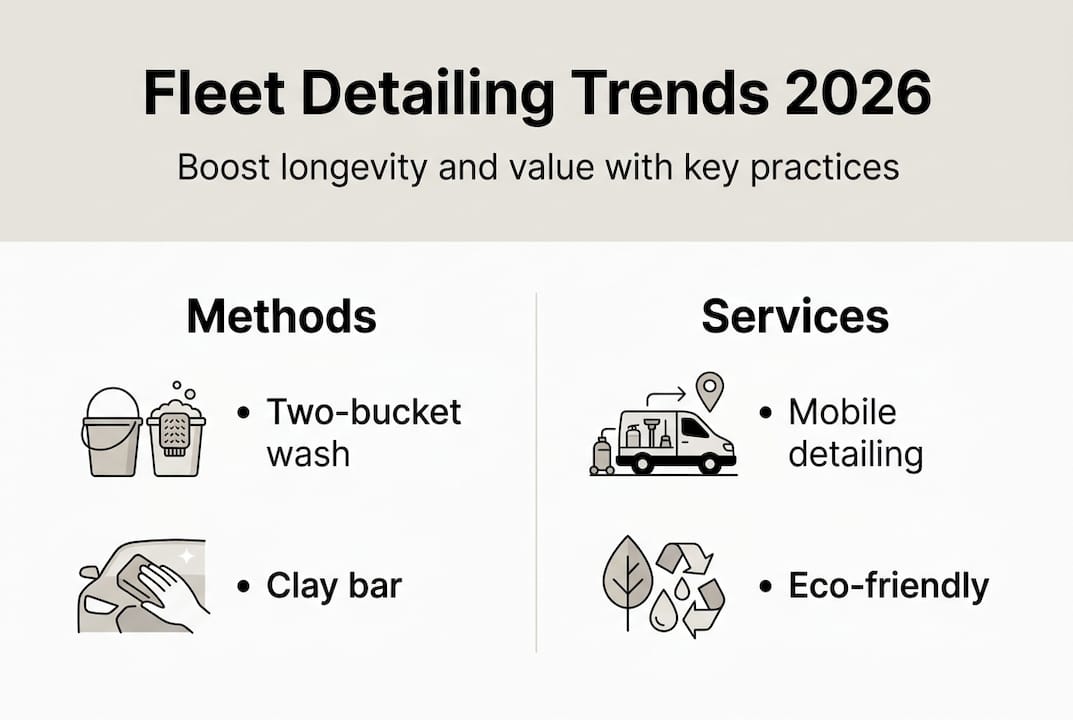
The mobile detailing market reached $126.3 billion in 2025 and is growing at an 8.4% compound annual growth rate. The driving forces are flexibility, reduced operational downtime, and a growing emphasis on eco-friendly products. For a fleet operation, sending vehicles off-site for detailing means lost hours. Mobile services flip that equation by bringing the work to your yard during off-peak hours.
South Jersey fleets face a specific environmental challenge: road salt. From late fall through early spring, salt exposure accelerates corrosion on undercarriages, wheel wells, and lower body panels. Prioritizing mobile services that integrate with your diesel PM windows means you can schedule undercarriage rinses and protective coating applications right alongside oil changes and filter replacements.
The local detailing services advantage is real. A provider who knows South Jersey roads, salt seasons, and regional compliance standards brings context that a national chain simply cannot match. And with mobile detailing coverage expanding across the region, scheduling has never been more convenient.
Core advantages of mobile and eco-friendly fleet detailing:
- Service at your location eliminates vehicle transport time
- Off-hours scheduling keeps vehicles available during peak business hours
- Eco-friendly soaps and coatings reduce chemical exposure for drivers
- Waterless and low-water options support sustainability goals
- Integrated scheduling with PM reduces total vendor touchpoints
Pro Tip: Schedule your detailing appointments to align with your diesel PM or DOT inspection windows. You get two compliance and maintenance tasks handled in the same service window, which cuts downtime and keeps your fleet depreciation reduction strategy on track.
Edge cases, risk scenarios, and how to avoid costly mistakes
Even experienced fleet managers run into detailing problems that feel minor until they are not. These edge cases rarely show up in standard maintenance guides, but they can cause serious damage to vehicles, wraps, and your budget.
“High-pressure washing without proper PSI control, using non-wrap-safe chemicals, ignoring hard water spotting, and skipping undercarriage treatment in salt-heavy winters are among the most common and costly detailing errors.”
The most common detailing disasters and how to avoid them:
- High PSI damage: Pressure washing above 1,200 PSI on painted surfaces strips clear coat and forces water into door seams. Always use a wide-angle nozzle and keep distance consistent.
- Wrap incompatibility: Standard degreasers and solvents dissolve vinyl wrap adhesive. Use only wrap-safe, pH-neutral products on branded vehicles.
- Hard water spotting: South Jersey’s water supply leaves mineral deposits that etch into paint if not removed quickly. Use a dedicated spot remover or deionized water for final rinses.
- Rodent infestation after storage: Vehicles parked during off-season accumulate nesting materials in engine bays and cabins. A thorough interior and engine bay detail before returning to service prevents mechanical and HVAC damage.
- Neglected undercarriage: Salt bonds to frame rails, brake lines, and suspension components. Skipping undercarriage cleaning after winter is one of the fastest ways to accelerate structural corrosion.
Refer to the fleet detailing terminology guide if you need clear definitions for any of the products or processes your detailing provider mentions.
Routine checks that protect South Jersey fleets year-round:
- Weekly: Exterior rinse, window and mirror inspection, interior trash removal
- Monthly: Full exterior hand wash, tire and wheel cleaning, light inspection
- Quarterly: Full interior-exterior detail, clay bar, protective coating reapplication
- Seasonally: Undercarriage wash, engine bay cleaning, wrap condition check
For specialty vehicles including agricultural equipment and utility trucks, the cleaning approach for specialty vehicles follows similar principles but requires additional attention to mechanical exposure points.
Pro Tip: After every winter season, put undercarriage and wheel well inspection at the top of your detailing checklist. Salt corrosion in these areas is invisible until it is expensive. Catching it early with a targeted rinse and protective spray costs far less than frame repair.
Rethinking fleet detailing: More than a cleaning checklist
Here is what years of working with commercial fleets has made clear: the managers who see the best results are not the ones who detail most frequently. They are the ones who treat detailing as an integrated part of asset management rather than a reactive task triggered by visible dirt.
The fleets that schedule detailing around PM windows, use mobile services to eliminate downtime, and invest in ceramic coatings to reduce long-term maintenance costs consistently outperform those that treat it as periodic spend. The data backs this up. The detailing advantages for fleets are not theoretical. They show up in resale numbers, driver satisfaction scores, and inspection pass rates.
The shift to eco-friendly and mobile services is not a trend you can afford to ignore. It is where the industry is going, and South Jersey fleets that adapt now will have a structural cost and compliance advantage over those that wait.
Next steps: Professional fleet detailing in South Jersey
If the trends covered here have you rethinking your current approach, the next step is straightforward. CDC Auto Detailing provides mobile, professional fleet detailing across South Jersey, bringing the service to your location so your vehicles stay operational and your schedule stays intact.
Explore the full range of fleet detailing options available for commercial operations, learn how to implement mobile detailing across your yard, and see why ceramic coatings for fleets are one of the smartest long-term investments you can make for asset preservation. Contact CDC Auto Detailing to schedule a consultation and get a plan built around your fleet’s size, routes, and maintenance calendar.
Frequently asked questions
How often should my fleet be professionally detailed?
Most fleets benefit from exterior washes monthly and full detail every 1 to 3 months depending on route conditions, vehicle type, and seasonal exposure.
Are eco-friendly detailing chemicals as effective as traditional ones?
Yes. Modern eco-friendly detailing products are formulated to match or outperform traditional chemicals while reducing driver exposure to harsh solvents and meeting environmental standards.
What are the top risks of improper fleet detailing?
High PSI washing strips paint, non-wrap-safe chemicals damage vinyl branding, and skipping undercarriage treatment after winter accelerates corrosion on frame components.
How does mobile detailing reduce fleet downtime?
Mobile detailing services come to your facility and work during off-hours, so vehicles are serviced without being pulled from your active rotation or transported to a shop.
Why does regular detailing improve resale value and retention?
Consistent detailing prevents corrosion, maintains interior appeal, and signals professionalism, all of which contribute to higher residual values and stronger driver satisfaction scores.