
TL;DR:
- Proactive fleet maintenance and driver engagement significantly reduce costly breakdowns, sometimes by up to 60 percent.
- Implementing structured preventive maintenance schedules, leveraging technology, and standardizing vehicle models streamline operations and lower costs.
Fleet downtime is not a minor inconvenience. With costs ranging from $448 to $760 per vehicle per day, a single breakdown can wipe out a day’s revenue before your driver even calls it in. The fleet maintenance tips in this article go beyond oil changes and tire rotations. You’ll find a structured, data-backed approach to preventive maintenance for vehicles, driver accountability, parts inventory, and technology integration, all written for fleet managers and business owners who need results, not theory.
Table of Contents
- Key takeaways
- 1. Build a structured preventive maintenance program
- 2. Manage engine, transmission, brakes, tires, and electrical systems
- 3. Involve your drivers as active maintenance partners
- 4. Standardize vehicles and manage parts inventory strategically
- 5. Use technology and data to prioritize maintenance decisions
- My take on the shift from reactive to proactive fleet management
- How professional fleet detailing protects your investment
- FAQ
Key takeaways
| Point | Details |
|---|---|
| Downtime costs are severe | At up to $760 per vehicle daily, unplanned breakdowns demand a proactive maintenance program. |
| PM scheduling must be customized | OEM intervals are a starting point; adjust based on real usage data, terrain, and load. |
| Drivers are your first line of defense | Trained drivers who report issues early catch problems before they become costly repairs. |
| Parts and vendor management matter | Standardizing vehicle specs and tracking warranty reimbursements directly reduce operational costs. |
| Technology accelerates outcomes | OBD telematics and AI-driven CMMS platforms can cut roadside breakdowns by 40 to 60 percent. |
1. Build a structured preventive maintenance program
The foundation of every effective fleet operation is a preventive maintenance (PM) program with clear intervals and documented workflows. Without it, you are always reacting rather than anticipating. Reactive repairs cost significantly more than scheduled service, and the four interconnected systems of any solid program, PM intervals, inspection workflows, parts inventory, and vendor management, must all function together. Remove one and you create the gaps that cause breakdowns.
Start with your manufacturer’s recommendations as a baseline, then adjust for your actual operating conditions. A delivery van running stop-and-go urban routes wears brakes far faster than the same model on a highway route. OEM intervals need real-world adjustments based on terrain, idle time, and load weight. The fleet that uses data from its own routes will always outperform the fleet following a generic schedule.
Common PM intervals to build your schedule around:
- Daily pre-trip: Fluid levels, tire pressure, lights, and cab interior checks
- Every 5,000 miles: Engine oil and filter change, brake visual inspection
- Every 15,000 miles: Air filter, belts, hoses, and full brake system check
- Every 30,000 miles: Transmission fluid, coolant flush, and suspension inspection
- Annually: Full vehicle safety audit, electrical system diagnostic
Pro Tip: Automate your PM schedule through a CMMS platform tied to odometer data or telematics. Manual tracking creates gaps. Automation eliminates them.
2. Manage engine, transmission, brakes, tires, and electrical systems
These five systems cause the vast majority of fleet breakdowns and are also the most preventable. Every solid fleet inspection checklist targets them specifically.
Engine and fluids
Engine oil degradation is gradual and invisible until it isn’t. Change oil and filters on schedule without exception. Watch for darkening color, a burning smell, or oil level drops between changes. These are early signals of internal wear or a leak, not just routine aging.
Transmission
Transmission failures are among the most expensive repairs a fleet vehicle can face. Check fluid condition and level regularly. In vehicles with manual transmissions, monitor clutch behavior. Slipping, delayed engagement, or unusual odors from the transmission are signals that should never be deferred.
Brakes
Visual checks are not enough. Tracking brake pad thickness with gauges rather than estimates is a critical standard. Worn pads below fleet minimums can trigger instant out-of-service violations during roadside inspections. Build pad thickness measurements into every scheduled service.
Tires
Tires represent both a safety and cost issue. Under-inflated tires reduce fuel economy and wear unevenly. Check pressure weekly, rotate tires every 5,000 to 7,000 miles, and replace when tread depth drops below 4/32 of an inch for commercial vehicles. The annual maintenance cost per vehicle runs over 11 cents per mile in tires and repairs alone, meaning proper tire management is one of the highest-return habits you can build.
Electrical systems
Battery failures and fault code accumulation are leading causes of roadside breakdowns. Monitor battery health at every service interval. Connect to OBD diagnostics to capture fault codes before they escalate into shutdowns.
| System | Key check | Frequency |
|---|---|---|
| Engine | Oil color, level, and filter condition | Every 5,000 miles |
| Transmission | Fluid condition and engagement behavior | Every 15,000 miles |
| Brakes | Pad thickness via gauge, rotor condition | Every 5,000 miles |
| Tires | Pressure, tread depth, and rotation | Weekly and every 6,000 miles |
| Electrical | Battery voltage, OBD fault codes | Every service interval |
Pro Tip: Never defer brake or electrical fault alerts. Both carry legal and safety consequences that reactive repairs cannot undo.
3. Involve your drivers as active maintenance partners
Your drivers interact with every vehicle more hours per day than any technician does. They feel vibrations, hear unusual sounds, and notice performance changes before any sensor reports them. The challenge is creating the systems and culture that turn those observations into service tickets.
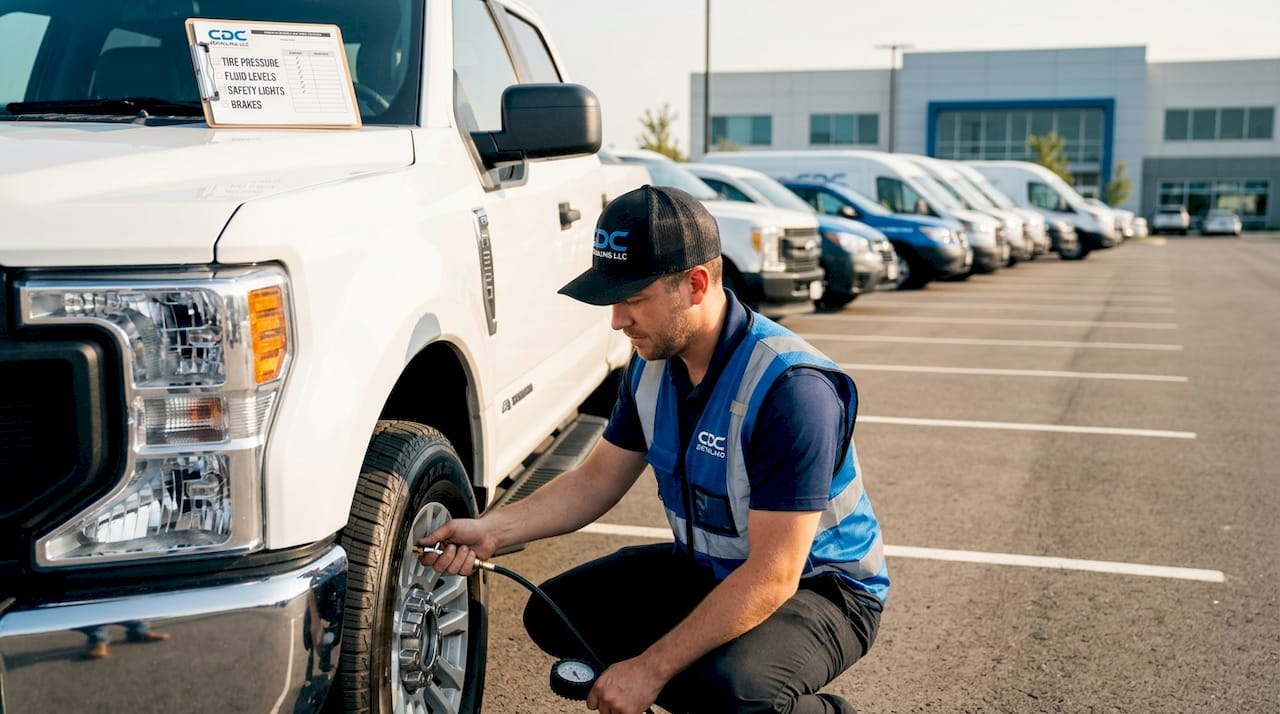
Driver training is shifting rapidly toward full qualification and regulatory compliance as the top priority in fleet safety management. That same focus should extend to vehicle condition reporting. Train every driver on vehicle-specific pre-trip and post-trip inspection procedures, not a generic checklist, but one calibrated to the actual vehicle class they operate.
Build a reporting culture with three specific components:
- Mobile-friendly reporting tools: A driver who can submit an issue from their phone in 60 seconds is far more likely to report it than one who has to fill out a paper form back at the depot
- No-blame reporting policy: Drivers should never hesitate to flag an issue out of fear of being blamed for damage. Your goal is early detection, not accountability theater
- Closed-loop feedback: When a driver reports an issue and sees it resolved quickly, they report the next one faster. Ignore reports and you lose the system entirely
The importance of identifying non-compliant drivers jumped from 16 percent to 31 percent between 2025 and 2026, a signal that regulators and top fleet operators are treating driver compliance as a maintenance issue, not just a behavioral one.
Pro Tip: Tie driver inspection completion rates to your fleet reporting metrics. Low completion rates predict maintenance gaps before the vehicles show it.
4. Standardize vehicles and manage parts inventory strategically
Every additional vehicle model in your fleet multiplies the parts you need to stock, the training your technicians need, and the vendor relationships you have to manage. Fleet managers who build decisions around data and minimize vehicle variety create maintenance operations that run faster and cheaper.
Here is how to manage parts and inventory as a system:
- Standardize vehicle specifications. Where possible, run the same make and model across vehicle classes. Shared parts across your fleet mean fewer SKUs in your warehouse and faster service times.
- Maintain a critical parts inventory. Identify the components that cause the longest delays when they fail, filters, belts, brake pads, and batteries are common culprits, and keep adequate stock on hand. Running out of a $15 filter while a $100,000 truck sits idle is a planning failure, not a supply chain problem.
- Build reliable vendor relationships. Using the same shop or supplier consistently builds a complete service history for each vehicle and creates accountability in the relationship. Vendors who know your fleet perform better than those who see your vehicles once.
- Track and pursue warranty reimbursements. Warranty claims are frequently overlooked by fleet managers who treat them as administrative noise. Top managers actively monitor open claims and follow up to recover costs that would otherwise disappear.
- Evaluate parts reliability with data. If the same component fails repeatedly on the same vehicle class, that is a pattern, not bad luck. Use your maintenance records to flag recurring failures and challenge your vendor or spec your next vehicle order accordingly.
5. Use technology and data to prioritize maintenance decisions
The most expensive fleet maintenance decision you will ever make is the one driven by assumption rather than data. Modern technology removes most of that guesswork if you know how to apply it.
OBD telematics and AI-powered CMMS platforms reduce missed PM events, surface fault codes early, and lower roadside breakdowns by 40 to 60 percent. These are not incremental improvements. They represent a structural shift in how maintenance gets done, from calendar-based guessing to condition-based precision.
Digital twins take this further. Real-time digital twin simulation uses live sensor data to model wear patterns and predict failures weeks before they occur. A fleet manager using this technology knows which vehicles to pull for service before a driver reports anything, and often before the vehicle itself triggers a fault code.
Beyond the predictive tools, daily monitoring of PM compliance rates tells you where your program is working and where it is falling apart. A fleet with 90 percent PM compliance looks very different operationally from one at 70 percent, even if the schedules look the same on paper.
Pro Tip: Set a PM compliance target of 95 percent or higher. Anything below 85 percent is a sign your scheduling system, not your technicians, needs fixing.
For a deeper look at how to apply these vehicle maintenance strategies systematically, the structured frameworks will help you translate data into service schedules that actually hold.
My take on the shift from reactive to proactive fleet management
I’ve watched fleets operate both ways, and the difference is not subtle. The operations that wait for something to break before they act spend more money, lose more time, and burn out their maintenance staff faster than those that run structured PM programs. That much is obvious. What I’ve found less obvious, and more worth saying, is how often the biggest leverage point isn’t the technology or the schedule. It’s the relationship with your drivers.
The best-maintained fleets I’ve encountered all share one trait: drivers who feel like partners in the process, not just operators who hand the vehicle back at the end of the shift. When a driver feels responsible for a vehicle and trusted to report problems honestly, you get early warnings that no telematics system can replicate. You get the “the steering feels a little loose” conversation that prevents a tie rod failure two weeks later.
Consistency in scheduling is the second thing I’d stress. Top fleet managers don’t extend service intervals when things are busy. They understand that delaying service multiplies future costs, not just the repair bill but the downtime, the rental vehicle, the missed delivery, and the customer relationship that took the hit. Holding the schedule is a discipline, not a suggestion.
The fleet maintenance tips that actually move the needle combine technology, driver engagement, and scheduling discipline into a single repeatable system. Any one of those alone is not enough.
— Charles
How professional fleet detailing protects your investment
Mechanical maintenance keeps vehicles running. Professional detailing keeps them working as business assets. A fleet vehicle that looks neglected sends a message to every client and prospect it pulls up in front of. That cost is harder to quantify than a repair bill, but it’s real.
At Cdcautodetailing, we work with fleet operators across South Jersey to keep vehicles in condition that reflects the professionalism of the businesses behind them. Ceramic coatings and paint protection film reduce surface wear between service intervals and cut the time and cost of routine cleaning. Our mobile detailing model fits around your operational schedule so vehicles don’t need to leave rotation for hours at a time. If you want to see what the right fleet detailing services look like in practice, or explore the full range of detailing options available for commercial fleets, we make it straightforward to get started.
FAQ
What is the most cost-effective fleet maintenance tip?
Preventive maintenance scheduled before failures occur delivers the highest return. With downtime costing up to $760 per vehicle daily, a consistent PM schedule is far cheaper than any reactive repair.
How often should fleet vehicles be inspected?
Drivers should complete a pre-trip and post-trip inspection daily. Full mechanical inspections should follow your PM schedule, typically every 5,000 miles or per manufacturer guidelines adjusted for your actual operating conditions.
Can telematics really reduce fleet breakdowns?
Yes. OBD telematics paired with AI-powered CMMS reduces roadside breakdowns by 40 to 60 percent by triggering automatic work orders when fault codes appear, before problems become failures.
How does driver training affect fleet maintenance outcomes?
Trained drivers who report anomalies early catch issues before they escalate. Fleet data shows that identifying non-compliant drivers doubled in priority between 2025 and 2026, reflecting how directly driver behavior affects maintenance costs.
Why does vehicle standardization matter for fleet maintenance?
Running the same make and model across vehicle classes reduces the number of parts you need to stock, simplifies technician training, and speeds up service turnaround. Fewer variables in your fleet mean fewer points of failure in your maintenance program.