
TL;DR:
- Maintaining fleet appearance reduces costs, prevents rust, and boosts resale value.
- Regular cleaning, detailing, and protective coatings extend vehicle lifespan and improve branding.
- Tracking performance metrics and involving drivers in inspections enhance cost efficiency and accountability.
Fleet vehicle appearance tips: maintain value and impress clients
A scratched bumper, a faded logo, or a grimy interior sends a message to your clients before anyone opens their mouth. For fleet managers and business owners in South Jersey, neglecting vehicle appearance is not just an aesthetic problem. It costs real money through accelerating wear, lower resale prices, and unexpected repair bills. This article delivers expert, actionable tips to help you assess your fleet’s visual standards, build a sustainable maintenance routine, choose the right protective treatments, and track results over time so your vehicles keep earning their keep.
Table of Contents
- Assessing fleet appearance: Why it matters
- Routine cleaning and detailing: Protecting your investment
- Advanced protection: Coatings, wraps, and films
- Tracking appearance and maintenance: Performance metrics
- What most fleet managers overlook: The hidden ROI of appearance
- Professional solutions for fleet appearance in South Jersey
- Frequently asked questions
Key Takeaways
| Point | Details |
|---|---|
| Appearance affects costs | Maintaining fleet vehicle appearance significantly reduces maintenance and repair expenses. |
| Preventive care boosts value | Routine cleaning and advanced protection increase resale value and prolong vehicle lifespans. |
| Data-driven tracking works | Using metrics and photo documentation optimizes maintenance schedules and limits downtime. |
| Expert detailing adds ROI | Professional detailing delivers durable, high-quality results that enhance your fleet’s image. |
Assessing fleet appearance: Why it matters
Your fleet is a rolling advertisement. Every vehicle that pulls into a client’s parking lot makes an impression, and that impression either builds trust or quietly erodes it. Before you can improve fleet appearance, you need a clear-eyed assessment of where things stand right now.
Start by looking at your vehicles through a client’s eyes. Walk around each unit and check the following:
- Paint condition: Fading, chips, oxidation, or surface scratches that suggest neglect
- Interior cleanliness: Stained seats, cluttered dashboards, or worn floor mats that reflect poorly on your team
- Branding integrity: Logos, decals, and wraps that are peeling, cracked, or misaligned
- Glass and lights: Cloudy headlights or cracked windshields that signal deferred maintenance
- Undercarriage and tires: Rust, uneven wear, or road grime that suggests skipped inspections
This kind of structured walkthrough forms the baseline for your appearance program. Without it, you are reacting to problems rather than preventing them.
Now consider the financial stakes. Fleet maintenance benchmarks from Fleetio show that the average fleet vehicle is 6.4 years old, with overall maintenance running around 40 cents per mile. That cost climbs sharply to $1.10 per mile for vehicles older than ten years, even though those older units represent just 12% of miles driven but consume 33.5 to 34% of your total service spending. That gap is not accidental. It reflects compounding neglect.
Appearance maintenance connects directly to this cost curve. A vehicle whose paint and protective coatings are kept in good condition resists rust, surface corrosion, and UV damage far longer than one that is simply washed when it looks dirty. Consistent exterior care reduces the likelihood that minor surface damage escalates into bodywork, repainting, or premature retirement from the fleet.
Resale value is another underappreciated factor. Well-maintained vehicles command significantly stronger trade-in or auction prices. Buyers at fleet disposal auctions pay close attention to paint, glass, interiors, and branding residue. A clean, well-presented vehicle consistently earns more than one that shows the visual wear of inattention.
For a practical framework on how to save costs and boost longevity across your fleet, structured appearance evaluations work best when paired with your existing maintenance scheduling. Use fleet performance benchmarking tools to compare your own fleet’s condition trends against industry peers, so you know whether your appearance spend is above or below the norm for your vehicle type and age mix.
Benchmarking also helps you make the case internally. Numbers speak louder than opinions when you are asking leadership to approve a detailing program or a protective coating investment.
Routine cleaning and detailing: Protecting your investment
Knowing what to look for is only half the job. The other half is building a cleaning and detailing routine that actually gets followed across a busy, distributed fleet. This is where most programs fall apart, not because managers lack intention, but because there is no system.
Fleetio data highlights a telling ratio: scheduled maintenance accounts for 53.7% of fleet service activity, while unscheduled maintenance accounts for 40.1%. In the best-run fleets, that balance shifts even further toward planned work. The same logic applies to appearance care. When cleaning happens on a schedule, it becomes predictable, budgetable, and far less likely to be skipped.
Here is a practical cleaning and detailing sequence you can adapt to your fleet size and vehicle types:
- Weekly exterior rinse: Remove road salt, bird droppings, and surface contaminants before they bond to the paint. This is particularly critical in South Jersey winters when road salt exposure is high.
- Bi-weekly full exterior wash: Include wheels, wheel wells, and lower panels where road grime accumulates fastest.
- Monthly interior detail: Vacuum all surfaces, clean touch points (steering wheels, door handles, center consoles), and treat upholstery or vinyl to prevent cracking and staining.
- Quarterly full detail with inspection: This is your deep-clean cycle. Inspect paint for chips and touch-ups, check wrap integrity, and assess branding decals for replacement.
- Annual paint decontamination and protection reapplication: Remove bonded iron particles and industrial fallout, then reapply wax, sealant, or ceramic coating booster depending on your protection layer.
Branding touch-ups deserve special attention. A partial wrap or logo decal that is starting to peel does not just look bad. It signals to clients that your organization does not sweat the details, which raises questions about your service quality.
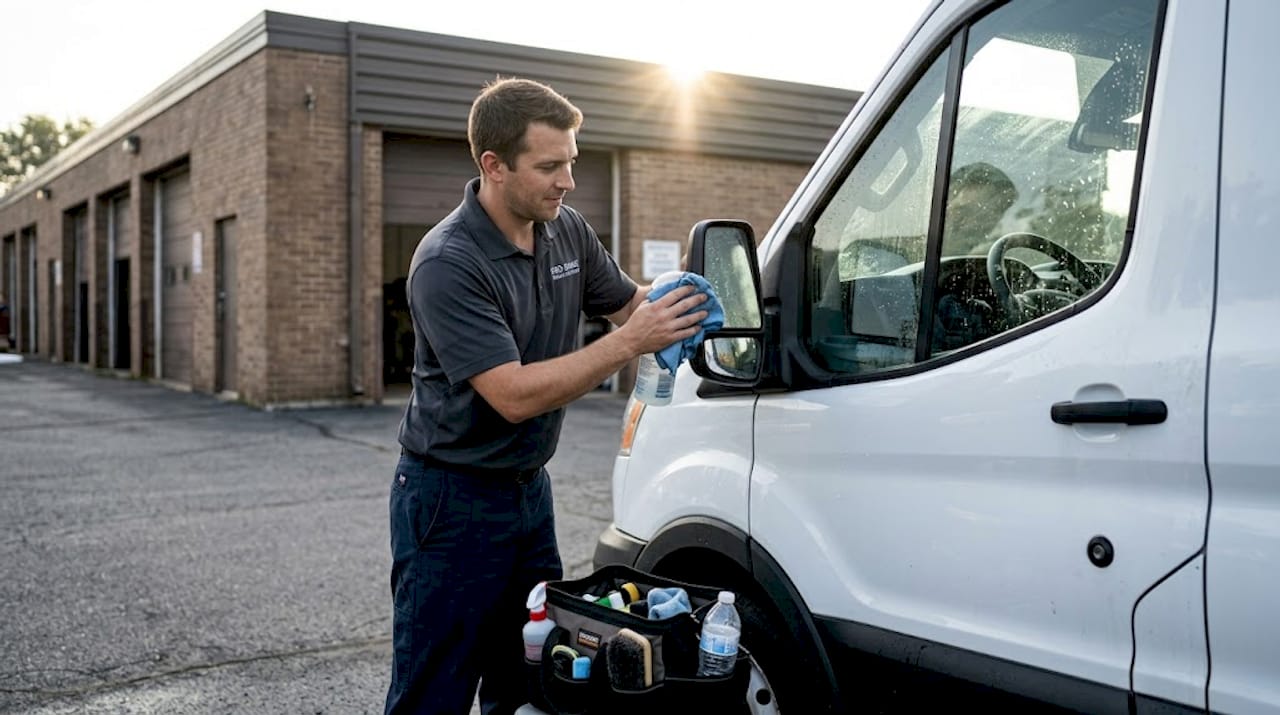
Pro Tip: Carry a microfiber cloth and a spray detailer in each vehicle so drivers can handle spot cleaning between full washes. This simple habit prevents bird droppings and sap from etching into clear coat, which can turn a five-minute fix into a costly paint correction job.
For a detailed reference, use this vehicle cleaning checklist as a starting point for your own fleet-specific schedule. Customize the frequency based on vehicle type, exposure to harsh conditions, and how often each unit is in front of clients.
Consistency matters more than perfection here. A fleet where every vehicle gets a thorough wash monthly will outperform one where half the vehicles get detailed quarterly and the rest are ignored. Standardize the minimum, then build up from there.
Advanced protection: Coatings, wraps, and films
Routine cleaning preserves what you have. Advanced protection products actively extend the lifespan of your vehicles’ surfaces and reduce how much cleaning and repair you need over time. Understanding the differences between the main options helps you match the right solution to each vehicle’s role and expected service life.
| Protection type | Typical durability | Best for | Maintenance required |
|---|---|---|---|
| Ceramic coating | 2 to 5 years | High-visibility, long-service vehicles | Low: rinse and pH-neutral wash |
| Paint protection film (PPF) | 5 to 10 years | Front-impact areas, high-mileage units | Very low: self-healing against light scratches |
| Vinyl wrap | 3 to 7 years | Branded fleet vehicles, color changes | Moderate: avoid pressure washing seams |
| Paint sealant | 6 to 12 months | Short-service vehicles, budget fleets | Moderate: requires regular reapplication |
Ceramic coatings create a semi-permanent hydrophobic layer (water-repelling surface) over your paint. Dirt, salt, and contaminants bead off rather than bonding to the surface. This means less time spent washing and less paint degradation from repeated abrasion. Fleet ceramic coatings are especially cost-effective on vehicles you plan to keep for three or more years, where the reduced maintenance labor and better resale value more than offset the upfront cost.
Paint protection film is the most aggressive physical barrier you can apply. It absorbs stone chips, minor abrasions, and road debris that would otherwise reach the paint. On delivery vehicles and service trucks that rack up significant highway miles, PPF on the hood, bumper, and mirrors pays for itself by eliminating frequent touch-up paint work. Learning more about protective coatings can help you understand which combination works best for your specific vehicle usage patterns.
Vinyl wraps serve double duty for fleet managers. They protect the underlying paint while delivering consistent, professional branding across your entire fleet. When a wrap eventually reaches the end of its life, you remove it to reveal factory paint underneath, which improves trade-in value significantly.
The case for investing in these products is reinforced by data. Top-performing fleets maintain an 80:20 ratio of preventive to reactive maintenance, compared to the industry average of 60:40. That shift directly reduces downtime from the industry average of 8.2%. Applying the same preventive logic to appearance means investing in coatings and wraps now to avoid costly bodywork, repaints, and wrap replacements later.
Key benefits of investing in advanced protection:
- Reduces paint repair frequency and associated labor costs
- Maintains branding sharpness and professional presentation longer
- Improves resale value by preserving factory or wrapped paint condition
- Cuts washing time and detailing labor across the fleet
- Signals professionalism to clients who notice the details
Tracking appearance and maintenance: Performance metrics
Investing in appearance programs without measuring results is like running ads without checking whether anyone clicked. You need a simple framework that tells you whether your spending is working and where to adjust.
The most effective fleet managers build a performance dashboard with a small number of meaningful metrics. Here is what to track:
| Metric | What it tells you | Target benchmark |
|---|---|---|
| Cost per mile (appearance) | Spend efficiency per vehicle | Below $0.05/mile for maintained fleet |
| Scheduled vs. unscheduled appearance tasks | Program discipline | 80%+ scheduled |
| Downtime hours from appearance-related repairs | Operational impact | Below 8% of total downtime |
| Resale value at disposal | Long-term ROI | 10 to 15% above market baseline |
| Compliance rate | Fleet-wide consistency | 95%+ vehicles on schedule |
The data is consistent: tracking compliance and cost per mile enables fleet leaders to identify which vehicles are underperforming before problems become expensive. The 8.2% industry average downtime figure is a useful ceiling to measure against, and fleets that shift toward preventive appearance work see it drop.
Good appearance management also relies on documentation. Keep a photo log of each vehicle at every scheduled detail. This takes under two minutes per unit and gives you a visual timeline that makes deterioration patterns obvious. You will spot a wrap starting to bubble at the seams or paint oxidation developing on a specific panel well before it becomes a repair bill.
Pro Tip: Assign each driver brief ownership of their vehicle’s appearance log. When drivers know they will be photographing and reporting condition monthly, they are more likely to report minor issues early rather than assuming someone else will handle it.
Your maintenance benchmarks also need to account for vehicle age. Vehicles over ten years old demand closer monitoring because their maintenance cost escalation is steep. If appearance tracking reveals that a specific older unit is consuming disproportionate repair and detailing spend, that data supports a rational replacement or disposal decision rather than an emotional one.
What most fleet managers overlook: The hidden ROI of appearance
Most fleet managers think of appearance maintenance as a cost center, not a revenue driver. That framing is where the real money is being left on the table.
When a vehicle looks sharp, drivers take better care of it. This is not speculation; it is observable workplace behavior. Clean, well-maintained equipment signals that leadership values the tools they provide, and employees respond by treating those tools with more respect. The result is fewer minor incidents, earlier damage reporting, and a stronger culture of accountability.
There is also a client trust dimension that rarely makes it into the ROI calculation. A prospective client who watches your team arrive in a polished, clearly branded vehicle starts the meeting with a higher baseline of confidence than one who sees road-grimed trucks with faded logos. That advantage is hard to quantify, but it is real.
Consistent preventive work creates a compounding effect. Fleet data confirms that older vehicles drive disproportionate service spend, and appearance neglect accelerates that curve by allowing surface damage to become structural damage. Rust from untreated chips, mold from uncleaned interiors, and UV degradation of plastic components all shorten vehicle life in ways that never appear on an appearance maintenance invoice but absolutely appear on your operating cost statement.
The managers we see getting the most from their fleets are not just following a checklist. They treat appearance as a strategic asset. For fresh thinking on how detailing trends for longevity are reshaping what top fleets do in 2026, the shift is clearly toward treating appearance as infrastructure, not cosmetics.
Professional solutions for fleet appearance in South Jersey
Putting these strategies into practice takes the right partner, especially when your fleet spans multiple vehicle types or you need consistent results across a large number of units.
At CDC Auto Detailing, we specialize in mobile fleet detailing services across South Jersey, bringing professional-grade cleaning, ceramic coatings, paint protection film, and vinyl wrap maintenance directly to your location. You can explore auto detailing examples to see the range of services available, or review our dedicated ceramic coating services for fleet-specific applications. If you are deciding where to start, our guide on types of fleet detailing breaks down the options by vehicle type and business need. We work with fleet managers who want results they can track, not just a one-time clean.
Frequently asked questions
How often should fleet vehicles be professionally detailed?
A quarterly schedule is recommended for most fleets, but monthly detailing may be needed for high-mileage or high-visibility vehicles that represent your brand in front of clients daily.
What are the biggest risks of skipping preventive appearance maintenance?
Skipping preventive appearance maintenance accelerates paint damage, increases repair costs, and erodes resale value, particularly for older vehicles where disproportionate service spend already creates financial pressure.
Which protection options deliver the best ROI for fleet appearance?
Ceramic coatings and paint protection film offer lasting value by reducing ongoing maintenance costs, and top-performing fleets that prioritize preventive investments consistently outperform averages on downtime and resale metrics.
How can managers track appearance maintenance compliance effectively?
Building a simple dashboard of cost per mile, scheduled task completion, and photo documentation per vehicle creates accountability and surfaces early warning signs before they become costly repairs, aligning with best-in-class benchmarks that target 80% or more preventive activity.