
Yes, you can remove a ceramic coating, but only by abrasion. A cured coating has to be machine-polished off with a cutting compound and then refined. No soap, vinegar, solvent or “stripping wash” will dissolve it. Because every pass of the polisher also thins your clear coat, the real question is whether you need removal at all, and who should do it if you do.
We install ceramic coatings on cars, trucks and fleet vehicles across South Jersey, so we see both sides: owners who want a coating gone, and owners who only needed a good decontamination. This guide covers what works, what does not, what it risks, and how to decide.
TL;DR
- Ceramic coating is removed mechanically, by machine polishing with a cutting compound. Chemicals, dish soap, vinegar and thinners do not dissolve it.
- Every polishing pass removes a thin layer of clear coat, so removal is a one-way, paint-thinning job. Measure paint depth first.
- You must remove the coating on any panel headed for collision repair or repaint. Most other owners only need to decontaminate and re-top the coating.
- You cannot reliably confirm by eye that all the coating is gone. Experience and a methodical process matter more than any product.
Table of Contents
- Why a ceramic coating will not just wash off
- What removal actually involves
- The real risk: thinning your clear coat
- Do you actually need to remove it?
- When removal is the right call
- DIY or professional: how to decide
- Our perspective
- Protecting your paint without a removal job
- What to ask before anyone touches your paint
- FAQ
- Sources
Why a ceramic coating will not just wash off
A ceramic coating is not a wax. It is a thin, hard layer that bonds to your clear coat and is meant to last for years. That durability is the product’s whole selling point, and it is also why removal is hard.
DetailingWiki explains that a coating offers solid protection for a very long time, unlike wax or sealant. The collision industry says the same thing from the repair side. The I-CAR guidance on ceramic coatings quotes PPG’s bulletin PD-811 saying that most surface cleaners will not wipe the coating off.
So the answers to the questions people type most often are short:
- What dissolves ceramic coating? Nothing you can safely buy for the job. Removal is abrasive, not chemical.
- Will Dawn dish soap remove it? No. Dish soap may strip wax and weaken water beading for a short time, but a cured coating stays put.
- Does vinegar remove it? No, and acidic household liquids can mark the finish.
- What destroys a ceramic coating? In practice, abrasion: polishing, compounding, wet-sanding, or years of aggressive automatic washes. Harsh chemicals mostly dull the slickness without truly removing anything.
Some retailer guides do sell chemical strippers or stripping washes as a removal route. Our view, backed by the I-CAR and DetailingWiki material above, is that these may take off a thin or failed topper layer. They are not a dependable way to clear a properly cured, multi-year coating.
What removal actually involves
In professional practice, removal is a polishing job. The usual sequence looks like this:
- Wash and decontaminate. Remove dirt, iron fallout and bonded grime so you are not grinding it into the paint. Our guide to a decontamination wash shows what this step covers.
- Inspect and measure. Check the paint with a depth gauge, panel by panel, and note any repainted areas, tight body lines and edges.
- Cut the coating off. Use a machine polisher with a cutting compound. The I-CAR summary of PPG’s guidance names buffing with a heavy-duty compound on a wool pad as best practice. It treats sanding, only in the P600 to P800 range and only if necessary, as a last resort because ceramic particles can get embedded in the surface.
- Refine. A finer polish and pad bring the gloss back after the aggressive cut. Manufacturers publish their own procedures. For example, 3M’s ceramic coating removal procedure includes a polishing step with an ultrafine foam pad and an ultrafine machine polish.
- Wipe down and check. An isopropyl alcohol wipe clears polishing oils so you can see the surface honestly.
How you know it is gone
This is the part most guides skip. Per DetailingWiki, you cannot confirm visually that the coating is fully removed. Water may stop beading, yet residual oils can mimic a bare surface. An IPA wipe helps temporarily, but true confirmation comes from experience reading how the paint responds under the polisher.
That is why a half-removed coating is a common outcome in DIY attempts. You end up with patchy beading, uneven gloss and a surface that new coating may not bond to evenly.
The real risk: thinning your clear coat
Polishing is reductive. According to the I-CAR material, each step removes a microscopic layer of clear coat, which makes removal a high-risk job without proper equipment and skill. The same source notes that burning through the clear coat is easy on tight body lines and swage lines, which is why professionals watch thickness with a paint depth gauge as they work.
Clear coat does not grow back. Once it is too thin, the fix is a repaint. A few situations raise the odds of trouble:
- Thin factory paint, common on edges, roof lines and older vehicles that have already been polished several times.
- Previously repainted panels, where the thickness is unknown and often uneven.
- Rotary polishers and aggressive pads in untrained hands, which cut fast and leave little room for correction.
- Sharp creases and edges, where paint is naturally thinnest and heat builds quickly.
The same logic applies to other things stuck to your paint. If you have ever peeled off adhesive graphics, you know the paint underneath can change over time. A guide on dealership decal removal makes the case for testing in a small spot first, and the same habit applies to any abrasive or chemical on your clear coat.
Do you actually need to remove it?
Often, no. Detailing professionals told DetailingWiki’s readers that most owners do not need removal. They need to decontaminate the surface and apply a professional-grade topper or maintenance spray. A coating that looks dead is frequently just clogged with road film, hard water spotting or iron particles.
Before you commit to a cut, try these in order:
- A proper wash. A pH-balanced shampoo and clean mitts, not a quick drive-through.
- Chemical decontamination. Iron remover and a tar remover where needed.
- Light mechanical decon. A clay mitt or towel used with plenty of lubricant.
- A fresh topper. A coating-safe sealant or spray restores slickness and beading.
If the coating is truly failing, with peeling, hazing or high spots, ask what is wrong before you strip it. Our article on fixing ceramic coating high spots covers the cases where a fix within the cure window is the better answer, and our guide on maintaining ceramic coatings shows how to keep one performing.
When removal is the right call
There are real reasons to take a coating off. These are the main ones.
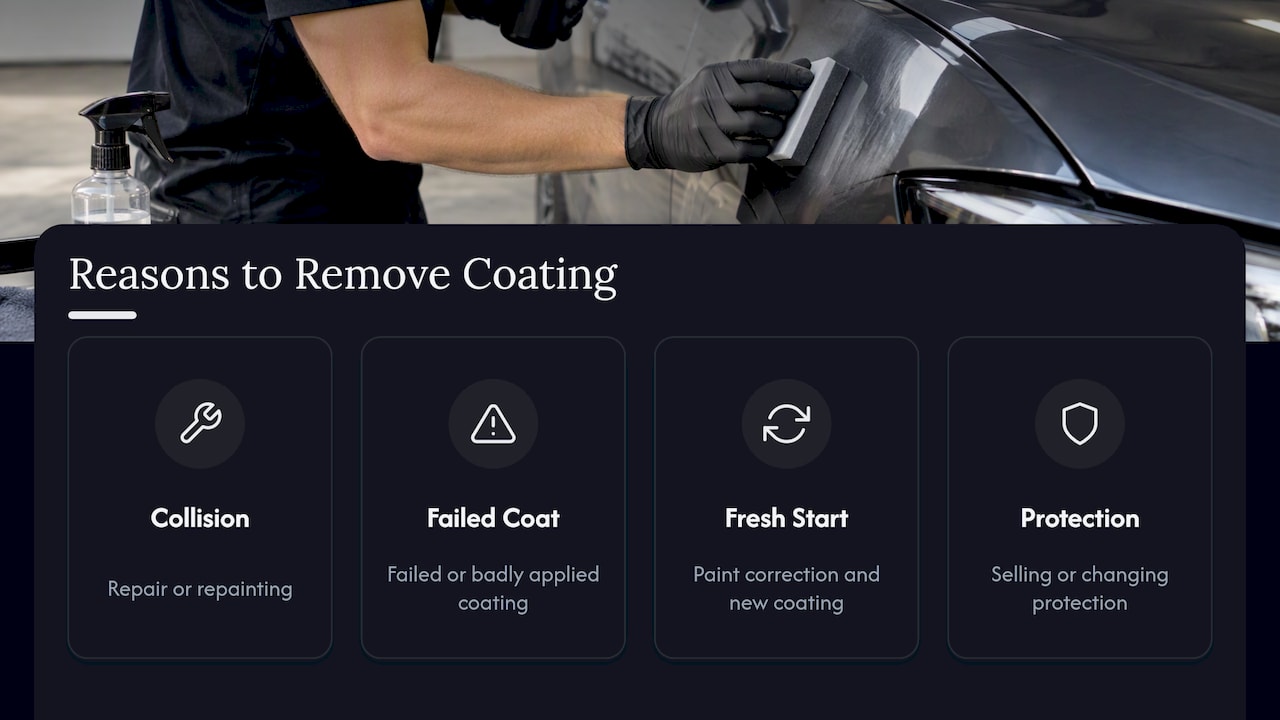
Collision repair or repainting
This is the clearest case. The I-CAR guidance states that refinish manufacturers such as Axalta and AkzoNobel warn that leftover coating before paint preparation risks fish-eyes, poor adhesion and paint system failure. JTAPE adds that in most collision repairs, the coating needs to come off completely on the affected panels. The Society of Collision Repair Specialists keeps a page of refinish manufacturer technical information that includes recommendations for ceramic coating removal.
If your car is going to a body shop, tell them which coating brand is on it. I-CAR advises technicians to ask the owner for the product used, since some makers have specific guidance for their formulas.
A failed or badly applied coating
If an installer left heavy high spots, uneven coverage or hazing that will not level, a controlled correction may be needed. Whether that means polishing back one panel or the entire car depends on how deeply the coating is cured and how much paint you have to spare.
Starting fresh with paint correction
If you plan full paint correction and a new coating, the old layer comes off during the cutting stage anyway. That is the cleanest scenario, because you are already committing to a polishing process with measured depth.
Selling or changing protection
Some owners want to switch to paint protection film or a different system. Usually you can work over a decontaminated coating with the right prep, but PPF adhesion depends on a clean, properly prepared surface. Ask the installer before assuming a strip is needed. Our paint protection film page explains the options.
DIY or professional: how to decide
| Situation | Reasonable route |
|---|---|
| Coating just looks dull or does not bead | Wash, decontaminate, re-top. No removal. |
| Small area, such as a spot where you need adhesive to bond | Professional spot correction, or very careful DIY with a depth reading |
| One panel going to a body shop | Let the shop handle it, and tell them the brand |
| Full-car removal, thin or repainted paint | Professional with a paint depth gauge |
| Full-car removal, healthy original paint, experienced owner with a DA polisher | Possible, but budget extra time and stop at the first sign of trouble |
A dual-action polisher is more forgiving than a rotary, and many consumer coatings do come off with patience. The trouble is that you do not find out how thin your paint is until it is too late. If you do try it yourself, these habits cut the risk:
- Measure paint thickness on every panel before you start, and mark thin spots.
- Start with the least aggressive pad and compound that works, on a test spot.
- Work in small sections, wipe, and inspect under good light.
- Keep the polisher moving and watch edges and body lines, where heat and thin paint combine.
- Stop if you see a color change on the pad or very low readings, and call a professional.
Avoid hand-polishing the entire car. Industry repair standards discourage hand work and aggressive pads without training, and you will tire long before the coating gives way.
Our perspective
Most of the removal questions we hear start with a bad experience: a coating that stopped beading after two winters, or an installer who oversold. In nearly every case the better first step is not stripping. It is a deep clean and a maintenance plan, because a coating that is dirty is not the same as a coating that has failed.
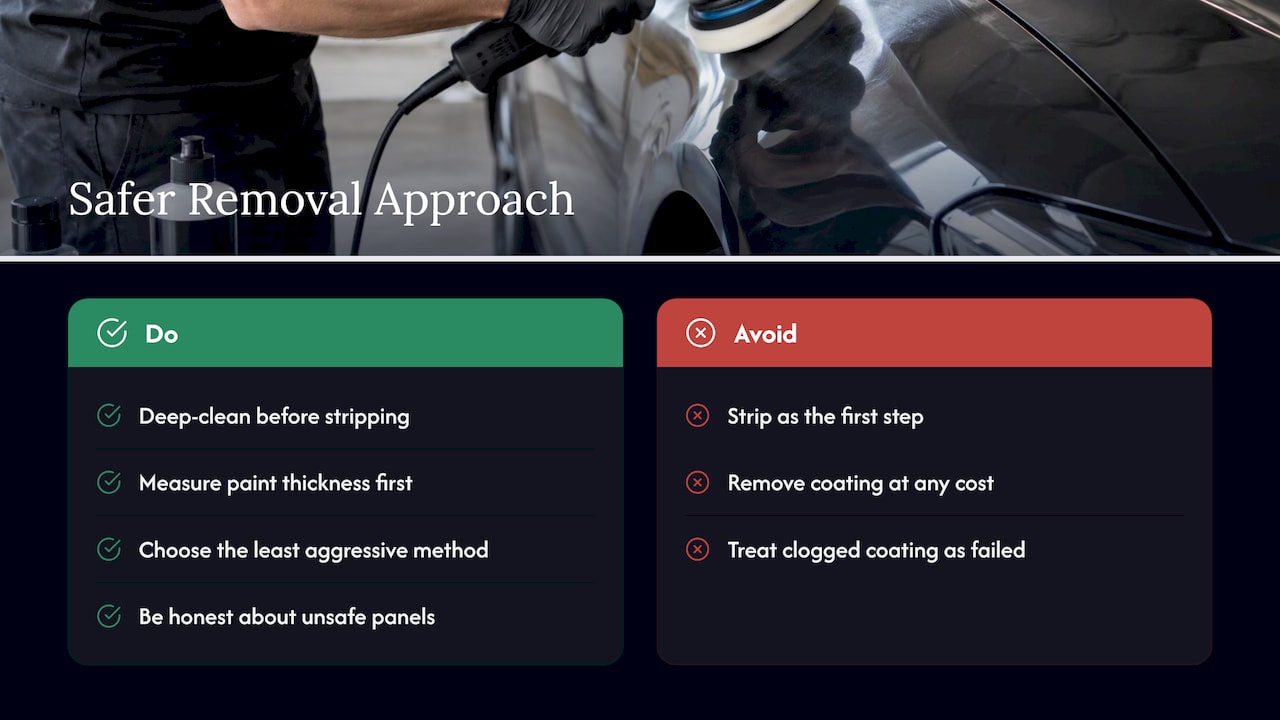
We also think removal should be treated as paint surgery. The point is not to make the coating disappear at any cost. The point is to protect the clear coat you have left, because it is the only one the car will ever get. That means measuring first, choosing the least aggressive method that works, and being honest when a panel does not have enough paint to cut safely.
It is also a reason we care about getting the original application right: proper prep, correct cure time and a clear explanation of what the coating will and will not do. If you are thinking about applying a coating, our professional ceramic coating process guide explains how we approach it, so you are never in the position of wanting it gone.
— Charles
Protecting your paint without a removal job
If your coating is tired but not failed, our packages are a better fit than a strip. We are a mobile detailing company based in Pitman, serving South Jersey, and we come to you.
Our ceramic coating packages are published as follows:
| Package | Price |
|---|---|
| 3 Year Package | $1,000 to $1,200 |
| 5 Year Package | $1,500 to $1,700 |
| 8 Year Package | $2,200 to $2,400 |
Ceramic coating also carries a 10% booking charge. For regular upkeep, our Exterior Maintenance Plan is $100 per week per vehicle or $200 per month per vehicle, and our detail packages start at $375 for Bronze. See all of them on our detail packages page. Mobile detailing carries an additional fee from $100, and there is a $100 booking charge on detail packages. If you are weighing a new protection layer or want a second opinion on what is on your car, get in touch through our site and tell us the brand, the age and what is going wrong.
What to ask before anyone touches your paint
Whether you hire a shop or a mobile detailer, a good professional will answer these without hesitation:
- What is the paint thickness on each panel? Ask to see the readings.
- Which method will you use first, and why? The answer should be machine polishing, with sanding only as a last resort.
- What will you do if a panel reads too thin? The right answer is to stop and tell you.
- How will you confirm the coating is gone? Expect a mention of IPA wipe-downs and experience, not magic.
- What is the plan afterward? Refinement, a new coating or protection film, and aftercare.
If the answer to the first question is a shrug, find someone else.
FAQ
Can you remove ceramic coating yourself?
You can try, but it is easy to go too far. The job needs a machine polisher, a cutting compound and a depth gauge, and you cannot see by eye when the coating is fully gone. If your paint is thin, repainted or you have never used a polisher, hire a professional.
How long does a ceramic coating last before it needs removing?
Most coatings never need removal. They wear and lose their slickness, and you can decontaminate and top them up. Removal is mainly for collision repair, repainting, or starting fresh with paint correction.
Does a clay bar or stripping wash remove ceramic coating?
Not reliably. Sources such as I-CAR and DetailingWiki say a properly cured coating needs abrasion. A clay bar or stripping wash may clean the surface or take off a topper, but it will not dependably clear a multi-year coating.
Will removing a coating damage my paint?
It can. Each polishing pass takes off a small amount of clear coat, so the risk comes from how much is removed and how thin the paint was to begin with. Measuring thickness and using the gentlest method that works keeps the risk low.
Sources
- Ceramic Coatings Considerations, I-CAR
- How to remove a ceramic coating, DetailingWiki
- Removing Ceramic Coating for Collision Repair, JTAPE
- Refinish Manufacturer Technical Information, Society of Collision Repair Specialists
- Ceramic coating removal procedure, 3M