
Tesla paint has a reputation for chipping and marring easily, and the reputation is partly earned. One independent inspection measured thin, soft paint on an early Model 3, and owner surveys show real paint complaints. But the same data shows quality improved, and a gentle wash routine plus the right protection keeps a Tesla looking sharp. This guide separates what was measured from what is forum folklore, then shows what to do about it.
TL;DR
- A 2019 Finnish inspection of one Model 3 found thin paint and a soft pencil-hardness rating. That is one car, not every Tesla.
- Owner surveys show paint chips and scratches were a real complaint, and that reported defects fell sharply between 2018 and 2019.
- Most damage comes from how the car is washed and dried. Hand-wash with a soft cloth, or use a touchless wash, and remove bird droppings, tar and sap quickly.
- Paint protection film (PPF) handles stone chips. Ceramic coating handles swirls, etching and easier cleaning. Many Tesla owners combine them on the front end.
- We offer both, mobile, anywhere in South Jersey.
Table of Contents
- Is Tesla paint really softer than other cars?
- What paint problems do Tesla owners actually report?
- Has Tesla paint gotten better?
- How to wash a Tesla without marring the paint
- PPF, ceramic coating or both?
- A note on self-healing claims
- Our perspective
- Book Tesla paint protection in South Jersey
- Which Tesla paint color holds up best?
- Everyday habits that keep a Tesla’s paint sharp
- FAQ
- Sources
Is Tesla paint really softer than other cars?
The best-known measurement comes from Finland. An inspection of a Model 3 found the paint averaged 106 microns, with some areas in the low 70s, against a stated 110 to 150 micron standard, and a hardness rating of “F”. The report said that was softer than the 2H to 3H level commonly found on other brands. It used the Wolff-Wilborn pencil test, which is a simple scratch test, not a lab analysis of the clear coat chemistry.
Three things are worth keeping in mind when you read that result:
- It was one car from 2019. A single inspection tells you about that vehicle and that production period.
- Pencil hardness is a rough tool. It indicates how easily a surface marks, but it does not explain how a paint system behaves over years.
- Thin and soft together matter. The same report noted that a thin, soft film lets stone blemishes form more easily on the flanks. That matches what many owners describe: small chips along the lower doors and the front end.
If you are comparing a Tesla to a car you owned before, you may notice that road debris leaves marks sooner. If you have not noticed a difference, that is also a valid experience. Owners who run their cars through automatic washes for years report mixed results, which is exactly what you would expect when wash method matters as much as paint.
What paint problems do Tesla owners actually report?
Owner surveys give a better picture than any single car. Bloomberg’s survey of almost 5,000 Model 3 owners found chipped paint, misaligned panels and, less often, mechanical trouble, with about 12% reporting a paint issue. Scratches and dents were reported too. Consumer Reports also found paint and trim complaints among owners of more than 500 2018 Model 3s.
The common problems fall into four groups:
| Problem | What you see | Usual cause |
|---|---|---|
| Stone chips | Small pits on the hood, bumper, mirrors and rocker panels | Highway debris hitting thin paint |
| Swirl marks | Fine circular scratches visible in sun | Dirty towels, brushes, rushed drying |
| Etching | Dull spots or outlines | Bird droppings, sap, bug residue left on the surface |
| Factory flaws | Orange peel, dust nibs, uneven texture | Production quality at the time the car was built |
The last row matters. J.D. Power attributed Tesla’s production-related issues, including paint imperfections, mainly to factory quality. In other words, some of what owners call soft paint is application quality, not hardness.
Has Tesla paint gotten better?
The numbers say yes, with a caveat. Bloomberg’s October 2019 survey found reported defects peaked at 80 issues per 100 vehicles in the third quarter of 2018 and fell to 35 per 100 by September 2019. New-owner complaints dropped 44% in the third quarter of 2019 compared with the year before.
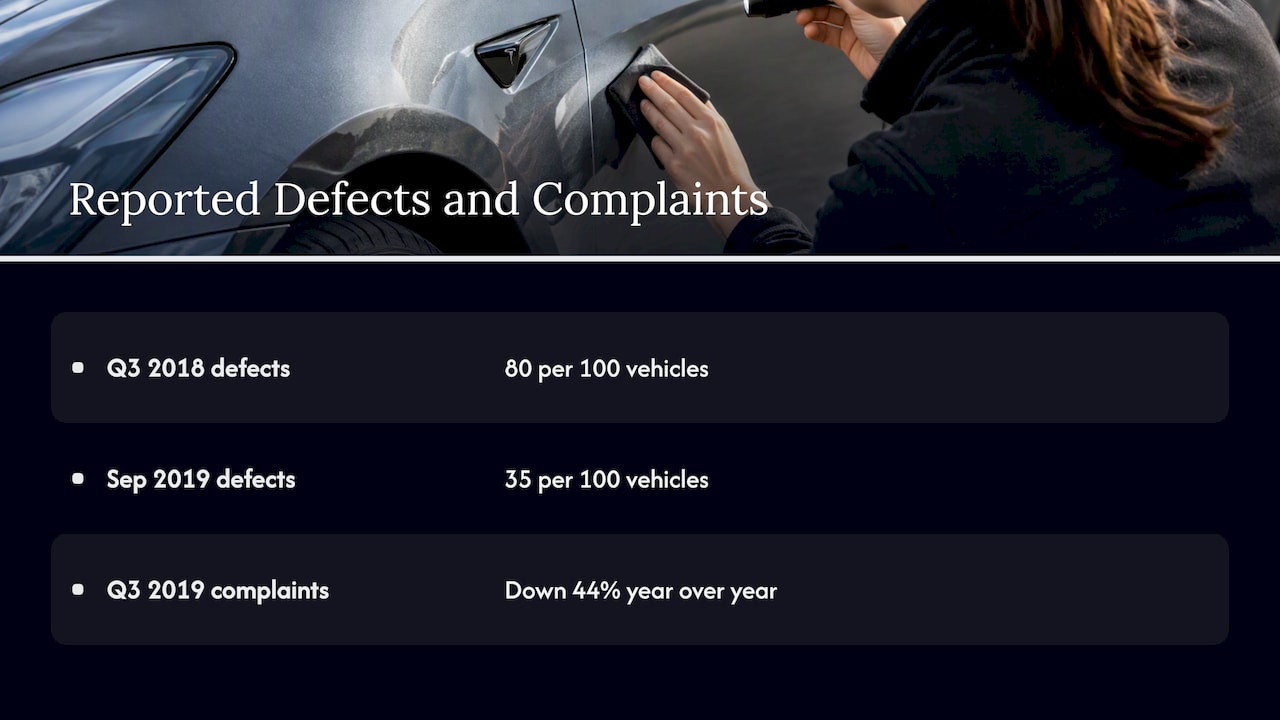
The caveat is that a survey counts reported defects. It does not prove the clear coat itself became harder or thicker. Elon Musk said Tesla improved its paint quality toward the end of 2020, after acknowledging that paint had not always dried enough during the 2020 production ramp. That points to process fixes, such as curing and consistency, rather than a new paint formula.
What this means for you: a newer Tesla is likely to arrive in better shape than a 2018 car, but you should still inspect it in daylight at delivery and plan protection before the first winter of road salt and spring pollen.
How to wash a Tesla without marring the paint
Most swirl marks are self-inflicted, and they are the easiest part of this problem to prevent. Tesla’s own guidance in the owner’s manual is to hand-wash with cold or lukewarm water, mild high-quality car shampoo and a clean soft cloth, and to avoid brushes and harsh or acidic cleaners. If you do not hand-wash, it recommends touchless automatic washes.
A routine that follows that advice:
- Rinse first. Flush loose grit off the panels before anything touches them.
- Use two buckets or a rinse-as-you-go method. One holds soapy water, the other clean water for rinsing the mitt.
- Work top to bottom. The lower doors and bumpers carry the most grit, so they go last.
- Skip brushes and spinning-brush tunnels. Bristles drag trapped grit across soft paint.
- Dry with a clean, plush microfiber towel. Pat or glide gently. Old, dirty or rough towels cause a large share of fine scratches.
- Wash before the car is filthy. The more dirt on the surface, the more abrasive the wash.
If you want a second walk-through of safe washing habits, this gentle car washing routine covers seasonal preparation and the tools that reduce scratching.
Act fast on corrosive contaminants
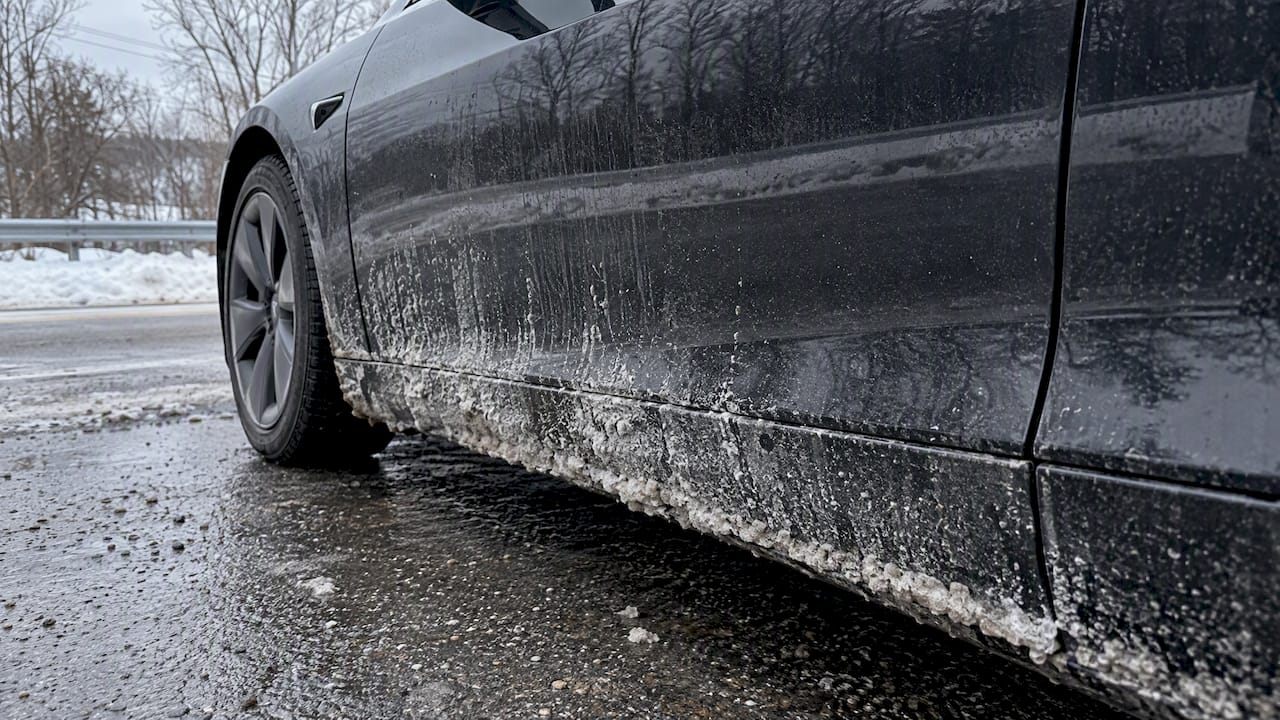
The same Tesla guidance says to remove bird droppings, tree resin, tar, road salt and industrial fallout immediately, without waiting for a full wash. In South Jersey, that means pine and oak sap in spring, pollen and bugs in summer, and road salt from December through March. When something has bonded, do not scrub. Our guides on removing tar without harming paint and stopping before sap scratches the clear coat explain how to loosen it first.
PPF, ceramic coating or both?
These two products solve different problems, and mixing them up leads to disappointment.
Paint protection film is a clear urethane layer applied over the paint. It absorbs the impact of small stones, so it is the right answer for chips. It sits on the surfaces that take the beating: the front bumper, the leading edge of the hood, fenders, mirrors and often the rocker panels. Our Tesla paint protection package pairs a PPF front clip with ceramic coating over the top.
Ceramic coating is a liquid layer that bonds to the clear coat. It adds slickness, makes washing easier and helps resist etching from droppings and fallout. It also gives a safer surface for drying, since towels glide instead of grabbing. It is not armor. As we explain in our piece on which marks ceramic coatings stop and which they do not, coatings help against light swirls, not against stone chips. For that reason a coating alone is not a chip solution on a car that sees highway miles.
How to choose:
| Your situation | What we would suggest |
|---|---|
| Mostly highway commuting, new car | PPF on the front end plus ceramic coating on the whole car |
| Mostly local driving, garage parked | Ceramic coating, with PPF on the bumper and mirrors if you like |
| Previously washed in tunnel washes, visible swirls | Paint correction first, then coating |
| Matte or satin finish | A coating made for matte, so it does not add shine, see ceramic coating for matte paint |
If the paint already has swirls or light defects, protect it only after correcting it. Sealing flaws under a coating locks them in. Our overview of paint correction explains the process, and the paint correction restore and protect guide shows what results to expect.
When to protect a new Tesla
The best window is early, ideally in the first weeks, before the car collects wash marring and chips. Protection applied to fresh paint needs less prep and less correction, which usually keeps the job simpler. If you are taking delivery soon, book the appointment before the car sees its first road trip.
A note on self-healing claims
Some films and coatings are marketed as self-healing. In practice, heat can let light surface marks in certain films relax and disappear, but self-healing does not make a surface immune. If you are weighing the options, our guides on what works in self-healing ceramic coatings and popular self-healing brands go through the details. We also offer a Revivify self-healing coating, and we can talk through whether it fits your car and driving.
Our perspective
We detail a lot of Teslas across South Jersey, and the pattern is consistent. The cars that look best at three years are rarely the ones with the best paint. They are the ones whose owners decided early how the car would be washed and protected.
Our view is simple. Treat the front end as a wear surface and put film on it. Treat the rest of the paint as something to keep clean without friction, and put a ceramic coating on it so the wash is easier and gentler. Document the work, because a detailed record of what was applied and when helps with long-term care and resale.
We come to you. Mobile service means the car is protected in your driveway or at your workplace, without you losing a day, and every vehicle gets a plan built around how it is actually driven rather than a generic package.
Charles
Book Tesla paint protection in South Jersey
We are a mobile detailing service based in Pitman, New Jersey, and we apply protective treatments at your home or workplace. For a Tesla, most owners start with one of three routes.
- Ceramic coating. Our ceramic coating packages are priced by durability: the 3 Year Package is $1,000 to $1,200, the 5 Year Package is $1,500 to $1,700, and the 8 Year Package is $2,200 to $2,400. There is a 10% ceramic coating booking charge.
- Paint protection film. See our paint protection film page. We do not publish a price because coverage varies by vehicle and by how much of the car you want covered.
- Detail packages and maintenance. Our detail packages start at $375 for Bronze, $600 for Silver, $1,000 for Silver+ and $1,500 for Gold. An Exterior Maintenance Plan is $200 per month per vehicle, or $100 per week. Mobile service carries an additional fee from $100, and there is a $100 booking charge.

If you are not sure which combination suits your car, tell us how you drive it and where it is parked, and we will recommend a plan. You can reach us through cdcautodetailing.com.
Which Tesla paint color holds up best?
Owners often ask about color durability, and there is no solid published evidence that one Tesla color is harder than another. What changes is how much the color shows. Dark colors such as black and deep blue show swirl marks and dust more. White hides minor marks but shows road tar and stains. Silver and gray hide most light defects. Whatever color you choose, the paint beneath is subject to the same wash habits and the same road debris, so the protection plan matters more than the shade.
Everyday habits that keep a Tesla’s paint sharp
A few small habits add up over the years you own the car:
- Park with some thought. Under sap-dropping trees and near construction dust costs you cleaning time and paint.
- Leave following distance. Stone chips mostly come from vehicles ahead, especially trucks and gravel haulers.
- Do not dry wipe. Wiping dust off a dry panel is one of the quickest ways to create fine scratches.
- Rinse off salt promptly in winter. Road salt left on the car continues to act on the paint and the underbody.
- Check the door edges and lower panels. Chips often start where you do not look.
- Keep maintenance regular. A scheduled exterior wash by someone who uses clean tools beats a monthly rush job at an automatic wash.
If you want the benefits in more depth before you decide, our guide to the benefits of ceramic coating covers what a coating does day to day.
FAQ
Is Tesla paint actually soft?
One 2019 Finnish inspection rated a Model 3’s paint as softer and thinner than typical standards, and owner surveys show real chip and scratch complaints. That is not proof that every Tesla is the same. How you wash and protect the car affects its finish as much as the paint does.
Can I take my Tesla through an automatic car wash?
Tesla’s owner’s manual recommends touchless automatic washes if you are not hand-washing and advises against brushes. Touchless washes avoid the bristle contact that causes most swirl marks. Hand-washing with a soft cloth and mild shampoo is still the gentlest choice.
Is ceramic coating enough to stop rock chips on a Tesla?
No. Ceramic coating helps against light swirls, etching and contamination, but it does not stop stone impacts. Paint protection film is the product built for chips, which is why we often pair PPF on the front end with a coating over the whole car.
How much does ceramic coating cost for a Tesla with CDC Detailing?
Our ceramic coating packages run $1,000 to $1,200 for 3 years, $1,500 to $1,700 for 5 years and $2,200 to $2,400 for 8 years, plus a 10% booking charge. Mobile service carries an additional fee from $100. Check our ceramic coating page for current details.
Has Tesla paint gotten better since the early Model 3?
Survey data suggests so. Reported defects fell from 80 per 100 vehicles in late 2018 to 35 per 100 by September 2019, and Musk said paint quality improved again at the end of 2020. Those figures track reported defects, not proven changes to the paint’s hardness.
Sources
- Finnish Tesla Model 3 Inspection Reveals Soft, Thin, Under-Spec Paint
- Tesla Model 3 Survey: What Owners Think About the Electric Car
- Tesla Model 3 Loses CR Recommendation
- Tesla lags auto industry in quality, finds new J.D. Power study
- Don’t buy Teslas during a production ramp, Elon Musk says
- Tesla Model 3 owner’s manual: Cleaning
- Gentle car washing routine for the new season