
Water spots are mineral deposits left on your paint when drops of water evaporate. Fresh ones usually come off with a gentle wash, a clay bar or a diluted vinegar wipe. Spots that have sat for weeks can etch into the clear coat, and then only polishing removes them. The trick is knowing which kind you have before you reach for anything abrasive.
This guide covers what causes the spots, how to tell a surface deposit from etching, the safest removal order, what it costs to fix them, and how to stop them returning. We detail cars across South Jersey, where sprinklers, well water and humid summers keep this problem busy, so we have seen most versions of it.
TL;DR
- Water spots are mostly calcium and magnesium left behind when water dries. They rarely fade by themselves.
- Start with the least aggressive fix: a proper wash, then a clay bar or a vinegar and water mix, then a paint-safe spot remover.
- If you can still see or feel the outline of a spot after cleaning, it has etched into the clear coat and needs polishing, not more chemicals.
- Prevent spots by washing in the shade, working in sections, rinsing soap fully and drying by blotting, never by air-drying.
- A ceramic coating or sealant makes water bead and release, so fewer minerals stay on the paint.
Table of Contents
- What water spots actually are
- Do water spots go away on their own?
- Surface deposit or etching? A two-minute test
- How to remove water spots without damaging the clear coat
- Quick guide: which fix for which spot
- What it costs to get rid of water spots
- How to prevent water spots when washing
- Protection that makes spots harder to form
- Our perspective: fix the paint first, then protect it
- When to call a detailer
- FAQ
- Sources
What water spots actually are
Water spots on automotive paint are generally caused by droplets that carry dissolved minerals, mainly calcium and magnesium. When the water evaporates, the minerals stay behind as a ring or dot. The U.S. Geological Survey notes that hard water is high in dissolved minerals, largely calcium and magnesium, and that the residue it leaves is unsightly rather than dangerous. On your paint, though, “unsightly” can turn into “permanent” if it sits long enough.
The usual sources on a car are:
- Lawn sprinklers. Irrigation water is often hard, and a car parked within reach gets a fresh coat of minerals every cycle. This is the classic cause in suburban driveways.
- Rain that dries on dirty paint. Rain mixes with road film and dust, then dries in place.
- Washing in sun or wind. The water flashes off before you can dry it.
- Hard tap or well water. If your hose water is hard, every rinse that air-dries leaves a dusting.
There is a second, nastier category. Environmental contamination such as acid rain can chemically etch or erode microscopic layers of the clear coat. Mineral spots that stay for a long time can do the same thing: prolonged deposits may etch the clear coat. This is why the age of a spot matters as much as its appearance.
Do water spots go away on their own?
No, not usually. A hard rain may rinse off a light film, but mineral deposits bonded to paint tend to stay until you remove them. Waiting also makes things worse. Sun bakes the minerals on, and the longer they sit, the better the chance that they leave a mark that no amount of washing will touch.
So the practical rule: treat spots as soon as you see them, and do not assume the next rain will help.
Surface deposit or etching? A two-minute test
Everything else in this guide depends on this answer.
- Wash and dry the panel so you are looking at the paint, not grime.
- Look at it in indirect light, then under a flashlight held at a low angle. Surface deposits look like chalky white or gray dots that sit on top. Etched spots look like shallow dimples or rings, often with a clearly defined edge, and they stay visible even when the paint is wet and clean.
- Run a fingertip over it (a clean fingertip inside a thin plastic sandwich bag senses texture better). A raised, gritty feel points to a mineral deposit. A smooth surface with a visible outline points to etching.
- Try the gentlest cleaner on a small test area. If the spot vanishes, it was a deposit. If it softens but leaves a ghost ring, it is probably partly etched.
The maker of one polish product puts the dividing line the same way: fresh, unetched spots can be treated with a chemical remover, but if spots have etched into the surface, chemical cleaners will not fix them and polishing is required.
How to remove water spots without damaging the clear coat
Work up a ladder, starting at the bottom rung. One detailing guide recommends starting with the least aggressive method and moving to stronger ones only as needed, and that matches how we work on customer cars.
Step 1: Wash the car properly
Start with a freshly washed car, in the shade, with a pH-balanced car shampoo. Skip dish soap: household cleaning agents are not formulated for car paint and may strip protective wax. Plenty of light spots are just dried soap film or dust, and they disappear here. Dry by blotting with a clean microfiber towel.
Step 2: Use a clay bar on stubborn deposits
If the spots are still there and feel gritty, a clay bar with plenty of lubricant lifts bonded minerals off the surface without chemicals. Keep the paint slick, fold the clay often so you are always on a clean face, and stop when the panel feels glass smooth. AutoZone lists a clay bar, soap and water, vinegar or a paint-safe remover as the first things to try, with polishing for etched spots.
Step 3: Dissolve the minerals with diluted vinegar
Mineral deposits dissolve in mild acid. USGS explains that vinegar’s acidity helps dissolve mineral particles so they wash away, and AutoZone suggests equal parts household vinegar and pure water for hard-water spots.
How to do it safely:
- Work on a cool panel, out of the sun, one small area at a time.
- Spray or dab the mix onto a microfiber towel, lay it over the spot for 30 to 60 seconds, then wipe gently. Do not scrub.
- Rinse the area thoroughly with clean water so no acid dries on the paint.
- Keep it off aluminum and chrome: Turtle Wax’s professional guide says vinegar should be avoided on aluminum or chrome.
- Re-protect the area afterward. Acid can thin wax or sealant, so plan on adding fresh protection.
Use distilled water for the mix if your tap water is hard. Otherwise you are diluting vinegar with the problem you are trying to remove.
Step 4: A dedicated water spot remover
If vinegar only partly works, a purpose-made remover is the next step. Read the label. For example, Meguiar’s documents its Water Spot Remover as safe for clear coat and glossy painted surfaces but not for flat, matte or satin finishes, and describes it as gently polishing spots away. That detail matters: a product that polishes is mildly abrasive, and on matte paint or wrap it would leave a shiny patch.
Step 5: Polish when the spots are etched
When a spot stays visible after steps 1 to 4, the damage is in the clear coat itself. The fix is to level the surface around the dimple with a fine polish and a soft pad, then protect the result. By hand this works on very light etching. For anything deeper, or on a dark car where every mistake shows, machine polishing by someone who measures paint thickness is safer than guessing. Clear coat is only a couple of mils thick, and you cannot put it back once it is gone.
What not to do
- Do not use a dry towel on dry spots. Minerals are hard, and wiping them drags them across the paint.
- Do not use kitchen scouring products, magic erasers or abrasive compounds to “speed things up.”
- Do not work in direct sun. Chemicals flash dry and leave new marks.
- Do not leave vinegar on the paint to soak while you do something else.
Quick guide: which fix for which spot
| What you see | What it probably is | First thing to try | If that fails |
|---|---|---|---|
| Chalky white dots after rain or a sprinkler, gritty to the touch | Fresh mineral deposit | Wash, then diluted vinegar | Clay bar, then paint-safe remover |
| Faint haze or ring that fades when you wash | Soap or dust film | Re-wash and rinse thoroughly | Clay bar |
| Visible rings that stay when the paint is wet and clean | Etching in the clear coat | Light polish | Machine polish by a pro |
| Spots on glass | Mineral film | Diluted vinegar, rinse well | Dedicated glass cleaner |
| Spots on matte, satin or wrapped paint | Deposit, but easily damaged surface | Wash, then check the finish maker’s advice | Ask a detailer |
What it costs to get rid of water spots
The honest answer is a range, because the work depends on how deep the damage goes.
- DIY, surface deposits: a bottle of vinegar, a clay bar kit and a few microfiber towels is a small outlay, and the work takes an afternoon.
- Professional wash and decontamination: our Exterior Detail starts at $175. That covers the outside of the car and is the right fit when spots are fresh and simply need removing safely.
- Polishing for etched spots: the price rises with the number of affected panels and the depth of the etching, so it is quoted after we see the paint. Our detail packages start at $375 for Bronze, with higher tiers up to $1,500 for Gold, and the right tier depends on what the car needs.
For mobile service we add a fee that starts at $100 and there is a $100 booking charge, both listed on the packages page. We would rather tell you that up front than have it surprise you at the end.
How to prevent water spots when washing
Most spots are made at the end of a wash, not the beginning. Consumer Reports gives the core advice: wash in the shade to prevent premature evaporation, work in small sections, rinse all soap thoroughly and never let the car air-dry. Direct sunlight can make soap dry and leave stains.
A routine that works:
- Pick the time and place. Early morning or evening, or a shaded driveway or garage. A panel that is hot to the touch is too hot to wash.
- Wash and rinse panel by panel. Roof first, then glass, hood, upper sides, and the lower sides last. Rinse each section before the soap can dry.
- Finish with a flowing rinse. Remove the spray nozzle and let water sheet off the panels. Less water left means less to dry.
- Dry right away. Consumer Reports advises against air-drying, which allows minerals in hard water to settle, and suggests blotting with a soft chamois or microfiber towel. The same guide says a wide-spray hose nozzle or a leaf blower on low can help clear water first, especially from mirrors, grilles and trim, which drip long after you finish.
- Use a drying aid or spray sealant on the wet or damp panel as you dry. It adds slickness for the towel and a thin layer of protection.
If your hose water is very hard, a deionizing filter on the hose is worth considering. It removes dissolved minerals from the final rinse, so even drops that dry leave nothing behind.
Outsmart the sprinklers
If you park near a lawn, check where the heads spray. Moving the car 10 feet, or asking the neighbor to shift the schedule, costs nothing. If spots appear after a sprinkler cycle, wipe the car down that same day with a damp microfiber and quick detailer, before the sun bakes them in.
Protection that makes spots harder to form
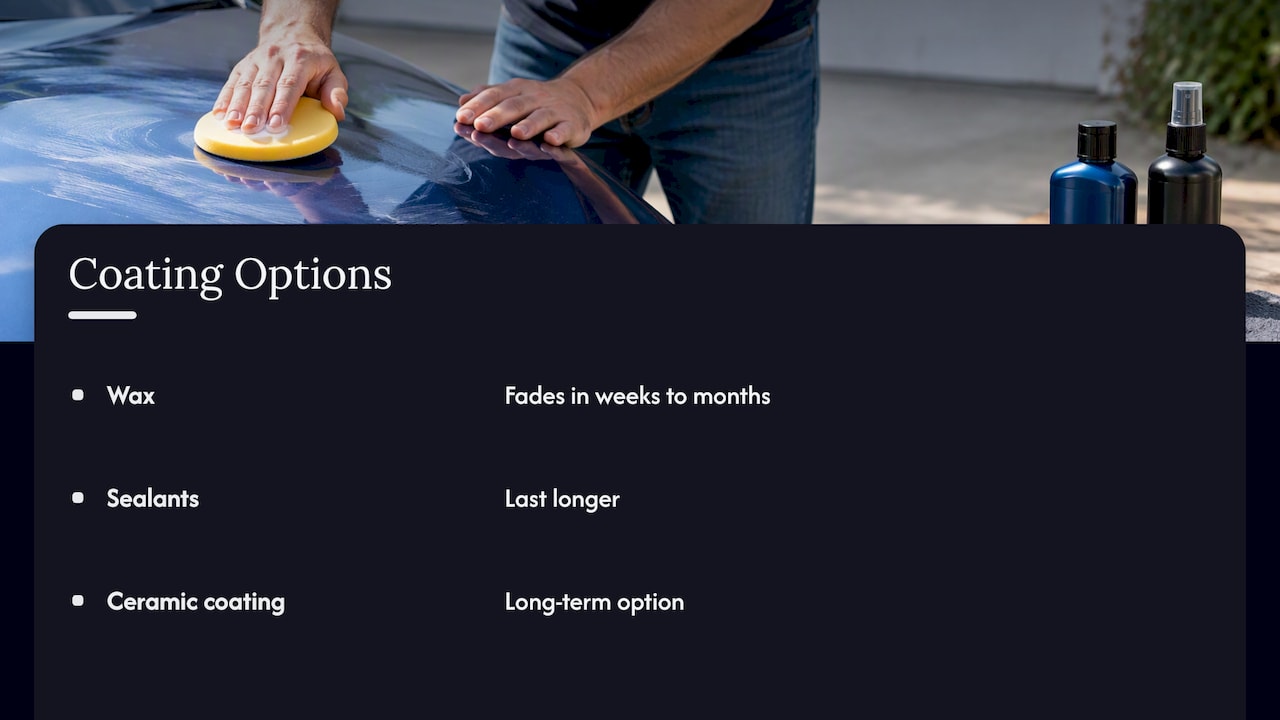
Bare clear coat gives minerals something to grip. A protective layer changes that: wax, polymer paint sealants and ceramic coatings create a protective layer between the car’s finish and the environment. Water beads and runs off, so less of it is left to dry in place, and what does dry is much easier to wipe off.
The options differ in how long they last. Wax gives a warm look but fades in weeks to months. Sealants last longer. A ceramic coating is the long-term option, and it is the one most of our customers choose when they are tired of fighting spots. Our guides on ceramic coating versus wax and how ceramic coatings protect paint go through the trade-offs. If you want to know what happens in the shop, read about the professional ceramic coating process.
One caveat: a coating does not make paint immune. Spots can still form on a coated car if hard water dries on it for a long time, but they sit on top of the coating, not in the clear coat. Coated paint is normally easier to clean. We would not promise any coating makes spotting impossible, and a good installer will not either.
Our perspective: fix the paint first, then protect it
We see two mistakes over and over. The first is owners attacking spots with the harshest thing in the garage, because the spots are “stubborn,” when a mild acid and a clay bar would have worked. The second is the reverse: owners who keep wiping at etched spots with vinegar for weeks, because they never checked whether the damage was above or below the surface.
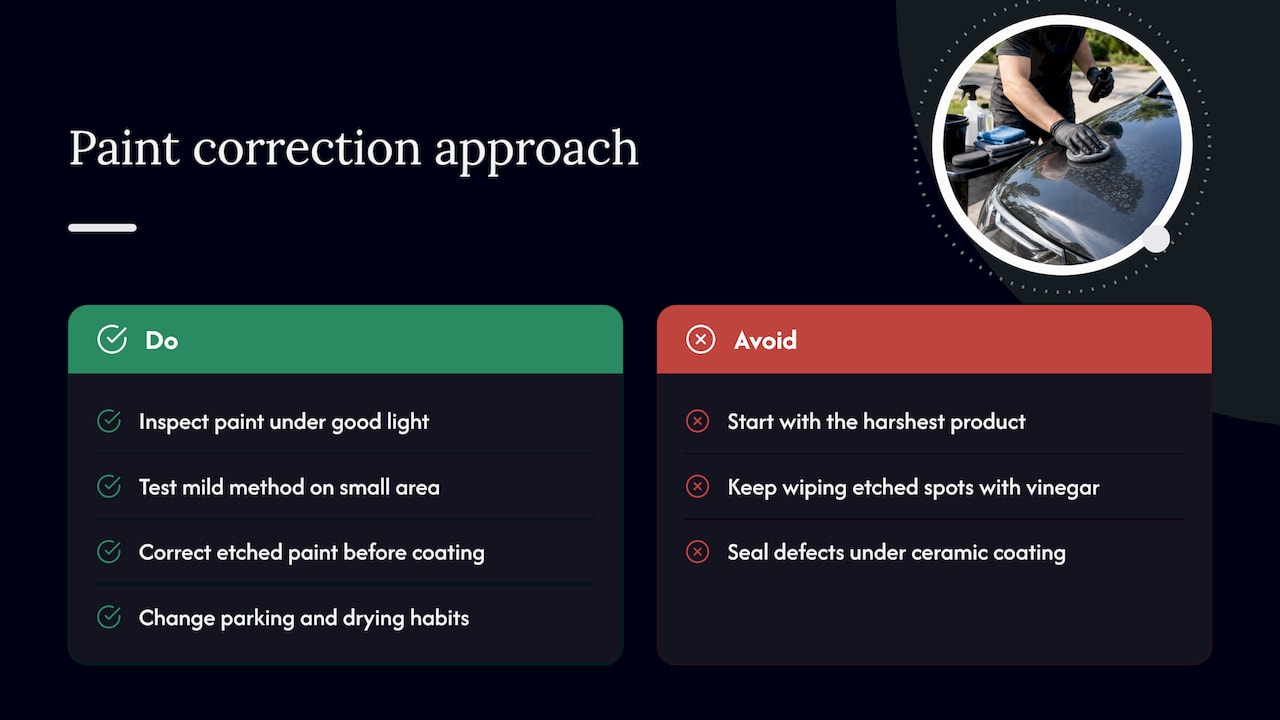
Our approach on a customer car is simple. We inspect the paint under good light, test the least aggressive method on a small area, and only step up when the result tells us to. If the spots have etched, we correct the paint first. Locking a ceramic coating over defects seals them in, so correction comes before protection, not after.
We also work at the customer’s home or workplace. That is useful here, because we can see where the car sits, and often spot the sprinkler or the tree that caused the problem. Most of the lasting fixes we deliver are not a product at all. They are a change in where the car is parked and how it gets dried.
— Charles
When to call a detailer
DIY is a good first move for fresh spots. Call a professional when:
- spots remain visible after a vinegar wipe and a clay bar;
- they cover a whole panel, such as a hood or roof that took the brunt of a sprinkler;
- the car is dark, where polishing errors show most;
- the finish is matte, satin, or paint protection film, where the wrong product causes permanent marks;
- you want protection applied after the spots are gone.
If you are in South Jersey and want it done at your location, start with our exterior detailing service. For cars with etched paint where you also want long-term protection, our ceramic coating packages are listed at $1,000 to $1,200 for the 3 Year Package, $1,500 to $1,700 for 5 Years and $2,200 to $2,400 for 8 Years. Not sure which level your car needs? Book through our detail packages page and we will assess the paint first.
If you want to keep the car looking right afterward, we also offer an Exterior Maintenance Plan at $200 per month per vehicle, or $100 per week. It is aimed at owners and small fleets that want regular washing done properly, without the wash-and-air-dry habits that cause spots.
Other contaminants behave differently. If what you are seeing is sticky rather than chalky, read how to handle tree sap without scratching the clear coat, and if you use automatic washes, our tips on avoiding scratches from automatic car washes apply.
FAQ
What dissolves hard water spots on a car?
Mild acid does it. A mix of equal parts white vinegar and pure or distilled water dissolves surface mineral deposits on most paint, and dedicated water spot removers work the same way. Rinse thoroughly afterward and keep vinegar away from aluminum and chrome.
Do water spots go away on their own?
Usually not. Rain can rinse away a light film, but bonded mineral deposits stay put, and the longer they sit in the sun the more likely they are to etch the clear coat. Treat them as soon as you notice them.
How do I avoid water spots when washing my car?
Wash in the shade, work one section at a time and rinse all soap before it dries. Then dry right away by blotting with a microfiber towel or chamois, rather than letting the car air-dry. A wide-spray rinse or a low-setting leaf blower removes most water first.
How much does it cost to remove water spots from a car?
It depends on how deep they go. Surface deposits can be handled with inexpensive DIY supplies, while etched spots need polishing, and that is priced by panel and condition. Our Exterior Detail starts at $175, and polishing work is quoted after we inspect the paint.
Sources
- Hardness of Water, U.S. Geological Survey
- How to Remove Water Spots on a Car, AutoZone
- A Guide to Removing Water Spots from a Vehicle, Turtle Wax Pro
- Will MAXRemove remove water spots?, MAXL
- Water Spot Removal Guide, How To Auto Detail
- Meguiar’s Water Spot Remover, A3714
- Expert Detailing Secrets for a Cleaner Car, Consumer Reports
- How to Wash Your Car Like a Pro, Consumer Reports
- Washing your car in the summer heat, USA Today