
TL;DR:
- A car window tint color chart maps film darkness using VLT percentages, indicating privacy, heat rejection, and legality. Choosing the correct tint depends on film technology, vehicle color, and legal limits, not just the darkness level. Using real-world samples and prioritizing quality film technology ensures optimal performance and legal compliance.
A car window tint color chart is a visual reference that maps window film darkness by Visible Light Transmission (VLT) percentage, directly determining how much privacy, heat rejection, and legal compliance you get from your tint. VLT is the industry standard for tint darkness, where a lower percentage means less light enters the vehicle. Common shades run from 5% (near-opaque) to 70% (nearly clear). Choosing the wrong shade costs you comfort, money, or a traffic citation. This guide covers every percentage level, film technology, vehicle color effects, and legal limits so you can make a confident, informed decision.
1. What does a car window tint color chart actually show?
A tint color chart maps VLT percentages to real-world appearance and performance. Each percentage tells you exactly how much visible light passes through the film. The chart is not just about looks. It connects darkness level to privacy, heat rejection, and legal standing in one reference.
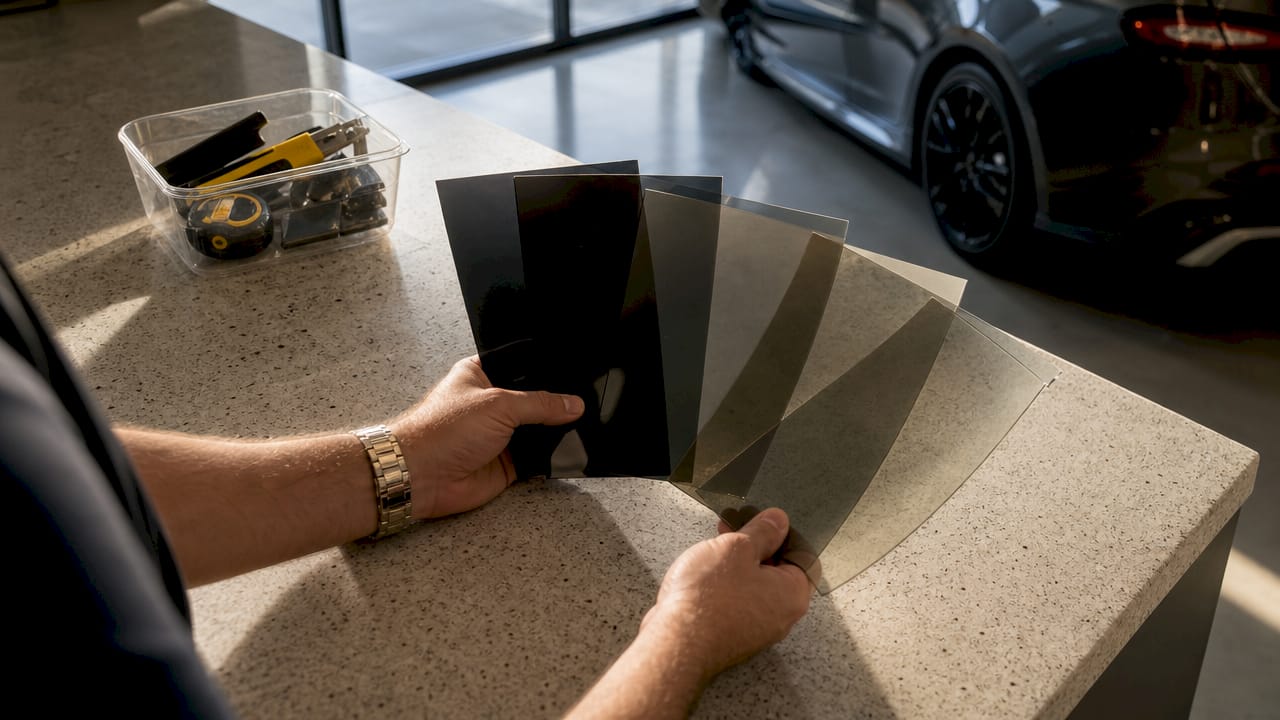
The standard percentages you will see on any tint color guide for cars are 5%, 15%, 20%, 35%, 50%, and 70%. Each step up in percentage lets in more light and reduces privacy. Each step down increases darkness and, depending on film technology, may improve heat blocking.
Pro Tip: A tint color chart is only a starting point. The film technology behind the percentage matters just as much as the shade itself.
2. Standard tint percentages and what they look like
VLT percentages define tint darkness across six common levels, each with a distinct visual effect and practical purpose.
| Tint Shade (VLT) | Appearance | Privacy Level | Typical Use |
|---|---|---|---|
| 5% | Nearly black, mirror-like | Maximum | Limo rear windows, privacy builds |
| 15% | Very dark | High | Rear windows on SUVs and trucks |
| 20% | Dark, limited visibility inside | High | Rear side windows, style builds |
| 35% | Medium, balanced look | Moderate | Front and rear, daily drivers |
| 50% | Light, subtle tint | Low | Front windows, legal compliance |
| 70% | Near-clear | Minimal | UV protection without visible tint |
The 5% shade is called “limo tint” for good reason. You cannot see through it in daylight. The 35% shade is the most popular choice for daily drivers because it balances style with safe daytime and nighttime visibility. The 50% and 70% shades look nearly invisible on most vehicles but still block UV rays depending on film quality.
Pro Tip: Do not judge a shade by its number alone. A 35% ceramic film blocks more heat than a 20% dyed film, even though it lets in more light.
3. How film technology changes performance beyond color
Film technology determines heat rejection and UV protection far more than tint darkness alone. Performance is driven by film technology, not just the VLT percentage. A light 50% nano-ceramic film outperforms a dark 20% dyed film on heat and UV blocking.
The four main film types are dyed, carbon, ceramic, and nano-ceramic. Each has a different performance profile and price point.
- Dyed film: The most affordable option. It absorbs heat rather than reflecting it, which limits performance. Lifespan runs roughly 3–5 years before fading or bubbling.
- Carbon film: No metallic layer, so it does not interfere with GPS, satellite radio, or cellular signals. It rejects more heat than dyed film and lasts longer.
- Ceramic film: Ceramic films provide 99% UV protection and heat rejection in the 85%–96% range. Lifespan reaches 10–20 years with proper installation.
- Nano-ceramic film: The top tier. Nano-ceramic films outperform darker dyed films even at lighter shades like 50% or 70%. They block infrared heat without darkening the glass.
One critical note on metallic films: metalized tints can interfere with electronic signals, including GPS and satellite radio. Vehicles with these systems should use carbon or ceramic films instead. For a deeper look at why ceramic and carbon films are worth the investment, Cdcautodetailing covers the ceramic vs. carbon comparison in detail.
Pro Tip: Prioritize film technology over darkness. A lighter ceramic film protects your interior and keeps your car cooler better than a dark dyed film.
4. How your vehicle’s color affects tint appearance
Your car’s exterior paint color changes how every tint shade looks in real life. A 35% VLT appears lighter on white vehicles than on black vehicles. This is one of the most overlooked factors in tint selection.
- Black vehicles: Dark tint blends into the body color, creating a clean, uniform look. Even a 35% shade reads as very dark.
- White or silver vehicles: The same 35% shade looks noticeably lighter and more transparent. Owners who want a bold look on light-colored cars often need to go to 20% or darker.
- Interior upholstery matters too: Light-colored interiors make tint appear lighter from outside compared to dark interiors. A beige interior will make your tint look less dramatic than a black interior will.
The practical takeaway is simple. Never choose a tint shade based on how it looks on a different vehicle in a photo. Always view samples installed on a car that matches your paint color and interior. This single step prevents the most common buyer disappointment in tint selection.
5. Legal limits and compliance you cannot ignore
Legal tint limits vary by state and directly affect which shades you can use on front versus rear windows. Front side window limits are usually stricter than rear windows, often requiring 35%–70% VLT on the front. Rear windows in many states allow as low as 5%–20% VLT.
Non-compliance carries real consequences:
- Traffic citations and fines
- Failed vehicle inspections
- Required removal and replacement of the film at your expense
- Reduced visibility at night, which creates a safety risk regardless of legality
Most experts recommend no darker than 35% VLT on front windows unless your state law explicitly allows darker shades. Going to 20% on front windows creates a genuine night driving hazard, even if it is technically legal in your jurisdiction.
The best way to verify your local rules is to check your state’s Department of Transportation website or consult a licensed installer. Cdcautodetailing’s guide on tinting laws for 2025 breaks down state-specific VLT limits clearly.
Pro Tip: Always confirm your state’s front window VLT limit before choosing a shade. Saving money on a darker tint is not worth a citation or a failed inspection.
6. How to use a tint color guide to choose your best shade
Choosing the right shade from a tint color guide for cars comes down to four practical steps. Follow them in order and you will avoid the most common mistakes.
- Confirm your legal limits first. Look up your state’s VLT requirements for front and rear windows before considering any shade. This eliminates options that will get you cited.
- Define your primary goal. Daily commuters who drive at night should prioritize visibility and stay at 35% or lighter on front windows. Owners who want maximum privacy on rear windows can go to 15% or 20% where the law allows.
- View samples on a real vehicle in natural light. Display board samples are insufficient for accurate assessment. Ask your installer to show you the shade installed on a car with a similar paint color and interior to yours. Midday sunlight gives you the most accurate read.
- Choose film technology based on performance needs. If heat rejection and UV protection matter to you, select ceramic or nano-ceramic film at your preferred shade. Do not sacrifice film quality to save a small amount upfront.
Seeing tint on actual vehicles in natural light is the single most reliable way to set accurate expectations. No chart or photo replaces that experience. For a full walkthrough of the decision process, Cdcautodetailing’s guide on how to choose window tinting covers every factor in plain language.
Key takeaways
The most effective tint choice combines the right VLT percentage, quality film technology, and full legal compliance for your specific vehicle and state.
| Point | Details |
|---|---|
| VLT percentage defines darkness | Lower VLT means less light and more privacy; 5% is maximum, 70% is near-clear. |
| Film technology beats darkness | Ceramic and nano-ceramic films block more heat at 50% than dyed films at 20%. |
| Vehicle color changes perception | A 35% tint looks darker on black cars than on white or silver ones. |
| Legal limits vary by window | Front windows typically require 35%–70% VLT; rear windows allow much darker shades. |
| View samples on real vehicles | Display boards mislead; always evaluate tint on a matching car in natural light. |
Why I think most people pick tint shades the wrong way
Most vehicle owners walk into a tint shop, point at the darkest option that sounds legal, and call it a decision. I have seen this play out hundreds of times, and it almost always leads to regret. Either the tint is too dark for safe night driving, or it looks nothing like what the owner expected once it is on their specific car.
The biggest mistake is treating darkness as the measure of quality. A 70% nano-ceramic film protects your interior and keeps your cabin cooler than a 20% dyed film. The person driving the nearly clear car is often getting better performance than the person with the blacked-out windows. That is counterintuitive, but it is true.
The second mistake is skipping the real-world sample step. I cannot overstate how different a shade looks on a white sedan versus a black SUV. If your installer only shows you a small film sample held up to a light, walk out and find someone who will show you the actual installed result on a comparable vehicle outside.
Finally, do not treat legal limits as a technicality. Front window limits exist because darker tints genuinely reduce your ability to see pedestrians and cyclists at night. Staying at 35% or lighter on front windows is not just about avoiding a ticket. It is about being able to drive safely after dark.
Pick the film technology first, then pick the shade. That order of operations produces better results every time.
— Charles
Professional window tinting from Cdcautodetailing
Cdcautodetailing serves vehicle owners across South Jersey with expert mobile window tinting, using carbon and ceramic film options across the full range of VLT shades. Every installation is done at your location, so there is no drop-off or waiting room involved.
The team at Cdcautodetailing helps you match the right shade and film technology to your vehicle’s color, your driving habits, and your state’s legal limits. Pair your tint with a ceramic coating service for complete exterior protection. Ready to get started? Visit the window tinting guide to learn more about available film options and book your appointment directly with the Cdcautodetailing team.
FAQ
What does VLT percentage mean on a tint chart?
VLT stands for Visible Light Transmission. A lower percentage means less light enters the vehicle, resulting in a darker, more private appearance.
What is the most popular tint shade for daily drivers?
The 35% VLT shade is the most common choice for daily drivers. It balances privacy and style with safe daytime and nighttime visibility.
Does darker tint always block more heat?
No. Heat rejection depends on film technology, not darkness alone. A light nano-ceramic film at 50% blocks more heat than a dark dyed film at 20%.
How do I know if my tint is legal?
Check your state’s Department of Transportation website for VLT limits by window position. Front side windows typically require 35%–70% VLT, while rear windows allow darker shades in most states.
Why does the same tint shade look different on different cars?
Exterior paint color and interior upholstery both affect tint appearance. Dark paint makes tint look darker; light interiors make it appear lighter from outside. Always view samples on a vehicle that matches your own.