
TL;DR:
- Clay bar treatment removes embedded contaminants that washing alone cannot eliminate.
- Using the correct grade and technique ensures safety and effectiveness in decontamination.
- Combining clay with chemical decontamination methods provides the best surface for paint protection.
Most vehicle owners in South Jersey wash their cars regularly and assume that’s enough to keep the paint in good shape. It isn’t. Washing removes surface dirt, but it leaves behind a layer of embedded contaminants that slowly damage your clear coat, dull your shine, and undermine any wax or sealant you apply afterward. Clay bar treatment is the step that separates a truly clean car from one that just looks clean. In this guide, you’ll learn exactly what clay bar treatment is, how it works, which grade to use, what risks to avoid, and how it compares to chemical decontamination methods.
Table of Contents
- What is clay bar treatment and why does it matter?
- The clay bar process: Step-by-step explained
- Grades of clay bar and alternatives: What should you use?
- Risks, myths, and how to avoid common clay bar mistakes
- Clay bar vs. chemical decontamination: When and why to combine methods
- The real secret: Clay bar’s underrated role in paint protection
- Get expert help with clay bar treatment and paint protection
- Frequently asked questions
Key Takeaways
| Point | Details |
|---|---|
| Removes hidden contaminants | Clay bar treatment extracts debris regular washing can’t touch, restoring a smooth finish. |
| Boosts protection results | A clean, smooth surface helps waxes and sealants last longer and perform better. |
| Risks are manageable | Using proper clay, lubricant, and technique ensures safety and prevents micro-marring. |
| Clay is not obsolete | Clay bar remains essential, even with new chemical and synthetic tools available. |
What is clay bar treatment and why does it matter?
If you’ve ever run your hand across a freshly washed car and felt a gritty, rough texture, that’s not leftover dirt. Those are embedded contaminants bonded to your paint’s surface. Regular washing, no matter how thorough, can’t pull them off. That’s where clay bar treatment comes in.
A clay bar is a malleable, putty-like resin compound. When used with a dedicated lubricant, it glides across the paint and physically lifts contaminants out of the clear coat. Think of it like pulling a splinter from skin. Water and soap can clean around it, but only the right tool actually removes it. As a mechanical decontamination process, clay bar treatment extracts embedded particles that washing alone cannot touch.
The contaminants clay bar removes include:
- Brake dust (metallic particles from rotors that bond to paint near wheel wells)
- Rail dust (iron particles from train or industrial activity that embed in paint)
- Industrial fallout (airborne pollution that settles and oxidizes on your finish)
- Tree sap and bug residue (sticky organic matter that hardens over time)
- Tar and road grime (petroleum-based deposits from road surfaces)
- Water spot minerals (calcium and magnesium deposits from hard water)
Left alone, these particles cause more than roughness. They accelerate oxidation, trap moisture under the clear coat, and create micro-abrasions every time you wash. Over months and years, they visibly dull your paint and reduce your car’s resale value.
“After a proper clay bar treatment, most paint surfaces feel noticeably smoother, almost like glass. The difference is immediately obvious to the touch.” Understanding the detailing clay benefits helps explain why professionals treat clay bar as a non-negotiable prep step before any paint protection.
Clay bar treatment also matters because it directly affects how well your wax, sealant, or ceramic coating bonds to the paint. Applying protection over contaminated paint is like painting over rust. The protection layer can’t adhere properly, which shortens its lifespan and reduces its effectiveness. If you want to restore your car’s paint shine and make that shine last, starting with a clean, decontaminated surface is the only way to do it right.
The clay bar process: Step-by-step explained
Clay bar treatment isn’t complicated, but it does require patience and the right technique. Rushing through it or skipping steps is how people end up with marring or wasted product.
Here’s how the process works:
- Pre-wash the vehicle thoroughly. Remove all loose dirt and debris first. Skipping this step means the clay drags grit across the paint, which causes scratches. Knowing how prepping your car for detailing works makes a real difference here.
- Dry the car completely. Water left on the surface dilutes your clay lubricant and reduces its effectiveness.
- Break off a small piece of clay (about the size of a golf ball) and flatten it into a disc shape.
- Spray clay lubricant generously onto a small section of paint (roughly 2 feet by 2 feet).
- Glide the clay bar using light, overlapping back-and-forth strokes. Never use circular motions. Let the clay do the work. Don’t press hard.
- Inspect and fold the clay frequently. As it picks up contaminants, the surface will turn gray or brown. Fold it to expose a clean face before continuing.
- Wipe the section dry with a clean microfiber towel and move to the next area.
- Apply polish, wax, or sealant immediately after. Clay removes your existing protection layer, so the paint is vulnerable until you reapply.
The clay bar methodology of pre-washing, lubricating, lightly gliding, and frequent inspection is what separates a safe treatment from a damaging one.
Pro Tip: After claying a panel, place a clean plastic sandwich bag over your hand and lightly run it across the paint. The bag amplifies texture, so you’ll feel any remaining roughness that your bare hand might miss. If it still feels gritty, clay that section again.
| Task | Time required | Result |
|---|---|---|
| Wash alone | 30 to 45 minutes | Surface clean, contaminants remain |
| Wash plus clay bar | 90 to 150 minutes | Surface and embedded contaminants removed |
| Wash, clay, and sealant | 2.5 to 3.5 hours | Full decontamination and protection |
For spring exterior detailing, clay bar treatment is especially valuable after winter, when road salt and industrial fallout have had months to embed in the paint.
Grades of clay bar and alternatives: What should you use?
Not all clay bars are the same. Choosing the wrong grade is one of the most common mistakes beginners make, and it can lead to unnecessary marring or wasted effort.
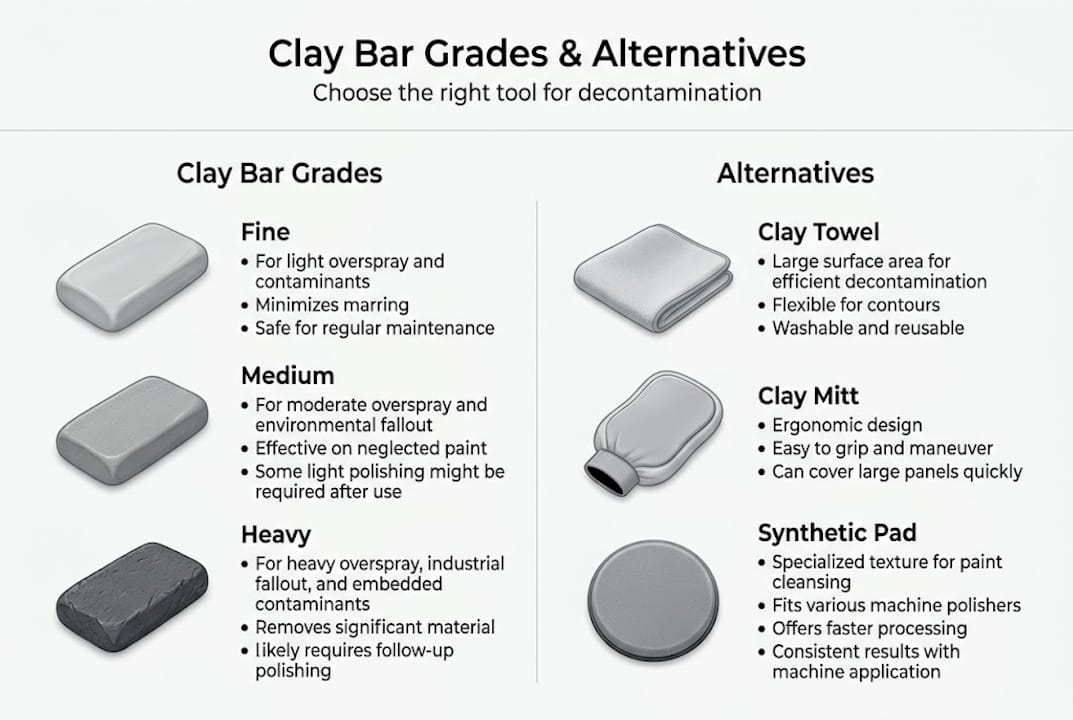
Clay bars come in three grades: fine, medium, and heavy, each designed for different contamination levels.
| Grade | Best for | Aggressiveness | Lifespan per bar |
|---|---|---|---|
| Fine | Light contamination, newer cars, maintenance | Low | 6 to 8 cars |
| Medium | Moderate contamination, daily drivers | Moderate | 4 to 6 cars |
| Heavy | Severe contamination, neglected paint, industrial fallout | High | 2 to 4 cars |
Choose your grade based on your car’s condition:
- Daily commuter with regular washes: Fine grade is sufficient and safer
- Car parked outdoors for extended periods: Medium grade handles accumulated fallout
- Neglected paint with visible roughness or staining: Heavy grade cuts through stubborn contamination
- Show car or freshly painted vehicle: Fine grade only, with extra lubrication
- Car near industrial areas or rail lines: Medium to heavy, depending on severity
Synthetic clay alternatives like clay towels and clay mitts have become popular because they’re rinsable and last longer. They work well for light to moderate contamination and are more forgiving for beginners. However, for severe cases, traditional clay bars still outperform synthetics in thoroughness. Understanding the benefits of different clay grades helps you pick the right tool from the start.
Pro Tip: If you’re new to clay bar treatment, always start with fine-grade clay. Even if your car has moderate contamination, you can make multiple passes with fine clay rather than risk marring with a more aggressive grade.
A standard 100g clay bar typically handles 4 to 6 average-sized vehicles before it’s too contaminated to use safely. Once the clay is heavily discolored and can no longer be folded to reveal a clean surface, replace it.
Risks, myths, and how to avoid common clay bar mistakes
Clay bar treatment has a reputation in some circles for being risky or damaging. That reputation is mostly undeserved, but it does come from real mistakes that real people make.
The biggest risks include:
- Micro-marring from insufficient lubrication (the clay drags instead of glides)
- Using too aggressive a grade on lightly contaminated or delicate paint
- Continuing with dropped or dirty clay (if the bar falls on the ground, throw it away)
- Applying too much pressure instead of letting the clay work naturally
- Skipping the post-clay protection step, leaving bare paint exposed
The myth that clay always damages paint is simply wrong. Improper clay bar use can cause micro-marring, but when done correctly with proper lubrication and the right grade, it’s safe and effective for most painted surfaces.
“Most marring caused by clay bar treatment is minor and can be polished out in the same detailing session. It’s not a reason to avoid clay; it’s a reason to use proper technique.”
One important exception: do not use a clay bar on ceramic-coated paint. The mechanical abrasion of clay can wear down the ceramic layer. For ceramic-coated vehicles, decon washes vs. clay bars is a comparison worth understanding. Chemical decontamination with an iron remover is the right approach for coated surfaces.
Matte finishes are another surface to avoid. The texture of matte paint traps clay particles and the process can alter the finish’s appearance permanently.
Clay bar vs. chemical decontamination: When and why to combine methods
Chemical decontamination uses iron removers and tar dissolvers to break down specific contaminants chemically, without any physical contact. It’s fast, effective, and safe for coated surfaces. So why use clay at all?
Because each method handles different types of contamination:
- Use chemical decontamination when: the car has iron fallout or tar deposits, the paint is ceramic-coated, or you want a fast first pass before clay
- Use clay bar when: the paint still feels rough after chemical decon, there are stubborn organic deposits like sap or road film, or you’re prepping for wax, sealant, or paint correction
- Use both when: you want the cleanest, smoothest possible surface before applying ceramic coating or paint protection film
Experts recommend chemical decontamination first with an iron remover, then following up with clay bar for truly clean paint. The iron remover dissolves metallic particles chemically, and the clay bar then removes anything left behind mechanically. Together, they’re more effective than either method alone.
Synthetic clay pads and towels work well as a middle ground. They’re gentler than traditional clay and easier to use, but for severe contamination or pre-coating prep, they don’t match the thoroughness of traditional clay. Understanding chemical vs. mechanical decontamination helps you decide which combination fits your car’s condition and your goals.
The real secret: Clay bar’s underrated role in paint protection
Here’s what most enthusiasts and even some pros get wrong: they treat clay bar as optional. With newer chemical decon products and synthetic alternatives available, it’s easy to assume clay is outdated. It isn’t.
No other method produces the same glass-smooth surface that traditional clay bar achieves. That smoothness isn’t just cosmetic. It directly determines how well ceramic coatings, paint protection film, and sealants bond to the paint. A contaminated surface, even one treated with iron remover, still has microscopic debris that interferes with adhesion.
We’ve seen ceramic coatings fail early, not because of application errors, but because the paint wasn’t properly decontaminated beforehand. Skipping clay before a premium protection step is like skipping primer before painting a wall. The top layer suffers for it. Following detailing best practices means treating clay bar as the foundation, not an optional add-on. Think of clay as insurance for your detailing investments. Everything you apply afterward performs better and lasts longer because of it.
Get expert help with clay bar treatment and paint protection
If you want the safest, smoothest finish with none of the guesswork, here’s how you can get pro-level results without lifting a finger.

Not everyone has the time, tools, or confidence to clay bar a vehicle correctly. A single mistake, like using the wrong grade or skipping lubrication, can mean extra polishing work. At CDC Auto Detailing, we bring professional clay bar treatment and paint protection services directly to your driveway across South Jersey. Our mobile detailing team combines clay bar decontamination with ceramic coatings, sealants, and film installation for results that last. Browse our auto detailing service examples to see what’s possible, then book your mobile detailing appointment today.
Frequently asked questions
How often should I use a clay bar on my car?
Clay bar treatment is typically recommended once or twice a year, or whenever the paint feels rough after washing. A 100g bar lasts 4 to 6 cars, so frequency depends on your contamination level and how much product you use per session.
Is clay bar treatment safe for all vehicle surfaces?
Clay bar is safe for painted surfaces, glass, and metal, but should be avoided on matte finishes and ceramic coatings. For coated vehicles, avoid clay on coatings and use chemical decontamination instead.
Can a clay bar remove scratches or paint swirls?
No. Clay bars remove embedded contaminants, not surface defects. Clay removes particles, not scratches, so paint correction is a separate step required for swirl marks and scratches.
What’s the difference between a clay bar and synthetic clay alternatives?
Synthetic clay towels and pads are rinsable, reusable, and gentler on paint, making them great for light contamination. However, synthetic clay is less thorough for severe or stubborn cases where traditional clay bars still deliver better results.