
TL;DR:
- Understanding your mobile detailing provider’s service area is crucial for maintaining fleet operational efficiency and minimizing downtime. A well-defined geographic boundary ensures faster response times, cost predictability, and consistent service quality, directly impacting vehicle resale value and business image. Negotiating comprehensive coverage and regularly reviewing service agreements help align fleet maintenance with evolving operational needs.
Running a commercial fleet without a clear understanding of your detailing provider’s service area is like planning a delivery route without checking road closures. You might get there eventually, but you’ll lose time, money, and patience along the way. For fleet managers and business owners in South Jersey, mobile service keeps vehicles operational by coming directly to your lot rather than pulling trucks off rotation for shop visits. Understanding exactly what a “fleet service area” means, and how to use that knowledge strategically, can be the difference between a fleet that runs smoothly and one that bleeds costs through unnecessary downtime.
Table of Contents
- What is a fleet service area?
- Why service area boundaries matter for fleet uptime
- How detailers determine fleet service area coverage
- Aligning fleet service area choices with business goals
- Why most fleets underestimate service area impact
- Upgrade your fleet care with the right service area partner
- Frequently asked questions
Key Takeaways
| Point | Details |
|---|---|
| Strategic boundaries | A well-defined fleet service area minimizes downtime and increases operational efficiency. |
| Impact on uptime | Service area coverage directly affects how fast your vehicles return to duty. |
| Tailored solutions | Mobile detailers often adapt their coverage for large or complex fleets when asked. |
| Partner selection | Choose a provider whose service area truly aligns with your fleet’s scale and needs. |
What is a fleet service area?
To set the stage, let’s first define what a fleet service area actually means for your commercial vehicles.
A fleet service area is the defined geographic zone within which a mobile detailing provider will dispatch technicians to your vehicles. It is not just a circle drawn on a map. It is a strategic business decision that reflects real-world constraints like travel time, fuel costs, technician availability, and equipment logistics. For mobile detailers, this boundary shapes how they schedule jobs, allocate resources, and deliver consistent results across multiple vehicles in a single visit.
When you hire a mobile provider, their service area determines whether your lot in Vineland, your satellite office in Cherry Hill, or your depot near Mullica Hill falls within reach. The difference matters enormously when you need 12 vehicles detailed before Monday’s client meetings.
Here is what a fleet service area typically covers in practical terms:
- Core coverage zone: The primary radius from the provider’s base where full services are available at standard pricing, usually 10 to 30 miles.
- Extended zone: A secondary ring where service may be available with added travel fees or modified scheduling.
- Out-of-zone requests: Special one-off jobs or large-contract arrangements negotiated separately, often requiring advance notice.
- On-site service scope: Mobile technicians perform planned inspections, servicing, and cleaning at your location to support uptime, compliance, and efficiency.
Understanding the full fleet detailing types available helps you align which services you need with what a provider can realistically deliver within their service footprint. And if you want to get a broader picture of what these arrangements look like in practice, reviewing a fleet service explained resource is a solid starting point before you sign anything.
Pro Tip: Always ask your provider to share a written description or map of their service area before the first appointment. Verbal assurances are not enough when you are managing dozens of vehicles across multiple sites.
Why service area boundaries matter for fleet uptime
Now that you understand what’s meant by a fleet service area, let’s see why those boundaries make a critical difference for your fleet’s day-to-day operation.
Every hour a vehicle sits off the road waiting for detailing is a cost. It is either a delayed delivery, a missed sales call, or a client-facing truck that looks like it has been through a mud pit. The closer your provider’s base is to your fleet’s parking location, the faster they can respond, and the more vehicles they can service in a single visit.
“Mobile service is positioned specifically to keep vehicles operational by bringing service to where they’re parked.” This principle is what separates a well-matched detailing partner from one that creates more friction than they solve.
Here is a breakdown of how service radius affects typical response times and potential downtime:
| Service radius from provider base | Estimated travel time | Vehicles serviceable per visit | Downtime risk |
|---|---|---|---|
| 0 to 10 miles | Under 20 minutes | High (6 to 10+) | Very low |
| 11 to 20 miles | 20 to 40 minutes | Moderate (4 to 6) | Low |
| 21 to 30 miles | 40 to 60 minutes | Limited (2 to 4) | Moderate |
| 30+ miles | Over 60 minutes | Difficult to scale | High |
The numbers are clear. The further you are from your provider’s home base, the more scheduling friction builds up. That friction shows up as delays, rescheduling, and ultimately, vehicles that do not get serviced on time.
Here are the top three ways that clearly defined service areas improve your fleet’s efficiency:
- Faster response windows. When your lot falls squarely inside a provider’s core zone, they can fit your fleet into tight weekly or biweekly rotations rather than treating you as a complex edge-case booking.
- Better cost predictability. No surprise travel surcharges or fuel fees that throw off your monthly maintenance budget.
- Consistent quality. Technicians who are not exhausted from a 90-minute drive show up ready to deliver quality work across every vehicle in your lineup.
Strong service area alignment also connects directly to cutting fleet depreciation over time. A truck that gets detailed consistently holds its resale value better and reflects positively on your brand. And when it comes to client-facing assets, that business image success translates into real revenue outcomes.
How detailers determine fleet service area coverage
With the value of well-defined boundaries clear, the next step is understanding exactly how these coverage zones are set up in the first place.
Mobile detailing companies do not pick their service areas at random. Several concrete factors drive where coverage begins and ends, and knowing these factors gives you leverage when negotiating coverage for your specific operation.
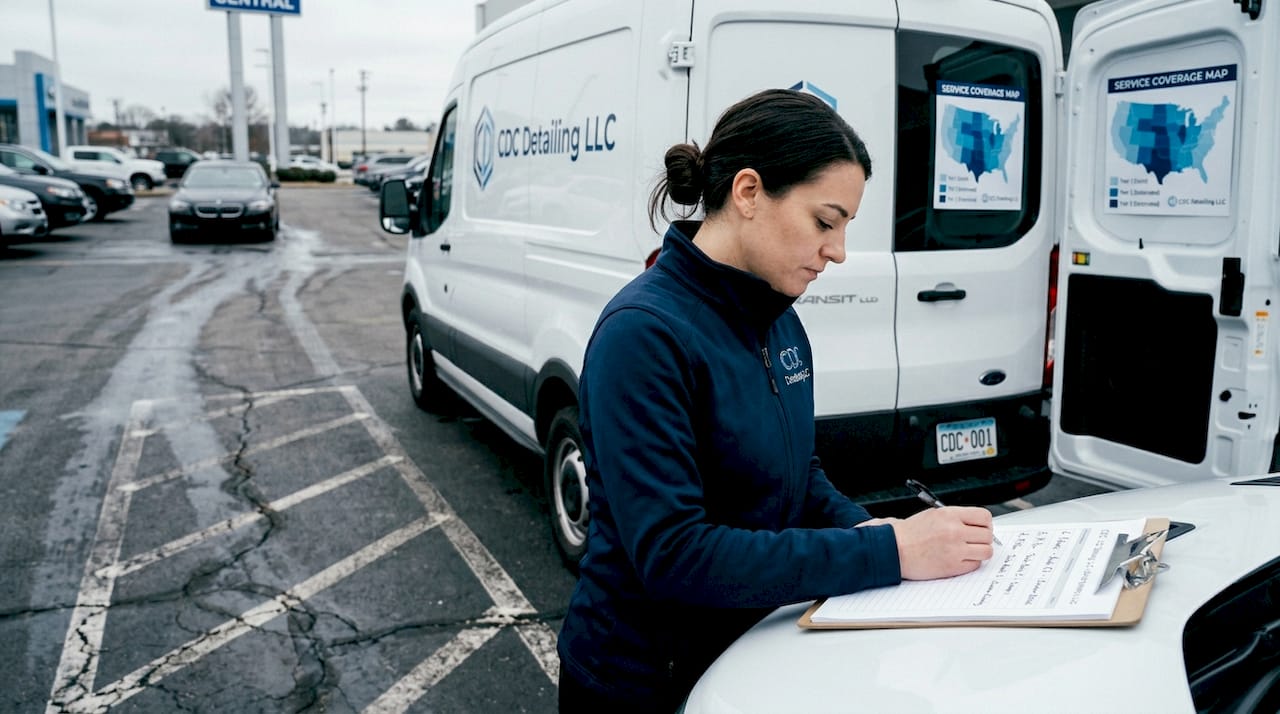
Geography and road access play a major role. A provider based in Pitman, New Jersey can reach Glassboro, Sewell, and Woodbury quickly because those areas are connected by direct routes with predictable traffic. Reaching locations in more rural or traffic-congested zones adds unpredictable time to every job.
Team size and equipment capacity matter just as much. A small mobile operation with one or two technicians and a single service van can only cover so much ground before quality starts to slip. Larger companies can sometimes expand zones by deploying multiple vehicles from different staging points.
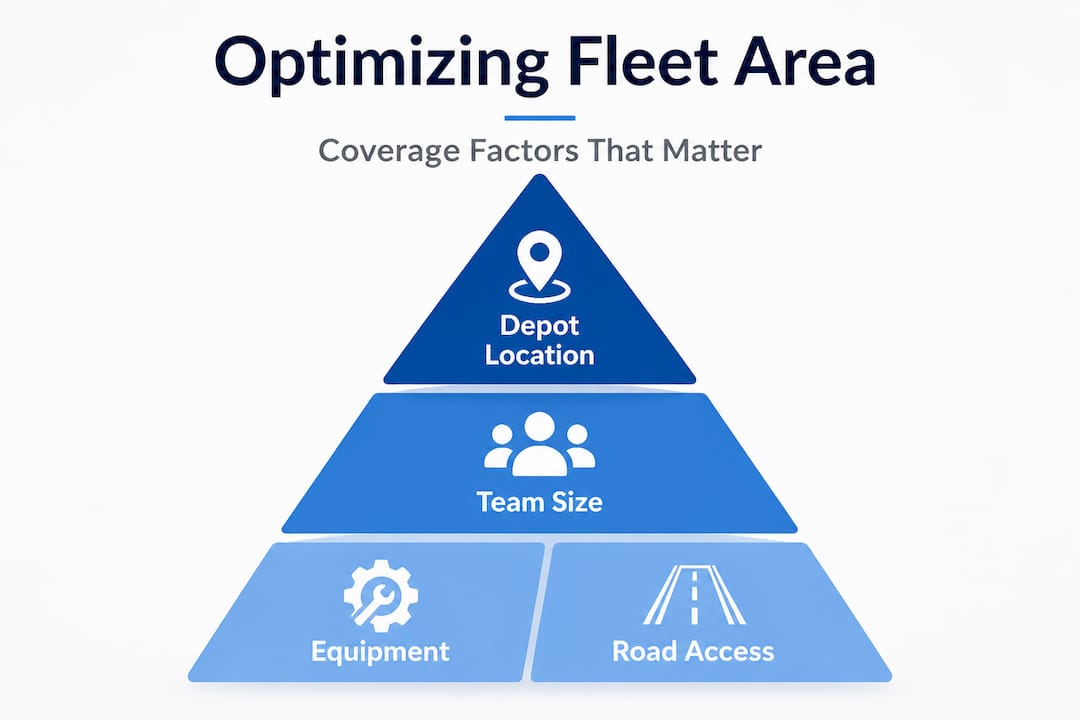
Fleet depot locations are a major consideration. Providers who have worked with fleets before understand that servicing 20 trucks in one location is far more efficient than servicing the same 20 trucks spread across four sites. Defining/limiting service area minimizes logistical friction versus hauling vehicles or overextending technicians.
Here is how standard radius coverage compares to custom fleet arrangements:
| Coverage type | How it works | Best for | Limitations |
|---|---|---|---|
| Standard radius | Fixed zone, published on website | Single-location fleets | May not cover satellite lots |
| Custom fleet zone | Negotiated per contract | Multi-depot operations | Requires volume commitment |
| Hybrid coverage | Core zone plus scheduled out-of-zone visits | Growing businesses | May require advance scheduling |
| Shared-route coverage | Provider batches nearby clients together | Small fleets in suburban areas | Less flexibility on timing |
When choosing local detailers for your fleet, it is worth looking past the published service map and asking specific questions:
- Do you service fleets at multiple locations under one contract?
- What advance notice is required for locations outside your standard zone?
- Are there volume thresholds that unlock expanded coverage?
- How do you handle same-week rescheduling for large fleet accounts?
Reviewing how other fleet operations are optimized in terms of mobile service logistics can also give you benchmarks for what a reasonable coverage expectation looks like.
Aligning fleet service area choices with business goals
After exploring how coverage is set, here’s how to ensure the service area you select truly serves your business goals and asset protection.
The mistake most fleet managers make is treating mobile detailing as a commodity purchase, choosing whoever responds fastest at the lowest price. The smarter move is to treat it as an operational partnership where geography, scheduling, and service scope are negotiated upfront.
Start by mapping your actual needs. Where are your vehicles parked overnight? Do you have multiple lots? Are there specific vehicles that require priority scheduling, like client-facing company cars or refrigerated trucks that cannot be taken out of rotation? Mobile service brings maintenance to vehicles where they’re parked, but only if your provider’s service area actually reaches those parking locations.
Follow these steps to align service area choices with your business strategy:
- Audit your fleet’s physical locations. List every address where your vehicles regularly park, including remote job sites if relevant. Cross-reference these with potential providers’ published service areas before making any calls.
- Prioritize vehicles by appearance sensitivity. Client-facing vehicles need frequent, consistent detailing. Work trucks on internal routes may tolerate a longer cycle. A clear priority tier system helps you negotiate service frequency per zone.
- Ask for a pilot agreement. Before committing to a full-year contract, propose a 60-day pilot covering your highest-priority lot. Evaluate punctuality, communication, and quality before expanding the arrangement.
- Negotiate multi-site coverage explicitly. Get it in writing if the provider agrees to service more than one location. Include scheduling windows, cancellation policies, and travel fee caps for each site.
- Build in an annual review clause. Fleets change. You may acquire new vehicles, open new locations, or shift operational focus. Build an annual review of the service agreement into your contract so the coverage stays aligned with your reality.
Understanding the full range of commercial detailing advantages available to South Jersey businesses helps set realistic expectations for what a well-structured service area arrangement can deliver.
Pro Tip: Review your service agreement terms every year as your fleet evolves. A provider whose coverage matched your needs 18 months ago may no longer be the best fit if you have added vehicles, new routes, or satellite locations.
Why most fleets underestimate service area impact
This brings us to a critical perspective gained from working with commercial fleets across South Jersey for years.
Most fleet managers we talk to spend significant time negotiating price per vehicle and almost no time mapping provider geography to their actual operations. It is an understandable oversight. Pricing is visible and easy to compare. Geography feels secondary until a detailing crew does not show up because your new satellite lot is six miles outside their service boundary.
The real cost of poor service area alignment is not the missed appointment. It is the accumulative effect over months. Vehicles that do not get serviced on a consistent rotation look worse, depreciate faster, and signal to clients and employees alike that your operation runs at a lower standard than it should. We have seen commercial fleets in South Jersey go from reactive, patchwork detailing to a structured mobile service arrangement and notice the shift in employee pride within weeks. Drivers take better care of a truck that looks cared for. That is not a theory. It is a pattern we observe repeatedly.
There is also a compliance angle that rarely gets discussed. Many industries require fleet vehicles to meet appearance standards for insurance, client contracts, or regulatory reasons. A provider whose service area does not reliably reach all your locations creates gaps that become compliance risks over time.
The fleets that get the most value from mobile detailing are the ones that treat service area alignment the same way they treat route optimization or fuel card management: as a core operational variable, not an afterthought. Reviewing how fleet cleaning versus individual detailing works in practice can clarify where structured service area agreements provide the most measurable return.
Upgrade your fleet care with the right service area partner
With a clear understanding of fleet service areas, you’re ready to get the best possible mobile detailing experience in South Jersey.
At CDC Auto Detailing, we built our service area specifically around the commercial needs of South Jersey fleet operators. We come to your lot, your depot, or your job site so your vehicles stay in rotation and your business keeps moving.
Whether you are new to mobile detailing or looking to replace a provider who keeps missing your locations, we make the process straightforward. Start by learning how auto detailing works for commercial fleets, then explore our approach to detailing for your business image. When you are ready to move forward, booking mobile detailing takes just a few minutes. Let us show you what the right service area partnership looks like for your fleet.
Frequently asked questions
How large is a typical fleet service area for mobile detailing?
Most mobile detailers maintain a core service area of 10 to 30 miles from their base, with custom arrangements sometimes available for larger fleets. Service area sizing minimizes logistical friction and supports mobile efficiency for both parties.
Can mobile detailers service vehicles at multiple company locations?
Yes, arrangements can often be made for businesses with multiple depots, but clear communication and advance planning are essential. Mobile service keeps vehicles operational at any location where the provider’s service area allows dispatch.
What happens if my fleet is outside the advertised service area?
Mobile providers may offer case-by-case exceptions, sometimes with added travel fees, so always ask about special arrangements before assuming coverage is unavailable. Defining service area limits helps providers manage logistics, but exceptions are more common than most managers realize.
Why do some mobile detailers limit their fleet service areas?
Service area limits help detailers optimize routes and protect both your uptime and their technicians’ effectiveness. Minimizing downtime and logistical friction is the core reason providers establish defined geographic boundaries for commercial accounts.